OpenAI Report Reveals Accelerating Enterprise AI Adoption in Healthcare
OpenAI report shows healthcare AI adoption surging 8× as enterprises embed LLMs into workflows!

Executive Summary
- Healthcare is among the fastest-growing sectors for Enterprise AI, recording 8× year-over-year adoption, according to OpenAI’s State of Enterprise AI report.
- Adoption is shifting from isolated pilots to deep workflow integration, including custom GPTs, structured processes, and automation.
- Generative AI usage is delivering measurable productivity gains, with workers saving 40–60 minutes per day, and heavy users reporting 10+ hours per week.
- A widening gap is emerging between “frontier” organizations and laggards, driven by differences in usage depth, not tool access.
- LLM-powered systems are increasingly embedded in healthcare operations, not just documentation or chat interfaces.
- Governance, data integration, and executive sponsorship—not model quality—are now the primary constraints to scaling Healthcare AI.
Together, these findings frame healthcare not as a cautious late adopter, but as a sector entering a decisive execution phase—one that reshapes how AI is operationalized at scale.
Key Healthcare AI Trends Shaping Innovation in 2026. Read more here!
What the OpenAI Report Actually Reveals About Healthcare Adoption
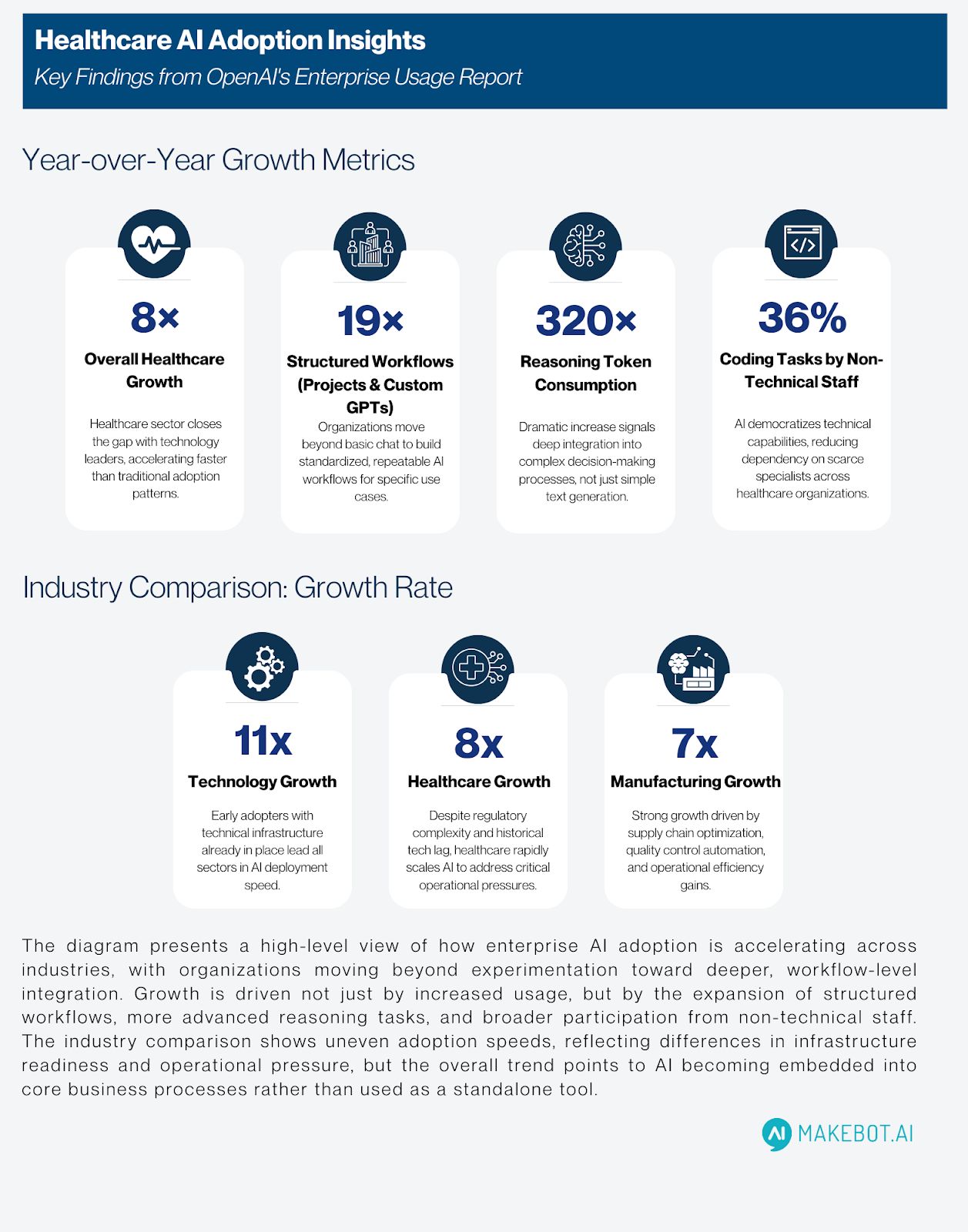
OpenAI’s report draws on de-identified enterprise usage data and a survey of 9,000 workers across nearly 100 enterprises, offering one of the clearest empirical views of Enterprise AI adoption to date. Within this dataset, healthcare stands out with 8× year-over-year growth, trailing only technology (11×) and slightly ahead of manufacturing (7×).
More importantly, healthcare’s growth is not limited to seat expansion. Weekly ChatGPT Enterprise usage increased roughly eightfold, while structured workflows—such as Projects and Custom GPTs—expanded 19× year-to-date. Average reasoning token consumption per organization rose 320×, signaling deeper integration of large language model capabilities into operational systems rather than surface-level experimentation.
This data suggests healthcare organizations are no longer testing whether AI works; they are determining how deeply it can be embedded—an evolution that naturally raises questions about what is driving this acceleration.
Why Healthcare Is Scaling Enterprise AI Faster Than Expected
Healthcare historically lags in technology adoption due to regulation, procurement cycles, and risk sensitivity. Yet the OpenAI data shows the sector rapidly closing the gap, largely because structural pressure now outweighs institutional caution.
Chronic staffing shortages, rising administrative overhead, and margin compression have created strong incentives to deploy AI in healthcare beyond pilots. Unlike consumer-facing experiments, enterprise deployments target operational bottlenecks—documentation, internal knowledge retrieval, workflow coordination, and administrative automation—where gains are measurable and defensible.
Another accelerant is skill diffusion. Coding and analytical tasks are increasingly performed by non-technical staff using Generative AI, with coding-related messages rising 36% outside traditional technical roles. This reduces dependency on scarce specialists and expands AI’s operational footprint across healthcare organizations.
As adoption accelerates, attention naturally shifts from why healthcare is adopting AI to where it is being deployed first.
Where Enterprise AI Is Being Deployed Across Healthcare Workflows
According to the report, healthcare organizations are prioritizing enterprise-grade use cases rather than novelty applications. Deployment patterns consistently cluster around workflows with high repetition, heavy documentation, and clear productivity metrics.
Common enterprise deployments include:
- Administrative and operational workflow automation
- Clinical documentation support and summarization
- Internal knowledge search and policy navigation
- Analytical support for operations, finance, and compliance teams
These systems increasingly rely on LLM-driven reasoning rather than simple text generation, reflecting a shift from “assistive chat” to embedded workflow engines. Approximately 20% of enterprise messages now flow through standardized environments, indicating maturing operational discipline.
This progression naturally leads to deeper architectural questions—specifically how models, data, and governance intersect in production systems.
Accenture and OpenAI expand their Enterprise AI partnership, accelerating global AI innovation. Read here!
The Role of LLMs, Data Integration, and Governance in Production Systems
The OpenAI report makes clear that model capability is no longer the bottleneck. Instead, success depends on whether organizations connect LLMs securely to internal data and workflows.
While average reasoning token usage has increased 320×, roughly one in four enterprises has not enabled data connectors, leaving models isolated from organizational context. In healthcare, this limits value and increases risk, as generic responses lack clinical, operational, or regulatory specificity.
Frontier organizations distinguish themselves by:
- Enabling secure data access for large language model systems
- Codifying institutional knowledge into reusable assets
- Establishing governance frameworks around usage, auditability, and oversight
This combination transforms Healthcare AI from a productivity enhancer into infrastructure—setting the stage for measurable ROI discussions.
Measuring ROI: Productivity, Cost Reduction, and Clinical Impact
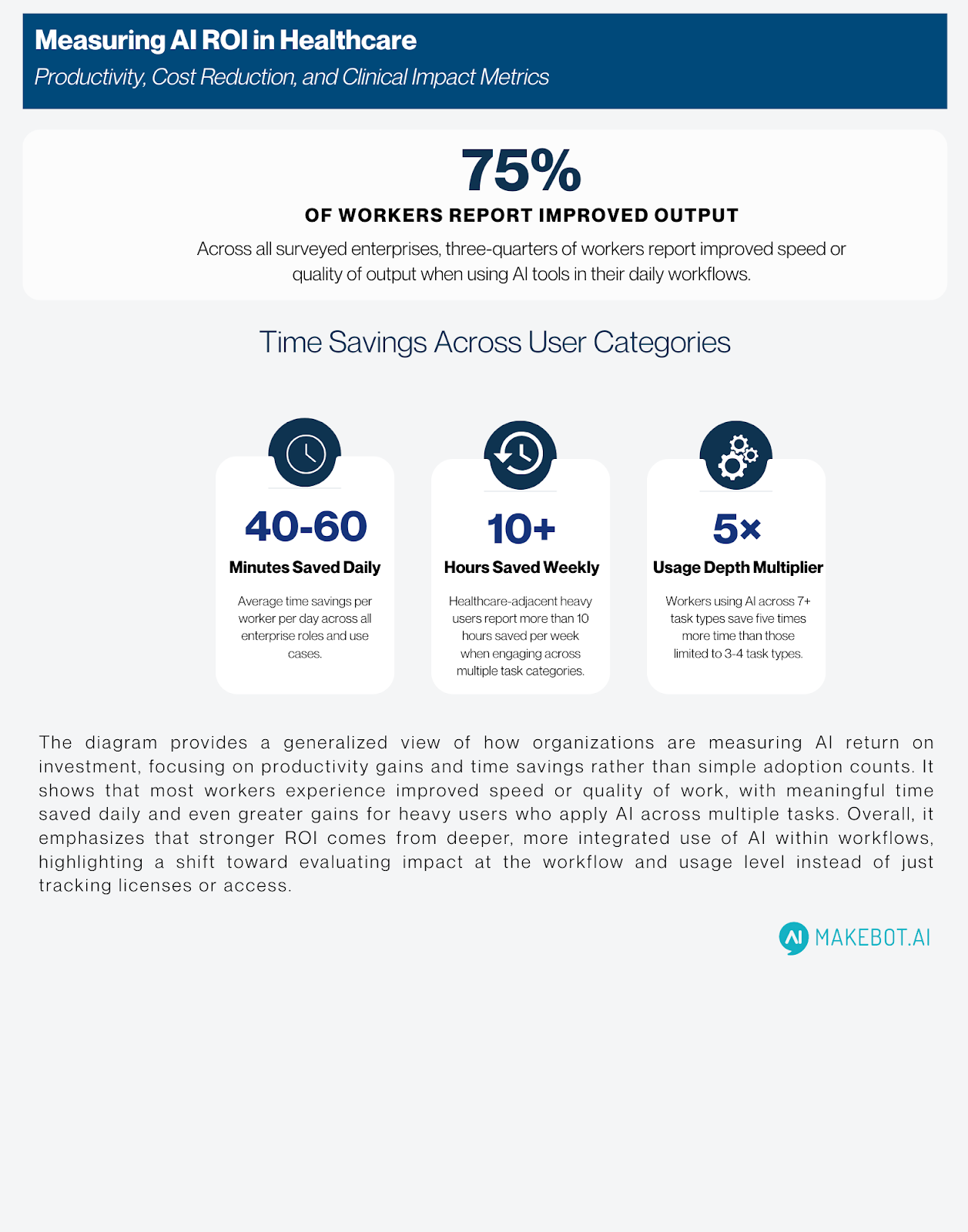
Across all surveyed enterprises, 75% of workers report improved speed or quality of output, with time savings averaging 40–60 minutes per day. In healthcare-adjacent roles, heavy users report more than 10 hours saved per week, particularly when engaging across multiple task categories.
Crucially, ROI correlates with usage depth, not access. Workers using AI across seven or more task types save five times more time than those limited to three or four. This pattern holds at the organizational level, where frontier firms generate 2× more messages per seat and 7× more through custom workflows.
These findings shift ROI measurement away from license counts toward workflow-level instrumentation, naturally raising concerns about what happens when organizations fail to operationalize at this depth.
Risks, Limitations, and Implementation Gaps Highlighted by the Data
Despite rapid adoption, the report emphasizes that Enterprise AI remains in its early innings. A widening divide separates organizations that embed AI into workflows from those that merely deploy tools.
Key risks include:
- Over-reliance on prompt-level usage without system integration
- Governance gaps across decentralized Custom GPT creation
- Data privacy and compliance challenges in regulated environments
- Hallucinations and domain-specific accuracy limitations
Importantly, these are organizational failures, not technical ones. OpenAI notes it releases new features every few days; most enterprises cannot absorb change at that pace. This reality reframes risk as a leadership and operating-model problem, not a technology flaw.
Understanding these constraints clarifies what the report implies for vendors and healthcare leaders navigating this transition.
Implications for Vendors, Health Systems, and AI Strategy Leaders
For vendors, the report signals a shift in buyer expectations: healthcare organizations increasingly value integration readiness, governance tooling, and workflow ownership over raw model performance.
For health systems, the message is sharper. AI advantage accrues to those who:
- Assign end-to-end ownership to workflows
- Measure usage depth and quality outcomes
- Standardize successful deployments and retire weak ones
The competitive gap is no longer about access to Generative AI, but about institutional learning speed. As frontier behaviors compound, laggards face diminishing returns from superficial adoption—prompting the question of what leaders should do next.
What Healthcare Executives Should Do Next
Based on OpenAI’s findings, healthcare leaders should prioritize execution over experimentation:
Action checklist:
- Identify one high-impact workflow per function and assign clear ownership
- Instrument metrics beyond usage: time saved, quality, rework, and risk
- Enable secure data connectors to ground AI in healthcare workflows
- Study frontier teams internally and codify their practices
- Treat Enterprise AI as operating infrastructure, not a side tool
The report’s core insight is straightforward: organizations that move from prompts to systems will define the next phase of healthcare productivity.
Showcasing Korea’s AI Innovation: Makebot’s HybridRAG Framework Presented at SIGIR 2025 in Italy. More here!
Conclusion
The OpenAI report does not describe a speculative future—it documents a structural shift already underway. With 8× year-over-year growth, healthcare is rapidly transitioning from cautious experimentation to operational dependence on Healthcare AI.
The winners will not be those with the most advanced models, but those that design workflows, governance, and measurement systems capable of absorbing continuous AI progress. In that sense, Generative AI is no longer just a tool for healthcare—it is becoming part of how the enterprise itself works.
Makebot: Turn AI Strategy Into Real Business Impact
The enterprise shift into AI requires more than tools—it requires industry-specific, trustworthy, ready-to-deploy solutions. Makebot delivers exactly that. From healthcare LLM agents trusted by top hospitals to AI systems for finance, retail, government, and customer service automation, we help organizations adopt AI that aligns with real-world environments and compliance needs.
With solutions like BotGrade, MagicTalk, MagicSearch, and MagicVoice, plus HybridRAG technology recognized at SIGIR 2025 for achieving up to 90% cost reduction, Makebot accelerates your AI journey from proof of concept to production—fast, secure, and ROI-driven.
👉 Begin your AI transformation today: www.makebot.ai
📩 Contact us: b2b@makebot.ai










.jpg)


What Happens to Marketing When the C-Suite Starts Using AI Every Day?






Why AI Shopping Assistants Will Replace Traditional Ecommerce Search






.jpg)

























Why Generative AI Projects Fail and How to Achieve Scalable AI Success











.jpg)

.png)