Google’s $1B Push to Transform AI Education and Workforce Training
Google invests $1B to reshape AI education, boosting skills, innovation, and workforce readiness.


Google’s announcement of a $1 billion investment in AI education and workforce training marks one of the most consequential corporate education initiatives in recent U.S. history. Across universities, nonprofits, and government-backed AI literacy programs, the company is positioning itself not only as a technology provider—but as a long-term architect of America’s AI-ready workforce.
This commitment arrives at a pivotal moment. Colleges are under pressure to integrate Educational Technology that prepares students for a labor market rapidly reshaped by automation and Generative AI. Employers report widening digital skills gaps, and many entry-level job categories are shrinking due to AI-driven productivity gains.
Google’s initiative directly responds to these trends by expanding access to advanced AI tools, upskilling pathways, and research infrastructure, ensuring that the next generation enters the workforce not as passive users of AI—but as “AI natives” capable of shaping the technology’s future.
Generative AI in K-12 Education: Transforming Learning Through Innovation. Read more here!
A Three-Year, $1 Billion Investment Targeting the Core of the U.S. Education
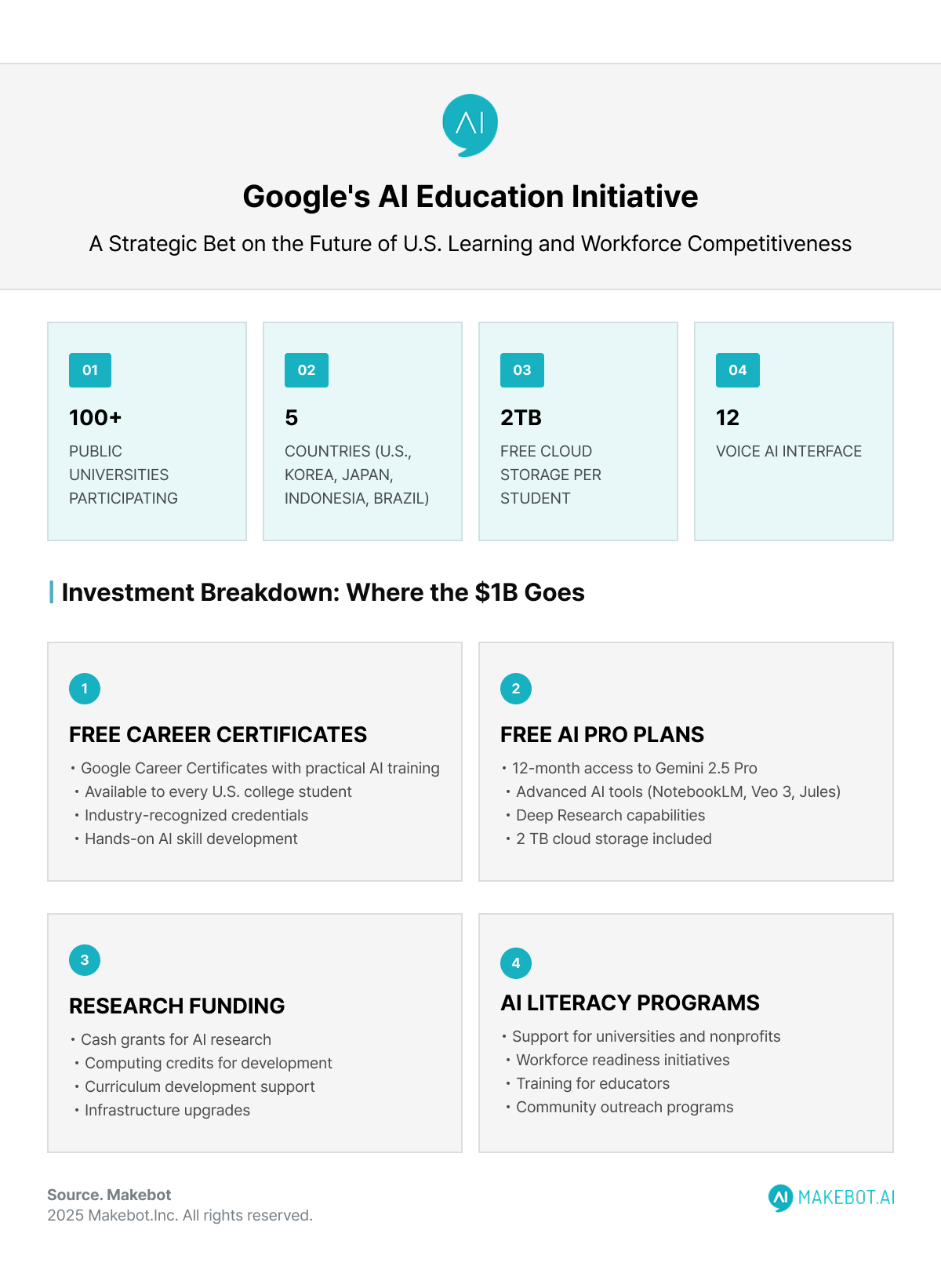
Google’s plan spreads the $1B commitment across AI literacy programs, free training, research funding, and cloud computing resources, all delivered in collaboration with more than 100 public universities—including Texas A&M, the University of North Carolina, the University of Michigan, Ohio State, and major statewide university systems.
The investment includes:
- Free Google Career Certificates with practical AI training for every U.S. college student.
- Free 12-month AI Pro plans enabling access to Gemini 2.5 Pro, NotebookLM, Veo 3, Deep Research, and expanded cloud storage.
- Cash funding and computing credits for AI research and curriculum development.
- Support for universities and nonprofits delivering AI literacy and workforce readiness initiatives.
This is not merely an expansion of digital skills programs—it is the foundation for a nationwide AI education ecosystem.
Expanding Access to Advanced AI Tools
Google’s most immediate contribution is the democratization of powerful AI tools for students aged 18 and above. The Google AI Pro plan, now free for college students in the U.S., Korea, Japan, Indonesia, and Brazil, includes:
- Gemini 2.5 Pro, Google’s most advanced reasoning model
- Deep Research for high-depth academic sourcing and literature reviews
- NotebookLM, a multimodal “thinking companion”
- Veo 3, an AI video generation system
- Jules, Google’s AI coding agent
- 2 TB of cloud storage for academic workloads
These tools enable students to perform tasks that previously required professional software—cinematic video production, automated research synthesis, code debugging, dataset organization, and more. For educators, this marks a significant leap in AI in Schools, normalizing AI-assisted learning across every academic discipline.
Guided Learning
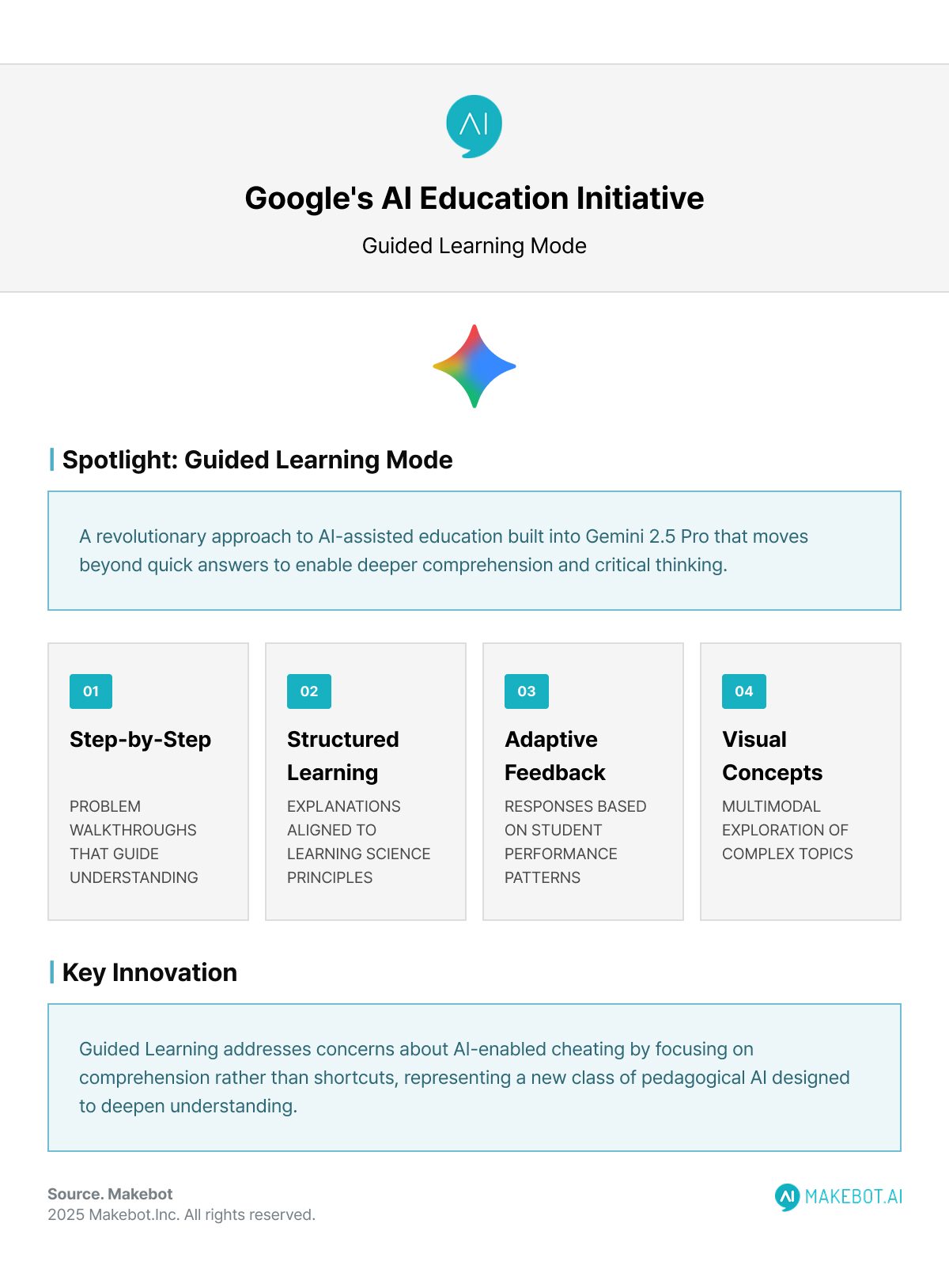
A standout feature in Google’s initiative is Guided Learning, a new mode built into Gemini 2.5 Pro. Unlike traditional AI chat interfaces, Guided Learning moves beyond quick answers, instead enabling:
- Step-by-step problem walkthroughs
- Structured explanations aligned to learning science
- Adaptive feedback based on student responses
- Visual, multimodal concept exploration
This directly supports the adoption of Adaptive Learning technologies—systems that personalize instruction based on student performance and cognitive patterns.
For universities testing AI as a pedagogical tool, Guided Learning represents a new class of AI Innovation designed to deepen comprehension rather than shortcut assignments, addressing long-standing concerns about AI-enabled cheating.
How AI Is Actually Being Applied in Education
To strengthen conceptual depth, below are the key instructional and institutional applications of AI:
1. AI-Based Learning Models Transforming Classrooms
- Guided Learning → provides structured cognitive scaffolding aligned with learning science.
- Adaptive Learning → adjusts content difficulty, pacing, and format based on real-time student mastery.
- Generative tutoring models → simulate Socratic-style questioning for deeper reasoning practice.
- Multimodal explanation engines → allow students to explore concepts through text, diagrams, simulations, and examples.
2. Changing Roles of Instructors
AI enables instructors to shift from content deliverers to learning architects. This includes:
- AI-generated lesson plans
- Automated formative assessments
- Personalized feedback workflows
- AI-assisted grading support for large classes
3. AI Reshaping Assessments
- Dynamic assessments that adapt question difficulty
- Authentic assessments (portfolio-based, project-based) monitored for originality through AI
- Process-focused evaluation, analyzing how a student thinks—not just the final answer
4. Automation in Campus Operations and Research
Real examples emerging in U.S. universities:
- AI chatbots handling 60–98% of student service queries (financial aid, enrollment, campus navigation)
- Automated research assistants that summarize papers, classify datasets, and check code quality
- AI-supported administrative workflows for scheduling, documentation, reporting, and compliance
- Campus-level predictive models for enrollment forecasting, dropout risk, and resource planning
A Step-by-Step Roadmap for AI Adoption in Education
To guide institutional leaders, Google’s initiative aligns with a practical implementation roadmap:
- Assessment
- Identify AI gaps in curriculum, infrastructure, faculty readiness, and data governance.
- Pilot
- Launch controlled pilots in targeted departments (e.g., engineering, business, general education).
- Scale
- Expand AI tools, adaptive learning models, and research support campus-wide.
- Governance
- Establish ethics committees, data privacy protocols, bias audits, and usage standards.
This roadmap helps universities move from experimentation to institution-wide transformation.
Google’s AI for Education Accelerator
The cornerstone of the $1B initiative is the AI for Education Accelerator, which provides:
- Free AI training for all U.S. college students
- Google Career Certificates recognized by employers nationwide
- Research funding for AI-related programs
- Cloud credits for university AI labs and student projects
More than 100 public universities have already joined, signaling a rapidly forming national standard for AI education. Google aims to expand this enrollment to every accredited nonprofit college in the United States.
This scale matters: with enrollment exceeding 14 million students nationally, the Accelerator could produce the largest AI-ready workforce in the world.
How ChatGPT-5 is Transforming Learning and Teaching. Read here!
Addressing the Workforce Shift
AI’s rapid integration into business operations is already reshaping employment patterns:
- Entry-level job postings dropped 15% in the past year, partially attributed to AI automation.
- Companies are prioritizing AI-proficient hires across technical and non-technical fields.
- New roles—AI workflow designers, prompt engineers, model testers—are emerging faster than traditional curricula can respond.
Google’s investment directly strengthens AI Development capabilities among students by:
- Building AI literacy at scale — ensuring every student can responsibly use, evaluate, and critique AI systems.
- Providing advanced hands-on tools — giving learners access to the same AI infrastructure used in enterprise environments.
- Supporting research pipelines — allowing universities to build new AI courses, labs, and collaborative programs.
- Equipping students with portable credentials — enabling seamless transition from campus to workforce.
The outcome: universities gain the infrastructure to teach AI at depth, and employers gain a future workforce capable of leveraging AI to drive innovation.
Strengthening the U.S. Education–Industry Pipeline
The initiative also integrates with a wider landscape of public and private AI education commitments:
- The White House cites Google as a lead contributor in national AI literacy efforts for K–12 and higher education.
- Over 80% of the top 100 U.S. universities already use Google Workspace for Education, enabling immediate deployment of Gemini for Education.
This positions Google as a central orchestrator in AI learning—from kindergarten digital literacy to advanced university research programs. The ripple effect supports:
- Curriculum modernization across STEM, humanities, and business fields
- Responsible AI governance through student and educator training
- Career mobility, especially for underserved communities gaining access to industry-grade AI tools
- A more AI-fluent national workforce, critical for economic competitiveness
Showcasing Korea’s AI Innovation: Makebot’s HybridRAG Framework Presented at SIGIR 2025 in Italy. More here!
Horizontal Expansion: How the U.S. Compares Globally
To broaden global context, here is how other countries are progressing:
Singapore
- National AI Literacy Framework integrated from primary school to university.
- AI tutors deployed in math and language subjects.
- Government-funded AI labs in polytechnics.
United Kingdom
- National Centre for Computing Education (NCCE) expanding AI curriculum.
- Government mandates on digital skills for all secondary schools.
Japan
- Massive national effort to train AI-ready teachers across all prefectures.
- Universities integrating AI co-teaching assistants.
United Arab Emirates
- AI University (MBZUAI) leading global AI research output per capita.
- AI-driven school administration systems adopted nationwide.
Compared globally, the U.S. is competitive in scale but not necessarily fastest; Asian and Middle Eastern nations often move with more centralized coordination. Google’s investment helps the U.S. close that structural gap.
The Strategic Outlook
Google’s initiative is not merely a philanthropic gesture—it is a strategic move reshaping the long-term relationship between education and AI.
For universities
It accelerates modernization, boosts research capacity, and enables scalable AI integration.
For students
It provides unprecedented access to enterprise-grade tools, future-proof credentials, and personalized learning technologies.
For the U.S. workforce
It strengthens national competitiveness by expanding AI fluency at a scale other nations cannot easily replicate.
For the AI ecosystem
It establishes Google as a foundational provider of learning infrastructure, influencing how the next generation interacts with, understands, and ultimately builds with AI.
In short, this $1B investment signals a shift: AI literacy is no longer optional—it is the new baseline for academic and professional success.
Strategic Implications: What Korean Universities Should Do Now
To provide actionable guidance for Korean education leaders, here are strategic next steps:
1. Accelerate AI Curriculum Modernization
- Integrate Generative AI, data literacy, and AI ethics into general education requirements.
- Partner with industry to co-design practical AI coursework.
2. Deploy AI Teaching Assistants and Adaptive Learning Systems
- Use AI to support high-enrollment courses and reduce faculty workload.
- Adopt Guided Learning and Adaptive Learning platforms to personalize instruction.
3. Build AI-Integrated Student Services
- Implement campus-wide AI chatbots for admissions, registrar, and financial aid.
- Automate routine administrative processes to improve service speed and accuracy.
4. Establish a National-Level AI Governance Framework
- Create formal committees for AI risk management, data privacy, and algorithmic accountability.
- Ensure international alignment with U.S., EU, and APAC best practices.
5. Form Global AI Education Partnerships
- Collaborate with Google, Makebot, and other global AI leaders.
- Pursue joint AI labs, shared curriculum programs, and exchange opportunities.
These steps will help Korean institutions remain globally competitive as AI becomes the defining force in education.
Unlock the Full Potential of AI in Education with Makebot
As AI adoption accelerates across universities and enterprises, Makebot enables institutions to move from exploration to real, measurable outcomes. With industry-specific LLM agents, advanced HybridRAG, and secure, domain-tailored deployments, we help education leaders implement AI systems that are reliable, scalable, and aligned with institutional goals—not generic chatbots.
Whether your priority is modernizing student services, supporting faculty with intelligent automation, or deploying private AI models with enterprise-grade performance, Makebot delivers rapid PoCs, end-to-end solutions, and proven ROI. Partner with us to bring future-ready AI capabilities to your campus or organization.
👉 www.makebot.ai | 📩 b2b@makebot.ai







.png)






.jpg)

What Happens to Marketing When the C-Suite Starts Using AI Every Day?







Why AI Shopping Assistants Will Replace Traditional Ecommerce Search





.jpg)
























Why Generative AI Projects Fail and How to Achieve Scalable AI Success









.jpg)
.png)













Interview Feature: Why Companies Are Betting Big on Generative AI