Why McKinsey Says AI Won’t Take Your Job
McKinsey says AI won’t take your job—automation shifts tasks, but human skills stay essential.

Even Though It Can Already Automate 57% of All U.S. Work Hours
The fear that artificial intelligence will wipe out entire professions has dominated public debate for years. With rapid advances in Generative AI, autonomous agents, and sophisticated decision-making systems, it’s easy to assume that human labor is becoming obsolete. But according to McKinsey, this assumption misrepresents what automation actually changes—and misunderstands the true nature of work.
A new McKinsey Global Institute report, Agents, robots, and us: Skill partnerships in the age of AI, offers a more technical, evidence-backed explanation: While current AI systems can theoretically automate 57% of U.S. work hours, this number reflects task-level potential, not real-world workforce displacement. In practice, work is far more complex, interdependent, and context-driven than individual task lists suggest. The future will not be defined by replacement—it will be shaped by redesigned human–machine collaboration.
This insight has significant implications for Business Management, workforce development, productivity planning, and long-term corporate strategy. Below is a deep dive into the mechanics behind McKinsey’s conclusion and what it means for organizations preparing for the age of AI Automation and AI Innovation.
To understand why, we first need to examine why McKinsey’s 57% automation estimate is widely misunderstood.
Beyond the Build: Uncovering the Hidden Costs of In-House LLM Chatbot Development. Read more here!
Technical Potential vs. Real-World Reality
Why 57% Automation Does Not Equal Job Loss
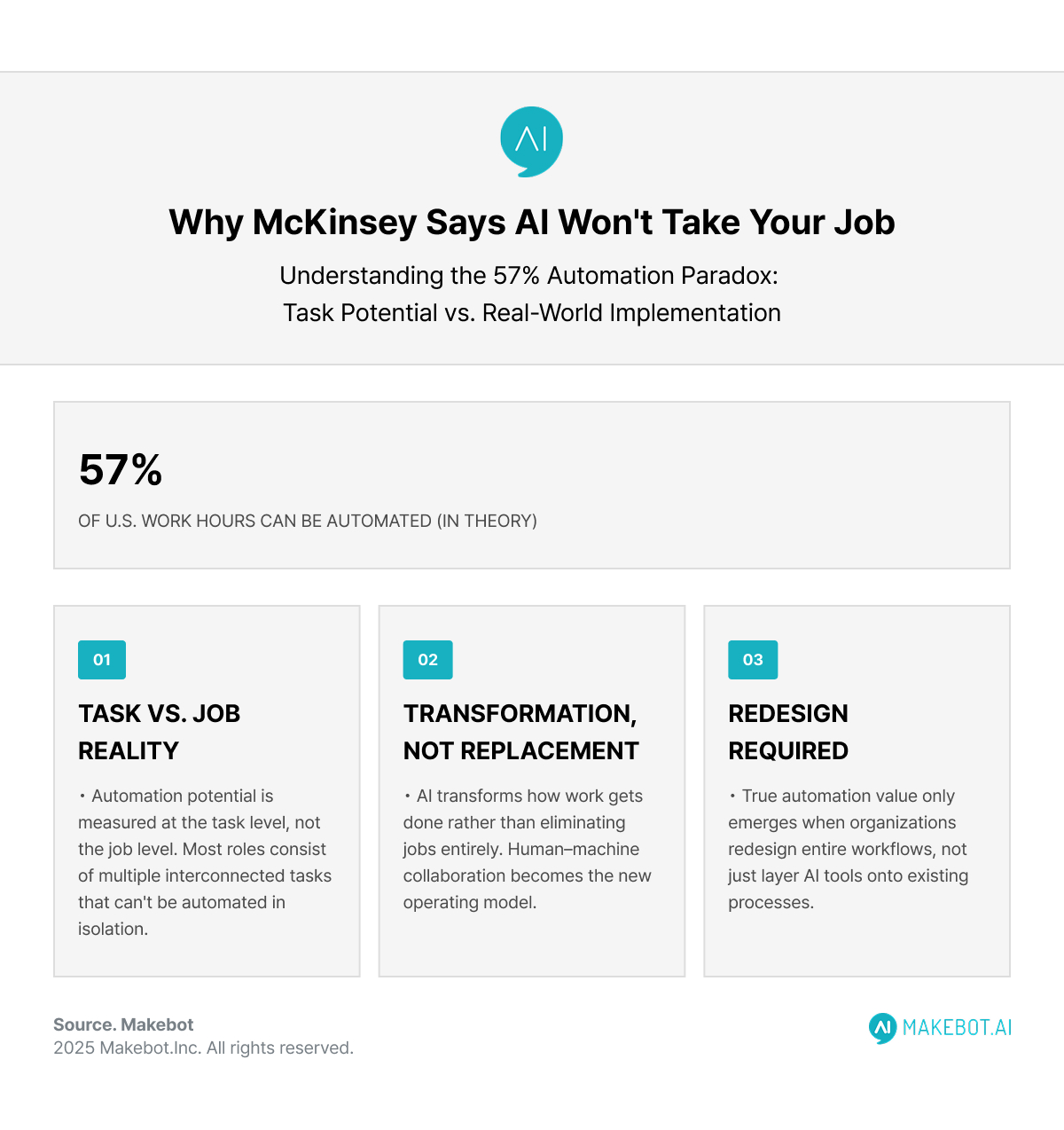
McKinsey’s estimate—that AI can automate over half of U.S. work hours—is based on analyzing the technical possibility of automating discrete tasks, such as document preparation, scheduling, data consolidation, or pattern-based analysis.
However, technical potential is not the same as practical replacement. True automation depends on:
- Process redesign
- Human oversight
- Organizational restructuring
- Regulatory and ethical constraints
- Customer and stakeholder expectations
Most workplaces are built on workflows, not isolated tasks. Automating fragments of a role does not eliminate the role; it simply transforms it. As McKinsey notes, automation at scale only achieves value when organizations redesign entire workflows, not just add tools on top of outdated structures.
This distinction fundamentally challenges the narrative that AI will cause sweeping unemployment. This brings us to the crucial insight in McKinsey’s report: the lasting power of human skills.
Human Skills Remain Durable
Over 70% Overlap Across Automatable and Non-Automatable Tasks
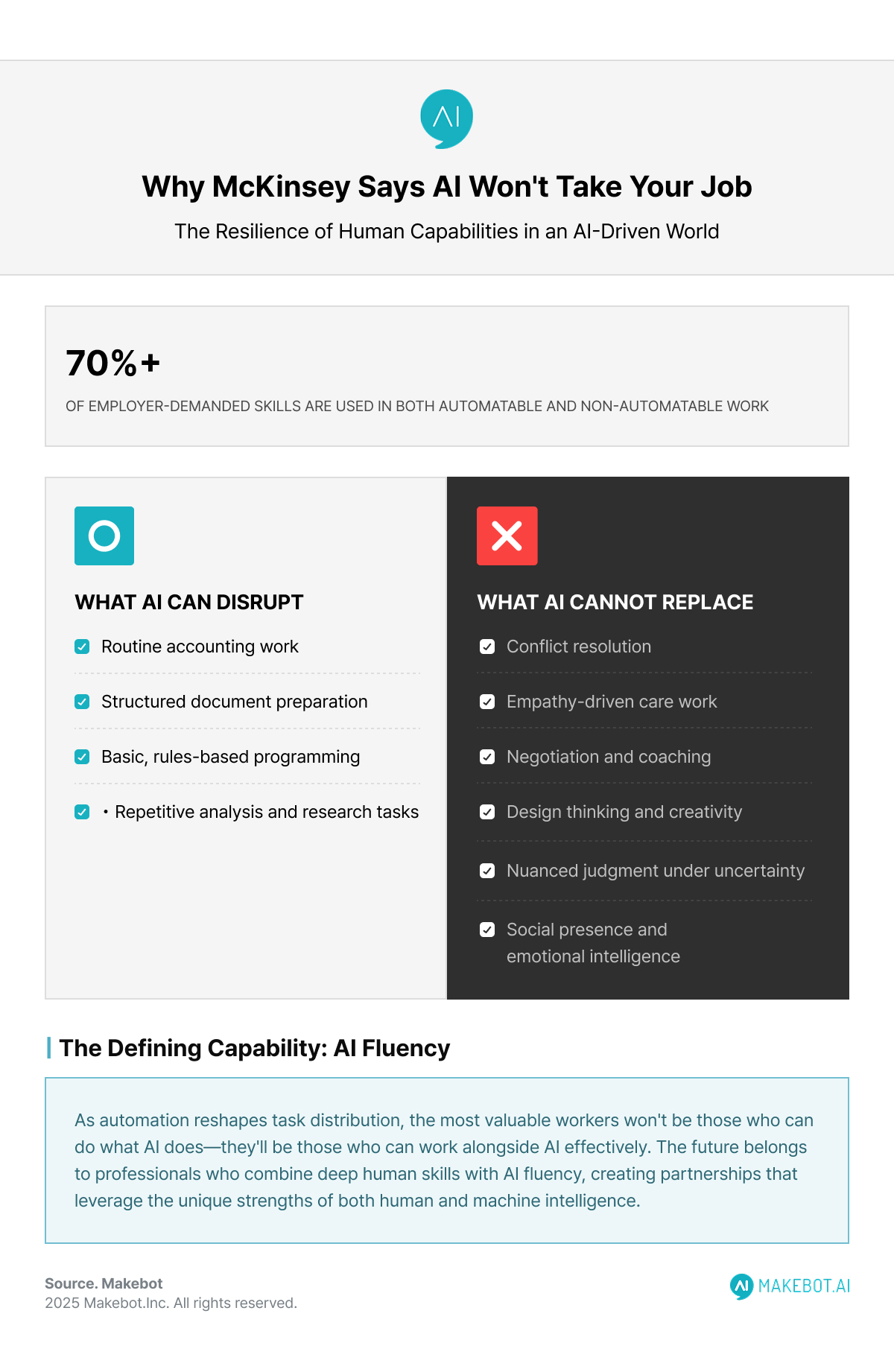
A central finding of the report is the resilience of human capabilities. McKinsey’s data shows that over 70% of the skills demanded by employers today are used in both automatable and non-automatable work. In other words, the vast majority of skills remain relevant even as tasks shift.
What AI can disrupt
- Routine accounting work
- Structured document preparation
- Basic, rules-based programming
- Repetitive analysis and research tasks
What AI cannot replace
- Conflict resolution
- Empathy-driven care work
- Negotiation and coaching
- Design thinking and creativity
- Nuanced judgment under uncertainty
- Social presence and emotional intelligence
Even in AI-heavy environments like finance, healthcare, customer support, and engineering, people still provide:
- Oversight
- Contextual interpretation
- Quality control
- Ethical filtering
- Human reassurance
This aligns with broader workforce studies showing that jobs grounded in hands-on work or emotional intelligence—like nursing, patient care, early childhood education, plumbing, and repair services—remain extremely difficult to automate.
These shifting skill demands lead directly to the defining capability of the AI-driven workforce: AI fluency.
McKinsey Report: How Generative AI is Reshaping Global Productivity and the Future of Work. Read here!
The Rise of AI Fluency
The Fastest-Growing Skill in the U.S. Labor Market
One of the most striking statistics: Demand for “AI fluency” has increased sevenfold in just two years, making it the fastest-growing skill requirement across job postings.
AI fluency does not require coding. It refers to the ability to:
- Use AI tools effectively
- Interpret model outputs
- Guide autonomous agents
- Apply AI in decision-making
- Collaborate with machine systems in hybrid workflows
This signals that AI is not replacing workers—it is reshaping what workers must know. In effect, AI fluency becomes the new digital literacy: a foundational competency across industries, roles, and career paths.
And this expanding requirement reshapes not only skill sets, but also the structure of everyday work.
Automation Forces a Shift from Execution to Orchestration
McKinsey’s analogy is powerful: The calculator didn’t eliminate mathematicians; it elevated them. The rise of automation mirrors that historical shift. As AI takes over repetitive execution, human workers increasingly specialize in:
- Guiding decisions
- Framing problems
- Designing workflows
- Applying judgment
- Managing exceptions
- Ensuring safety and compliance
- Providing the human presence machines cannot replicate
This reallocation of cognitive effort—from tasks to leadership, from execution to strategy—is why McKinsey argues the future of work is a partnership, not a substitution.
But this new division of labor succeeds only when organizations evolve their structures—leading to the next requirement: redesigning work itself.
Organizational Redesign Is Now a Core Human Imperative
The report is explicit: The U.S. could unlock $2.9 trillion in economic value by 2030, but only if organizations fundamentally rethink how work is structured.
Redesigning work includes:
- New processes
- Reimagined job roles
- AI-integrated team structures
- Updated performance metrics
- Cultural shifts toward experimentation
- Training for workforce adaptability
Companies that automate tasks without reengineering workflows often fail to realize value. Those that invest in organizational redesign unlock exponential productivity gains.
This principle is already visible in industry examples. HP’s restructuring, Capita’s automation of recruitment tasks, and agentic AI deployments across enterprises all reveal a single pattern: tools alone don’t drive transformation—workflow engineering does.To understand what this future looks like, we turn to historical precedent.
The Workforce Will Evolve
Economic history is clear: major technological transitions reshape employment but do not eliminate it. McKinsey expects the same outcome for AI. Jobs will shift, not vanish.
The transformation will unfold in stages:
- Tasks are automated.
- Roles adapt to new workflows.
- New capabilities (AI fluency) become essential.
- Entirely new categories of work emerge.
From AI oversight roles to autonomous-agent supervisors, from workflow architects to human-AI integration managers, new professions will rise as automation accelerates.
Showcasing Korea’s AI Innovation: Makebot’s HybridRAG Framework Presented at SIGIR 2025 in Italy. More from here!
AI Is Not Replacing Workers—It Is Rewriting the Blueprint of Work
The core message from McKinsey is straightforward but profound: AI is powerful enough to automate the majority of tasks, but not powerful enough to replace the majority of workers.
Human judgment, emotional intelligence, creativity, contextual reasoning, and care remain irreplaceable. AI excels at execution; humans excel at orchestration. The future of work belongs not to one or the other—but to the partnership between both.
Organizations that embrace this shift early—investing in AI fluency, redesigning workflows, and integrating intelligent systems responsibly—will capture outsized value in the next decade. Those that don’t risk falling behind in the new era of AI Innovation.
In a world where AI can automate 57% of work hours but cannot replace the human workforce, Makebot helps organizations unlock the true value of human–machine collaboration. Instead of deploying generic tools, we deliver industry-specific LLM agents and end-to-end AI systems tailored to your workflows—just as McKinsey emphasizes the need for redesigned processes, not task-level automation. From healthcare agents used by Seoul National University Hospital to enterprise-grade finance, retail, and public-sector solutions, Makebot equips your teams to orchestrate AI, not compete with it.
With ready-to-deploy platforms like BotGrade, MagicTalk, MagicSearch, and MagicVoice, plus HybridRAG technology proven at SIGIR 2025, Makebot accelerates your shift from experimentation to execution—boosting accuracy by 26.6% and cutting costs by up to 90%. Backed by global patents and trusted by over 1,000 enterprises, we turn AI potential into real economic impact. Start your AI transformation today at makebot.ai or contact b2b@makebot.ai to lead the next era of intelligent work.







.png)






.jpg)

What Happens to Marketing When the C-Suite Starts Using AI Every Day?







Why AI Shopping Assistants Will Replace Traditional Ecommerce Search





.jpg)























Why Generative AI Projects Fail and How to Achieve Scalable AI Success










.jpg)
.png)














Interview Feature: Why Companies Are Betting Big on Generative AI