Accenture and OpenAI expand their Enterprise AI partnership, accelerating global AI innovation.
Accenture and OpenAI expand their Enterprise AI partnership, accelerating global AI innovation.

The expanded collaboration between Accenture and OpenAI marks one of the most consequential moves in the evolution of Enterprise AI strategy. As global organizations accelerate their shift toward intelligent automation, agentic systems, and model-driven workflows, this strengthened Enterprise AI Partnership positions both companies at the center of large-scale digital reinvention.
Across consulting, operations, engineering, and delivery, the agreement redefines how enterprises adopt Generative AI, deploy AI agents, and operationalize AI Innovation at scale.
Interview Feature: Why Companies Are Betting Big on Generative AI. Read more here!
A Strategic Expansion Designed for the Next Era of Enterprise AI
At the core of the new Enterprise AI Partnership is Accenture’s decision to deploy ChatGPT Enterprise to tens of thousands of its professionals. This represents the largest enterprise rollout of OpenAI’s business-grade platform to date—and the largest concentration of talent trained through OpenAI Certifications in the global consulting sector.
This move does more than introduce tooling. It embeds Generative AI into the day-to-day workflows of one of the world’s most influential consulting firms, creating a living laboratory for rapid AI Development, enterprise-scale experimentation, and operational reinvention.
Accenture CEO Julie Sweet framed the partnership as a catalyst for measurable client impact: “By combining OpenAI’s breakthrough technologies with Accenture’s deep industry and functional expertise, we will accelerate enterprise reinvention and business outcomes.”
Why the Partnership Matters Now
The consulting industry is being fundamentally rewritten by Generative AI. For decades, advisory firms generated value through expertise, frameworks, and human-led analysis. Today, clients expect consultants to deliver:
- AI-powered automation
- Custom enterprise agents
- End-to-end workflow reinvention
- Production-grade model deployments
- Ongoing orchestration of Enterprise AI systems
This is pushing firms like Accenture to shift from advice-centric engagements to long-term transformation partnerships—building tools, integrating platforms, and designing operational architectures powered by AI Innovation.
By formalizing its alliance with OpenAI, Accenture secures privileged access to the latest model advances, enterprise implementation patterns, and security frameworks—creating a competitive moat as the global AI consulting boom intensifies.
How Accenture Will Use OpenAI Technology Across the Enterprise
The expanded Enterprise AI Partnership touches nearly every layer of Accenture’s business:
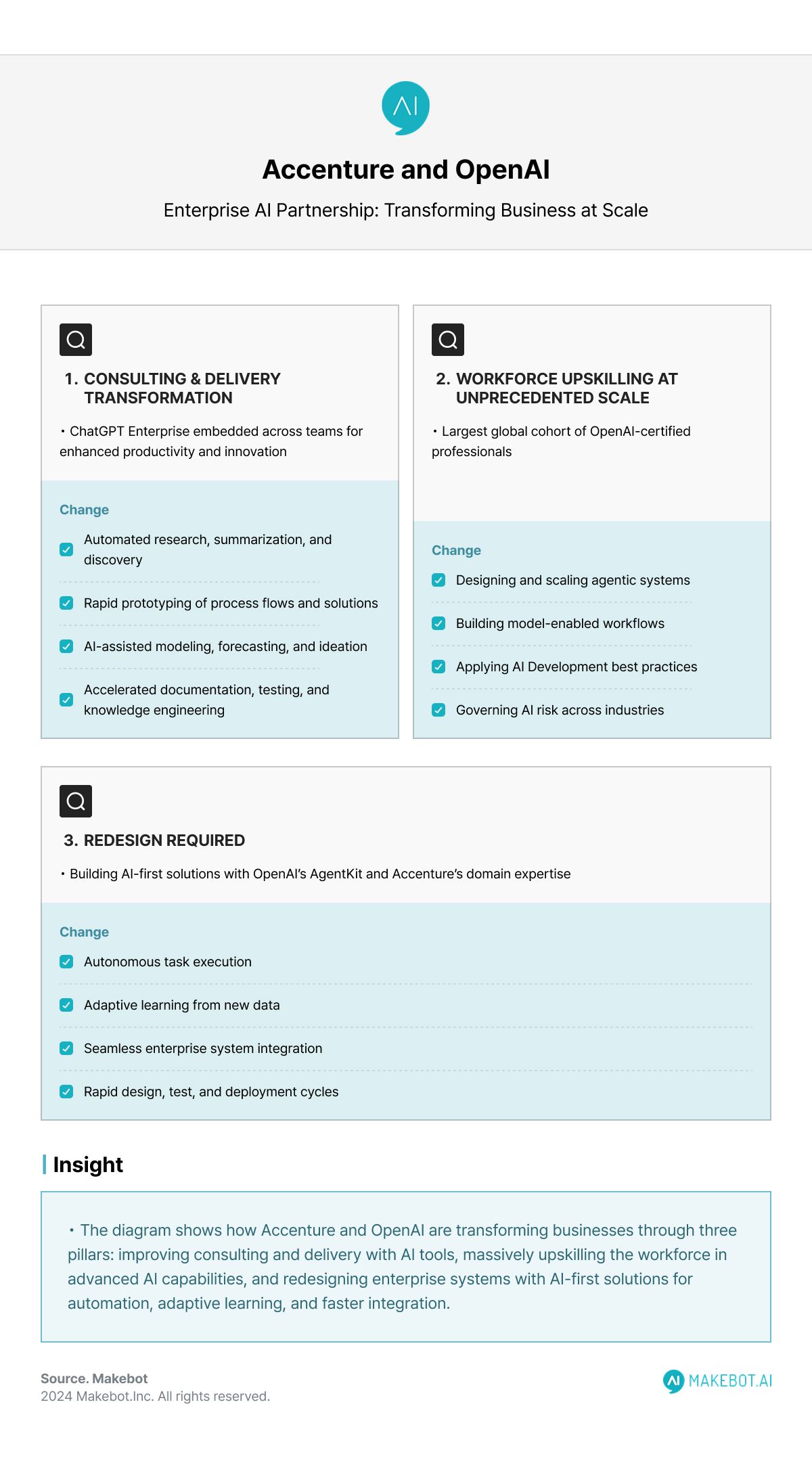
1. Consulting and Delivery Transformation
Teams across consulting, delivery, and operations will use ChatGPT Enterprise for:
- Automated research, summarization, and discovery
- Rapid prototyping of process flows and solutions
- AI-assisted modeling, forecasting, and ideation
- Accelerated documentation, testing, and knowledge engineering
With data privacy, encryption, and enterprise security controls, OpenAI’s enterprise suite enables Accenture to safely embed Generative AI into sensitive client engagements.
2. Workforce Upskilling at Unprecedented Scale
Accenture will now host the largest global cohort of OpenAI-certified professionals. This creates a new tier of AI consultants capable of:
- Designing and scaling agentic systems
- Building model-enabled workflows
- Applying AI Development best practices
- Governing AI risk across industries
Upskilling also aligns with Accenture’s recent restructuring and talent realignment, which emphasized reskilling over traditional workforce expansion.
3. Co-Developing the Next Generation of Enterprise AI Agents
Both companies will collaborate to build AI-first solutions in:
- Finance
- Supply chain
- HR
- Customer service
- Public sector and healthcare operations
Using OpenAI’s AgentKit and Accenture’s industry domain expertise, organizations can quickly design, test, and deploy custom agents that autonomously execute tasks, adapt to new data, and integrate across enterprise systems.
Accenture: Companies with AI-led Processes Outperform Peers by 2.5x in Revenue Growth. Read here!
The Flagship AI Client Program
The newly launched AI client program represents the operational backbone of the Enterprise AI Partnership. The initiative provides enterprises with:
- OpenAI implementation playbooks
- Industry-specific use cases
- SOC2-aligned security and deployment patterns
- Model evaluation and performance guidelines
- Cross-system integration frameworks
The objective: enable joint clients to adopt OpenAI’s agentic capabilities faster and with deeper integration across mission-critical processes.
This program is especially impactful because enterprises consistently cite the same AI adoption barriers:
- Unclear ROI
- Skills shortages
- Security concerns
- Integration complexity
- Slow movement from pilot to production
Accenture’s global delivery network and OpenAI’s advanced models address these challenges head-on, shortening time-to-value from months to weeks.
Accelerating OpenAI’s Enterprise Scale-Out
While the partnership is often framed as a win for Accenture, it is strategically just as important for OpenAI.
Accenture is helping OpenAI scale its front- and back-office functions—effectively serving as an operational accelerator. This includes globalized support models, enterprise-grade process management, and delivery frameworks that support AI Innovation across industries.
As OpenAI faces mounting competition from Google Gemini, Anthropic Claude, and emerging small-agent architectures, this partnership provides:
- Faster enterprise penetration
- Wider deployment reach
- Stronger alignment with existing SaaS ecosystems
- An operational backbone capable of supporting multi-billion user workloads
It also helps OpenAI maintain momentum amid escalating costs. With $1.4 trillion in data center investments planned, scaling enterprise revenue is critical—and Accenture provides a high-leverage distribution channel.
Industry Implications: A New Competitive Baseline for Enterprise AI
1. Pressure on Competing Consultancies
Competitors like PwC, Deloitte, EY, and KPMG must now accelerate their own Generative AI strategies. Accenture’s early access to OpenAI tooling—particularly agentic systems—creates differentiation that cannot be easily replicated.
2. Rise of Agent-Based Enterprise Architectures
The partnership strengthens the market shift toward autonomous enterprise agents that:
- Execute multi-step workflows
- Interface across SaaS tools
- Manage data pipelines
- Trigger system actions
- Operate with minimal supervision
Agentic architectures will become the baseline for Enterprise AI transformation over the next 24–36 months.
3. Acceleration of AI Governance Standards
With more enterprises integrating Generative AI into core processes, governance frameworks—from MCP (Model Context Protocol) to multi-agent policy engines—will become standard in digital transformation projects.
4. Greater Demand for AI-Ready Talent
The surge in AI Development talent trained via OpenAI Certifications signals a new labor market characterized by:
- Prompt engineering specialists
- Agent operations managers
- AI product owners
- Multi-agent orchestration engineers
What CIOs, CTOs, and AI Leaders Should Expect Next
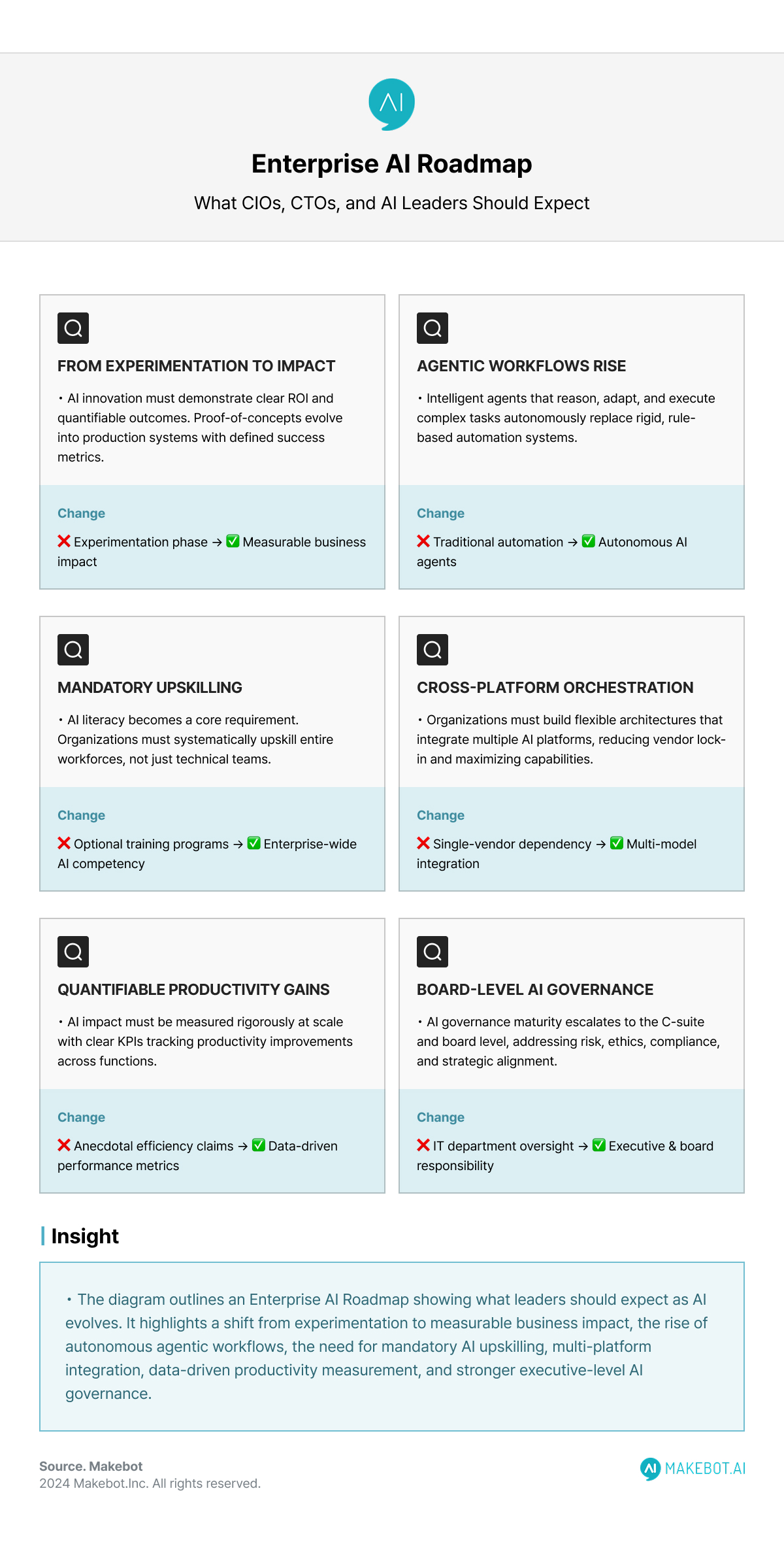
Accenture’s roadmap—reinforced by OpenAI—signals key trends for 2026 and beyond:
- AI Innovation shifts from experimentation to measurable impact
- Agentic workflows replace traditional automation
- Enterprise upskilling becomes mandatory, not optional
- Cross-platform orchestration becomes critical for reducing vendor lock-in
- Productivity gains become more quantifiable at scale
- AI governance maturity becomes a board-level priority
For organizations investing in Enterprise AI, the new partnership provides a replicable blueprint: deploy securely, upskill aggressively, integrate deeply, and scale through agents.
Showcasing Korea’s AI Innovation: Makebot’s HybridRAG Framework Presented at SIGIR 2025 in Italy. More here!
Conclusion
The expanded collaboration between Accenture and OpenAI is more than a corporate partnership—it is a structural shift in how modern enterprises adopt, integrate, and scale Generative AI. By combining Accenture’s execution muscle with OpenAI’s frontier models, the partnership delivers a powerful foundation for AI Development, operational reinvention, and competitive differentiation.
As enterprises move from pilot projects to system-wide transformation, this alliance sets a new global benchmark for what a mature, production-grade Enterprise AI Partnership looks like.
It signals the beginning of a new era: one where Enterprise AI, agentic systems, and continuous AI Innovation will define how organizations grow, compete, and operate in the decade ahead.
Drive Real Enterprise AI Impact with Makebot
Makebot bridges the gap between AI ambition and real-world execution. As enterprises race to adopt agentic systems and next-generation workflows, Makebot delivers industry-specific LLM agents and ready-to-deploy AI solutions built for measurable impact. From healthcare deployments at Seoul National University Hospital and Gangnam Severance Hospital to tailored solutions for finance, retail, and the public sector, Makebot provides trusted, secure, and scalable AI built around your business goals.
Backed by HybridRAG—presented at SIGIR 2025 with a 26.6% accuracy boost and up to 90% cost reduction—Makebot helps organizations move from Proof of Concept to production with unmatched speed. With tools like BotGrade, MagicTalk, MagicSearch, and MagicVoice, plus over 1,000 enterprise deployments, you can modernize customer experience, automate workflows, and unlock real ROI.
👉 www.makebot.ai | 📩 b2b@makebot.ai







.png)






.jpg)


What Happens to Marketing When the C-Suite Starts Using AI Every Day?







Why AI Shopping Assistants Will Replace Traditional Ecommerce Search






.jpg)

























Why Generative AI Projects Fail and How to Achieve Scalable AI Success









.jpg)

.png)















Interview Feature: Why Companies Are Betting Big on Generative AI