The global conversation around Generative AI has accelerated faster than nearly any technological shift in modern history. With trillions of dollars in capital expenditure committed to GPUs, data centers, and model development, analysts, investors, and technologists have repeatedly asked the same question:
Are we in an AI Bubble?
According to Arvind Krishna, CEO of International Business Machines Corporation (IBM), the answer is a decisive no. But his reasoning isn’t based on hype—it’s rooted in economic fundamentals, adoption patterns, historical precedent, and the long-term trajectory of AI Innovation and AI Development.
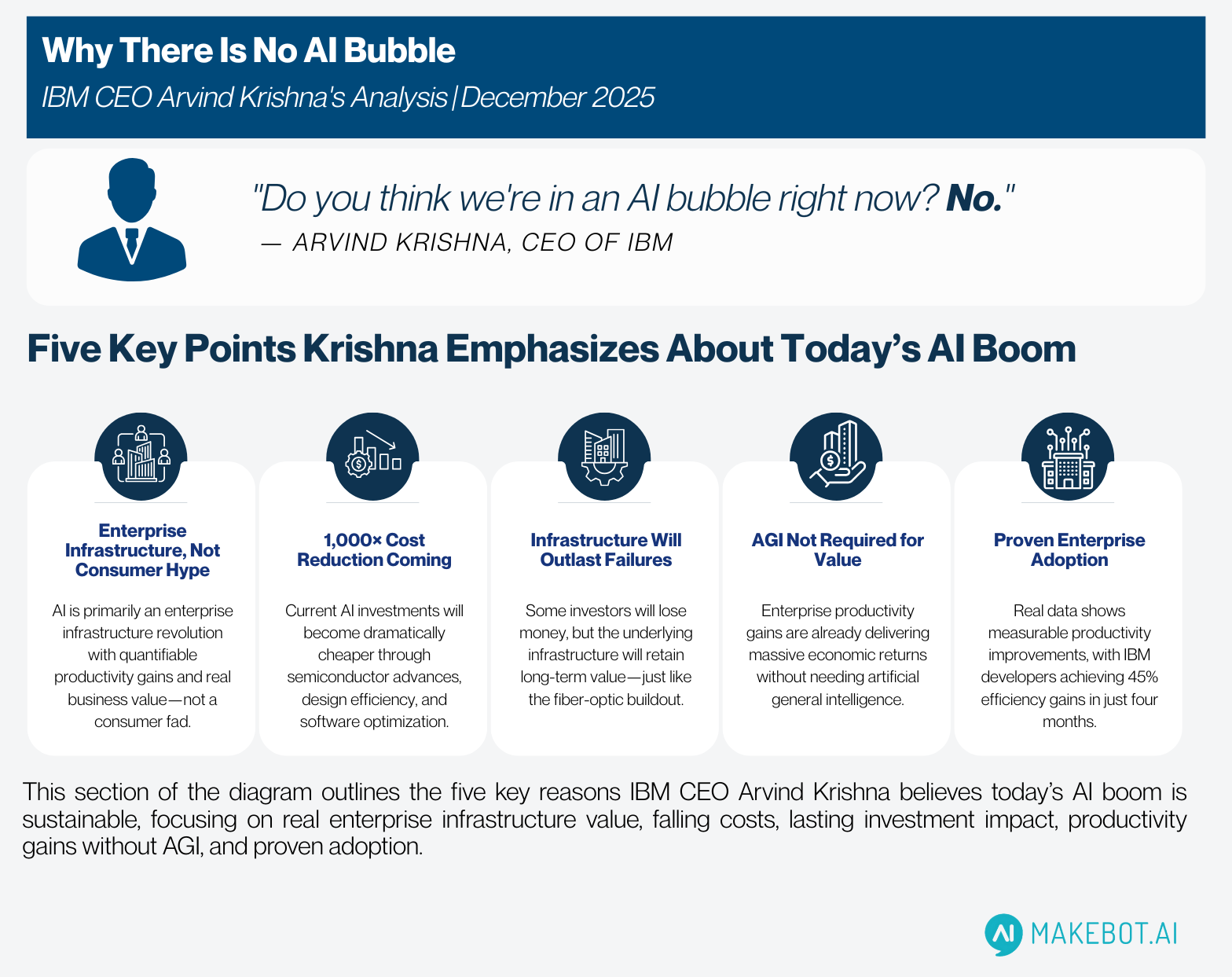
Five Key Points Krishna Emphasizes About Today’s AI Boom
- AI is primarily an enterprise infrastructure revolution, not a consumer hype cycle.
- Current AI investments will become 1,000× cheaper, making today’s spending rational over time.
- Some investors will lose money, but the sector itself will not collapse—just like past infrastructure booms.
- AI’s value does not depend on AGI; enterprise productivity already demonstrates huge economic returns.
- IBM is strategically positioned through hybrid cloud, trusted enterprise AI, and long-term bets like quantum computing.
In a far-reaching interview, on December 1st of 2025 , Krishna lays out a clear, data-backed argument explaining why today's AI wave is not speculative excess, but the beginning of a multi-decade transformation across enterprise and industrial infrastructure.
This article synthesizes his insights with broader market analysis to explain why the AI boom is real, why it will endure, and how IBM is strategically positioned for the next era of intelligent computing.
Why McKinsey Says AI Won’t Take Your Job. Read more here!
The First Principle: AI Is Not a Consumer Fad—It’s Enterprise Infrastructure
One of Krishna’s most important distinctions is between the B2C hype cycle and the B2B transformation quietly reshaping global industries. He acknowledges that some debt-backed bets—particularly in hyperscale consumer AI—will never pay off. But he is unequivocal:
“Do you think we're in an AI bubble right now? No.”
Why? Because enterprise AI isn't based on the hope of mass consumer adoption. It is grounded in quantifiable productivity gains, operational efficiencies, and the real modernization of business systems.
Even if some models or firms fail, the underlying infrastructure being built—compute, networking, storage, hybrid cloud systems—will continue delivering value far into the future, much like the fiber-optic overinvestments of the early 2000s.
Krishna draws that exact parallel:
- The fiber buildout led to financial collapses but the infrastructure became foundational.
- Similarly, AI infrastructure—from data centers to model frameworks—will outlive early market volatility.
AI Costs Will Decline by 1,000×—Making Today’s Investments Rational
Critics argue that the astronomical cost of GPUs and AI infrastructure is unsustainable. Krishna agrees the spending is massive—but insists the economics will correct.
He outlines three compounding cost curves:
1. 10× improvement in semiconductor capability
Driven by competition, material science innovation, and new architectures.
2. 10× improvement in chip design efficiency
Through emerging competitors like Groq and Cerebras—not just Nvidia.
3. 10× efficiency gains from software optimization
Via quantization, compression, caching, and model-deployment refinements.
Put together:
10× × 10× × 10× = 1,000× cheaper AI over the next five years.
This is a staggering economic shift—and one of Krishna’s core arguments that today’s investments will not burst like a bubble but amortize into long-term value.
Not All Capital Will Succeed—But the Sector Will
Krishna is not naïve about risk. He openly states:
“Some of the capital being spent… will not get its payback.”
But he differentiates between:
- Equity capital, which may see significant returns
- Debt capital, which is more vulnerable in speculative races
- Infrastructure assets, which retain long-term utility
This is similar to the fiber boom:
- Many firms failed.
- Investors lost billions.
- But every major company today benefits from that infrastructure.
This is why Krishna asserts: the AI sector is not a bubble, even if some investors lose money.
Google’s $1B Push to Transform AI Education and Workforce Training. Read here!
The AGI Chase Is Not What’s Driving Real Value
Another cornerstone of Krishna’s argument: He gives 0–1% odds that current LLM-based AI will achieve AGI. This matters because it dismantles the idea that the AI boom relies on speculative breakthroughs. Instead, Krishna believes the economic value lies in:
- Enterprise automation
- Workflow augmentation
- Data intelligence
- Industry-specific AI systems
- Domain-tuned models
- Hybrid-cloud integrations
He projects trillions in enterprise productivity, even without AGI. This is why the talk of AGI-based valuations doesn’t faze him—enterprise AI has a grounded, clear ROI.
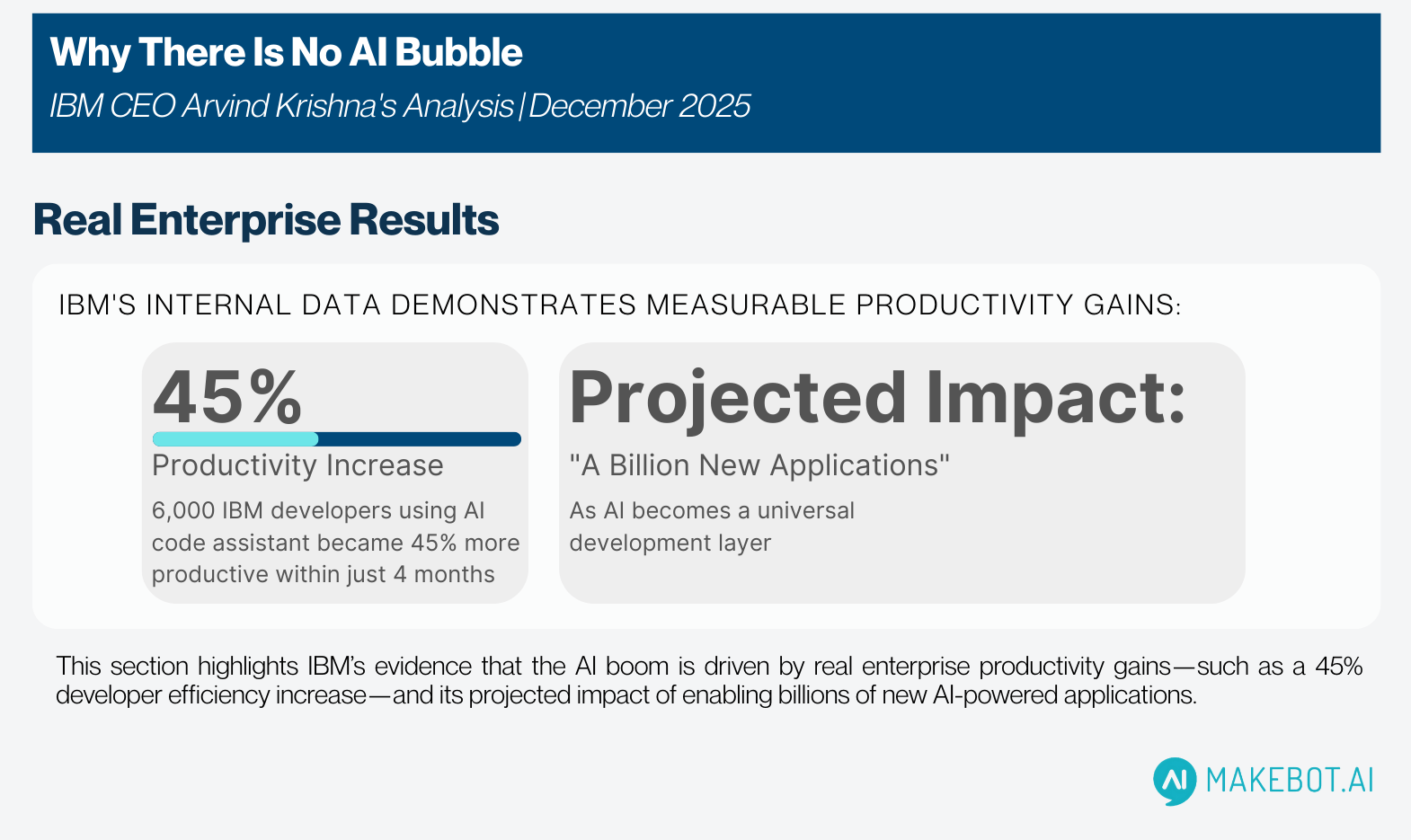
Enterprise Adoption Is Already Delivering Measurable Gains
Krishna provides rare, hard internal data from IBM:
6,000 IBM developers who adopted IBM’s generative code assistant became 45% more productive within four months.
This is not a hypothetical value. It is documented organizational productivity—an enterprise CEO’s dream metric.
The implication is profound:
If enterprise-wide AI adoption scales these gains across industries—insurance, logistics, finance, healthcare—the macroeconomic impact will dwarf past technology cycles.
Krishna even predicts the creation of: “A billion new applications” as AI becomes a universal development layer.
The Real Reason There Is No AI Bubble
Krishna’s thesis rests on three pillars:
Pillar 1: The AI economy is infrastructure-first, not consumer-first.
It resembles the internet and fiber transitions—assets that outlast speculative cycles.
Pillar 2: Enterprise ROI is already measurable, replicable, and accelerating.
From 45% productivity gains to billion-app ecosystems.
Pillar 3: AI will get exponentially cheaper and more efficient.
A 1,000× cost reduction fundamentally transforms long-term economics.
Meanwhile, speculative consumer AGI bets may fail—but the enterprise AI market will continue to compound in value.
Thus, Krishna concludes confidently:
There is no AI Bubble—only a misallocation of capital within a long-term, foundational technology shift.
What This Means for the Future of AI Development
Based on Krishna’s analysis, expect:
1. Massive enterprise AI modernization across every global industry
Healthcare, manufacturing, logistics, finance, public sector, energy—all stand to gain.
2. The rise of hybrid AI architectures
Multi-cloud, sovereign cloud, and on-prem AI systems.
3. New AI-native development stacks
Krishna predicts a "billion-application" future—far beyond the smartphone app boom.
4. A shift from model competition to cost competition
The real battle will be efficiency, not just accuracy.
5. A new computing layer emerging: quantum + AI
IBM is aiming to lead the next era of computational power.
Showcasing Korea’s AI Innovation: Makebot’s HybridRAG Framework Presented at SIGIR 2025 in Italy. More here!
Conclusion
Arvind Krishna presents a sober, mathematically grounded, historically informed case: AI is not overvalued. It is undervalued relative to the long-term structural impact it will have on enterprise productivity and global economic output.
Speculative players may fall. Debt investors may suffer. But the foundational infrastructure being built today—cloud, compute, data pipelines, AI tooling—will support decades of innovation.
In that world, the International Business Machines Corporation (IBM) is positioning itself not as a competitor in the AGI race but as the central backbone of enterprise AI—the layer of trust, integration, and intelligence that global industries will depend on.
And that, more than anything, is why Krishna sees no AI Bubble at all.
Makebot: Turn AI Strategy Into Real Business Impact
The enterprise shift into AI requires more than tools—it requires industry-specific, trustworthy, ready-to-deploy solutions. Makebot delivers exactly that. From healthcare LLM agents trusted by top hospitals to AI systems for finance, retail, government, and customer service automation, we help organizations adopt AI that aligns with real-world environments and compliance needs.
With solutions like BotGrade, MagicTalk, MagicSearch, and MagicVoice, plus HybridRAG technology recognized at SIGIR 2025 for achieving up to 90% cost reduction, Makebot accelerates your AI journey from proof of concept to production—fast, secure, and ROI-driven.
👉 Begin your AI transformation today: www.makebot.ai
📩 Contact us: b2b@makebot.ai









.jpg)


What Happens to Marketing When the C-Suite Starts Using AI Every Day?







Why AI Shopping Assistants Will Replace Traditional Ecommerce Search






.jpg)
























Why Generative AI Projects Fail and How to Achieve Scalable AI Success










.jpg)

.png)