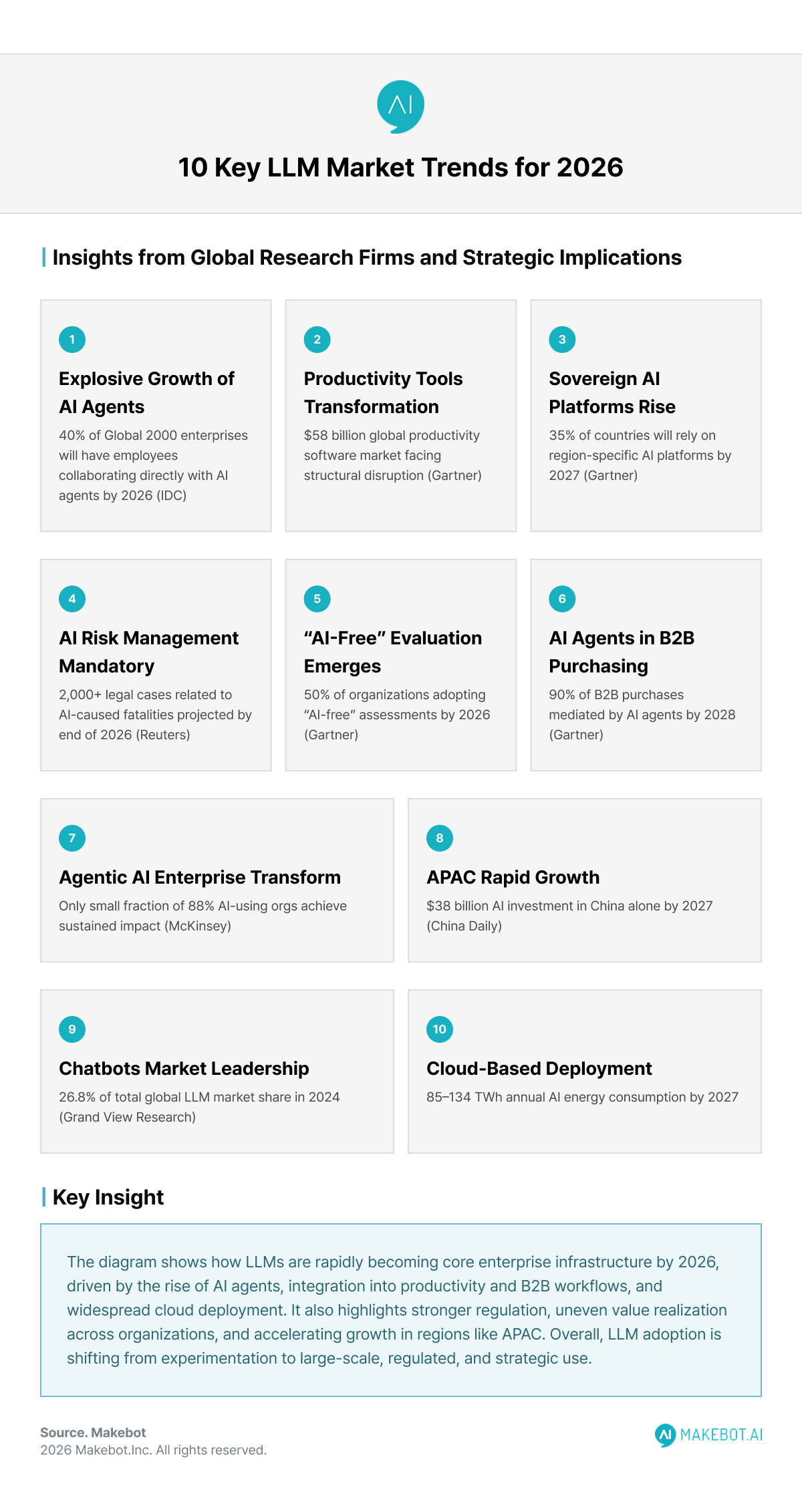
10 Key LLM Market Trends for 2026
10 data-driven LLM trends shaping enterprise AI strategy, governance, and scale in 2026.

Insights from Global Research Firms and Strategic Implications
Overview
The global Large Language Model (LLM) market is entering a decisive phase in 2026. After several years dominated by scale races and experimental deployments, Generative AI is now transitioning into core digital infrastructure for enterprises, governments, and platforms worldwide. This shift is driven by three converging forces: agentic AI maturation, enterprise operational pressure, and tightening regulatory expectations.
By 2026, LLMs are no longer evaluated primarily by benchmark scores, but by their ability to deliver reliable outcomes, operate under governance constraints, and integrate into complex enterprise workflows. The following ten trends synthesize forecasts and evidence from leading global research institutions and industry analyses, outlining how the LLM ecosystem will evolve—and where strategic advantage will emerge.
From Pilot to Production: How Enterprises Can Successfully Scale LLM Chatbots Across the Organization. Read more here!
Trend 1: Explosive Growth and Autonomy of AI Agents
AI agents are evolving beyond traditional conversational chatbots into autonomous, goal-oriented systems capable of executing multi-step tasks across enterprise workflows.
- By 2026, 40% of Global 2000 enterprises are expected to establish work environments where employees collaborate directly with AI agents rather than using them only as assistive tools (IDC).
- Agentic systems increasingly combine reasoning, retrieval, tool use, and execution, enabling them to handle customer service escalation, internal operations, enterprise search, compliance checks, and analytics.
- This shift marks a move from prompt-response AI to decision-capable AI systems, significantly increasing both value creation and risk exposure.
Importantly, the LLM landscape in 2026 is not converging toward a single dominant model. According to a comprehensive 2026 LLM Outlook analysis, leadership among top models continues to shift between OpenAI, Google, and Anthropic, depending on task, benchmark, and evaluation criteria. Current benchmarks place Google’s Gemini 3 Pro at the top overall, while Anthropic’s Claude models continue to outperform peers in coding-specific tasks — highlighting a growing pattern of task-level specialization rather than general-purpose dominance. This signals a structural shift toward agentic systems composed of multiple specialized models, rather than reliance on a single “best” LLM.
Makebot Perspective: Makebot integrates Voice AICC, AI chat, AI search, and AI internal tools into unified agentic workflows, reflecting the broader industry shift toward end-to-end AI agent systems rather than isolated chat interfaces.
Trend 2: The End — and Rebirth — of Productivity Tools
After more than three decades of dominance, traditional productivity software is facing its first structural disruption.
- Generative AI and AI agents are reshaping a $58 billion global productivity software market (Gartner).
- User interaction is shifting from document-centric and typing-based workflows to prompt-driven and outcome-oriented interfaces, reducing dependency on manual navigation and rigid UI structures.
- By 2026, productivity differentiation will increasingly depend on embedded AI reasoning and automation, not feature breadth.
Despite strong adoption narratives, measurable productivity gains remain uneven. Stanford-affiliated experts predict that 2026 will mark a shift from AI evangelism to AI evaluation, where organizations prioritize rigor, benchmarking, and ROI over speculative promise. Productivity improvements have been most consistently observed in programming, call centers, and narrowly defined workflows, while many large-scale AI initiatives continue to underperform expectations. This reinforces the emerging consensus that LLMs create value when tightly integrated into existing workflows, rather than deployed as standalone tools.
Trend 3: Expansion of Sovereign AI Platforms
Governments and regions are increasingly prioritizing AI sovereignty to control data, infrastructure, and model behavior.
- By 2027, 35% of countries are projected to rely on region-specific or sovereign AI platforms (Gartner).
- Demand is rising for LLMs optimized for local languages, regulatory norms, and culturally specific datasets, particularly in non-English markets.
- Language-specific performance and on-shore deployment are becoming procurement requirements, not optional features.
The distinction between open-weight and closed-weight models is becoming a defining fault line in the 2026 LLM ecosystem. While closed models dominate commercial APIs, open-weight models now outnumber closed alternatives, and the quality gap has narrowed from nearly one year in 2024 to approximately six months in 2025. At the current rate of progress, open-weight models are expected to reach — and potentially surpass — closed models in performance, particularly for sovereign and private deployments where data control and regulatory compliance are critical.
Makebot Perspective: Makebot supports 20+ languages, with specialized optimization for Korean-language enterprise AI use cases, aligning with the sovereign AI trend observed across APAC and Europe.
Trend 4: AI Risk Management Becomes Mandatory
As AI systems scale into safety-critical and decision-making roles, risk governance is no longer optional.
- By the end of 2026, more than 2,000 legal cases related to AI-caused fatalities are projected globally (Reuters).
- Enterprises are being required to adopt explainable AI (XAI), traceable data pipelines, ethical model design, and transparent governance frameworks.
- System-level accountability—rather than model disclaimers—is becoming the standard expectation.
Regulatory divergence is accelerating rather than converging. In the United States, AI-related state legislation has increased more than sixfold since 2023, exceeding 130 active bills, while federal policy has shifted toward minimizing regulatory friction to preserve competitive advantage. In contrast, the European Union’s AI Act emphasizes precaution and human-centric governance, though mounting industry pressure has already triggered discussions around simplification and delayed enforcement. This fragmented environment makes multi-jurisdiction compliance a baseline requirement for enterprise AI platforms operating globally.
Trend 5: Decline in Critical Thinking and the Rise of “AI-Free” Evaluation
The widespread use of generative systems is raising concerns about human cognitive atrophy.
- By 2026, 50% of global organizations are expected to adopt “AI-free” assessments to evaluate independent reasoning, creativity, and judgment (Gartner).
- Educational institutions and employers are re-prioritizing original thinking as a strategic differentiator, not just AI-augmented output.
- This creates a paradox: greater AI reliance increases the value of uniquely human skills.
This concern is increasingly echoed by academic researchers, who warn that unchecked reliance on LLMs may discourage users in areas such as writing, reasoning, and decision-making, reinforcing the need for human-centered AI design that augments — rather than replaces — cognitive development.
Trend 6: AI Agents as Intermediaries in B2B Purchasing
AI agents are transforming how businesses discover, evaluate, and purchase products and services.
- By 2028, 90% of B2B purchases are expected to be mediated by AI agents rather than direct human interaction (Gartner).
- An estimated $15 trillion in global B2B transactions will flow through AI-agent marketplaces, fundamentally altering sales, procurement, and marketing dynamics.
- SEO is evolving into AEO (Agent Engine Optimization), where visibility to AI agents matters more than ranking on human-facing search engines.
This transition mirrors early signals in consumer markets, where AI-driven shopping assistants are already influencing hundreds of billions of dollars in online purchases, suggesting that agent-mediated commerce will soon become a default interaction layer across both B2C and B2B environments.
Trend 7: The Rise of Agentic AI and Enterprise Transformation
Despite high adoption rates, enterprise value realization remains uneven.
- 88% of organizations report using AI, yet only a small fraction achieve measurable, sustained business impact (McKinsey).
- Agentic AI—systems capable of reasoning, acting, and adapting—is emerging as the next major lever for enterprise transformation.
- By 2030, AI is expected to reshape corporate strategy, workforce design, and innovation models (World Economic Forum).
A clear illustration of this shift toward specialization is the rise of domain-verified AI systems. Example is Harmonic, an AI system designed specifically for mathematical proof verification, which achieved gold-medal-level performance at the International Mathematics Olympiad by guaranteeing correctness rather than probabilistic outputs. This architecture prioritizes verifiability over fluency, directly addressing hallucination risks — a design philosophy increasingly relevant to regulated enterprise domains such as finance, law, and engineering.
Makebot Perspective: Makebot emphasizes outcome-driven AI integration, focusing on measurable operational improvements rather than surface-level AI adoption.
Trend 8: Rapid Growth in the Asia-Pacific (APAC) Region
APAC is projected to be the fastest-growing LLM market globally.
- China alone is expected to invest $38 billion in AI by 2027, driven by open-weight model development and infrastructure expansion (China Daily).
- Korea, Japan, and India are accelerating AI-led digital transformation, supported by government initiatives and enterprise demand.
- APAC’s growth is increasingly shaped by localized models, multilingual deployment, and cost-efficient architectures.
Beyond market growth, China is emerging as a structural force in global AI development. It now produces a share of high-impact AI research publications comparable to the United States and the European Union combined. This research leadership is reinforced by China’s commitment to open-weight models and its relative advantage in large-scale energy generation — a critical factor as AI data centers become increasingly power-intensive. While geopolitical constraints around advanced GPU access remain, China’s combination of open research, energy capacity, and rapidly improving model performance positions it as one of the most disruptive forces in the 2026 LLM landscape.
Makebot Perspective: As a Korea-based AI company, Makebot is strategically positioned within one of the fastest-scaling LLM regions globally.
Trend 9: Market Leadership of Chatbots and Virtual Assistants
Despite the rise of agents, chatbots remain the largest single LLM application segment.
- In 2024, chatbots accounted for 26.8% of total global LLM market share (Grand View Research).
- Growth is driven by cost reduction, customer service automation, and 24/7 support requirements across retail, healthcare, finance, and public services.
- The category is evolving toward multimodal, agent-assisted, and context-aware systems rather than simple Q&A bots.
Makebot Perspective: Makebot supports multi-channel chatbot deployment across five or more platforms, aligning with enterprise demands for scale and channel flexibility.
Trend 10: Dominance of Cloud-Based LLM Deployment
Cloud infrastructure is becoming the default deployment model for LLM systems.
- Enterprises are rapidly shifting from on-premise LLM deployments to cloud-based architectures to reduce cost and increase scalability.
- Hybrid deployment models are gaining traction, balancing regulatory compliance, latency, and operational efficiency.
- By 2026, cloud-native LLM architectures are expected to dominate new enterprise deployments.
Energy consumption is emerging as a hidden constraint on LLM scalability. Training GPT-3 alone required approximately 1,287 MWh of electricity, and projections estimate that the global AI sector could consume 85–134 terawatt-hours annually by 2027, comparable to the total electricity usage of countries such as the Netherlands. These constraints are accelerating interest in hybrid deployments, inference optimization, and model efficiency, rather than unchecked scaling.
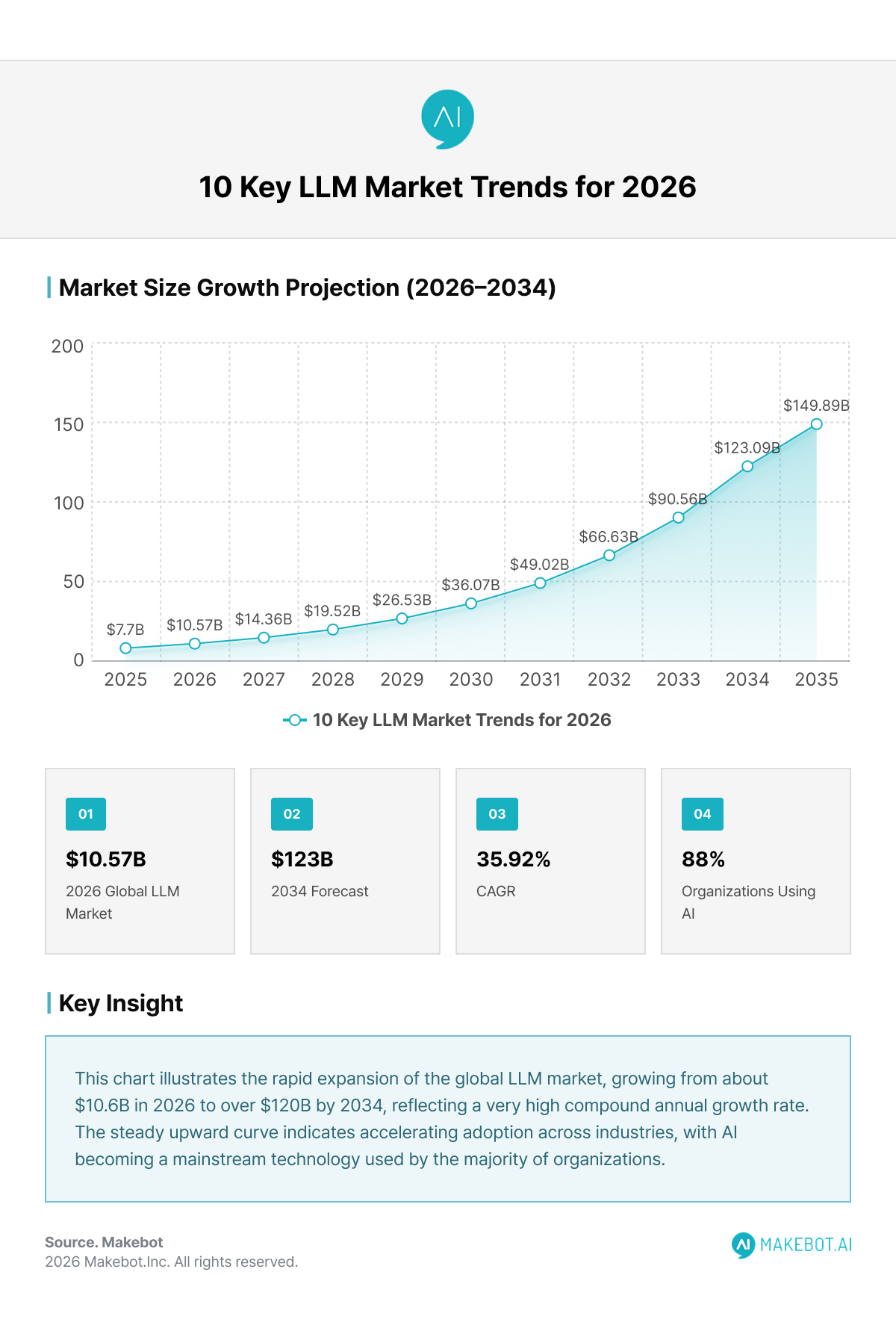
Market Size Snapshot
- 2026 Global LLM Market Size: USD 10.57 billion
- 2034 Forecast: USD 123 billion
- Compound Annual Growth Rate (CAGR): 35.92%
- North America Market Share: 32–33%
- Fastest-Growing Region: APAC
Sources: Precedence Research, Grand View Research
.jpg)
Makebot’s 2026 Vision: Leading with Integrated AI
Makebot positions itself not as a chatbot vendor, but as a fully integrated AI agent platform spanning voice, chat, search, and internal automation—reflecting the broader industry shift toward system-level AI architectures rather than standalone models.
Integrated AI Agent Platform Structure – Five Core Integrated Solutions
Centered on BotGrade, an LLM-based chatbot platform, Makebot’s ecosystem is organically integrated with:
- MagicTalk, AI chat consulting for customer and internal support
- MagicSearch, AI search that connects organizational knowledge and documents
- MagicVoice, AICC for contact center automation
- MagicWorks, AI productivity tools that support company-wide internal operations
In Korea, Makebot is virtually the only company capable of delivering an LLM-based integrated platform—covering voice, chat, chatbots, search, and internal operations—at a real, production-ready operational level. This provides enterprises with a foundation to begin AI adoption quickly and to sustain it with a highly competitive cost structure.
👉 www.makebot.ai | 📩 b2b@makebot.ai
Showcasing Korea’s AI Innovation: Makebot’s HybridRAG Framework Presented at SIGIR 2025 in Italy. More here!
Closing Statement
The 2026 AI Outlook marks a turning point for Large Language Models. The era of experimentation is giving way to performance-driven, accountable, and integrated AI systems. As enterprises navigate a rapidly expanding $10+ billion LLM market, success will depend less on access to the largest models and more on how effectively those models are embedded into real workflows.
Makebot is not simply a chatbot company. It represents one example of how enterprises can operationalize these trends, translating Generative AI from promise into measurable business outcomes as the LLM ecosystem matures.










.jpg)


What Happens to Marketing When the C-Suite Starts Using AI Every Day?







Why AI Shopping Assistants Will Replace Traditional Ecommerce Search






.jpg)

























Why Generative AI Projects Fail and How to Achieve Scalable AI Success











.jpg)

.png)