Why Generative AI Is a Key Component of a Responsible Business Model
Generative AI drives sustainable, transparent, ethical business growth while empowering people.


As artificial intelligence reshapes industries at an unprecedented pace, the focus is shifting from what AI can do to how responsibly it should be used. Generative AI—the ability of machines to create new content, insights, and interactions—is now central to that discussion.
Far beyond chatbots or automation tools, Generative AI is emerging as a cornerstone of a Responsible Business Model, enabling companies to optimize efficiency, reduce waste, enhance transparency, and empower both employees and customers.
According to McKinsey’s “Economic Potential of Generative AI” report, this technology could add $2.6 to $4.4 trillion annually in global value, with up to 70% of work activities technically automatable by Large Language Models (LLMs). Yet the most responsible organizations are those turning that potential into sustainable, ethical impact.
This growing need for sustainability and purpose-driven innovation sets the stage for how Generative AI redefines business responsibility.
The Questions That Will Build the Next Generation of AI Founders. Read more here!
1. Doing More With Less: Efficiency as Responsibility
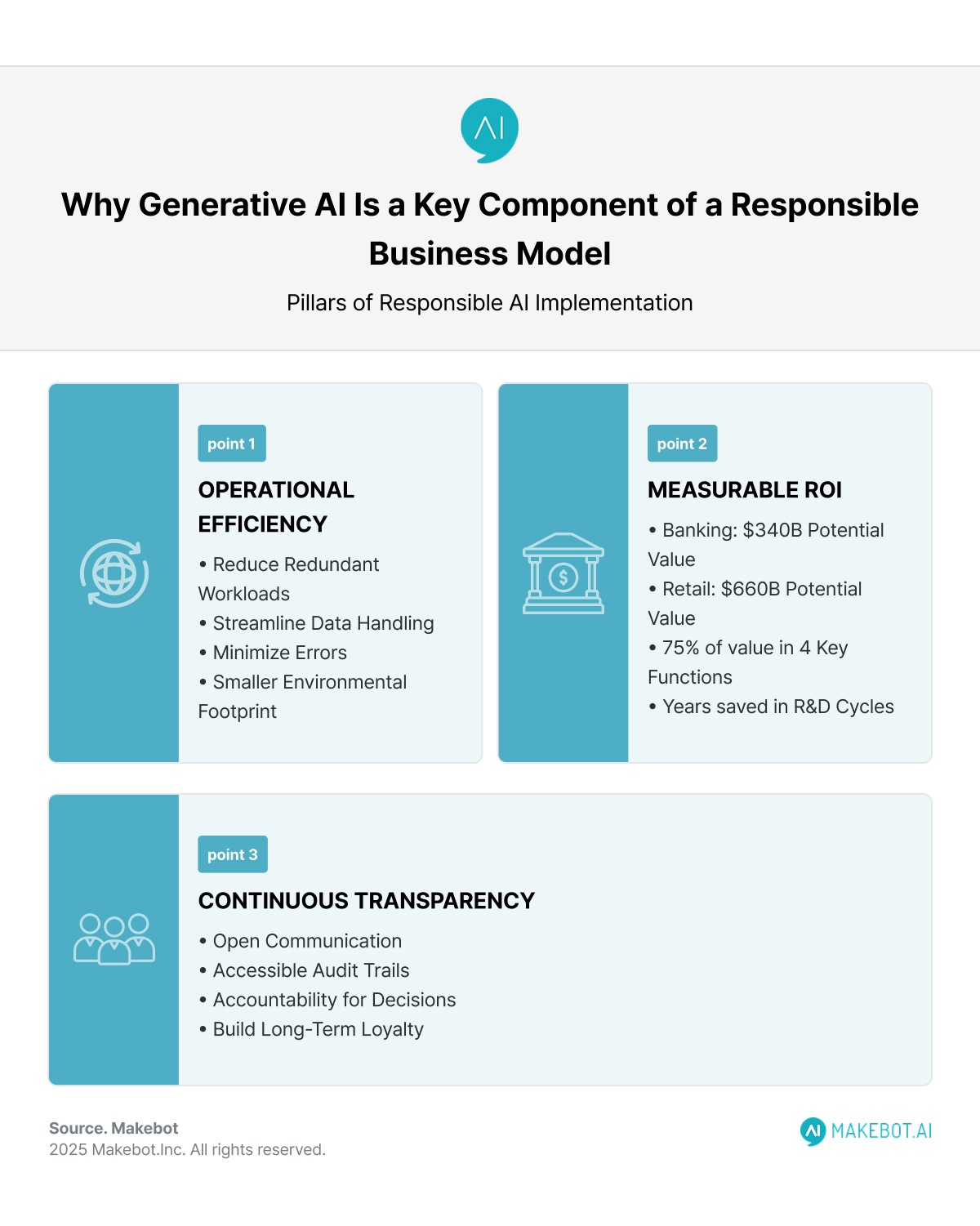
Efficiency lies at the core of sustainability. A responsible business model strives to do more with less—less energy, less waste, less friction. Generative AI achieves this by reducing redundant computational workloads and streamlining data handling.
Digital waste—cluttered systems, unnecessary data storage, or repeated human actions—can silently drain resources. Generative AI automates these processes, saving energy and minimizing errors, leading to leaner operations and a smaller environmental footprint From optimizing logistics to automating reporting, LLMs transform scattered workflows into unified intelligence systems. The result? A cleaner, faster, and more cost-efficient enterprise infrastructure.
And while efficiency drives sustainability, its greatest validation comes from measurable business impact.
McKinsey Report: How Generative AI is Reshaping Global Productivity and the Future of Work. More here!
2. The Economic Case for Responsible AI
McKinsey’s global analysis demonstrates that approximately 75% of Generative AI’s business value arises from four functions: customer operations, marketing and sales, software engineering, and R&D. By integrating Generative AI responsibly, companies unlock measurable ROI while advancing ethical innovation.
For example:
- Banking could gain up to $340 billion annually by automating compliance, risk management, and customer insights.
- Retail could see $660 billion in new value through hyper-personalized marketing and supply chain optimization.
- Pharmaceuticals could cut R&D cycles by years through AI-driven molecular simulation.
However, these gains require governance frameworks that uphold data ethics, human oversight, and continuous monitoring. Responsible AI isn’t just compliance—it’s the foundation of sustainable profit.
And as profits grow, so does the obligation to maintain transparency and public trust.
3. Building Trust Through Continuous Transparency
Customers now expect brands to be open about their technology use. Responsible businesses use Generative AI to increase—not obscure—transparency. By maintaining consistent data reporting, clear communication, and accessible audit trails, AI Business Solutions help brands build and maintain public trust.
Moreover, responsible deployment ensures accountability for every automated decision. This balance of automation and oversight not only protects reputation but also strengthens long-term loyalty—a critical, often overlooked Benefit of AI for business sustainability.
Yet to sustain this trust at scale, companies must embed responsibility into the very architecture of innovation.
4. The New Business Imperative: Sustainable Intelligence
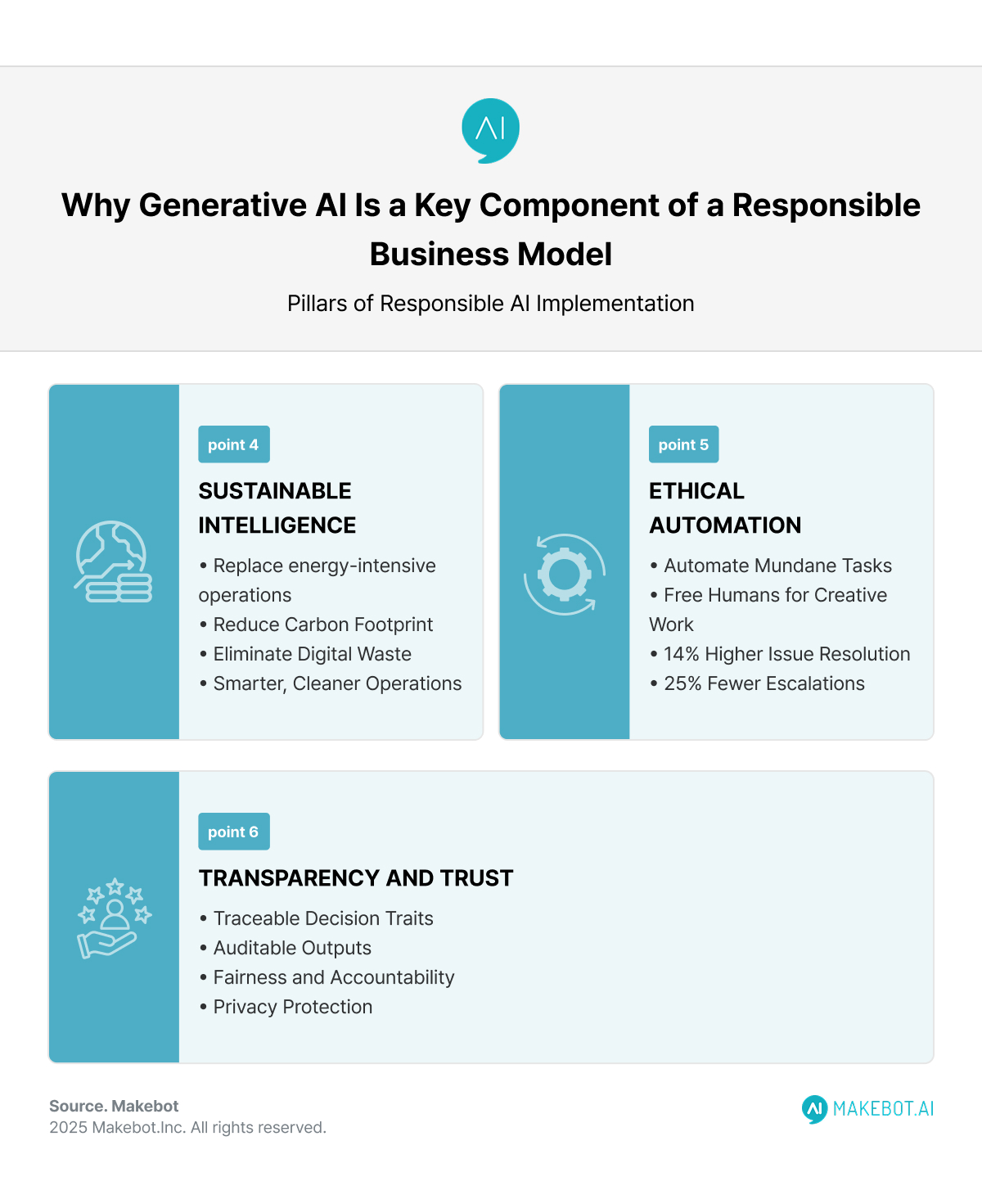
Sustainability is no longer limited to eco-friendly products—it’s about how businesses operate end-to-end. A recent study on Sustainable Service Models shows that Generative AI can make customer operations leaner and greener by replacing energy-intensive call centers with intelligent virtual agents that function around the clock at a fraction of the carbon footprint.
This shift achieves more than just cost efficiency—it creates a smarter, cleaner, and more responsible model of service delivery. AI-driven workflows eliminate repetitive processes, reduce digital waste, and reallocate human talent to creative, high-value work. In doing so, organizations not only strengthen resilience but also align operational goals with environmental and social responsibility.
From here, responsibility extends beyond infrastructure—it reaches the people behind the systems.
5. Empowering People Through Ethical Automation
A Responsible Business Model does not replace humans—it redefines their role. Generative AI supports employee well-being by automating mundane, repetitive tasks and freeing time for critical thinking, innovation, and relationship building.
McKinsey’s data reveals that automation could boost global productivity by 0.5% to 3.4% per year, provided workers are reskilled and redeployed effectively. For example, customer service agents augmented by AI saw 14% higher issue resolution rates and 25% fewer escalation requests, improving both satisfaction and morale.
This balance between machine precision and human empathy embodies the Benefits of AI when responsibly applied—where technology amplifies human potential rather than replacing it.
Once people are empowered, the next responsibility is ensuring that the systems guiding them operate transparently and fairly.
6. Transparency, Trust, and the Ethical Use of Data
Trust is the foundation of modern business, and AI for Business must prioritize transparency and fairness. NTT Data’s Generative AI and Responsible AI framework emphasizes key pillars: fairness, transparency, privacy, and accountability.
By documenting decision trails and explaining outputs, AI Business Solutions can make interactions auditable and verifiable. For instance, LLM-powered systems maintain traceable data logs that ensure regulatory compliance and enhance customer confidence.
This transparency mitigates risks such as bias or misinformation—concerns that McKinsey identifies as central to sustainable AI deployment. When stakeholders understand how algorithms function and why decisions are made, Generative AI becomes not only efficient but also ethically aligned.
With ethics established, the next step is leveraging that integrity to achieve greater operational efficiency.
The Future: Scaling Ethics Alongside Innovation
As adoption accelerates, Large Language Models must evolve under strong ethical guardrails. The next phase of digital transformation will depend on how companies balance AI scalability with responsible governance.
According to Unisys, embedding Responsible AI principles early on allows organizations to anticipate regulatory requirements, foster inclusive data ecosystems, and prevent harm before it occurs. The most competitive enterprises of the next decade will be those that integrate Generative AI not only for profit—but for purpose.
And as purpose becomes the guiding principle, it brings us back to the essence of responsible innovation itself.
Showcasing Korea’s AI Innovation: Makebot’s HybridRAG Framework Presented at SIGIR 2025 in Italy. Read here!
Conclusion
A Responsible Business Model isn’t defined by efficiency alone—it’s defined by ethics, sustainability, and long-term value creation. Generative AI represents the convergence of all three. It powers growth, reduces waste, enhances transparency, and empowers people.
When guided by human-centered governance, Generative AI becomes more than a productivity tool—it becomes the architecture of a sustainable future. Businesses that embrace this technology responsibly will not only outperform competitors but also redefine what it means to operate with purpose in the AI era.
Makebot: Turning Responsible AI into Real Business Impact
Makebot bridges the gap between AI ambition and responsible execution. We go beyond technology delivery—providing industry-specific LLM agents and end-to-end AI Business Solutions that align with your company’s goals, governance, and sustainability strategy. From healthcare agents used by Seoul National University Hospital and Gangnam Severance Hospital to enterprise-grade tools like BotGrade, MagicTalk, MagicSearch, and MagicVoice, Makebot enables organizations to scale Generative AI responsibly while maximizing ROI and efficiency.
Backed by HybridRAG technology—recognized at SIGIR 2025 for achieving 26.6% higher accuracy and up to 90% cost reduction—Makebot delivers proven, globally trusted solutions to over 1,000 enterprises. Generative AI is no longer just an innovation; it’s the foundation of responsible growth. Partner with Makebot to move strategically from exploration to execution, and turn AI potential into measurable business success.
👉 www.makebot.ai | 📩 b2b@makebot.ai





.jpg)


What Happens to Marketing When the C-Suite Starts Using AI Every Day?







Why AI Shopping Assistants Will Replace Traditional Ecommerce Search






.jpg)
























Why Generative AI Projects Fail and How to Achieve Scalable AI Success











.jpg)

.png)