Deloitte Insights: AI Fluency Becomes the Most Valuable Workforce Skill
AI access is no longer the barrier - workforce fluency now determines whether AI delivers real value

Primary Keywords : Generative AI , AI fluency , AI workforce skills , Deloitte AI insights , AI skills in workplace , future of work AI , AI literacy skills , workforce AI transformation , AI upskilling , AI talent demand , enterprise AI skills
The enterprise conversation around artificial intelligence has shifted decisively. The question is no longer whether organizations should adopt Generative AI, but whether their workforce can use it effectively enough to generate real value.
According to recent Deloitte AI insights, the primary constraint on AI-driven transformation is no longer access to technology—it is human capability. While AI tool availability increased by 50% in 2025, the AI skills gap remains the single largest barrier to integration .
This signals a structural shift: AI fluency, not AI access, is now the defining competitive advantage in the modern workplace.
Stanford AI Experts’ Predictions in 2026. Read more here!
Defining AI Fluency
At its core, AI fluency refers to the ability to understand, use, evaluate, and collaborate with AI systems effectively in real-world workflows .
This distinction matters.
- AI literacy skills: Understanding concepts like machine learning or large language models
- AI fluency: Embedding AI into decision-making, workflows, and problem-solving
Deloitte emphasizes that fluency is behavioral, not theoretical—it is measured by how employees actually use AI tools, not what they know about them.
Core Components of AI Fluency
From the report, four foundational capabilities define fluency:
- Prompt Engineering – Structuring inputs to optimize outputs
- Critical Evaluation – Verifying accuracy and detecting hallucinations
- Continuous Learning – Adapting to rapidly evolving AI systems
- Ethical Awareness – Managing bias, privacy, and accountability risks
These competencies collectively form the backbone of modern AI workforce skills.
The Data: AI Fluency as a Workforce Imperative
The urgency around AI skills in workplace environments is supported by strong empirical signals:
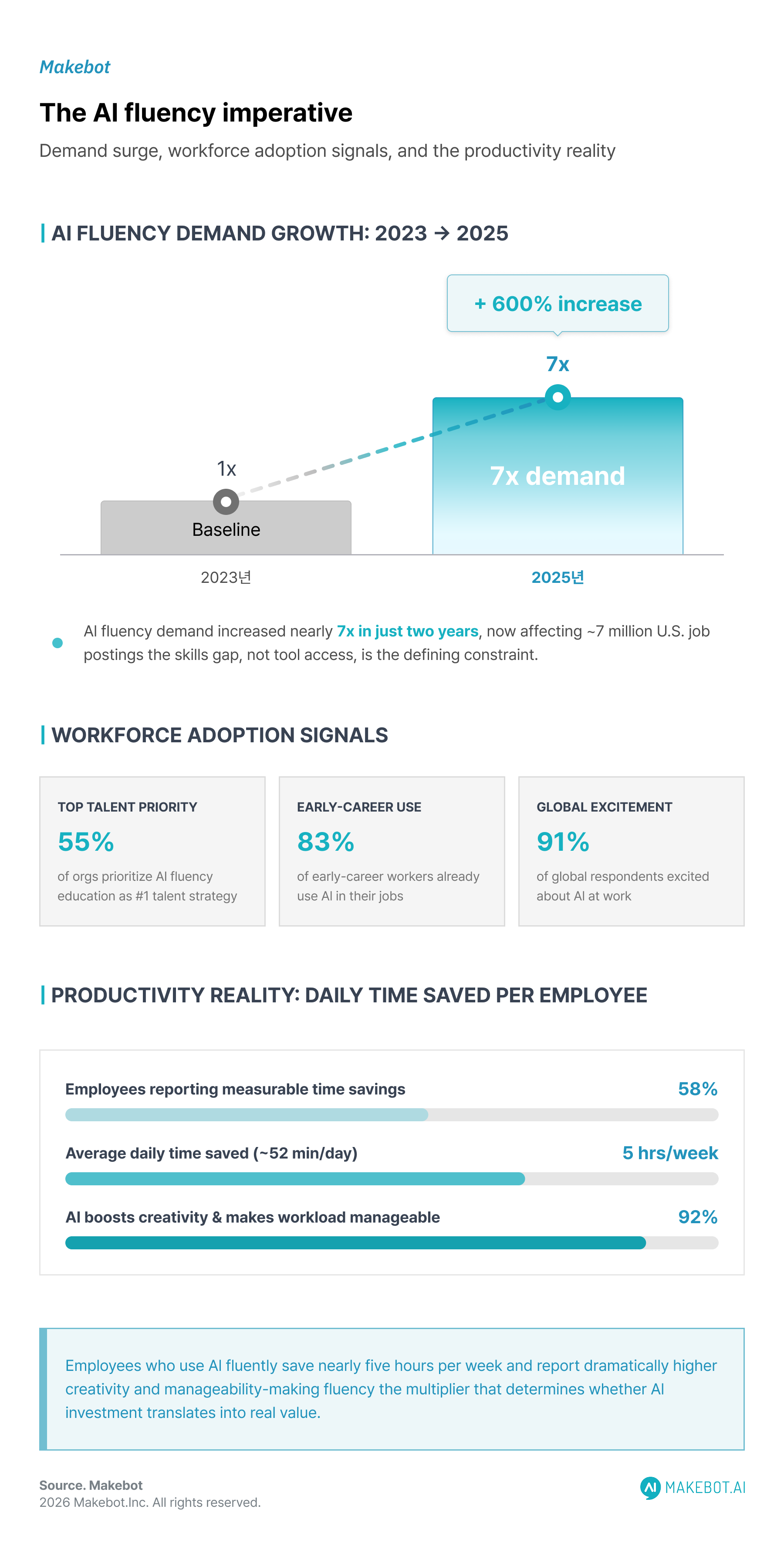
- 55% of organizations now prioritize AI fluency education as their top talent strategy (Accenture)
- Demand for AI fluency increased nearly 7× between 2023 and 2025 (Mckinsey)
- AI-related skills now appear in job postings affecting ~7 million workers in the U.S. alone (Mckinsey)
- Only 34% of organizations are fully reimagining their business around AI (Deloitte)
At the workforce level:
- 83% of early-career workers already use AI in their jobs (Deloitte)
- 91% of global respondents say they are excited about AI and 79% are familiar with the technology, though levels vary across regions. (Booking)
- Employees who adopt AI save an average of more than 30 minutes a day and report that AI makes their workload more manageable (92%) and boosts creativity (92%) (Edx)
These figures highlight a critical asymmetry: AI talent demand is accelerating faster than organizational capability development.
Human–AI Collaboration: From Tool to Teammate
One of the most significant shifts identified in Deloitte AI insights is the transition of AI from a tool to a collaborator. Rather than simple automation, AI enables capability amplification.
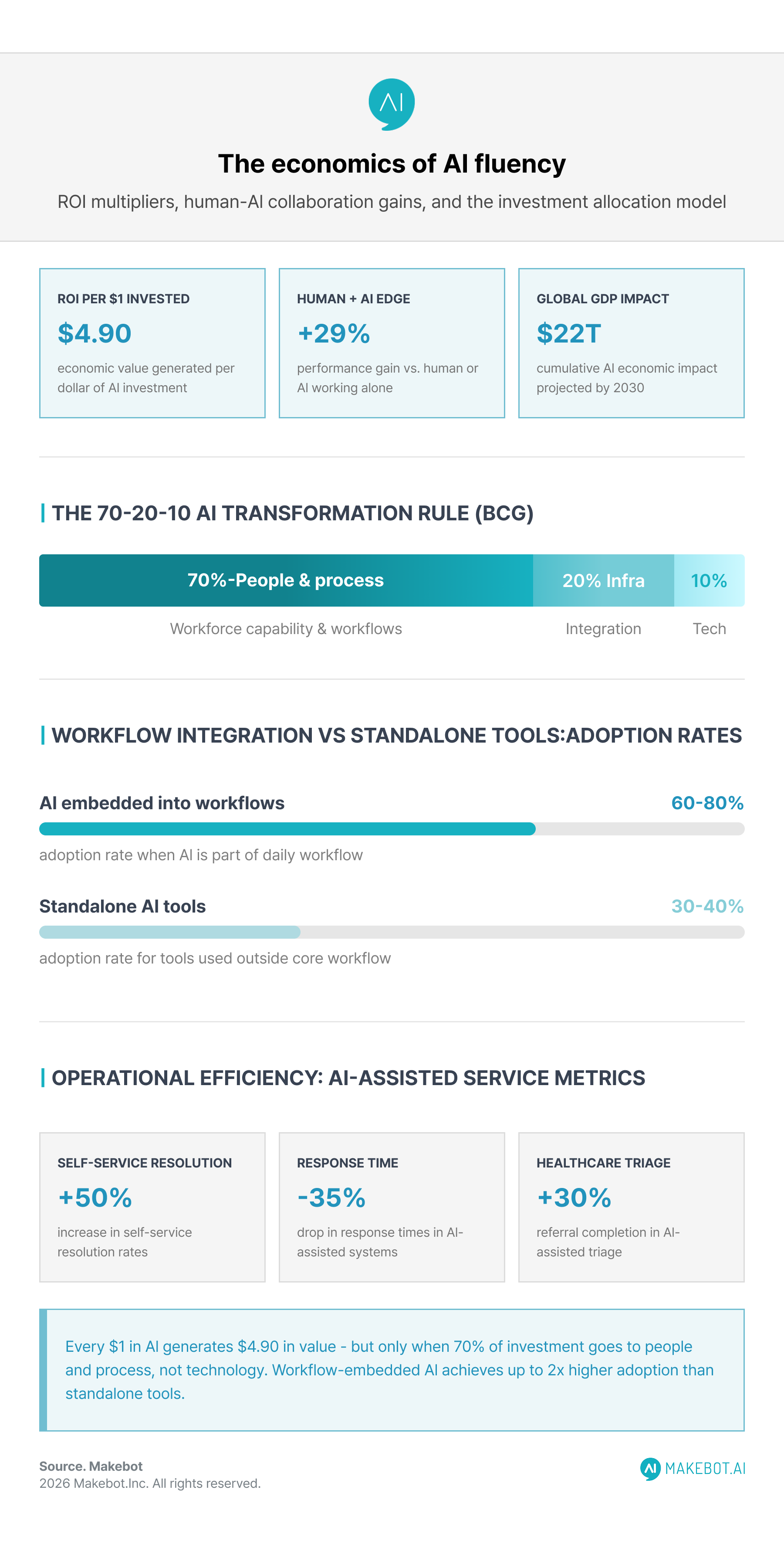
A key study cited by Deloitte found that: Human + AI collaboration improves performance by up to 29% compared to either working alone
Real-World Impact
In applied settings:
- AI-assisted healthcare triage increased referral completion by 30%
- Reduced assessment time by 23.5%
- Lowered treatment drop-off rates by 18%
These outcomes demonstrate that enterprise AI skills are not just about efficiency—they directly impact service quality and decision outcomes.
Why McKinsey Says AI Won’t Take Your Job. More here!
The Shift in Skill Demand: What AI Cannot Replace
As workforce AI transformation accelerates, the value of human skills is being redefined. Deloitte identifies a clear pattern: as AI automates routine cognitive tasks, human advantage shifts toward higher-order capabilities.
High-Value Human Skills in the AI Era
- Judgment and decision-making
- Problem framing and decomposition
- Systems thinking
- Ethical reasoning
- Social intelligence and collaboration
This reinforces a critical insight: AI fluency is not about replacing human intelligence—it is about augmenting it.
Productivity vs. Capability: The Hidden Trade-Off
Despite its benefits, Generative AI introduces complex trade-offs that organizations must actively manage.
Productivity Gains
- According to Forbes research on 2025 , a majority of employees (58%) report measurable time savings from using AI tools in the workplace. On average, workers save approximately 52 minutes per day—equivalent to nearly five hours per week—highlighting AI’s growing role in enhancing productivity. However, adoption and impact remain uneven: 23% of employees report not using AI tools at all, while another 19% indicate no significant time savings, often due to steep learning curves or the complex nature of their tasks. (Forbes)
- Self-service resolution rates increased by 50% in AI-assisted systems (Deloitte)
- Response times dropped by 35% (Deloitte)
Emerging Risks
However, these gains come with non-trivial downsides:
- Recent data highlights a growing disconnect between leadership expectations and employee experience: while 96% of C-suite executives anticipate that AI will significantly enhance workforce productivity, 77% of employees report that AI has, in fact, increased their workload. This gap underscores the challenges of AI implementation, where anticipated efficiency gains may be offset by added complexity, oversight, and adaptation demands at the operational level. (Upwork)
- Nearly 50% are unsure how to use AI effectively (Deloitte)
- Overreliance can lead to skill atrophy, especially in writing and critical thinking
This creates a paradox: AI improves output efficiency—but can erode foundational human capabilities if not managed carefully.
AI Fluency as a Structured Capability: The Tiered Model
Deloitte outlines a practical framework for scaling AI upskilling across organizations.
Three Levels of AI Fluency
- Use Fluency – Applying AI tools safely in everyday tasks
- Choose Fluency – Evaluating risks, tools, and trade-offs
- Build Fluency – Developing AI-powered solutions
This tiered approach aligns with how enterprise AI skills should be distributed:
- Baseline fluency for all employees
- Advanced capability for specialists
- Strategic fluency for leadership
Organizational Reality: AI Adoption Is Fragmented
Despite widespread investment, most organizations are still in early-stage transformation.
Key structural issues include:
- Lack of standardized AI practices
- Uneven adoption across teams
- No shared framework for measuring AI workforce skills
This fragmentation creates operational risk:
- Inconsistent output quality
- Increased compliance exposure
- Misalignment between AI investment and ROI
The Economics of AI Fluency
One of the most overlooked insights is the economic structure of AI transformation.
Research shows:
- The 70-20-10 AI transformation rule emphasizes that 70% of investment should go to people and process changes, 20% to infrastructure and integration, and 10% to the technology/algorithms. This approach addresses the 70% of implementation challenges stemming from organizational culture and workflows, ensuring AI adoption creates sustainable value over just technical pilot success. (BCG)
Additionally:
- Recent projections indicate that Artificial Intelligence (AI) will have a transformative impact on the global economy, with estimates suggesting a cumulative impact of $19.9 trillion to $22.3 trillion by 2030. (IDC)
- Every $1 invested in AI generates $4.90 in economic value
However, these returns are contingent on one factor: Workforce capability—not tool adoption—determines ROI.
Interview Feature: Why Companies Are Betting Big on Generative AI. Read here!
The Future of Work: AI Fluency as a Baseline Skill
Looking ahead, future of work AI trends point toward a fundamental restructuring of roles and workflows.
Key Predictions
- AI fluency will become a baseline skill across all roles
- Human workers will act as orchestrators of AI systems
- Work will shift toward interpretation, oversight, and exception handling
In government and enterprise settings:
- Over 150,000 public sector workers already use generative AI regularly
- More than 18,000 internal AI tools have been developed through experimentation
This signals a transition toward AI-native organizations, where fluency is embedded into daily operations.
Strategic Implications for Leaders
For executives and decision-makers, the implications are clear:
1. AI Training Is Not Enough
One-off training programs fail due to AI fluency decay—skills become outdated as tools evolve.
2. Work Must Be Redesigned
Organizations that embed AI into workflows achieve 60–80% adoption, compared to 30–40% for standalone tools
3. Talent Strategy Must Evolve
Failure to develop AI talent demand pipelines risks long-term capability gaps.
4. Human Oversight Remains Critical
AI systems require continuous validation, governance, and ethical control.
Conclusion: AI Fluency as the New Competitive Moat
The findings from Deloitte AI insights converge on a single conclusion: The competitive frontier has shifted from AI access to AI fluency.
Organizations that succeed in the next decade will not be those with the most advanced AI systems—but those with the most AI-fluent workforce.
In this new paradigm:
- AI literacy skills are the entry point
- AI fluency is the multiplier
- Workforce AI transformation is the outcome
The real question is no longer “Do we have AI?”
It is now: “Can our people actually use it to create value?”
Showcasing Korea’s AI Innovation: Makebot’s HybridRAG Framework Presented at SIGIR 2025 in Italy. Read here!





.png)








.jpg)

What Happens to Marketing When the C-Suite Starts Using AI Every Day?







Why AI Shopping Assistants Will Replace Traditional Ecommerce Search






.jpg)
























Why Generative AI Projects Fail and How to Achieve Scalable AI Success









.jpg)

.png)