Gemini in Healthcare: Multimodal Intelligence Reshaping Clinical and Biomedical Systems
Gemini shifts healthcareAI from single-task tools to integrated multimodal clinical reasoning system

Primary Keywords : Gemini healthcare , Gemini AI medicine , Google Gemini AI , AI in healthcare , Gemini diagnosis , Healthcare AI tools , Medical AI Gemini , AI patient care , Clinical AI systems , Gemini medical use
The emergence of Google Gemini AI marks a structural shift in how artificial intelligence is applied across medicine. Unlike earlier domain-specific systems, Gemini is built as a multimodal foundation model, capable of reasoning across text, imaging, genomic data, and longitudinal health records—a capability that directly aligns with the complexity of modern healthcare.
This evolution is not incremental. It represents a transition from narrow AI in healthcare tools toward generalized clinical reasoning systems that can integrate fragmented medical data into coherent, actionable insights.
At the center of this transformation is Med-Gemini, a medically fine-tuned variant that demonstrates state-of-the-art performance across diagnostic reasoning, imaging interpretation, and clinical summarization tasks.
McKinsey: How AI in Healthcare Can Improve Consumer Experiences. Read more here!
The Architecture of Gemini Healthcare Systems
Multimodality as a Clinical Requirement
Healthcare data is inherently multimodal—combining radiology scans, physician notes, lab results, genomics, and patient-generated data. Traditional Healthcare AI tools struggle because they are siloed (e.g., imaging-only or NLP-only systems).
Gemini in healthcare systems address this through:
- Native multimodal transformer architecture
- Long-context processing (100,000+ tokens)
- Cross-modal reasoning (image + text + structured data)
This allows Medical AI Gemini models to:
- Interpret CT scans while referencing patient history
- Generate differential diagnoses using both imaging and lab data
- Summarize entire electronic health records (EHRs) into clinical insights
This is not just a technical upgrade—it fundamentally changes how Clinical AI systems operate, shifting from task-based tools to integrated reasoning engines.
Benchmark Performance: A Step Change in Clinical AI
The most compelling evidence of Gemini AI in medicine capabilities comes from benchmark performance.
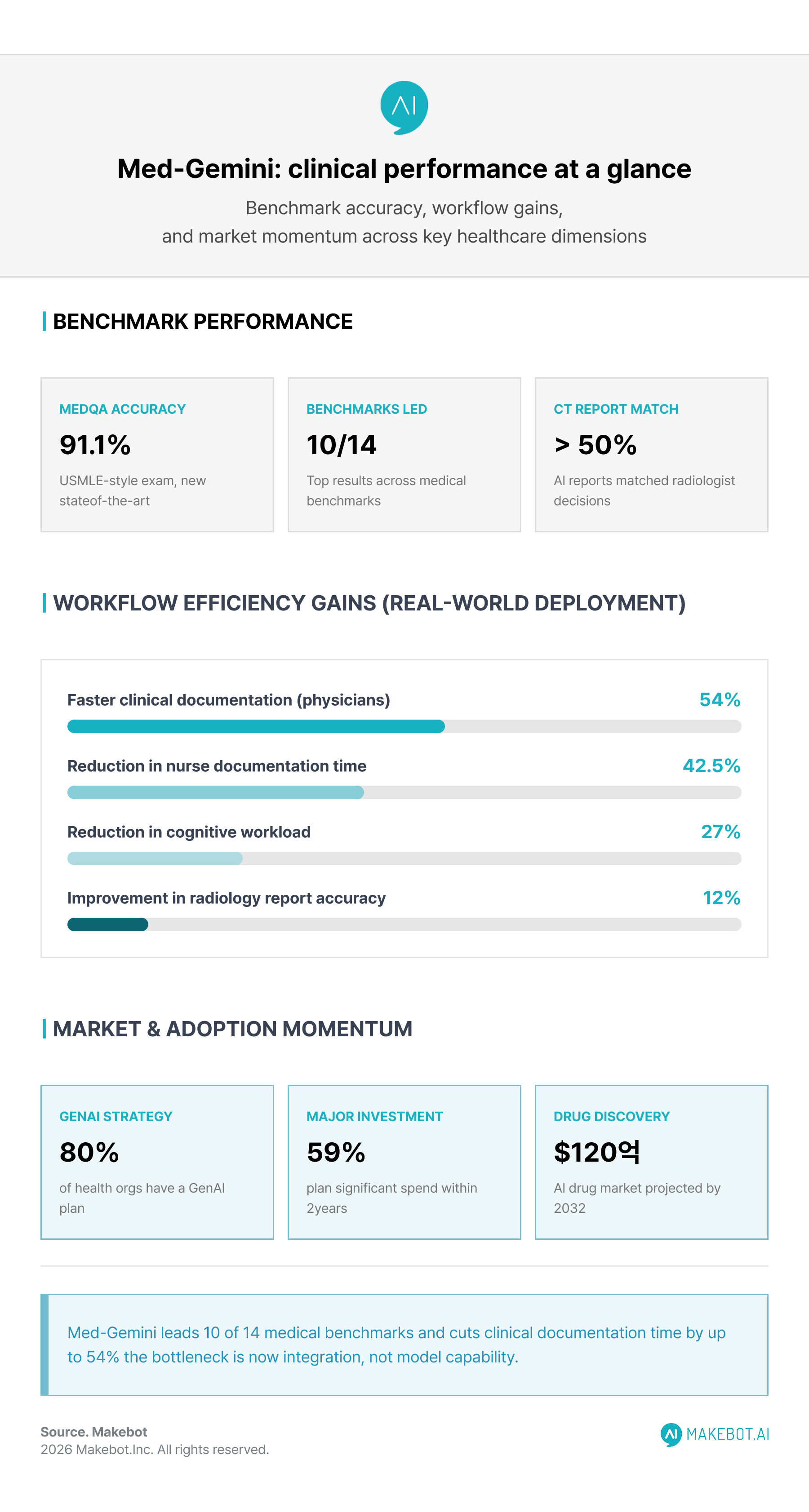
- 91.1% accuracy on MedQA (USMLE-style exam) — new state-of-the-art
- +4.6% improvement over Med-PaLM 2
- Outperformed GPT-4-class models across multimodal medical benchmarks
- Achieved top results in 10 out of 14 medical benchmarks
In imaging:
- Up to 12% improvement in radiology report generation accuracy
- More than 50% of AI-generated CT reports matched radiologist care decisions
These results indicate that Gemini diagnosis capabilities are approaching—though not replacing—expert-level reasoning in controlled environments.
Core Applications of Gemini in Healthcare
1. Clinical Decision Support and Diagnosis
Multimodal Diagnostic Reasoning
Gemini medical use cases in diagnosis extend beyond pattern recognition:
- Interpreting 2D and 3D medical imaging (X-rays, CT scans)
- Integrating EHR + imaging + genomics
- Generating differential diagnoses with reasoning chains
Unlike traditional Clinical AI systems that operate on single-modality pipelines (e.g., imaging-only CNNs or text-based NLP models), Gemini leverages native multimodal reasoning to correlate heterogeneous data streams in real time. This enables the model to contextualize imaging findings with longitudinal patient history, laboratory trends, and even genomic markers—effectively mimicking aspects of clinician-level diagnostic synthesis rather than isolated pattern detection.
In research settings, Med-Gemini demonstrated:
- Ability to analyze complex 3D imaging data
- Strong performance on NEJM clinical diagnostic challenges
Additionally, Med-Gemini integrates uncertainty-guided web search and long-context reasoning, allowing it to retrieve up-to-date medical knowledge and apply it within extended clinical narratives such as full patient charts or multi-visit histories—an area where previous models struggled due to context limitations.
This positions Gemini diagnosis systems as decision-support copilots, not standalone diagnosticians.
Critically, their value lies in augmenting clinical reasoning by surfacing overlooked correlations, rare disease patterns, or conflicting data points that may not be immediately apparent in time-constrained clinical environments.
2. Medical Imaging and Radiology Automation
Radiology is one of the most immediate beneficiaries of AI in healthcare, and Gemini significantly advances this domain.
Capabilities include:
- Automated radiology report generation
- Visual question answering on medical images
- Detection of anomalies missed in original reports
A notable example:
- Gemini identified previously missed pathology in CT scans
What differentiates Gemini from earlier radiology AI tools is its ability to process both image data and accompanying clinical context simultaneously. Rather than flagging anomalies in isolation, it can generate structured, clinically coherent reports that align imaging findings with patient symptoms, history, and prior scans—reducing fragmentation in radiology workflows.
This demonstrates how Clinical AI systems can augment—not replace—radiologists by improving sensitivity and consistency.
In practice, this shifts radiologists from primary detection roles toward validation and oversight, where AI pre-analysis accelerates throughput while maintaining diagnostic accountability.
3. Clinical Documentation and Workflow Efficiency
Administrative burden is one of healthcare’s biggest inefficiencies.
Real-world deployment data shows:
- 42.5% reduction in nurse documentation time
- 27% reduction in cognitive workload
- 54% faster clinical documentation for physicians
These gains come from AI patient care applications such as:
- Automated discharge summaries
- Voice-to-text clinical transcription
- Referral letter generation
Beyond basic transcription, Gemini-powered systems can perform contextual summarization—extracting clinically relevant information, structuring it according to documentation standards, and adapting outputs to specific use cases such as discharge summaries, referral letters, or insurance documentation.
This reduces not only time but also cognitive switching costs, where clinicians traditionally alternate between patient interaction and administrative systems—one of the primary contributors to burnout.
This is where Healthcare AI tools deliver immediate ROI—through operational efficiency rather than clinical risk. At scale, even modest efficiency gains translate into significant economic impact, potentially freeing thousands of clinician hours annually and enabling higher patient throughput without proportional increases in staffing.
4. Personalized Medicine and Genomics
One of the most advanced frontiers of Gemini in healthcare is genomics. The Med-Gemini-Polygenic model:
- Predicts 8 major health outcomes (e.g., stroke, diabetes)
- Successfully generalized to 6 additional conditions without explicit training
This suggests:
- Emergent understanding of genetic correlations
- Potential for precision medicine at scale
Unlike traditional polygenic risk score (PRS) models that rely on linear statistical associations, Gemini-based genomic models leverage deep representation learning to capture complex, non-linear relationships across genetic variants, environmental factors, and clinical outcomes.
Combined with wearable data:
- Large Sensor Model (LSM) enables real-time health monitoring
- Personal Health LLM provides personalized recommendations
This integration creates a continuous feedback loop between clinical data and real-world patient behavior, enabling dynamic risk assessment rather than static predictions—an essential shift for preventive and personalized healthcare models.
This creates a unified system for AI patient care across clinical and lifestyle domains. In the long term, this convergence could enable proactive intervention strategies, where AI identifies risk trajectories before disease onset and recommends personalized lifestyle or therapeutic adjustments.
5. Drug Discovery and Biomedical Research
The pharmaceutical impact of Google Gemini AI is equally significant.
Key data points:
- AI drug discovery market projected to grow from $1.35B (2023) to $12.02B (2032)
- Over 460 AI startups active in drug discovery
Supporting models include:
- TxGemma → molecular property prediction
- MedGemma → multimodal clinical reasoning
Capabilities:
- Predicting drug toxicity and binding affinity
- Accelerating target identification
- Enabling in silico experimentation
Gemini’s advantage in this domain lies in its ability to unify disparate biomedical datasets—such as molecular structures, clinical trial data, and scientific literature—into a single reasoning framework. This allows researchers to move beyond narrow predictive models toward hypothesis generation and multi-step research workflows.
Additionally, agentic capabilities introduced in newer Gemini models enable automation of complex research pipelines, such as literature review, compound screening, and experimental design, significantly reducing the time between discovery and validation.
This positions Medical AI Gemini as a research accelerator, not just a clinical tool. Importantly, its role is not to replace domain experts but to compress the research cycle, allowing scientists to iterate faster on high-value hypotheses while minimizing time spent on low-probability candidates.
6. Conversational AI and Patient Interaction
The AMIE system (Articulate Medical Intelligence Explorer) represents a new class of conversational clinical AI.
Functions include:
- Taking patient history
- Asking follow-up questions
- Generating diagnostic hypotheses
Unlike traditional chatbots, AMIE integrates clinical reasoning with conversational empathy, enabling more natural and context-aware interactions that resemble real patient–physician dialogues.
This is particularly important in early-stage triage and remote care, where structured questioning and adaptive follow-ups can significantly improve the quality of collected patient information before clinical evaluation.
This moves beyond chatbots into empathetic clinical interaction systems, a key evolution in AI patient care. Over time, such systems could act as front-line digital triage layers, reducing unnecessary hospital visits while ensuring that high-risk cases are escalated appropriately.
Deloitte: 75% of Healthcare Leaders Are Scaling Generative AI to Transform Care and Operations. More here!
Market Adoption and Industry Momentum
The rise of Gemini in healthcare aligns with broader adoption trends:
- 80% of healthcare organizations have a GenAI strategy
- 59% plan major investments within 2 years
- 81% report AI talent shortages
Additionally:
- Google's AI chatbot Gemini has surpassed 750 million monthly active users (MAUs), according to the company's fourth-quarter 2025 earnings.
This indicates that Clinical AI systems are moving from experimentation to enterprise-scale deployment.
Trade-offs, Risks, and Limitations
Despite its capabilities, Gemini AI in medicine introduces critical challenges.
1. Reliability and Hallucination Risk
- AI-generated outputs can be plausible but incorrect
- Requires human-in-the-loop validation
2. Bias and Fairness
- Models may reflect training data biases
- Risk of unequal healthcare outcomes
3. Data Privacy and Compliance
- Handling PHI requires strict HIPAA-compliant infrastructure
- De-identification is necessary but imperfect
4. Regulatory Uncertainty
- AI-assisted diagnosis may require medical device approval
- Liability remains unclear in clinical errors
5. Infrastructure Barriers
- Many hospitals lack:
- Cloud readiness
- AI expertise
- Interoperable systems
These constraints highlight a key insight: The bottleneck is no longer model capability—but safe integration into real-world healthcare systems.
Strategic Implications for Healthcare Organizations
For decision-makers, the rise of Gemini healthcare suggests three strategic priorities:
1. Shift from Tools to Systems
Move from isolated AI tools toward integrated Clinical AI systems.
2. Invest in Data Infrastructure
Multimodal AI requires:
- Clean EHR data
- Interoperable systems
- Scalable cloud environments
3. Prioritize Augmentation, Not Automation
The most successful deployments:
- Enhance clinician productivity
- Do not replace clinical judgment
Studies Reveal Generative AI Enhances Physician-Patient Communication. Continue Reading Here!
Conclusion: Toward a Multimodal Clinical Intelligence Layer
Gemini medical use cases signal the emergence of a new paradigm: A unified intelligence layer capable of reasoning across all forms of medical data.
With state-of-the-art diagnostic accuracy, measurable workflow improvements, and expanding applications in genomics and drug discovery, Gemini AI in medicine represents one of the most significant advancements in AI in healthcare to date.
However, its success will not depend solely on model performance—but on:
- Trust
- Regulation
- Clinical integration
In the near future, the defining question will not be whether healthcare adopts AI—but: How responsibly and effectively systems like Gemini are embedded into the fabric of care delivery.
Showcasing Korea’s AI Innovation: Makebot’s HybridRAG Framework Presented at SIGIR 2025 in Italy. Read here!




.png)







.jpg)

What Happens to Marketing When the C-Suite Starts Using AI Every Day?







Why AI Shopping Assistants Will Replace Traditional Ecommerce Search





.jpg)





















Why Generative AI Projects Fail and How to Achieve Scalable AI Success







.jpg)

.png)