How AI Chatbots Are Increasing E-Commerce Conversion Rates
How conversational AI drives higher conversion through real-time guidance and personalization


The rapid evolution of digital commerce has shifted customer expectations toward instant interaction, personalized recommendations, and seamless purchasing experiences. In this environment, the traditional static online storefront is increasingly inadequate for guiding customers through complex purchasing decisions.
This shift has accelerated the adoption of the AI Chatbot as a central component of AI Business Solutions for modern retail environments. Today’s conversational systems do far more than automate customer support—they actively influence purchasing behavior, guide product discovery, and reduce friction during the buying journey.
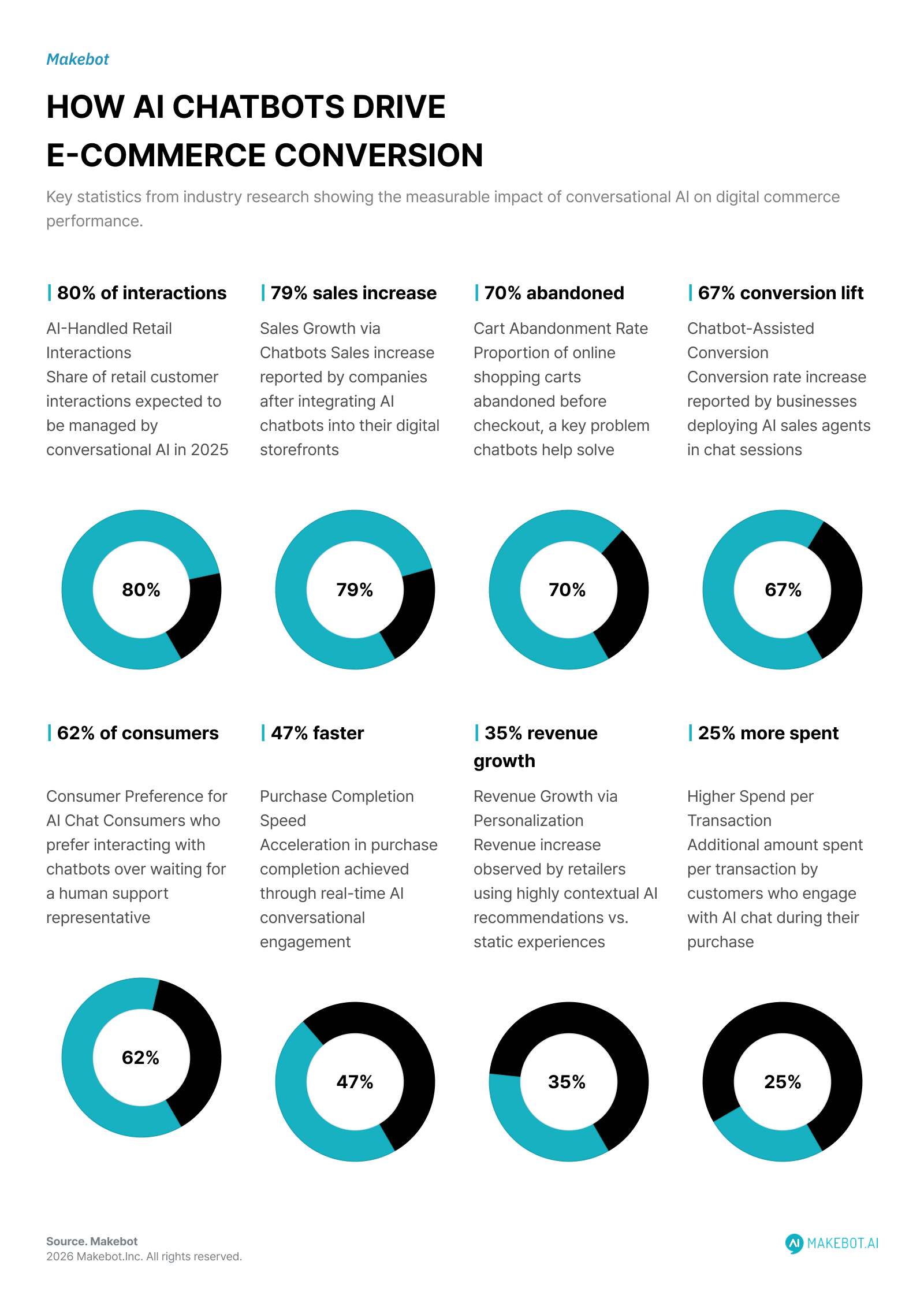
Market data strongly supports this transformation. Research shows that 80% of retail customer interactions are expected to be handled by conversational AI technologies in 2025, indicating a massive shift in how retailers manage digital customer engagement.
At the same time, customer behavior is evolving toward faster, more interactive experiences. Surveys indicate that 62% of consumers prefer interacting with chatbots rather than waiting for a human customer service representative, particularly when they need quick answers during the purchasing process.
These behavioral shifts are driving widespread adoption of AI in Ecommerce, with conversational systems increasingly integrated into Digital Marketing, Marketing Automation, and customer engagement strategies.
Glossary of Technical Key Terms
- AI Chatbot – An AI-powered conversational system that interacts with online shoppers to provide assistance, product recommendations, and purchase guidance in real time.
- Conversational Commerce – A digital commerce approach where customers interact with AI assistants or chatbots to discover products and complete purchases through conversation.
- Generative AI – An advanced AI technology that generates responses, recommendations, or content dynamically based on real-time user interactions and data.
- Marketing Automation – The use of AI and software systems to automatically manage marketing processes such as customer engagement, campaigns, and personalized messaging.
- Conversion Rate Optimization (CRO) – A data-driven strategy focused on increasing the percentage of website visitors who complete desired actions such as purchases.
How LLMs Are Embedded into Modern Marketing Automation Platforms. Read more here!
Market Growth and Adoption of AI Innovation in Digital Commerce
The rapid adoption of conversational systems is closely tied to the broader expansion of artificial intelligence technologies in business operations.
Global surveys indicate that 89% of companies are already using or experimenting with AI technologies, while 97% plan to increase their AI investments in the coming years, reflecting the growing strategic importance of AI innovation across industries.
Within the e-commerce sector specifically, conversational AI is becoming one of the fastest-growing technology investments. This growth is driven by measurable improvements in both operational efficiency and revenue performance.
For example:
- Companies deploying conversational commerce solutions report sales increases of up to 79% after integrating AI chatbots into their digital storefronts.
- AI-driven automation can reduce manual customer support workloads by as much as 80%, allowing human agents to focus on higher-value interactions.
- Retailers implementing conversational AI solutions report conversion increases averaging 25% in lead generation and sales engagement.
These performance improvements highlight why conversational systems are rapidly becoming core infrastructure for AI Business Solutions in the digital commerce ecosystem.
The Conversion Challenge in AI in Ecommerce
Despite massive investments in Digital Marketing, many online retailers still struggle with conversion performance. One of the most persistent challenges in online retail is cart abandonment, where customers add products to their cart but leave before completing the purchase.
Industry research shows that approximately 70% of online shopping carts are abandoned before checkout, representing billions of dollars in lost revenue annually.
In many cases, these abandoned purchases occur because customers cannot quickly find answers to important questions, such as:
- product specifications
- shipping timelines
- return policies
- payment options
When these uncertainties remain unresolved, potential buyers often leave the website entirely.
Conversational systems address this challenge by providing instant decision support during the most critical moments of the purchasing journey.
How Retrieval Augmented Generation Improves Product Recommendation Accuracy in E-Commerce. Read here!
Conversational Commerce and Customer Spending Behavior
One of the most important advantages of the AI Chatbot is its ability to engage customers precisely when purchasing intent is strongest.
Research shows that shoppers who interact with conversational assistants demonstrate significantly higher purchasing behavior. For example, customers engaging with AI chat systems spend approximately 25% more per transaction compared to customers who do not interact with chatbots.
This increase in spending occurs because conversational systems:
- reduce decision friction
- offer personalized product recommendations
- provide real-time purchase guidance
By removing uncertainty at the moment of decision, chatbots preserve purchasing momentum and significantly increase the likelihood of conversion.
Personalization and Revenue Impact with Generative AI
Personalization has long been recognized as a critical factor in online retail success. However, traditional personalization systems often rely on historical user data rather than real-time behavioral signals.
Conversational AI systems powered by Generative AI enable dynamic personalization based on real-time customer interactions.
Industry studies indicate that:
- AI-driven personalization strategies can increase revenue by 5–15%.
- Retailers implementing highly contextual recommendations have observed 20–35% revenue growth compared to static shopping experiences.
These improvements occur because conversational systems analyze multiple signals simultaneously, including browsing behavior, search queries, and conversation context.
Rather than presenting generic product suggestions, chatbots deliver highly relevant recommendations tailored to the specific needs of each shopper.
Cart Recovery and Checkout Optimization
Another major area where conversational AI delivers measurable value is in cart recovery.
Traditional cart recovery strategies typically rely on delayed email campaigns sent after a customer abandons the website. However, these approaches often fail to capture customers while purchasing intent remains strong.
Conversational AI enables businesses to intervene earlier in the process.
When chatbots detect hesitation during checkout—such as prolonged inactivity—they can proactively engage customers to resolve uncertainty.
Industry benchmarks indicate that conversational interventions during checkout can improve cart recovery rates by 20–25%, particularly when assistance is provided in real time.
Additionally, AI-driven conversational interactions have been shown to accelerate purchase completion by up to 47%, demonstrating how real-time engagement can significantly shorten the buying journey.
Why Most Enterprise Chatbot Projects Fail Before They Begin. Read here!
Omnichannel Engagement and Customer Experience
Modern consumers rarely interact with brands through a single digital channel. Instead, purchasing journeys often span multiple platforms, including websites, messaging applications, and social media.
Research indicates that 82% of consumers are more likely to purchase from brands that offer consistent omnichannel conversational experiences.
For example, a customer may:
- Discover a product through Instagram
- Ask questions via WhatsApp
- Complete the purchase on a website
Advanced chatbot systems maintain conversation continuity across these channels, ensuring a seamless and personalized customer experience.
Conversion Performance and Revenue Impact
When conversational AI systems are implemented strategically, they can influence multiple stages of the sales funnel simultaneously.
Industry benchmarks show that:
- Businesses deploying AI sales agents report conversion increases of up to 67% in chatbot-assisted sessions.
- AI chatbots can generate 10–25% conversion improvements during early pilot deployments.
- In enterprise retail environments, even a 1–2% improvement in conversion rate can translate into millions of dollars in additional revenue due to high transaction volumes.
When these improvements are combined with higher average order value and reduced cart abandonment, businesses can achieve significant revenue growth.
In some cases, organizations implementing advanced conversational commerce systems have reported 2–3× sales growth over a 12-month period as chatbot-driven optimization improves multiple stages of the buying journey simultaneously.
The Future of AI Innovation in E-Commerce
The role of conversational AI in digital commerce is expected to expand significantly over the next several years.
Emerging technologies powered by Generative AI are enabling chatbots to support increasingly sophisticated capabilities, including:
- voice-enabled shopping assistants
- visual product search using image recognition
- predictive purchase recommendations
- autonomous AI sales agents
These innovations are transforming chatbots from support tools into intelligent digital sales representatives capable of managing the entire purchasing journey.
Conclusion
The growing adoption of conversational AI reflects a broader transformation in how businesses approach digital customer engagement. As consumer expectations for speed, personalization, and real-time support continue to rise, the AI Chatbot has emerged as a critical component of modern e-commerce infrastructure.
Supported by measurable performance improvements , chatbots are rapidly becoming one of the most impactful AI Business Solutions in digital commerce.
By integrating AI in Ecommerce, Generative AI, and advanced Marketing Automation, businesses can transform conversational interfaces into revenue-generating systems that improve customer experience while driving measurable financial performance.
As AI Innovation continues to reshape digital retail, conversational AI will play a central role in defining the next generation of Digital Marketing and online commerce strategies.
Showcasing Korea’s AI Innovation: Makebot’s HybridRAG Framework Presented at SIGIR 2025 in Italy. Read here!
To maximize the revenue potential of conversational commerce, businesses require AI infrastructures that can deliver fast, accurate, and scalable interactions. Makebot’s advanced chatbot architectures—such as its HybridRAG framework—optimize knowledge retrieval and response generation, enabling enterprise-grade conversational systems that support high-volume customer engagement environments.
Through its AI Business Solutions, Makebot enables organizations to deploy intelligent AI Chatbot systems that integrate Generative AI, Marketing Automation, and data-driven personalization—transforming conversational interfaces into scalable engines for conversion optimization and digital commerce growth.
👉 Start your AI transformation: www.makebot.ai
📩 Inquiries: b2b@makebot.ai
.jpg)

What Happens to Marketing When the C-Suite Starts Using AI Every Day?









Why AI Shopping Assistants Will Replace Traditional Ecommerce Search






.jpg)


























Why Generative AI Projects Fail and How to Achieve Scalable AI Success










.jpg)

.png)