Why Students Use AI Daily but Still Lack AI Literacy
95% of students use AI daily but 58% lack AI skills - the same gap costing enterprises trillions.

A striking contradiction now defines classrooms and campuses worldwide: nearly every student uses artificial intelligence, and most of them will admit, if asked honestly, that they don't really understand it. According to the UK's 2026 Student Generative AI Survey, 95% of students report using AI in at least one way, and 94% use generative AI to help with assessed academic work. Yet separate research finds that 58% of students believe they lack sufficient AI knowledge or skills to use these tools well. Usage has become universal. Understanding has not caught up.
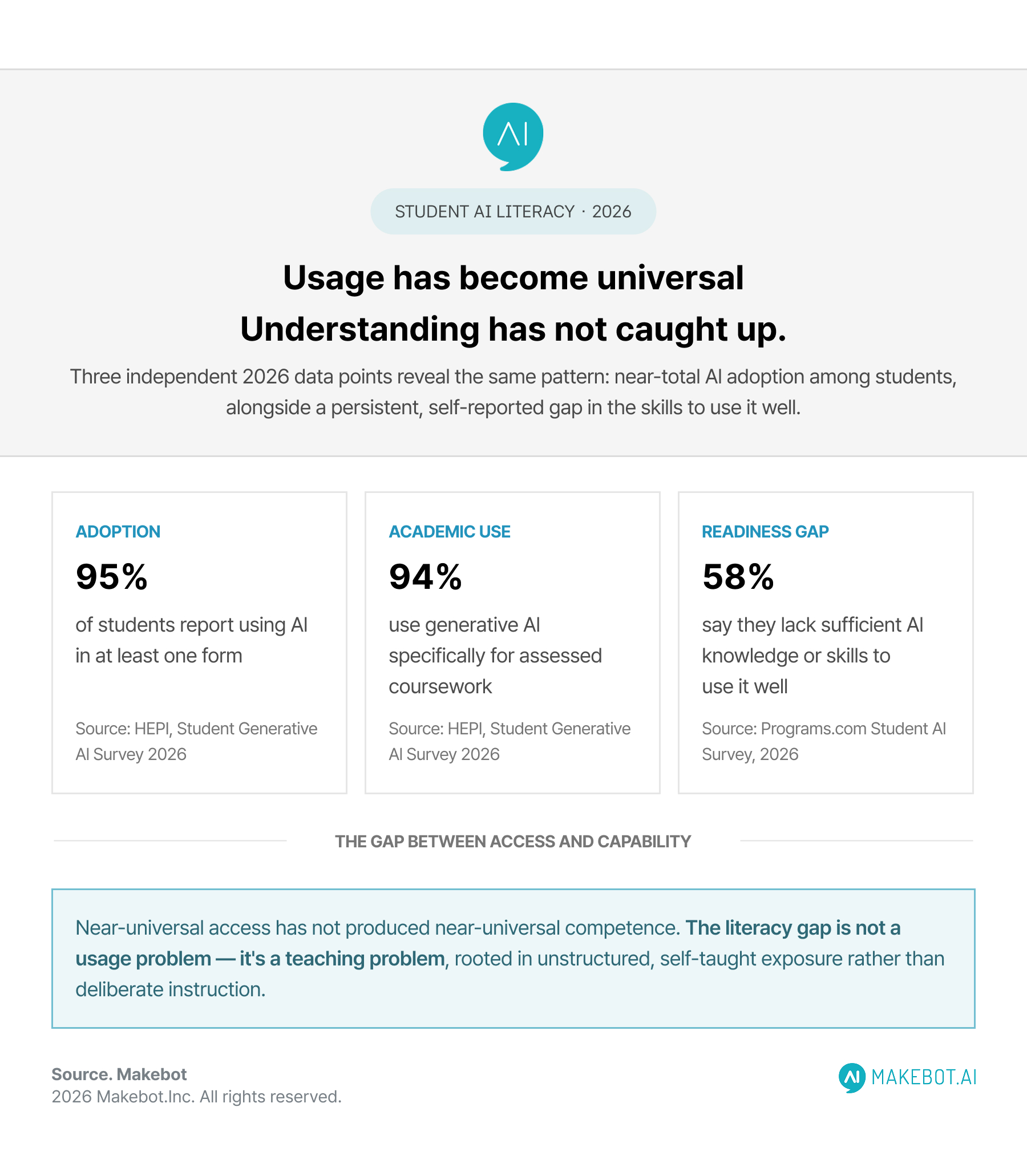
This isn't a minor discrepancy - it's the defining tension of AI in education right now. Students are fluent in prompting but often unaware of how models generate answers, why outputs can be wrong with total confidence, or how to evaluate AI-assisted work critically. And this gap doesn't disappear at graduation. It follows students directly into the workforce, where enterprise data from McKinsey, Deloitte, PwC, and Gartner shows the exact same pattern playing out among employees, executives, and entire organizations: near-universal adoption, but a shockingly thin layer of real capability underneath it.
Generative AI in K-12 Education: Transforming Learning Through Innovation. Explore the latest insights here!
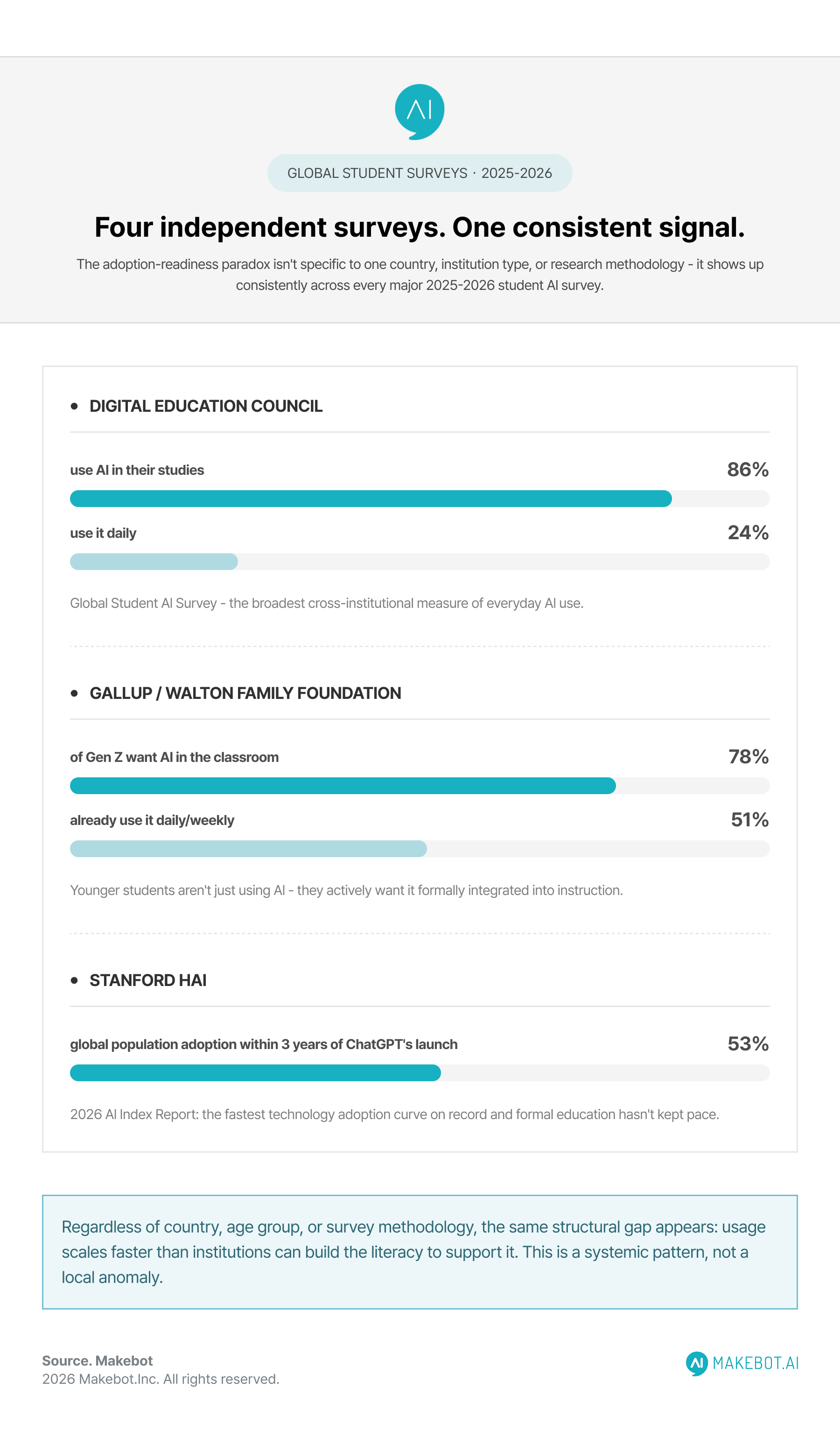
The Paradox in Numbers: Daily Use, Missing Fluency
The scale of student AI literacy exposure is no longer in question. Multiple independent surveys converge on the same conclusion: generative AI in education has become infrastructure for student life, not an optional add-on.
- The Digital Education Council's global student survey found 86% of students use AI in their studies, with 24% doing so daily and 54% at least weekly.
- The Lumina Foundation–Gallup 2026 State of Higher Education report, surveying nearly 4,000 U.S. associate and bachelor's degree students, found 57% use AI daily or weekly for schoolwork, including 64% who lean on it for coursework they don't understand and 60% who use it to check homework answers.
- A Gallup/Walton Family Foundation survey found 78% of Gen Z students believe AI belongs in the classroom, and 51% already use it daily or weekly.
- Global student AI usage climbed sharply between 2024 and 2025, and by early 2026 the majority of higher-education students treat AI as a default research and brainstorming partner.
What's missing from these numbers is competence. AI skills - the ability to evaluate outputs, recognize hallucinated or fabricated information, understand model limitations, and use AI transparently and ethically - are not tracking with usage volume. Stanford HAI's 2026 AI Index Report explicitly flags this as a structural issue, noting that generative AI reached 53% global population adoption within three years of ChatGPT's launch, while formal education systems remain slow to adapt curricula, assessment models, and teacher training to match.
How ChatGPT-5 is Transforming Learning and Teaching. Read the expert analysis here!
What AI Literacy Actually Means - and Why Frequent Use Isn't It
AI literacy is frequently conflated with AI usage, but the two are not the same skill. Typing a prompt into a chatbot requires no understanding of:
- How large language models generate text probabilistically, rather than by "looking up" facts
- Why outputs can sound authoritative while being factually wrong
- How training data, bias, and model design shape what a system will and won't produce
- When AI-assisted work crosses from legitimate support into academic dishonesty
- How to fact-check, cite, and disclose AI involvement responsibly
This distinction matters because most current classroom exposure to AI is unstructured. Students are largely self-taught, learning through trial and error rather than deliberate instruction. The result is a generation fluent in the mechanics of prompting but under-equipped in the judgment needed to use outputs responsibly - a gap institutions are only beginning to name, let alone close.
Institutional Policy Is Lagging Behind Student Behavior
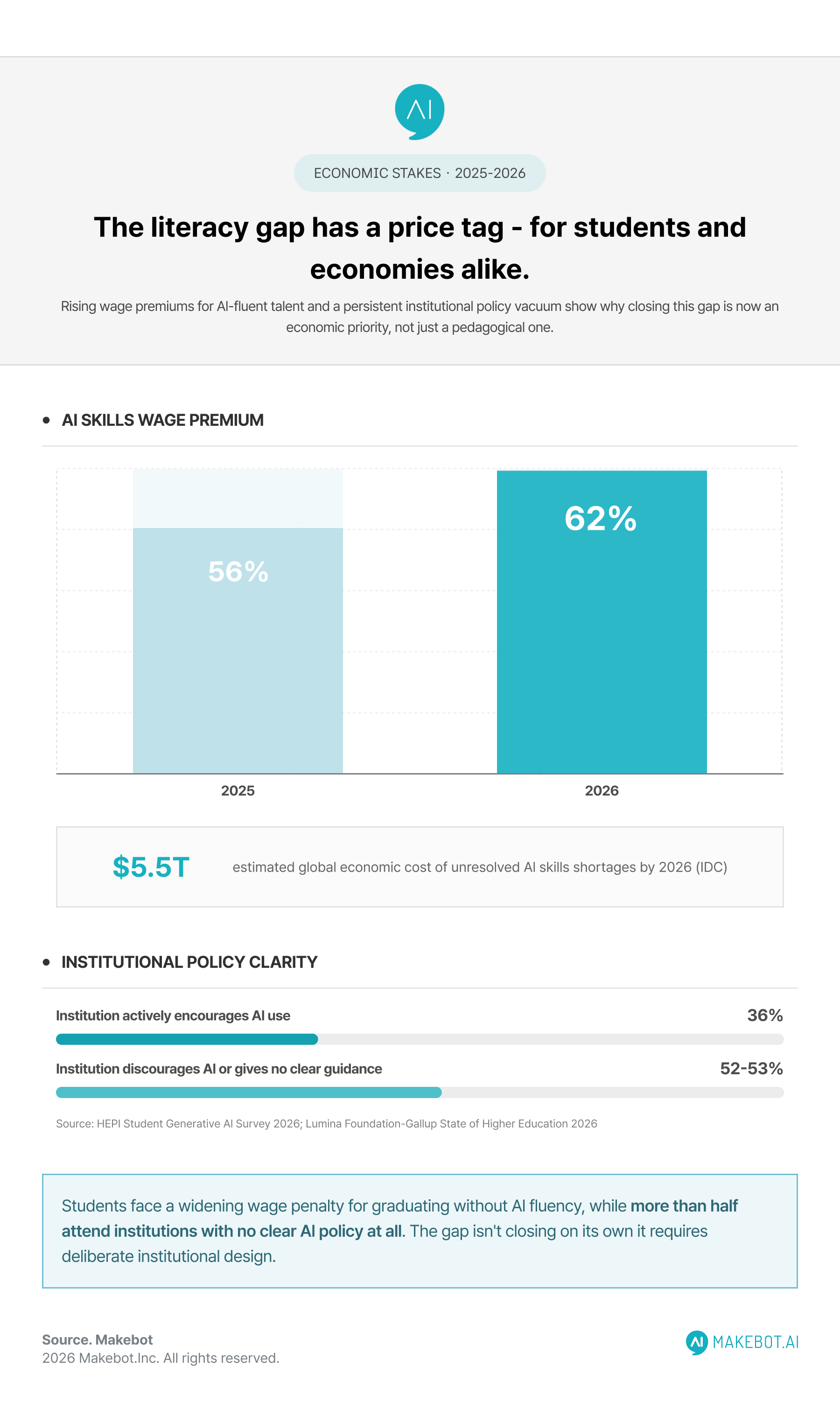
One of the clearest drivers of the literacy gap is policy inconsistency. The Lumina–Gallup study found that even as 57% of students use AI regularly for schoolwork, 52–53% say their institution either discourages AI use in coursework or offers no clear guidance on it at all. The UK's HEPI 2026 survey found a similar disconnect: while AI use is nearly universal among students, only 36% feel their institution actively encourages it, and only 38% say they're given access to sanctioned tools.
This "unclear rules" environment has a direct literacy cost. When institutions neither ban nor actively teach AI, students default to informal, ungoverned experimentation - the least effective way to build durable skill. Encouragingly, some of the more structured interventions show what's possible when literacy is taught deliberately rather than left to chance:
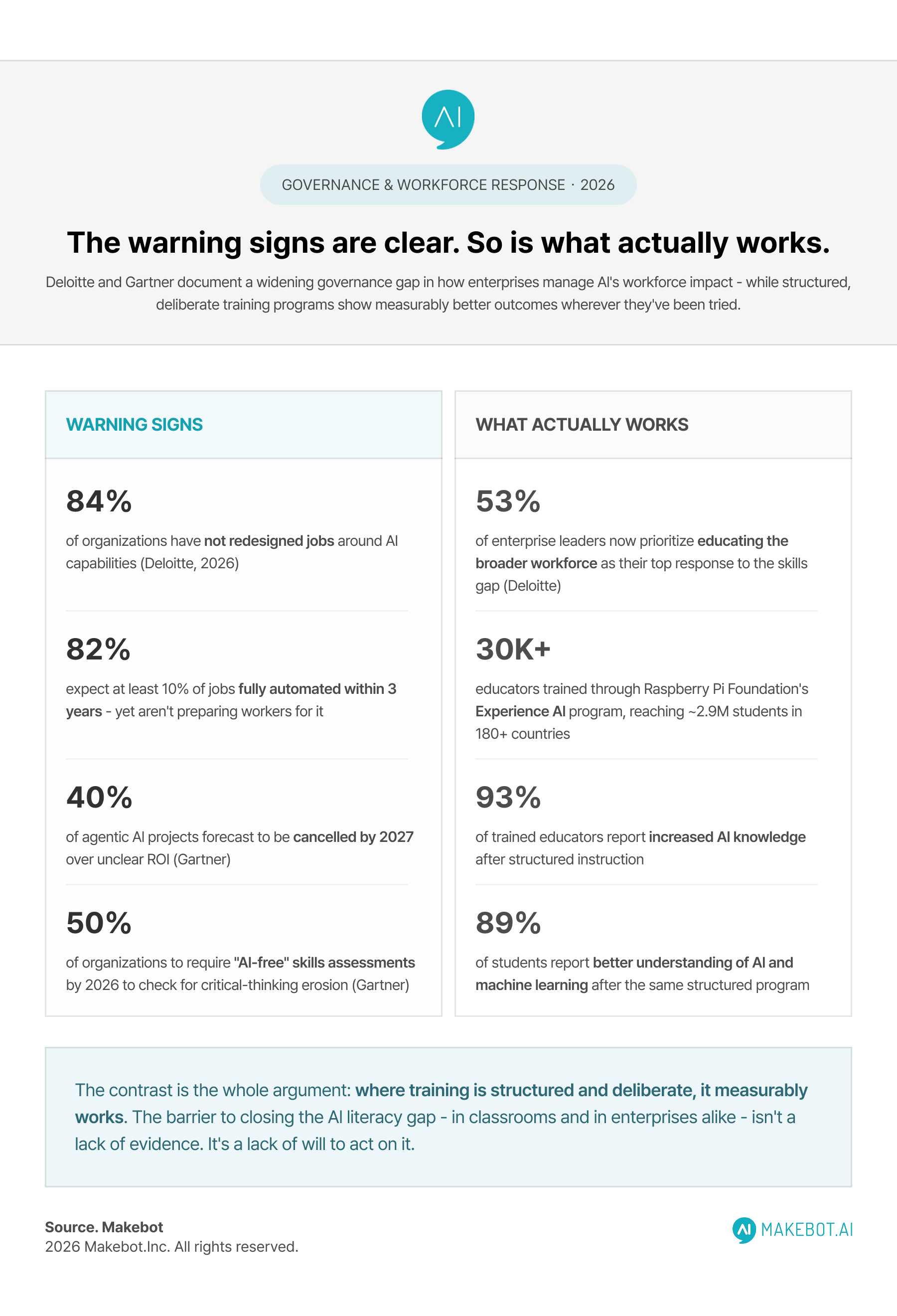
- The Raspberry Pi Foundation's three-year impact report on Experience AI, developed with Google DeepMind, has trained more than 30,000 educators - reaching an estimated 2.9 million young people across 180+ countries. It found 93% of educators reported increased AI knowledge, and 89% of students reported a better understanding of what AI and machine learning actually are after structured instruction.
- Schools with explicit AI curricula and defined usage rules consistently report higher student confidence and lower misuse rates than schools with informal or absent policies.
The takeaway is not that AI use should be restricted - usage is already too widespread for that to be realistic - but that AI education needs the same intentional design that any other core competency receives.
How NLP in the Education Sector Can Enhance Learning Experience? Discover what’s next here!

The Enterprise Mirror: The Same Gap, Higher Stakes
The pattern visible in classrooms is not unique to education. It is, almost exactly, the same pattern playing out inside enterprises investing billions in AI - and the enterprise data helps explain why the student literacy gap matters so much: it's the pipeline feeding tomorrow's workforce into an environment that has not solved this problem either.
McKinsey's State of AI research found that 88% of organizations now regularly use AI in at least one business function, and 72% report using generative AI - up sharply from 33% just two years earlier. Global AI spending is projected to surpass $300 billion in 2026 alone. But adoption has sharply outpaced measurable value:
- Only 39% of organizations report AI's impact showing up at the enterprise-level EBIT (earnings) line, despite widespread use-case-level gains.
- Just 23% of organizations report scaling agentic AI systems beyond isolated pilots; nearly two-thirds haven't begun scaling AI across the enterprise at all.
- In that same 1,993-company McKinsey survey, only about 6% of organizations qualify as "AI high performers" - meaning they attribute more than 5% of enterprise-wide EBIT and "significant value" to AI. Independent analysis of the underlying respondent count (109 of 1,993) puts the figure at roughly 5.5%, making it one of the most consistently cited AI ROI benchmarks in 2025–2026 reporting.
- PwC's 29th Global CEO Survey of 4,454 executives across 95 countries found just 12% of CEOs - the self-described "vanguard" - report both revenue growth and cost reduction from AI; 56% report neither.
Deloitte's 2026 State of AI in the Enterprise report puts a name to the underlying cause: insufficient worker skills is now the single most-cited barrier to integrating AI into existing workflows - ahead of budget, technology limitations, or leadership skepticism. Worker access to sanctioned AI tools rose roughly 50% in a single year, yet only 34% of leaders say their organization is genuinely reimagining the business around AI rather than layering it onto old processes. IDC research reinforces the scale of the problem, estimating that unresolved AI skills shortages could cost the global economy up to $5.5 trillion by 2026 in delays, quality issues, and lost competitiveness.
7 Ways Generative AI is Making Workplaces More Inclusive. Explore the future of AI here!

Why Some Organizations Achieve Far Higher AI Returns
McKinsey's research identifies a small cohort of "AI high performers" - companies that attribute more than 5% of EBIT to AI - and the traits separating them from everyone else are strikingly organizational rather than technical:
- High performers are 3x more likely to report strong senior leadership ownership and visible role-modeling of AI use.
- They are 2.8x more likely to have fundamentally redesigned workflows around AI (55% vs. 20% of other organizations).
- They are far more likely to have formal human-in-the-loop review processes: 65% vs. 23% among peers.
- More than a third of high performers dedicate over 20% of their digital budget to AI - making them roughly five times more likely than peers to make a serious financial commitment rather than a token pilot.
In other words, the organizations winning the AI investment game are not simply the ones using the most tools. They're the ones that treat AI capability as a structured discipline: measured, resourced, led from the top, and embedded into how work actually gets redesigned - not bolted onto legacy processes.
Survey: Half of U.S. Adults Now Use AI Large Language Models Like ChatGPT. See how enterprises are transforming here!
Common Challenges Enterprises Face When Scaling AI
Across McKinsey, Deloitte, and Gartner research, the recurring obstacles to scaling AI initiatives cluster into a few consistent categories:
- Skills and fluency gaps - cited by Deloitte as the top barrier to integration, ahead of any technical constraint.
- Weak governance and unclear ROI tracking - Gartner projects more than 40% of agentic AI projects will be cancelled by 2027 due to escalating costs and unclear return on investment.
- Security and risk uncertainty - nearly two-thirds of organizations cite security and risk concerns as the top barrier to scaling agentic AI specifically.
- Job and role redesign lag - Deloitte found 84% of organizations have not redesigned jobs around AI capabilities, even though 82% expect at least 10% of jobs to be substantially automated within three years.
- Shallow adoption practices - fewer than one in three organizations follow most recommended AI scaling practices, and fewer than one in five track well-defined KPIs for their AI initiatives.
Successful Adopters vs. Struggling Organizations
(Comparison synthesized from McKinsey's State of AI 2025 high-performer analysis)
Teacher-Generative AI Collaboration: Redefining the Educator’s Role. Learn how industry leaders are adapting here!
What This Means for Student AI Literacy Going Forward
The enterprise data isn't a tangent - it's a preview. Students who graduate having used AI daily but never learned to evaluate, question, or govern it are stepping directly into an economy where the exact same shallow-adoption pattern is already costing organizations trillions in unrealized value. Digital literacy built on trial-and-error prompting doesn't automatically translate into the judgment employers are now scrambling to hire for.
There are early signals that both education and industry are converging on the same corrective:
- Gartner predicts that by 2026, 50% of organizations will require periodic "AI-free" skills assessments specifically to check whether employees' critical-thinking ability is eroding under constant AI assistance - a concern with an obvious parallel in classrooms grading AI-assisted work.
- AI-related skills now command a significant wage premium over comparable roles without them - PwC's Global AI Jobs Barometer put the average premium at 56% in 2025, rising to 62% in the 2026 edition - meaning the literacy gap has a direct, quantifiable cost to students who graduate without it.
- Deloitte's most common workforce response to the skills gap is "educating the broader workforce to raise AI fluency" (cited by 53% of surveyed leaders) - the same intervention structured programs like Experience AI have already shown works in K–12 and higher-education settings.
Best ChatGPT Alternatives for Academic Writing. Explore the data and findings here!
Building Real AI Literacy: Strategic Recommendations
For institutions and students aiming to close the gap rather than widen it, the evidence points toward a few consistent priorities:
- Treat AI literacy as a taught skill, not an assumed one. Structured programs like Raspberry Pi Foundation's Experience AI show measurable gains in both educator and student understanding compared to informal exposure.
- Set clear, published AI policies. Ambiguity - not restriction - is what correlates most with poor literacy outcomes; students need to know exactly what's permitted and why.
- Teach verification, not just prompting. Fact-checking AI output, recognizing hallucinations, and understanding model limitations should be as central to AI learning as the prompting techniques themselves.
- Mirror what high-performing enterprises do. Leadership visibility, structured practice, and outcome tracking - the same traits separating AI high performers from struggling companies - apply just as directly to classrooms and training programs.
- Prioritize AI-powered education tools with transparency built in, so students can see how and why an output was generated rather than treating the model as a black box.
Showcasing Korea’s AI Innovation: Makebot’s HybridRAG Framework Presented at SIGIR 2025 in Italy. Read here!
Conclusion: Adoption Was Never the Hard Part
Both classrooms and boardrooms have already answered the easy question - "will people use AI?" - with a resounding yes. What remains unresolved, in nearly identical proportions across student and enterprise populations, is whether that usage translates into real capability, sound judgment, and measurable value. McKinsey's finding that only about 6% of organizations qualify as true AI high performers, and the finding that 58% of students feel they lack basic AI skills, are two data points describing the same underlying failure: capability has not scaled at the same pace as access.
The organizations - and the students - who pull ahead over the next several years won't be the ones who used AI first or most often. They'll be the ones who treated AI literacy as seriously as any other core competency: taught deliberately, measured consistently, and led from the top. For AI education for students, that means the window to close this gap is now, before an entire generation enters a workforce that is still struggling to solve the exact same problem.
Build AI That Teaches Organizations How to Use It - Not Just Deploy It
The literacy gap doesn't close itself. Whether in classrooms or enterprise workflows, the organizations pulling ahead are those treating AI capability as a structured discipline - built in, measured, and led from the top. Makebot is a leading generative AI and LLM solutions provider trusted by over 1,000 enterprise clients across healthcare, public institutions, finance, and beyond. With a proprietary multi-LLM platform, a hybrid RAG architecture designed to compound institutional knowledge rather than reset it with every session, and deep expertise in deploying AI that integrates directly into existing workflows, Makebot helps organizations close the gap between adoption and real, measurable capability - the same gap this data shows is costing enterprises and graduates alike.





.png)








.jpg)

What Happens to Marketing When the C-Suite Starts Using AI Every Day?







Why AI Shopping Assistants Will Replace Traditional Ecommerce Search






.jpg)
























Why Generative AI Projects Fail and How to Achieve Scalable AI Success










.jpg)

.png)