What Hospital CIOs Should Evaluate Before Choosing an Enterprise AI Platform
Hospital CIOs should judge AI platforms on governance and RAG accuracy, not demos.

Introduction
Hospital CIOs are no longer being asked whether to adopt AI - they are being asked to justify why an initiative hasn't scaled yet. Boards see the market numbers. Clinicians want relief from documentation burden. Finance wants margin recovery. Yet enterprise AI procurement in healthcare carries a risk unlike almost any other sector: a flawed enterprise AI platform doesn't just waste budget, it can propagate clinical errors, expose protected health information, or entrench inequities in care delivery. This article lays out the technical, operational, and governance criteria CIOs should apply when evaluating a healthcare AI platform - grounded in the latest data from McKinsey, Deloitte, Gartner, IDC, PwC, and Stanford HAI - and explains why the organizations pulling ahead are doing so through discipline, not just technology selection.
McKinsey: AI Could Save the Healthcare Industry $360 Billion Annually. Read more here!
The State of Enterprise AI Adoption in Healthcare
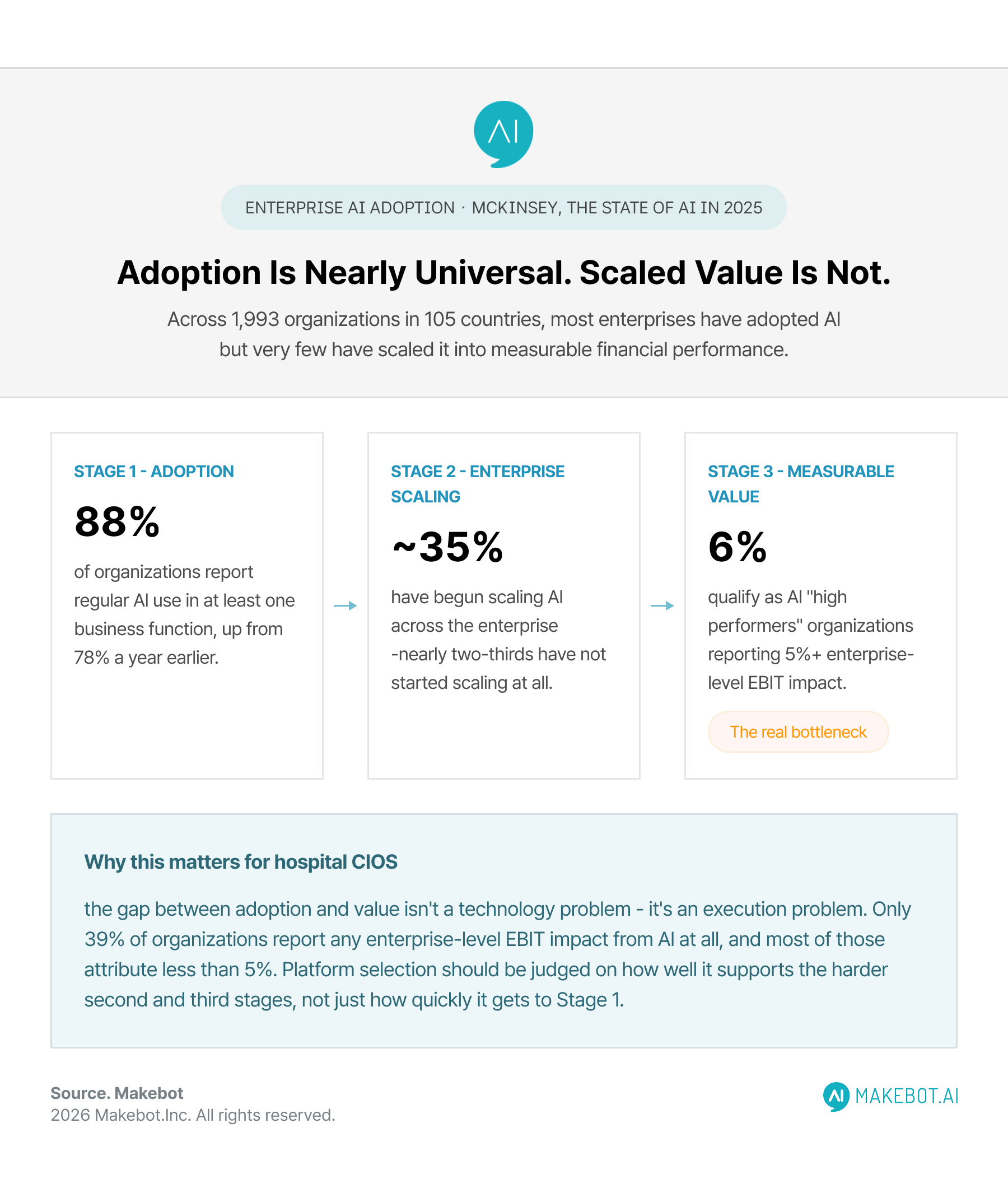
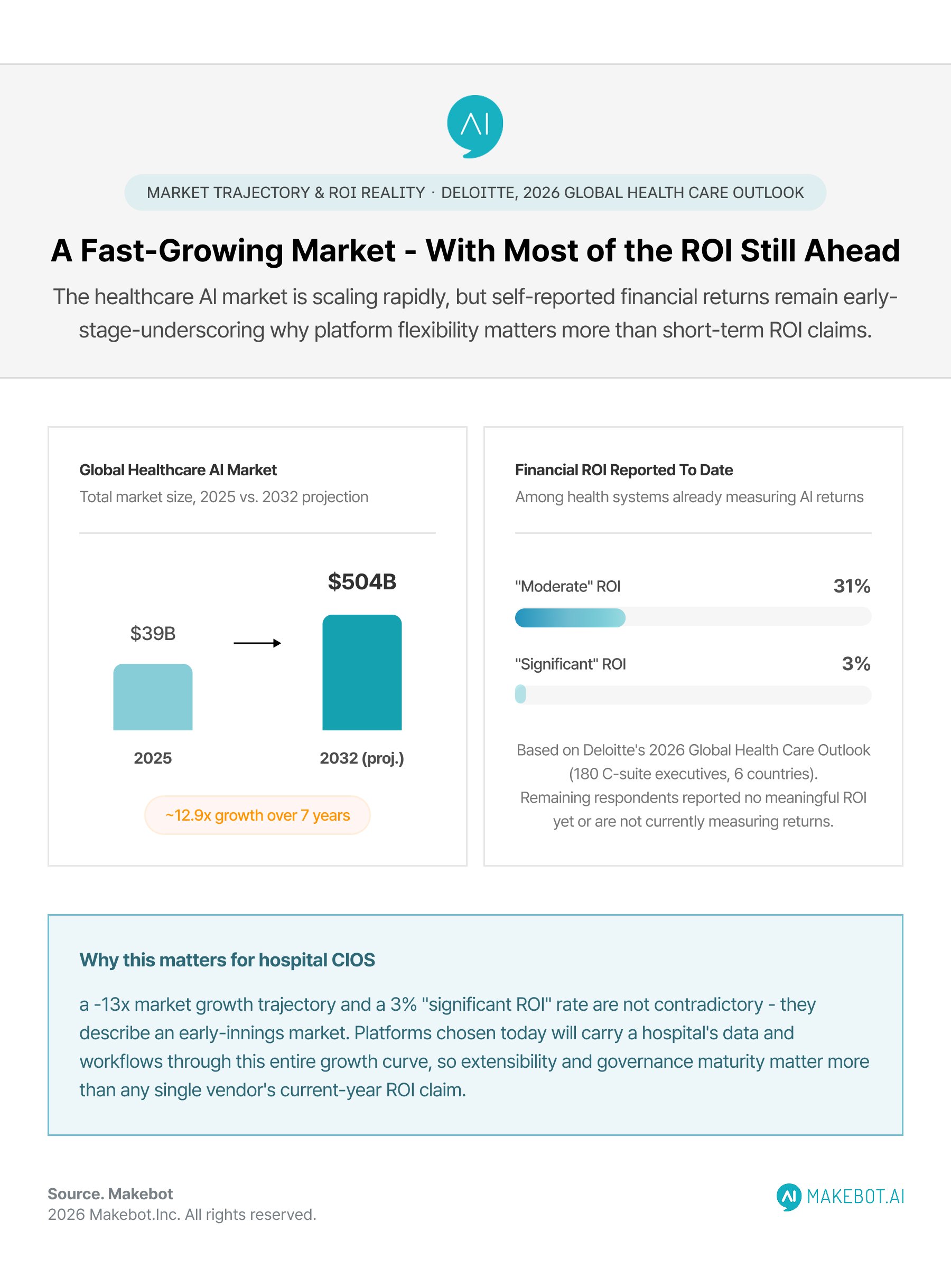
Healthcare has moved decisively past the experimentation phase. Deloitte's 2026 Global Health Care Outlook, surveying 180 C-suite executives across six countries, found that 37% of US health system executives expect AI to be a major strategic focus in 2026, and the broader enterprise healthcare AI market is on a steep growth curve - from $39 billion globally in 2025 to a projected $504 billion by 2032. That growth is a direct reflection of how quickly Generative AI in healthcare has moved from isolated pilot programs to a core infrastructure decision sitting on the CIO's desk. The same trajectory mirrors what McKinsey found across industries generally: 88% of organizations now report regular AI use in at least one business function, up from 78% a year earlier.
But adoption breadth hides a scaling problem. McKinsey's research shows that nearly two-thirds of organizations have not begun scaling AI across the enterprise. By industry, healthcare is one of the sectors where AI agent use is most widely reported, alongside technology, media, and telecommunications. Yet across all industries and functions combined, McKinsey found that no single business function has more than 10% of respondents reporting they are scaling AI agents - a reminder that even in healthcare's relatively advanced agentic-AI posture, most deployments remain narrow in scope. For a hospital CIO, this means the platform decision isn't just "which vendor has the best demo." It's "which platform architecture can actually survive the transition from pilot to system-wide deployment."
- Deloitte (100 health system/health plan tech executives, Sept. 2025): 85% plan to increase agentic AI investment over the next two to three years; 61% are already building or implementing initiatives.
- McKinsey (1,993 respondents, 105 countries): Only 39% of organizations report any enterprise-level EBIT impact from AI, and most of those attribute less than 5%.
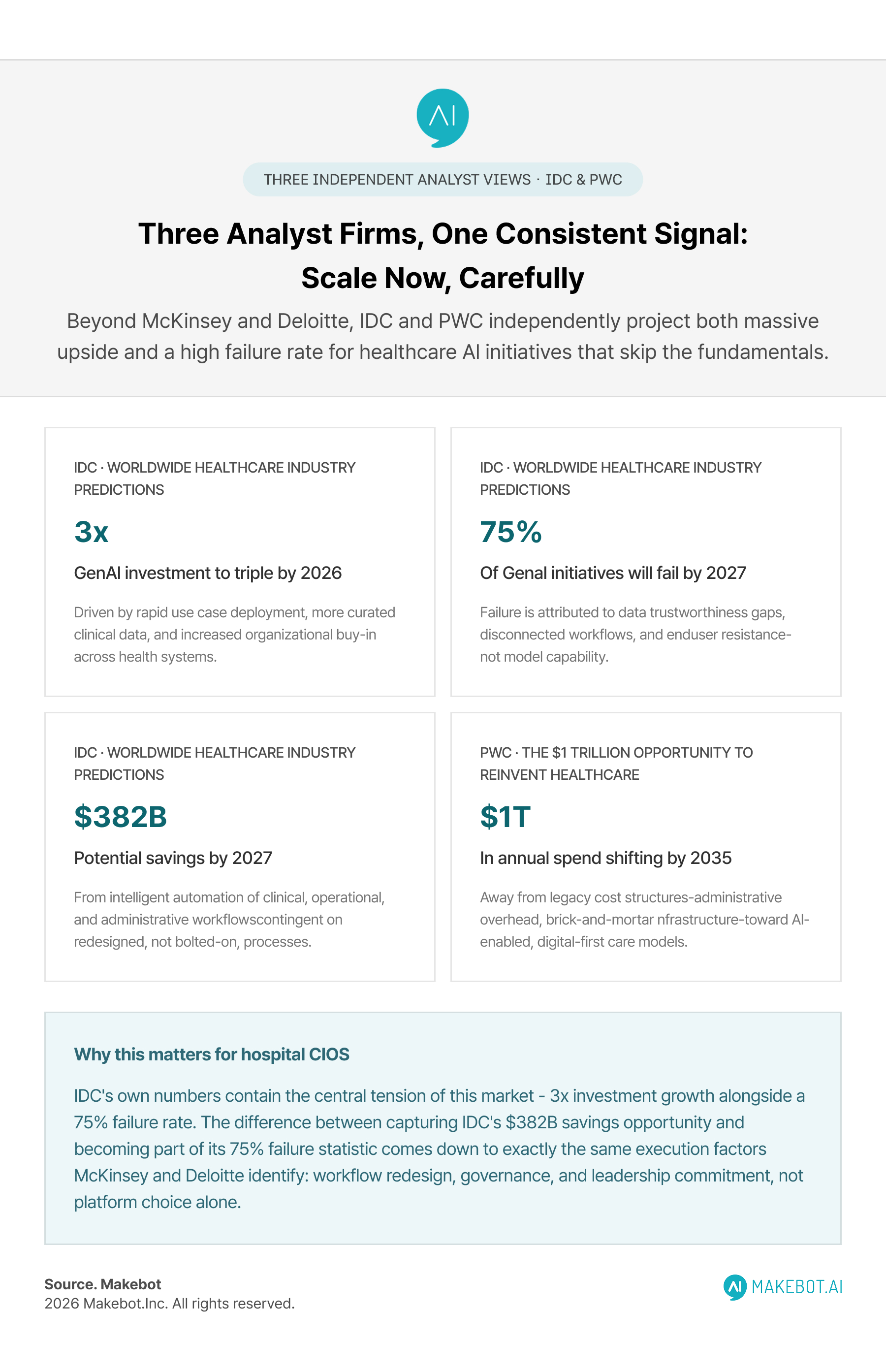
- IDC: Predicts healthcare GenAI investment will triple by 2026, but also warns that 75% of healthcare GenAI initiatives will fail to meet expected benefits by 2027 without addressing data trust and workflow integration.
The pattern is consistent across every major research firm: adoption is easy, scaled value is hard, and the platforms chosen at the outset heavily determine which side of that gap a hospital ends up on.
The Growing Role of AI Chatbots in Modern Healthcare Communication. Read here!
Why Some Health Systems Achieve Higher AI ROI Than Others
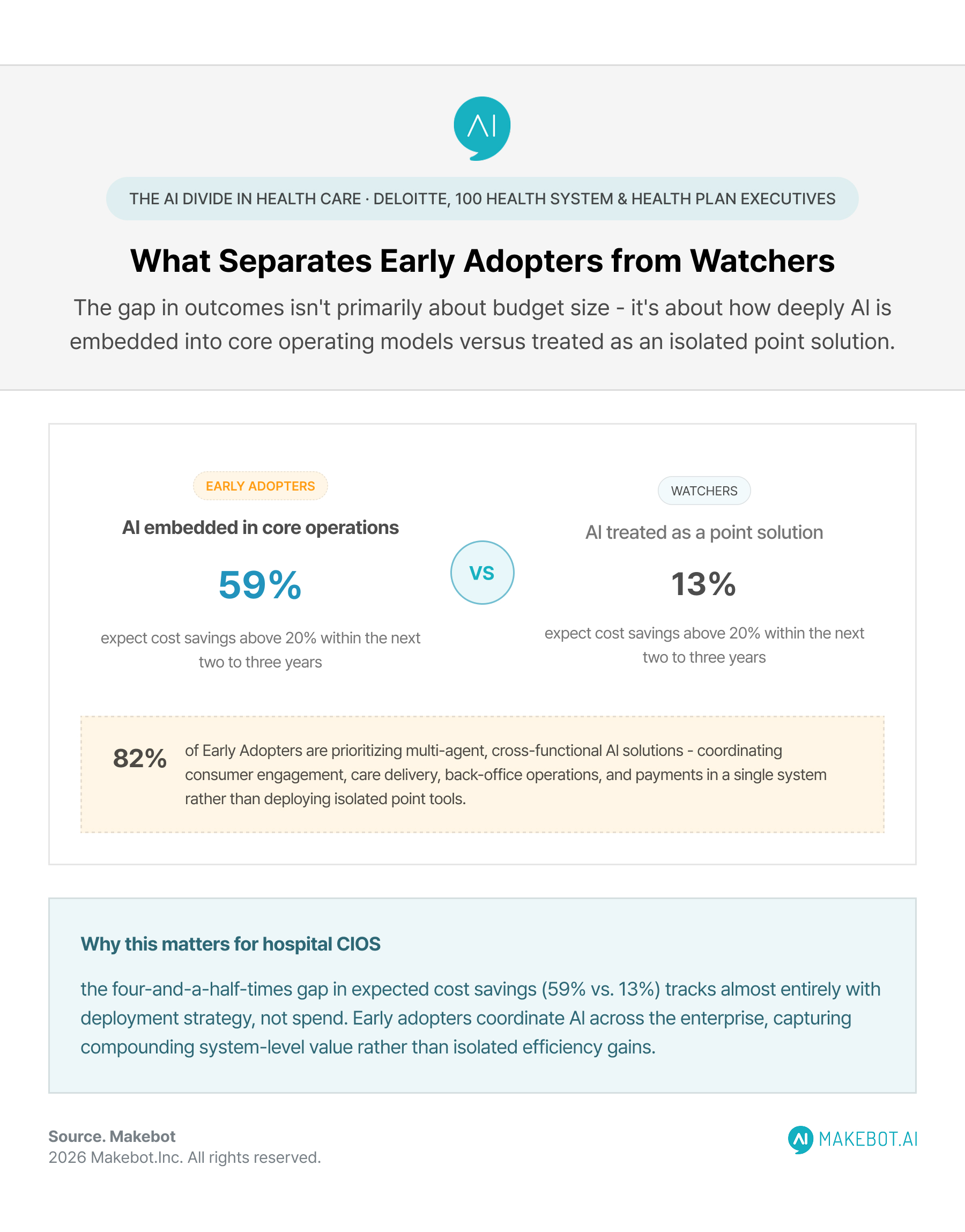
Deloitte's research on the emerging "AI divide" in health care is instructive because it isolates the variable CIOs actually control. Comparing "early adopters" to "watchers," the gap wasn't primarily about budget size - it was about how deeply AI was embedded into core operating models versus treated as a point solution.
- 59% of early adopters expect cost savings exceeding 20% within two to three years, compared with 13% of watchers.
- 82% of early adopters are prioritizing multi-agent solutions that coordinate work across consumer engagement, care delivery, back-office operations, and payment processing - capturing compounding, system-level benefits rather than isolated efficiency gains.
- Adoption friction is easing broadly: 40% of leaders say technical talent is no longer a major barrier, with similar improvement in resistance to change (38%) and leadership buy-in (35%).
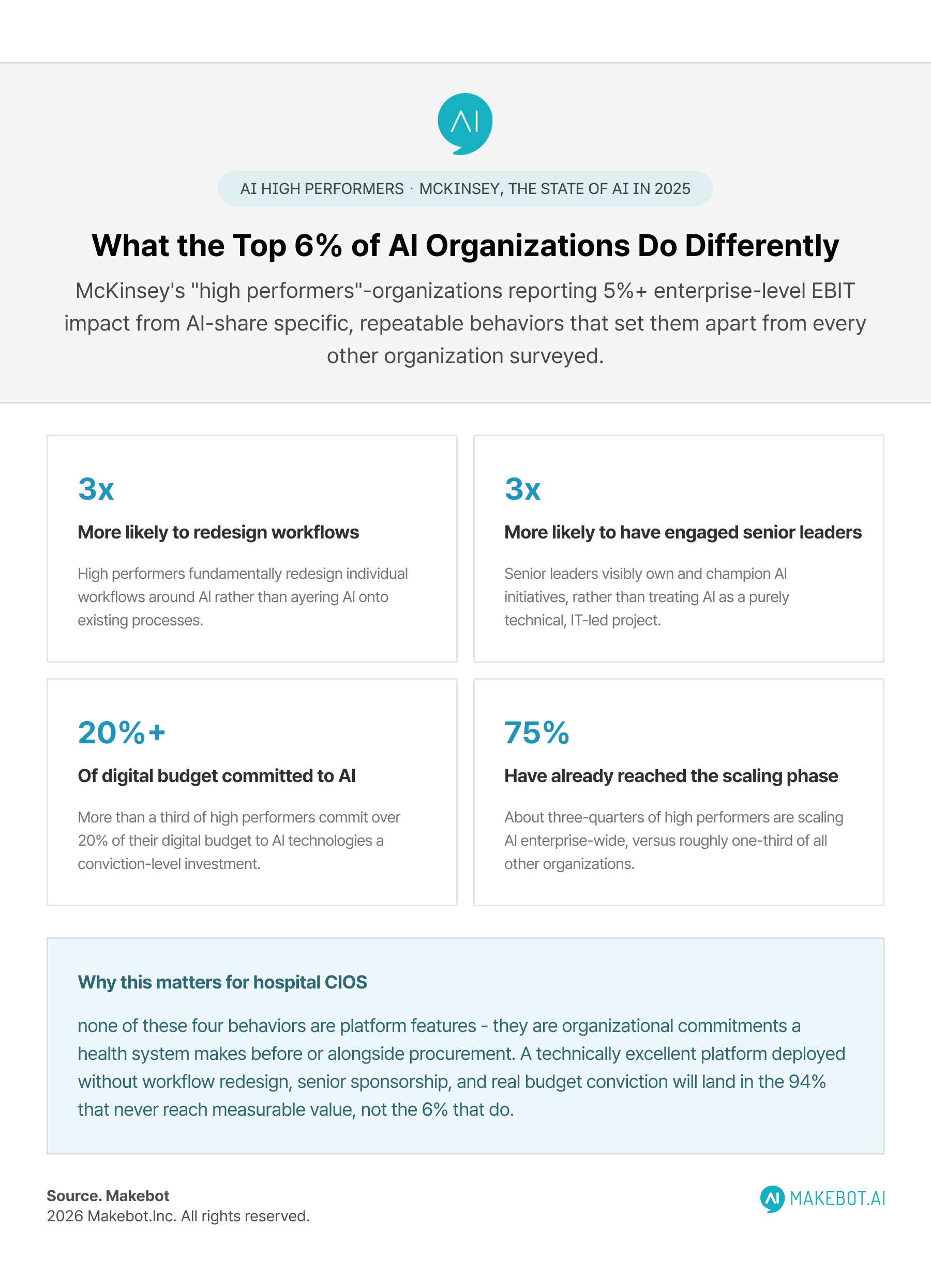
McKinsey's broader cross-industry findings reinforce the same conclusion. Organizations it classifies as AI "high performers" - about 6% of respondents, defined by 5%+ EBIT impact and self-reported significant value - share specific, repeatable behaviors:
- They are nearly three times more likely to have fundamentally redesigned workflows rather than layering AI onto existing processes.
- They are three times more likely to report senior leaders who visibly own and champion AI initiatives.
- More than a third commit over 20% of their digital budget to AI technologies, and roughly three-quarters have reached the scaling phase, versus one-third of other organizations.
For a hospital AI program, this translates directly: platform selection matters, but it is downstream of whether leadership is willing to redesign clinical and administrative workflows around the tool rather than forcing the tool to mimic the old workflow.
Reducing Hallucinations in Clinical LLMs Using Retrieval Augmented Generation. Read here!
Core Evaluation Criteria for an Enterprise AI Platform
1. Clinical and Data Architecture
The foundation of any credible healthcare AI platform is how it handles patient data and grounds its outputs in verified clinical sources.
- Retrieval-Augmented Generation (RAG) quality: Because RAG in healthcare connects a model's outputs to a hospital's own clinical documentation, formularies, and protocols rather than relying purely on a model's trained knowledge, retrieval accuracy - not just model size - determines real-world safety. CIOs should ask vendors for retrieval precision benchmarks specific to clinical documents, not generic RAG performance claims.
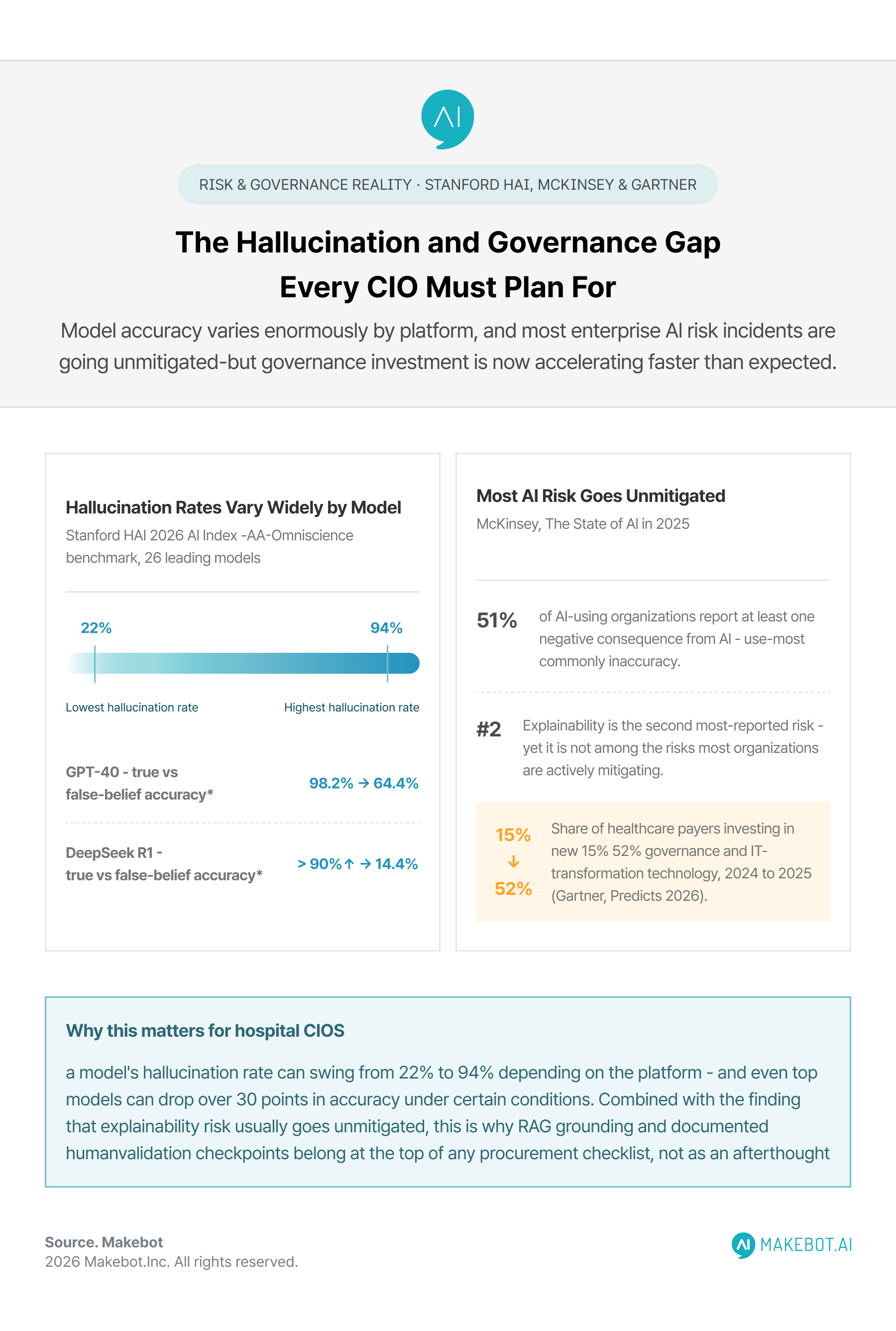
- Hallucination mitigation: Stanford HAI's 2026 AI Index found hallucination rates across 26 leading models ranging from 22% to 94% on the AA-Omniscience knowledge benchmark. A separate benchmark in the same report - KaBLE, which tests whether models can distinguish knowledge from belief - found similarly sharp swings for individual models: GPT-4o's accuracy on true beliefs was 98.2%, but dropped to 64.4% on first-person false beliefs, and DeepSeek R1 fell from over 90% to 14.4% under the same condition. In a clinical context, that kind of variance - regardless of which benchmark is used - is the difference between a documentation aid and a liability.
- Interoperability: The platform must integrate cleanly with existing EHR systems, HL7/FHIR standards, and imaging or lab systems without requiring parallel data entry, which independently undermines clinician adoption.
2. Governance, Risk, and Compliance
Healthcare AI governance is where most procurement processes are weakest, and where regulatory and reputational exposure is highest.
- Human-in-the-loop controls: McKinsey found that AI high performers are more likely than others to have defined, explicit processes for determining when model outputs require human validation - one of the strongest differentiators of high-performing organizations across all industries.
- Audit trails and explainability: Every clinical or billing-adjacent output should be traceable to its source data and reasoning path, both for compliance and for clinician trust.
- Incident response: McKinsey's survey found that 51% of AI-using organizations have experienced at least one negative consequence from AI use, most commonly inaccuracy - yet explainability, the second most common risk, is not among the risks most organizations actively mitigate. CIOs should push vendors to demonstrate specific mitigation protocols, not general assurances.
- Regulatory alignment: Platforms should demonstrate a clear compliance posture for HIPAA, applicable state privacy laws, and - where the platform touches diagnostic or triage decisions - a credible path through FDA guidance for AI-enabled software.
- Governance capacity is scaling faster than expected: Gartner's Predicts 2026: U.S. Healthcare Payers Bet Big on Agentic Workforce report found that the share of health care payer organizations investing in new technology for business and IT transformation jumped from 15% in 2024 to 52% in 2025, with all surveyed organizations reporting they have already deployed or plan to deploy agentic AI by 2028. Gartner further predicts that by 2028, 80% of ambulatory claims will be processed through AI-enabled, real-time adjudication - but cautions that success depends on strong data quality, governance, and human oversight, particularly in workflows that directly affect patient access to care.
3. Workforce Impact and Change Management
A platform's technical merits are irrelevant if clinicians won't use it. The clearest evidence of measurable clinical ROI so far comes from ambient documentation tools:
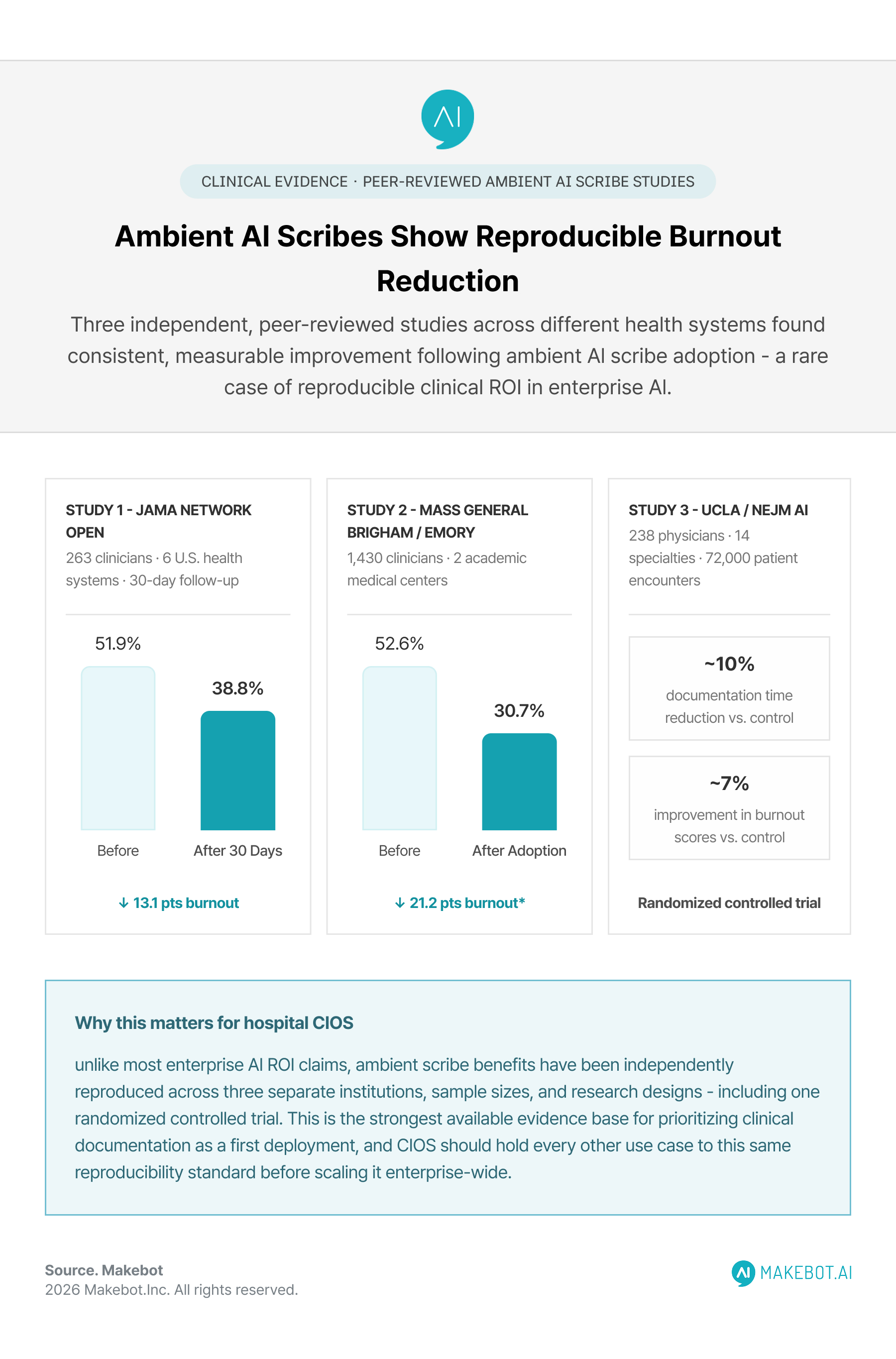
- A multicenter quality-improvement study published in JAMA Network Open (263 clinicians, six US health systems) found burnout fell from 51.9% to 38.8% after 30 days of ambient AI scribe use, alongside reduced after-hours documentation and improved patient focus.
- A separate academic medical center study reported a 21.2-percentage-point absolute reduction in burnout prevalence (from 52.6% to 30.7%) with ambient scribe adoption.
- A UCLA randomized trial (NEJM AI, 2025) found measurable reductions in documentation time when comparing ambient AI scribe tools against usual documentation practice.
These results matter for platform evaluation because they demonstrate that healthcare AI chatbot and ambient documentation tools with strong adoption design produce reproducible outcomes across institutions - a bar CIOs should hold every vendor to before committing enterprise-wide.
4. Total Cost of Ownership and ROI Measurement
- IDC projects that intelligent automation could save the healthcare industry up to $382 billion by 2027 through optimized clinical, operational, and administrative workflows - but only where automation is deployed against redesigned processes, not bolted onto legacy ones.
- PwC takes a longer view: its report "From Breaking Point to Breakthrough: The $1 Trillion Opportunity to Reinvent Healthcare" projects that $1 trillion in annual US healthcare spending will shift away from legacy cost structures like administrative overhead and brick-and-mortar infrastructure toward AI-enabled, digital-first care models by 2035 - a horizon CIOs should keep in mind when weighing a platform's long-term extensibility against near-term feature checklists.
- Deloitte's 2026 outlook found that among health systems already measuring returns, only 3% report "significant" financial ROI so far, while 31% report "moderate" returns - a reminder that most of the value curve is still ahead, and platform flexibility matters more than short-term ROI claims.
- CIOs should require vendors to define ROI measurement methodology upfront - cost avoidance, revenue capture, and productivity gains each need distinct, auditable metrics rather than a single blended "AI value" figure.
New Studies Show AI Can Improve Medication Safety by Detecting Prescription Risks Earlier. Explore the latest insights here!
Comparing Platform Evaluation Priorities: High Performers vs. Cautious Adopters
Common Challenges When Scaling Hospital AI Initiatives
- Data fragmentation and quality: Siloed EHR, imaging, and billing systems make it difficult to feed a healthcare LLM consistent, high-fidelity context - one of the most cited blockers to scaling in McKinsey's cross-industry research.
- Workforce trust deficits: Clinicians who have experienced early, poorly tuned tools are often skeptical of subsequent rollouts, making change management as important as technical accuracy.
- Governance debt: Organizations that delay building formal AI oversight structures accumulate risk faster than they accumulate value, particularly as agentic systems take on more autonomous, multi-step actions.
- Vendor lock-in risk: Given how fast the underlying model landscape is shifting, CIOs should favor AI platform for hospitals architectures that abstract the orchestration and governance layer from any single underlying model provider.
- Measurement gaps: Many hospitals still lack a consistent framework for attributing savings or outcomes to specific AI deployments, which stalls board-level investment decisions even when frontline results are positive.
Can AI Health Assistants Reduce Unnecessary Clinic Visits? What Early Data Suggests. Continue reading here!
Strategic Recommendations for Hospital CIOs
- Require vendors to provide clinical-domain-specific accuracy and hallucination benchmarks, not general-purpose LLM leaderboard scores.
- Insist on a documented human-in-the-loop validation framework before any clinical-facing deployment goes live.
- Pilot with a defined workflow-redesign component, not just a technology swap, since workflow redesign is one of the strongest predictors of measurable value.
- Build ROI measurement into the contract from day one, with explicit definitions of cost avoidance, productivity, and revenue-impact metrics.
- Evaluate the platform's governance and orchestration layer independently from its underlying model, given how quickly model performance and pricing are shifting.
- Start with high-frequency, high-burden workflows - such as clinical documentation - where the evidence base for measurable ROI is already strongest.
Showcasing Korea’s AI Innovation: Makebot’s HybridRAG Framework Presented at SIGIR 2025 in Italy. Read here!
Conclusion
The organizations separating themselves in enterprise AI aren't the ones with access to a fundamentally different technology - they're the ones treating platform selection as the beginning of a governance and workflow transformation process, not the end of a procurement exercise. For hospital CIOs, that means evaluating an enterprise AI platform on its data architecture, its governance maturity, its clinician-facing evidence base, and its total cost of ownership - not on demo polish or model benchmark rankings alone. The data is unambiguous: hospitals that redesign workflows, invest meaningfully, and build explicit human-oversight structures are already pulling ahead of peers still running disconnected pilots. As the healthcare AI market moves toward a projected $504 billion by 2032, the platform decisions made in the next twenty-four months will shape which health systems capture that value - and which spend the next decade catching up.










.jpg)


What Happens to Marketing When the C-Suite Starts Using AI Every Day?






Why AI Shopping Assistants Will Replace Traditional Ecommerce Search






.jpg)

























Why Generative AI Projects Fail and How to Achieve Scalable AI Success











.jpg)

.png)