How Generative AI Is Reshaping Brand Strategy and Digital Advertising
AI ad copy lifted JPMorgan CTR by 450% - how generative AI is reshaping brand strategy at scale.


Introduction
The advertising industry has always run on the tension between creative intuition and quantitative precision. Generative AI is collapsing that tension entirely—and the implications for brand strategy are far-reaching. What once required weeks of creative production, audience research, and iterative copywriting can now be accomplished in hours. But speed is only the opening argument. The deeper transformation is structural: AI is changing who makes brand decisions, how advertising inventory is bought, and how consumer relationships are managed at scale.
For marketing leaders navigating this shift, the challenge is not whether to adopt AI-powered marketing tools—that debate is largely settled. The challenge is understanding how to deploy generative AI in marketing in ways that create durable competitive advantage, rather than temporary operational efficiency. This article examines the latest evidence on what is working, what is failing, and what separates organizations capturing real value from those still running pilots that never mature into impact.
7 Proven Factors That Drive AI ROI in 2026, According to a Survey of 1,000+ Executives. Explore the latest insights here!
The Scale of the Transformation: By the Numbers
Before examining specific applications, it is worth establishing the scale of the current shift. The market for generative AI in marketing and advertising tells a clear directional story.
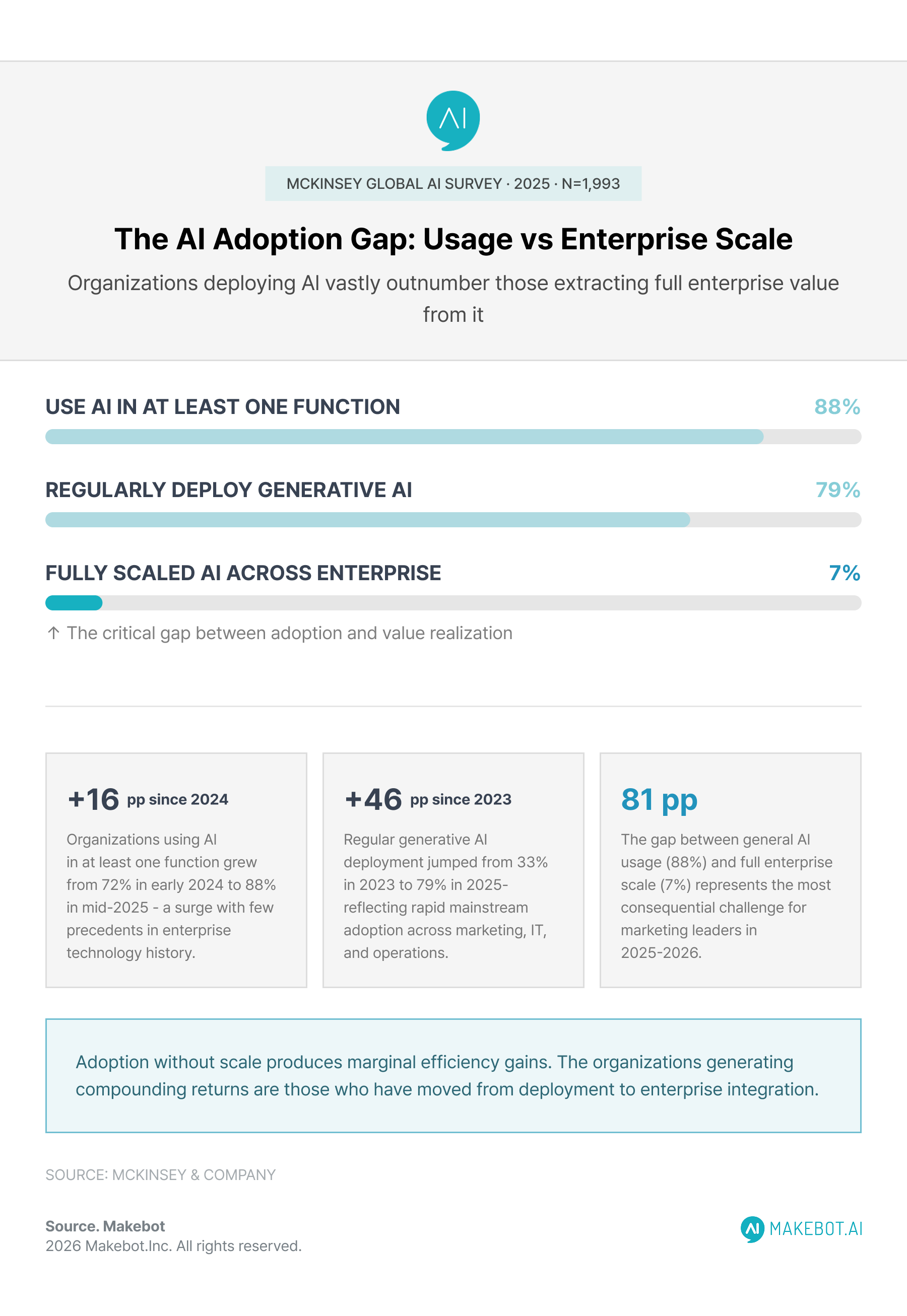
McKinsey's 2025 global survey—conducted among 1,993 participants in June–July 2025—found that 88% of organizations now use AI in at least one business function, up from 72% in early 2024. Reported use of generative AI specifically has surged: 79% of organizations regularly deploy gen AI across marketing, product development, service operations, and IT, compared to just 33% in 2023. The speed of this adoption curve has few precedents in enterprise technology history.
Yet the headline adoption numbers require careful interpretation. Only 7% of McKinsey survey respondents indicate that AI has been fully scaled and integrated across their organizations. Usage is up; value at scale remains elusive. This distinction—between deployment and value realization—is the defining strategic challenge of the current era.
Deloitte's 2026 "State of AI in the Enterprise" report, based on a survey of 3,235 senior leaders across 24 countries (August–September 2025), reinforces this picture: rising AI spend but elusive ROI, with organizations pivoting from experimentation toward integration but falling short of full enterprise deployment. Deloitte's separate 2025 tech value survey of nearly 550 leaders found that AI and generative AI were the clear front-runners in investment priorities, with 74% of surveyed organizations reporting investments in those capabilities over the past year—nearly 20 percentage points higher than the next most popular technology areas.
The investment momentum is reinforced at the senior leadership level. According to BCG's 2025 CMO Survey of 200+ marketing leaders, 71% of CMOs plan to invest over $10 million annually in generative AI over the next three years, up from 57% in 2024, with 83% expressing optimism about AI technology.
APAC AI Outlook 2026 Signals AI's Breakout Moment as a New Revenue Driver. Read the expert analysis here!
AI-Driven Marketing: From Content Factory to Brand Intelligence
The most immediate and widely documented application of generative AI advertising is content production. The economics are dramatic. Teams that previously required 15 or more writers, designers, and campaign managers working at full capacity can now operate with fewer people using generative AI for initial content creation—at a fraction of the cost with measurably higher engagement rates.
But framing this solely as a cost story misses the strategic significance. AI content generation is enabling a qualitative shift in what is possible for brand teams:
- Speed of iteration: Campaigns that previously required weeks of development can be tested, refined, and deployed within days, enabling real-time response to market conditions and competitor moves.
- Content breadth: A single campaign brief can now generate hundreds of creative variations—copy, visual concepts, headlines, CTAs—simultaneously tested across audience segments.
- Personalization depth: AI systems can tailor messaging to individual behavioral signals, purchase history, and contextual cues in ways that manual segmentation cannot replicate.
- Multilingual and multichannel execution: Global brands can deploy locally adapted content at scale without proportional increases in creative headcount.
CarMax used OpenAI's language models to generate content in hours that would have taken years for human teams, resulting in measurable spikes in page views and SEO rankings—a well-documented case of AI transforming a content supply chain at scale.
The Personalization Imperative
AI-driven marketing delivers its highest returns when personalization is treated as a strategic asset rather than a tactical feature. Deloitte Digital research shows that 80% of consumers are more likely to purchase from brands delivering personalized experiences, and companies leading in personalization are three times more likely to exceed revenue targets—with 56% of marketers actively investing in personalization capabilities.
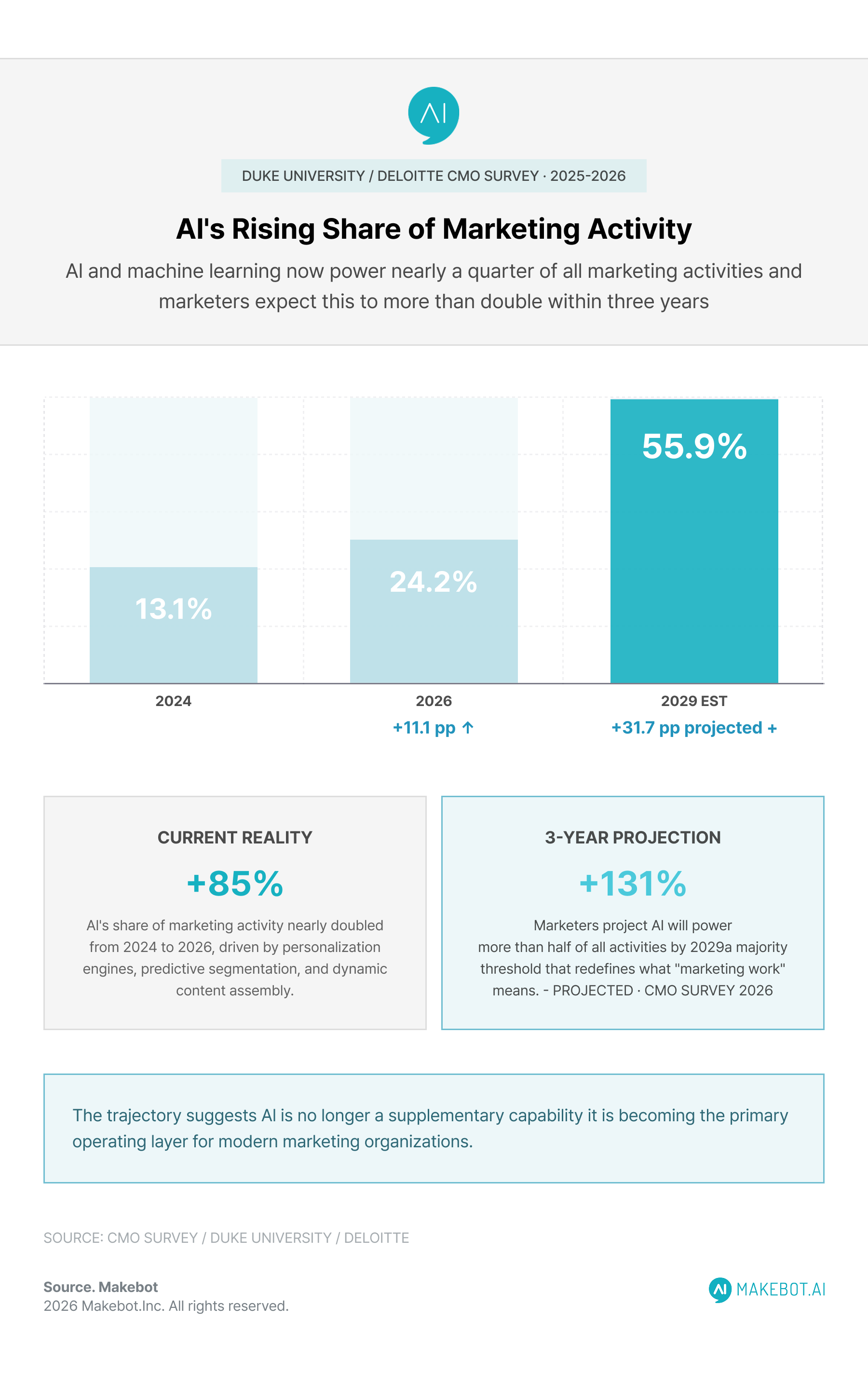
The Duke University/Deloitte CMO Survey quantifies the operational shift precisely: AI and machine learning now power 24.2% of all marketing activities as of 2026, nearly doubling from 13.1% in 2024—with marketing leaders projecting this will reach 55.9% within three years. Personalization engines, predictive audience segmentation, and dynamic content assembly are the primary drivers of this acceleration. The brands extracting the most value are those who have moved beyond using AI to reduce costs toward using AI to deliver experiences that were previously impossible to deliver at scale.
OpenAI Releases GPT-5.5 Instant: A New Default Model for ChatGPT. Discover what’s next here!
Generative AI Advertising: Rewriting the Rules of Programmatic
The structural impact of AI in digital advertising is most visible in programmatic buying and creative optimization—two functions that are being fundamentally rearchitected by machine intelligence.
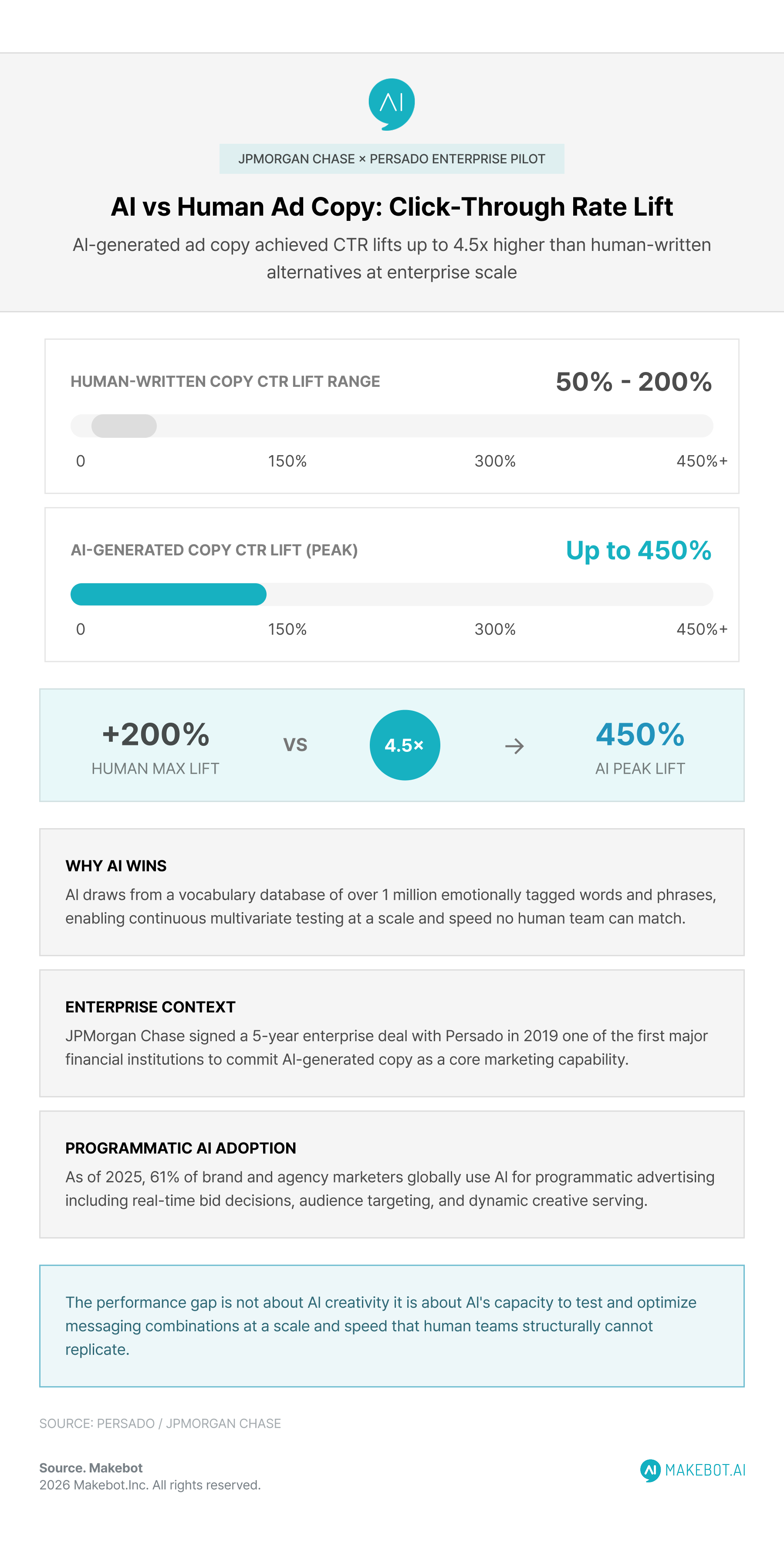
According to a 2025 industry report, 61% of brand and agency marketers worldwide are already using AI for programmatic advertising. In practice, this means AI systems are now responsible for real-time bid decisions, audience segment identification, contextual placement, and creative serving—functions that previously required large, specialized trading desk teams.
The performance implications are significant. JPMorgan Chase's pilot with Persado—announced in its 2019 five-year enterprise deal and widely cited since—found that AI-rendered ad copy achieved click-through rate lifts as high as 450%, compared to a 50–200% lift range for human-written alternatives. This is not attributable to AI creativity per se, but to AI's ability to test and optimize at a scale and speed that human teams cannot match, drawing from a vocabulary database of over one million emotionally tagged words and phrases.
Dynamic Creative Optimization (DCO) represents the convergence of these capabilities. With DCO, AI customizes ad creatives for each user based on their preferences, location, and device—and contextual targeting further ensures that ads match relevant content without relying on invasive personal data. For brands navigating the post-cookie advertising environment, this combination of behavioral intelligence and privacy compliance is strategically critical.
What AI-Powered Programmatic Unlocks
- Real-time budget reallocation based on performance signals across channels and audience segments
- Continuous creative testing without requiring manual A/B test setup or human interpretation of results
- Audience expansion by identifying high-value behavioral lookalikes that rules-based targeting would miss
- Cross-channel frequency management that prevents ad fatigue without sacrificing reach
- Predictive analytics that forecast conversion likelihood before media dollars are committed
Agentic AI vs Generative AI: Why the Difference Will Define Enterprise Strategy in 2026. Explore the future of AI here!
AI Brand Strategy: Building Long-Term Equity in an Algorithmic Era
The implications of AI brand strategy extend beyond campaign execution into the foundational questions of how brands are discovered, evaluated, and chosen. Generative AI is changing how organizations are discovered, evaluated, and compared. What was once a primarily keyword-led activity is becoming a more interpretive, AI-mediated process, where systems synthesize information and present answers directly to users.
This shift has profound consequences for brand investment. Deloitte's 2025 Connected Consumer research shows that more than 50% of consumers are now experimenting with or regularly using generative AI tools, signaling that AI-assisted discovery is moving rapidly into the mainstream. Discovery journeys now span traditional search engines, social platforms, creator content, and conversational interfaces. When a consumer's first interaction with a category is through an AI-generated summary—rather than a brand's owned web properties—the traditional funnel changes entirely.
According to industry research, AI Overviews have reduced organic click-through rates by up to 61% for informational queries, with zero-click searches now accounting for a substantial share of all search activity. Brands that have not structured their content and entity signals for AI discoverability are systematically disadvantaged in AI-mediated environments—arguably the most underappreciated strategic risk in enterprise marketing today.
The Agentic AI Horizon
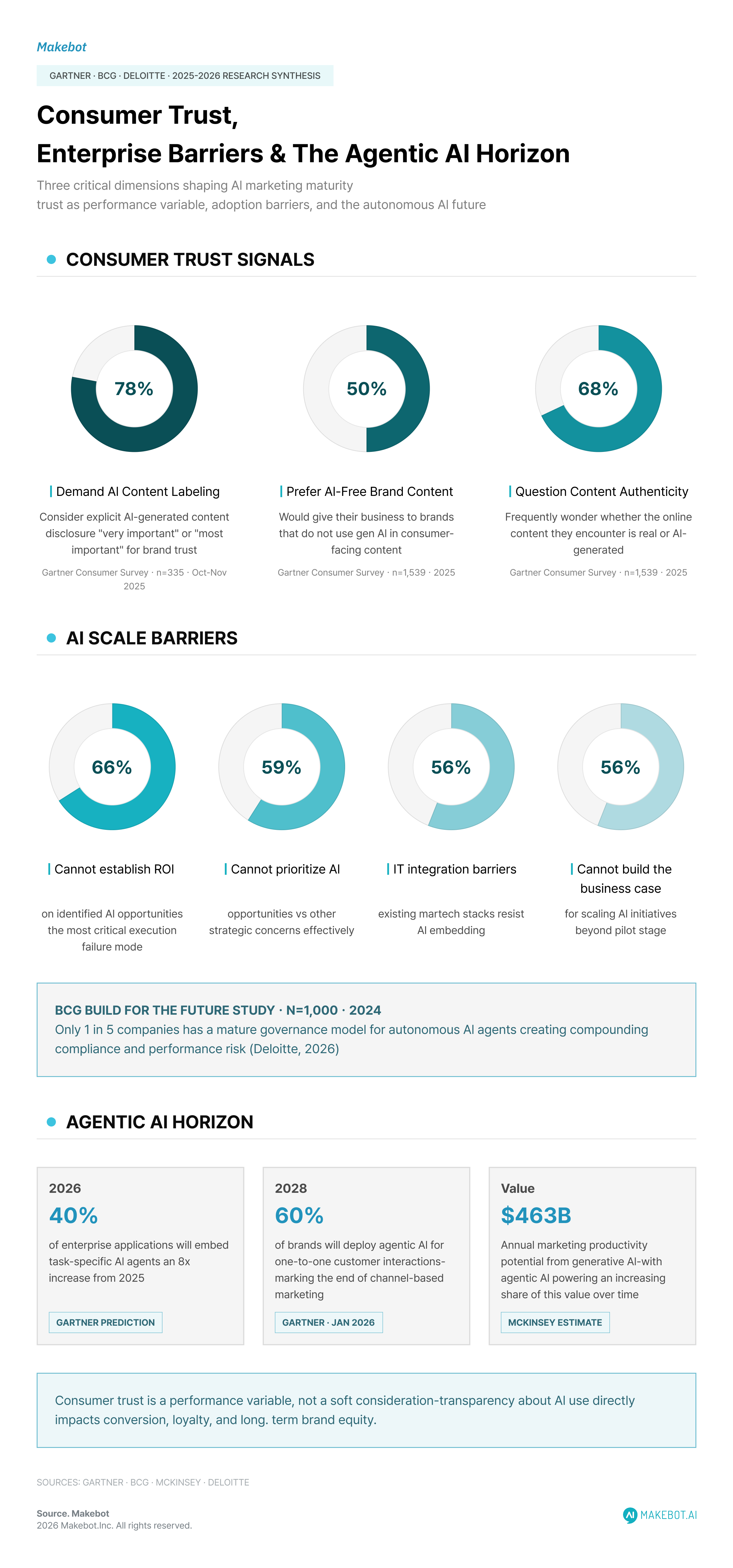
Looking forward, the trajectory of marketing AI points toward autonomous, agent-driven interactions that eliminate the distinction between campaign and conversation. Gartner's January 2026 press release predicts 60% of brands will use agentic AI to deliver streamlined one-to-one interactions by 2028, with these AI agents acting as persistent digital concierges spanning marketing, sales, and support. "This marks the end of channel-based marketing as we know it," said Emily Weiss, Senior Principal Researcher in the Gartner Marketing practice.
McKinsey quantifies the agentic opportunity: gen AI could drive approximately $463 billion in marketing productivity, with agentic AI expected to power an increasing share of that value over time. From autonomous campaign managers to AI agents that handle customer lifecycle communications end-to-end, the category is moving from assistance to autonomy.
Microsoft CEO Satya Nadella On How AI Is Transforming Organizations, Teams And Leadership. See how enterprises are transforming here!
Why Some Organizations Win and Others Stall
The gap between organizations capturing AI's marketing value and those running expensive pilots without impact is well-documented—and the causes are instructive.
Gartner's research on early gen AI adopters indicates potential for 15.2% cost savings and 22.6% productivity improvement on average. Deloitte's broader enterprise survey further found that 74% of respondents say their most advanced generative AI initiative is meeting or exceeding their ROI expectations. But these figures describe organizations already executing well—not the median.
According to BCG's Build for the Future 2024 Global Study (n=1,000), the key challenges in AI adoption are significant: 56% of companies have difficulty integrating AI with existing IT systems; 66% struggle to establish ROI on identified opportunities; 59% face difficulty prioritizing AI versus other concerns; and 56% find difficulty making the business case for scaling initiatives.
The contrast between high-performers and the rest reveals a consistent pattern. Organizations achieving meaningful AI marketing automation returns share three characteristics:
- Workflow redesign, not tool deployment. McKinsey notes that capturing generative AI value depends on workflow redesign, data, and change management—not just tool selection. Companies that layer AI onto legacy processes typically see marginal gains. Companies that redesign workflows around AI capabilities see compounding returns.
- Data infrastructure investment. AI-driven personalization, predictive analytics, and dynamic creative all depend on clean, structured, well-governed data. Organizations that underinvest in data management cannot unlock the personalization value that justifies AI spend.
- Governance and accountability structures. Deloitte's 2026 enterprise survey (3,235 respondents) found that agentic AI usage is poised to rise sharply, but oversight is lagging: only one in five companies has a mature governance model for autonomous AI agents. This governance gap creates both compliance risk and performance risk.
The Trust Dimension
Effective AI-powered marketing also requires managing consumer trust carefully. The Gartner Consumer Community survey of 335 U.S. consumers (October–November 2025) found that 78% say explicit labeling of AI-generated content is "very important" or the "most important factor" in maintaining trust. A separate Gartner survey of 1,539 U.S. consumers found that 50% would prefer to give their business to brands that do not use gen AI in consumer-facing content, and 68% frequently wonder whether the content they see is real.
These findings have direct implications for brand strategy: transparency about AI involvement is not just an ethical consideration—it is a performance variable. Brands that communicate AI use with clarity can preserve the trust equity that makes their other marketing investments work.
Why Generative AI Projects Fail and How to Achieve Scalable AI Success. Learn how industry leaders are adapting here!
Comparing AI Leaders vs. Laggards: A Strategic Framework
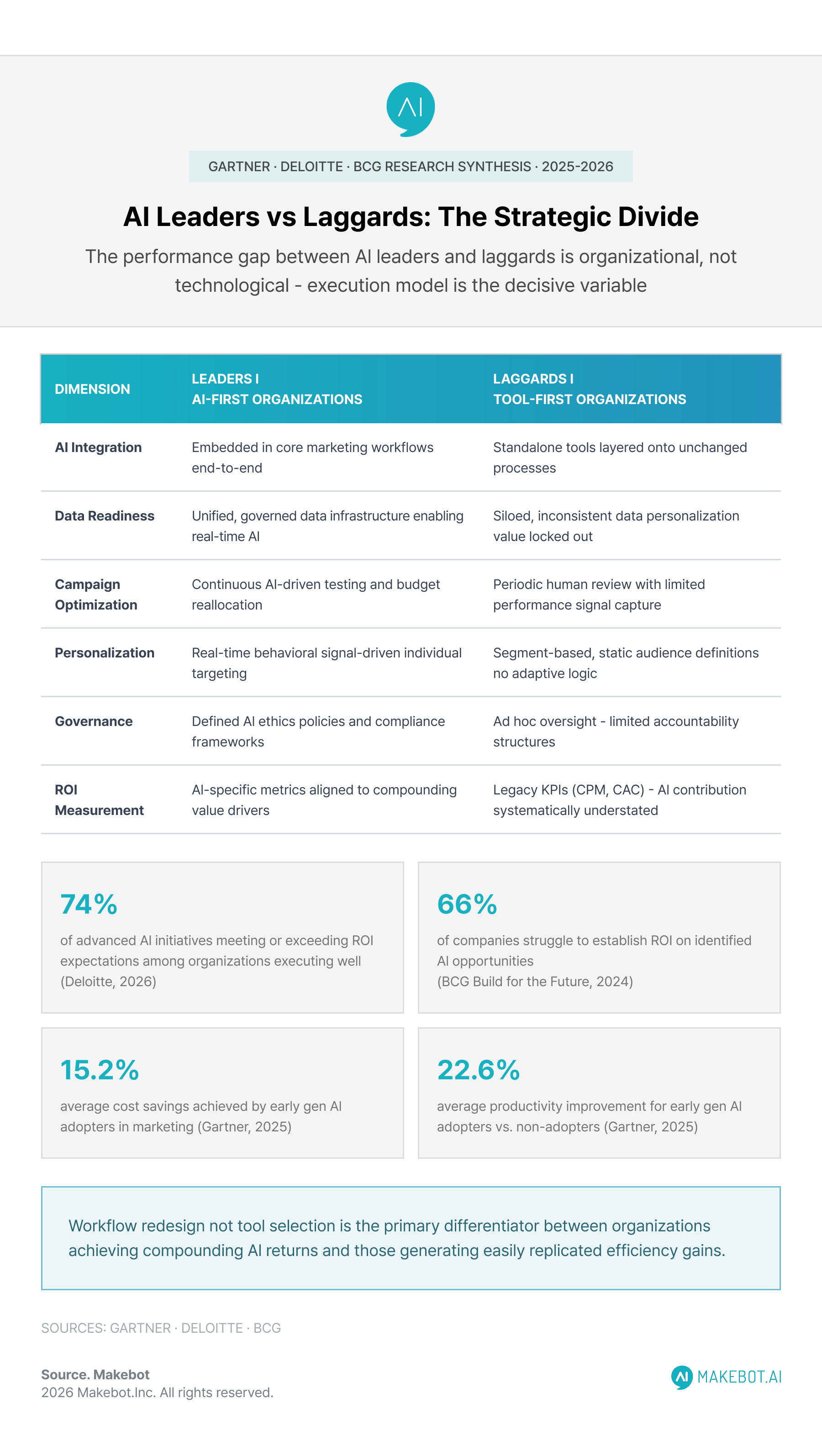
The gap between these two profiles is not primarily technological—it is organizational. Leading organizations treat AI-driven marketing as an operating model transformation, not a software upgrade.
Challenges Enterprises Face When Scaling AI Marketing Initiatives
Despite strong momentum, scaling digital advertising AI across complex enterprise environments surfaces predictable friction. Understanding these challenges helps marketing leaders set realistic expectations and design for them proactively.
Integration complexity remains the most frequently cited barrier. Enterprise martech stacks are typically composed of dozens of point solutions with inconsistent data schemas and API compatibility. Integrating generative AI into these environments without creating new data silos requires significant architectural investment that many organizations underestimate at the outset.
Creative governance at scale presents a distinct challenge. When AI systems can generate thousands of ad variations, the question of what gets approved, by whom, and how quickly becomes a bottleneck. Brands with strong voice, legal, and compliance requirements find that AI-generated creative requires robust human review workflows—and designing those workflows efficiently is non-trivial.
Talent and capability gaps are a persistent constraint. Research indicates a 2.4× higher likelihood for C-suite executives to cite employee readiness as a barrier to generative AI adoption compared to leadership alignment issues. The organizations moving fastest are investing in prompt engineering capability, AI literacy training, and new hybrid roles that combine marketing expertise with AI proficiency.
Measurement misalignment also undermines AI ROI visibility. Traditional marketing KPIs—impressions, CPM, CAC—do not always capture the compounding value of AI-driven personalization and content optimization. Organizations that rely on legacy measurement frameworks often understate AI's contribution and underinvest accordingly.
The Long-Term Implications for Brand Strategy
The trajectory of generative AI in marketing points toward a fundamental redefinition of what brand strategy means—and what it requires. In the near term, the competitive advantage flows to organizations deploying AI for content production efficiency and campaign optimization. In the medium term, the advantage accrues to those who have built AI-mediated personalization at scale. In the long term, the defining variable will be brand trust in an environment where AI-generated content is ubiquitous.
Forrester has warned that the AI hype period is ending, and organizations could face significant losses from ungoverned generative AI use—through legal settlements, regulatory fines, and reputational damage. They also expect advertisers to reduce display ad budgets as consumers migrate toward AI-generated summaries. This is not a prediction to dismiss—it reflects the correction that follows any period of overextension.
The brands that will emerge strongest from this transition are those that use AI to do what human creativity cannot do alone—operating at scale, adapting in real time, and personalizing with precision—while preserving the distinctly human elements of brand identity that AI cannot generate: authentic narrative, earned trust, and cultural relevance.
AI marketing automation handles the distribution and optimization layer. Brand strategy still requires the vision that gives distribution something worth amplifying.
Showcasing Korea’s AI Innovation: Makebot’s HybridRAG Framework Presented at SIGIR 2025 in Italy. Read here!
Conclusion
Generative AI is not a temporary augmentation layer on existing marketing operations—it is a structural shift in how brand value is created, communicated, and protected. The evidence from McKinsey, Deloitte, Gartner, BCG, and the CMO Survey is directionally consistent: organizations that treat AI as a strategic operating model transformation are capturing meaningful, measurable returns, while those treating it as a productivity tool are generating efficiency gains that competitors will quickly replicate.
The defining insight is one that leading organizations have already internalized: the value of AI in marketing is not in the technology—it is in the decisions the technology enables. Faster content, smarter targeting, and dynamic personalization are all means to an end. That end is a brand that is more relevant, more trusted, and more commercially effective than it was before AI was part of its operational fabric.
For enterprise marketing leaders, the window for strategic advantage from early AI adoption remains open—but it is narrowing. The organizations investing now in data infrastructure, workflow redesign, and AI governance are not just improving marketing efficiency. They are building capabilities that will define brand competitiveness for the next decade.
.jpg)

What Happens to Marketing When the C-Suite Starts Using AI Every Day?









Why AI Shopping Assistants Will Replace Traditional Ecommerce Search






.jpg)
























Why Generative AI Projects Fail and How to Achieve Scalable AI Success











.jpg)

.png)