Philips Survey: Most Clinicians Use AI but Lack Formal Training
70%+ of clinicians lack AI training - Philips 2026 reveals shadow AI surging to fill the gap.


Introduction
Artificial intelligence has moved from the hospital boardroom to the clinical bedside faster than most health systems anticipated. And yet, a striking paradox has emerged: the same technology that is saving clinicians hours every week and helping flag potential medical errors is being deployed largely without formal instruction or oversight.
Philips' Future Health Index 2026-the 11th edition of its annual global survey, drawing on perspectives from more than 2,000 healthcare professionals and over 20,000 patients across 10 countries-makes this contradiction impossible to ignore. Clinicians are embracing AI in healthcare at an accelerating rate, reaping real efficiency gains, and increasingly relying on AI-enabled tools for everything from transcription to clinical decision support. But the organizational infrastructure needed to support that adoption-particularly formal clinician AI training-has not kept pace.
This article unpacks the Philips findings in depth, contextualizes them within the broader landscape of healthcare AI adoption, and examines what the data means for health systems navigating a pivotal moment in digital transformation.
Studies Reveal Generative AI Enhances Physician-Patient Communication. Explore the latest insights here!
The Adoption Surge: AI Is Already Reshaping Daily Clinical Work
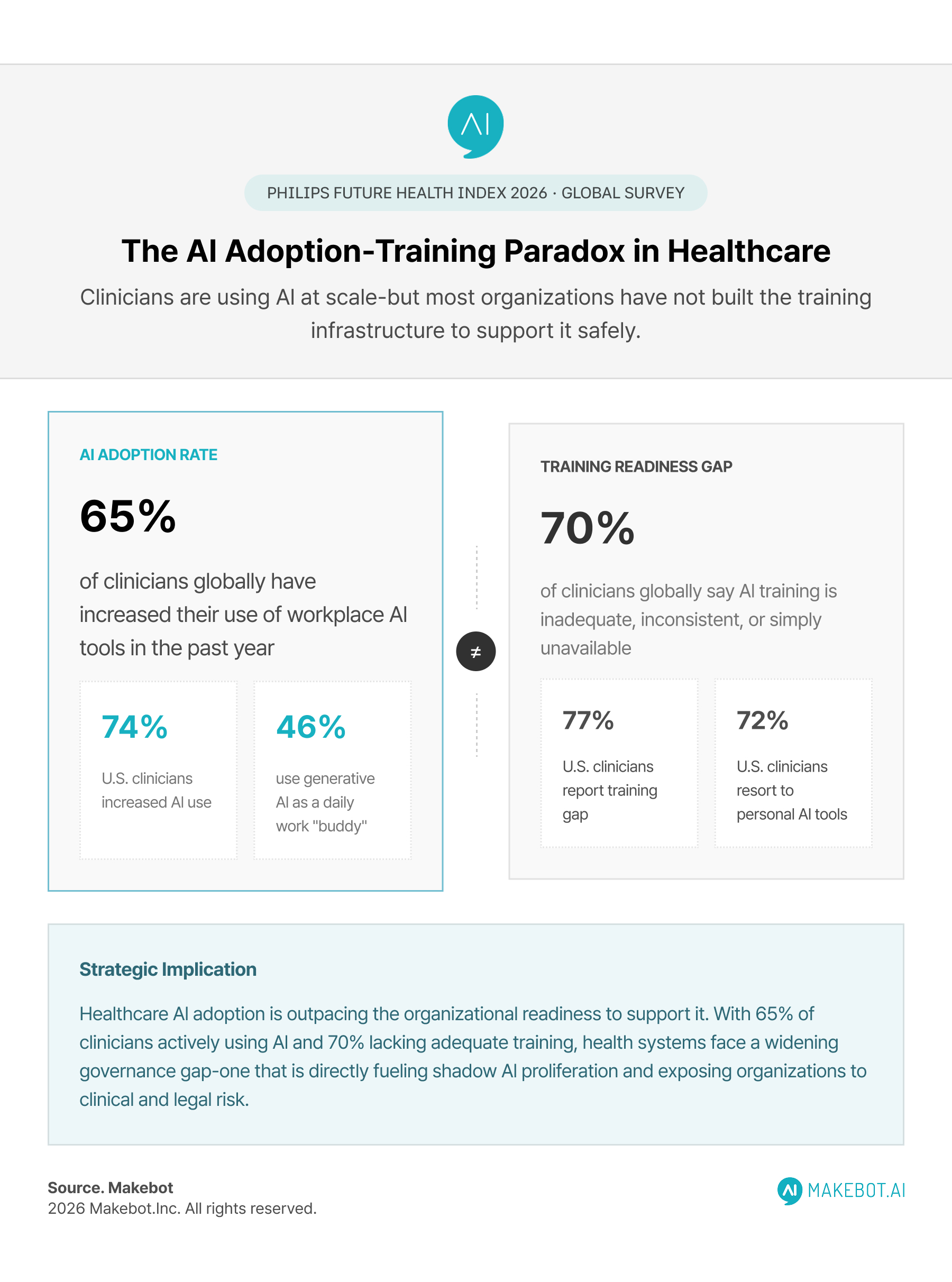
The scale of AI uptake among healthcare professionals in 2026 is no longer a projection-it is a documented reality. According to the Philips Future Health Index 2026, nearly two-thirds of clinicians globally (65%) have increased their use of workplace AI tools over the past year. In the U.S.-specific edition of the same report, that figure climbs to 74%. The applications are remarkably diverse.
What clinicians are using AI for today:
- 52% use AI to transcribe clinical notes-the single most common use case
- 46% use generative AI as a professional "buddy" or AI chatbot, such as ChatGPT, to discuss work-related ideas
- 45% rely on AI tools for clinical decision support, such as suggesting diagnoses based on patient symptoms
- 44% use AI-enabled tools to flag potential dangerous drug interactions
- 20% use AI to schedule patient appointments
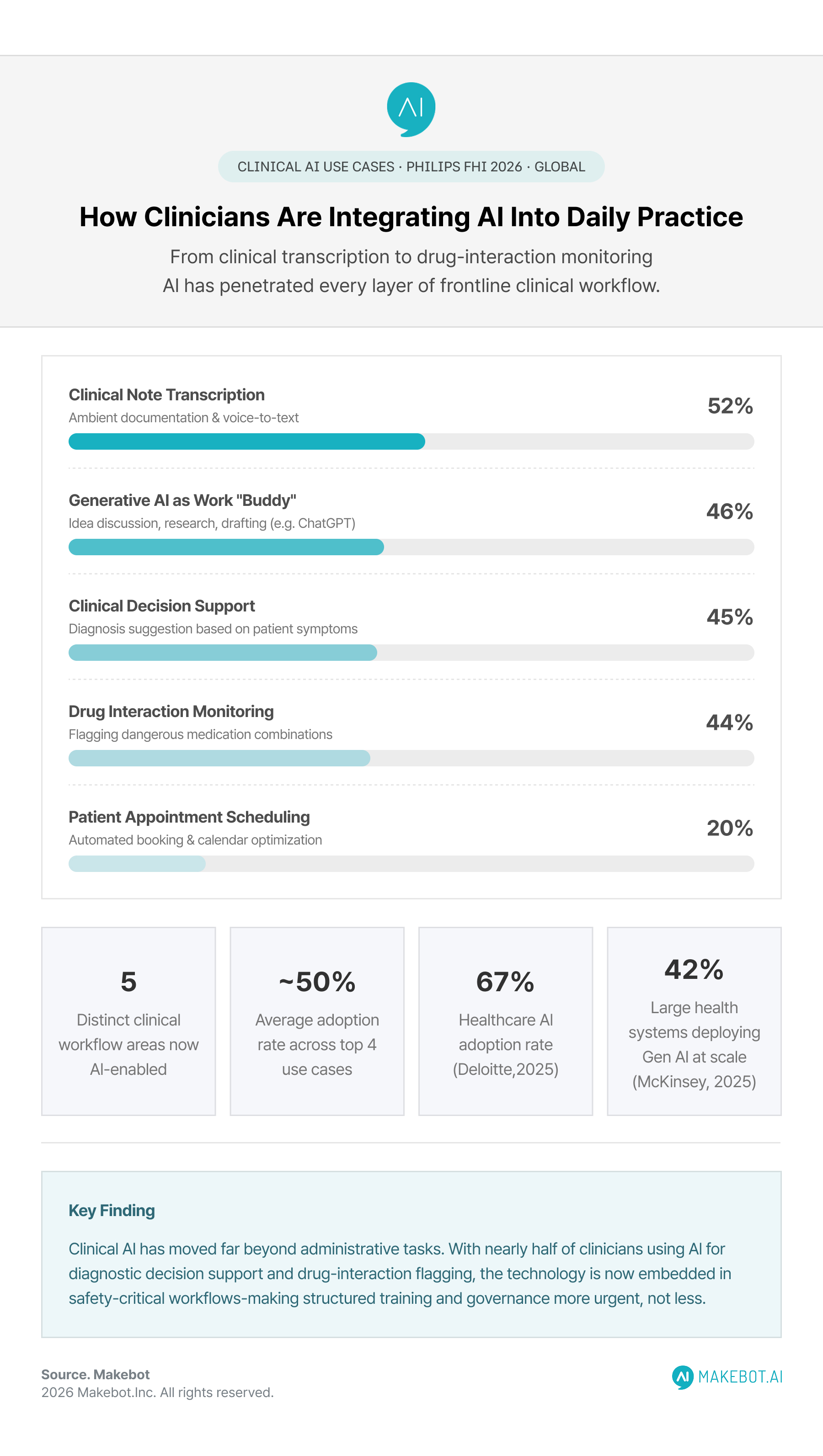
This breadth of use reflects how deeply healthcare AI has penetrated frontline workflows. It is not confined to administrative back-office functions. Clinicians are actively integrating AI into diagnostic reasoning, medication safety checks, and patient communication-domains that have traditionally been the exclusive purview of human clinical judgment.
The adoption trend also aligns with broader enterprise data. Deloitte's State of AI in the Enterprise 2025 found that the healthcare sector has reached a 67% AI adoption rate, trailing only financial services and technology. And according to McKinsey's 2025 generative AI tracking, approximately 42% of large organizations-including major health systems-have deployed Generative AI in healthcare workflows at scale, moving well beyond pilot programs.
For healthcare, the shift from experimentation to production-grade deployment is defining 2026.
How Claude AI Is Transforming Clinical Research and Healthcare Innovation. Read the expert analysis here!
Measurable Impact: Time Saved, Patients Seen, Errors Prevented
What separates the Philips findings from aspirational projections is their specificity. The Future Health Index 2026 does not traffic in vague promises of transformation-it quantifies what AI is actually delivering in daily clinical settings.
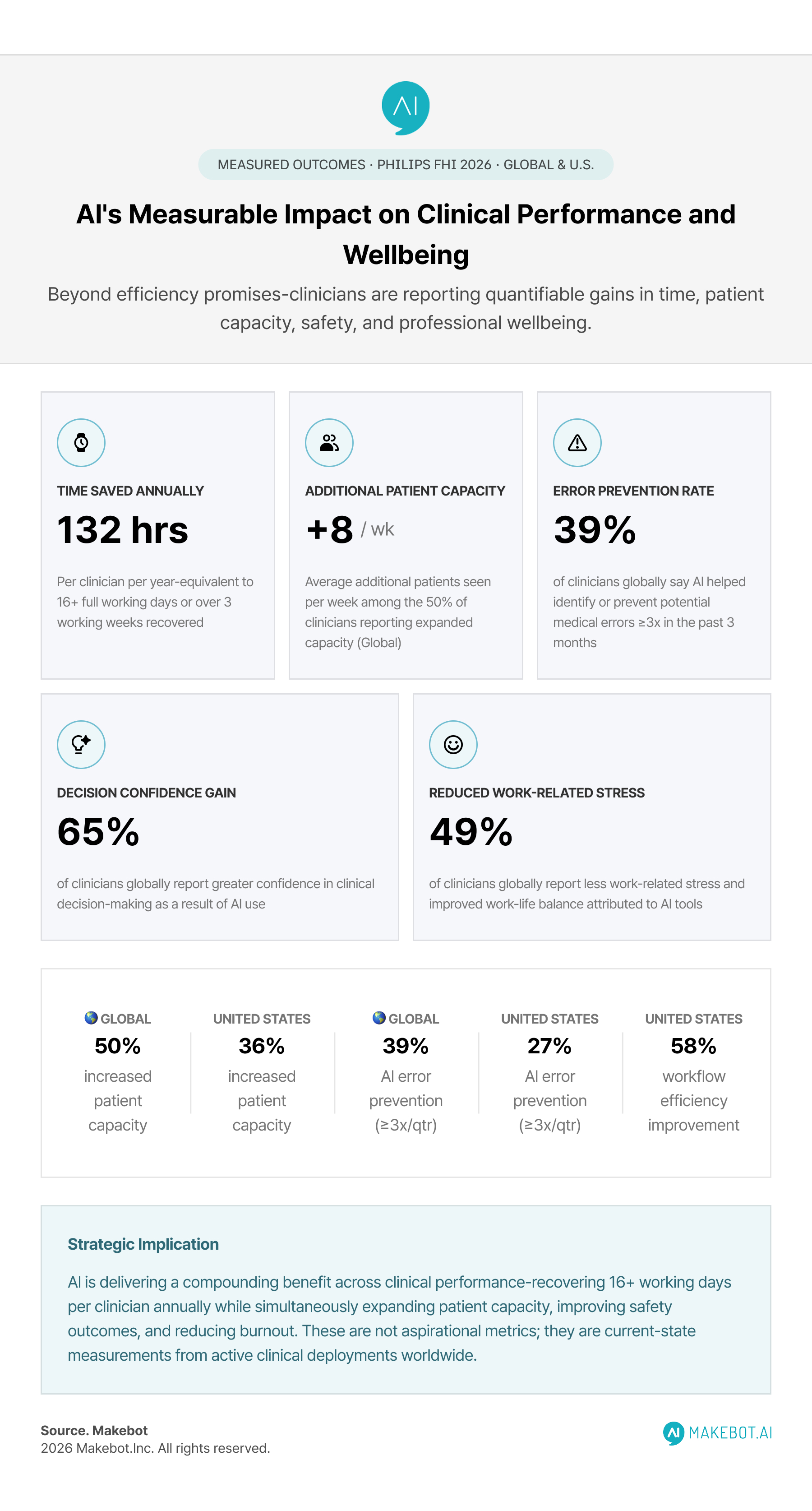
Global report highlights (2,000+ clinicians, 10 countries):
- AI saves clinicians an average of 132 hours per year-equivalent to more than 16 full working days, or over three working weeks (46% of clinicians globally report this level of savings)
- 50% of clinicians globally report they now have more capacity to see patients, at an average of eight additional patients per week
- 65% report greater confidence in clinical decision-making
- 39% say AI has helped identify or prevent potential medical errors at least three times in the past three months
- 49% report less work-related stress and a better work-life balance as a result of AI use
U.S.-specific findings from the companion report:
- 36% of U.S. clinicians say AI has increased their capacity to see patients, with a median increase of five additional patients per week
- 58% report workflow efficiency improvements and 54% see improved speed in diagnostic decision-making
- 36% report less work-related stress, 35% cite better work-life balance, and 32% say they work less overtime
- 27% report AI identified or prevented potential medical errors at least three times in the past three months
- 77% describe AI training as inadequate, inconsistent, or unavailable-higher than the global figure of 70%
These figures carry weight precisely because they come from clinicians themselves, not vendors or technology advocates. When 39% of healthcare professionals globally report that AI has caught potential errors multiple times in a single quarter-and a separate U.S.-focused analysis puts that figure at 27%-it signals something more than workflow convenience: a meaningful patient safety dividend across both markets.
The burnout dimension deserves equal attention. In 2025, physician burnout rates remained at 54% according to compiled healthcare workforce data, down from 60% but still at crisis levels. AI tools that demonstrably reduce documentation burden and overtime hours are doing more than improving productivity; they are addressing one of the most destabilizing workforce challenges in modern medicine. As Philips CMO Carla Goulart Peron noted in the report: "Half of the clinicians we surveyed report experiencing less stress and a better work-life balance"-a figure borne out by the global data showing 49% reporting reduced work-related stress.
KPMG: AI's Extensive Adoption in Healthcare. Discover what’s next here!
The Training Gap: Adoption Without Preparation
Here is where the Philips report delivers its most urgent finding-and its most uncomfortable one.
Despite the widespread adoption and measurable benefits described above, 70% of clinicians globally report that AI training available to them is inadequate, inconsistent, or simply unavailable. In the U.S., Philips' companion report found that figure reaches 77%-even higher than the global average-and that 72% of U.S. clinicians turn to personal AI tools when workplace options don't meet their needs.
This is not a minor operational footnote. It represents a fundamental structural failure in how health systems have approached AI training in healthcare. Organizations have enabled AI tool access without building the scaffolding necessary for clinicians to use those tools safely, accurately, or confidently.
What clinicians say they need most:
- How to check the accuracy of AI recommendations-the top-cited training gap
- How to navigate and operate AI tools effectively in clinical workflows
- How to understand legal liability when AI is involved in clinical decisions
These are not abstract skill gaps. They are the core competencies required to use AI responsibly in a care environment. When a clinician cannot reliably evaluate whether an AI-generated diagnostic suggestion is accurate, the technology's patient safety benefits become double-edged. The same capability that flags a dangerous drug interaction can, if blindly trusted without proper verification skills, introduce its own form of clinical risk.
The legal dimension is also increasingly pressing. As medical AI becomes more deeply embedded in diagnostic and treatment workflows, clinicians face genuine exposure around documentation, attribution, and accountability when AI is in the clinical loop. The Philips data suggests most healthcare professionals are navigating this landscape without formal guidance.
RAG vs. Fine-Tuning in Healthcare AI: Which Model Predicts Patient Outcomes Better? Explore the future of AI here!
Shadow AI: The Inevitable Consequence of an Unmet Need
When institutional AI tools fail to meet clinical needs-and when training is absent-clinicians do not simply disengage. They find alternatives. This dynamic is producing what the industry now calls "shadow AI": the use of personal, unauthorized, or consumer-grade AI tools in clinical settings without institutional oversight or HIPAA-compliant safeguards.
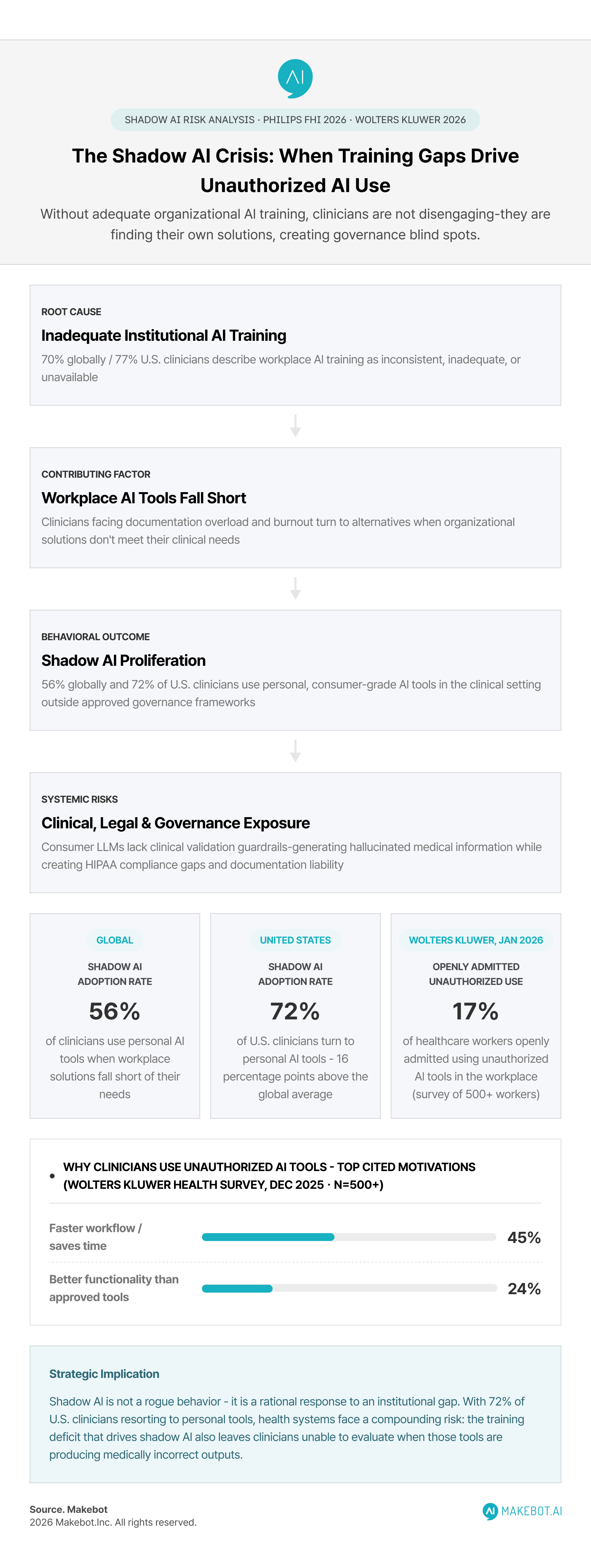
The Philips Future Health Index 2026 found that more than half of clinicians globally (56%) admit to using personal AI tools when workplace solutions do not meet their needs. The U.S.-specific report puts that figure even higher at 72%. In the UK cohort, the global report's 56% figure also held, with healthcare professionals turning to general-purpose tools like ChatGPT to fill the gap left by inadequate enterprise AI.
A complementary December 2025 survey commissioned by Wolters Kluwer Health-covering more than 500 healthcare workers-found that 17% openly admitted to using unauthorized AI tools in the workplace, with 45% citing faster workflow as the primary motivation and 24% pointing to better functionality than approved alternatives.
Wolters Kluwer's own technology experts noted in their 2026 healthcare AI outlook that "shadow AI surged across healthcare organizations in 2025", driven by burnout, staffing shortages, and the gap between approved tools and clinician needs. Their recommendation: health systems must move urgently to deploy purpose-built Generative AI in healthcare workflows-tools that are rigorously validated, transparent with source citations, and built with expert-in-the-loop oversight rather than consumer-grade alternatives.
The risk is not simply a governance headache. Consumer-grade large language models can produce medically plausible but factually incorrect information-so-called "hallucinations"-without the validation layers and clinical knowledge guardrails built into purpose-built healthcare AI assistants. When clinicians lack training in AI evaluation, they are less equipped to recognize these errors, compounding the problem.
McKinsey: How AI in Healthcare Can Improve Consumer Experiences. See how enterprises are transforming here!
The Readiness Divide: Why Some Health Systems Pull Ahead
The Philips data also surfaces an important structural divergence-between health systems that are realizing significant AI returns and those still struggling to move beyond isolated pilots. This is not simply a matter of technology investment; it is a matter of organizational maturity.
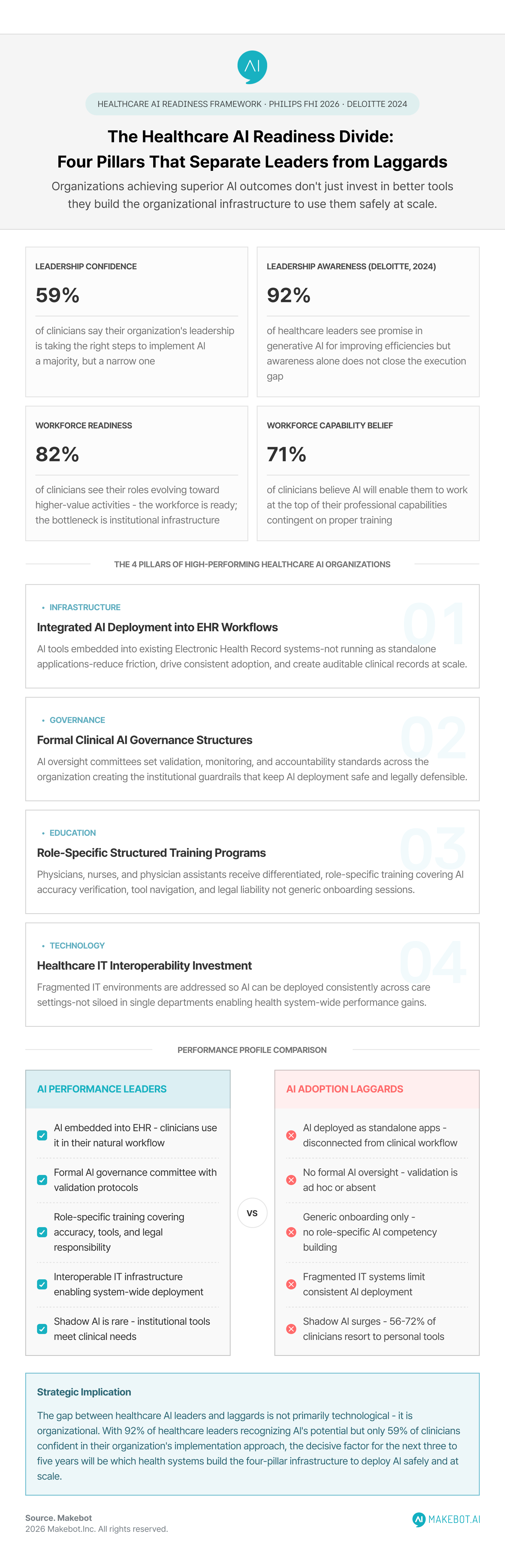
59% of clinicians say their organization's leadership is taking the right steps to implement AI. That is a majority, but a narrow one. And leadership direction alone does not translate to execution readiness when training infrastructure is absent.
The organizations achieving the strongest returns share a recognizable profile:
- Integrated AI deployment: AI tools are embedded into existing EHR workflows rather than running as standalone applications, reducing friction and increasing consistent use
- Clinical governance structures: Formal AI oversight committees set standards for validation, monitoring, and accountability-something IntuitionLabs' hospital AI analysis projects will become standard practice among large health systems by the late 2020s
- Structured training programs: Clinicians receive role-specific instruction on AI tool operation, accuracy verification, and legal responsibility-not ad hoc onboarding
- Interoperability investment: Fragmented healthcare IT environments are addressed, enabling AI to deploy consistently across care settings rather than being limited to a single unit or department
Health systems that lack these foundations tend to cycle through the same pattern: rapid adoption of AI tools, initial enthusiasm, erosion of confidence when errors occur or tools underperform, and eventual retreat to informal workarounds-including shadow AI.
Deloitte's 2024 Life Sciences and Health Care Generative AI Outlook found that 92% of healthcare leaders see promise in generative AI for improving efficiencies, and 65% see it enabling quicker decision-making. The challenge is not awareness or even intent. It is the organizational execution gap between recognizing AI's potential and building the systems required to realize it safely.
Why Healthcare AI Governance Matters More as Models Become More Powerful. Learn how industry leaders are adapting here!
Patients Are Changing Too: The AI-Informed Consultation
One of the most striking dimensions of the Philips 2026 data is what it reveals about patients-not just clinicians.
74% of clinicians report that patients are now arriving at consultations already informed by AI, having used tools like general-purpose chatbots, AI healthcare assistants, or healthcare conversational AI platforms to research symptoms, diagnoses, or treatment options before their appointment. Sixty-three percent of clinicians regard these AI-informed patients as genuine partners in what they describe as an "extended, hybrid care team."
More than half of patients (56%) in the survey expect AI to help them take a more active role in their own care in the future. Deloitte's Healthcare Consumer Survey echoes this: approximately 46% of consumers believe AI will help lower their medical costs, and roughly 80% of Americans express interest or enthusiasm about AI-enabled healthcare advances.
This shift has profound implications for clinical practice. When patients arrive pre-informed by AI, consultations change in character. Clinicians who understand how AI chatbots in healthcare work-their strengths, their tendencies to hallucinate, their variable reliability across medical domains-are better equipped to have productive conversations with AI-informed patients. Those without that training may find themselves navigating patient expectations shaped by tools they have never formally evaluated.
The dynamic reinforces the urgency of structured AI training in healthcare from a patient experience standpoint, not only an operational one.
How Enterprise Hospitals Are Combining RAG with GPT-5 for Safer Healthcare AI Systems. Explore the data and findings here!
What Effective Clinician AI Training Looks Like
Given the depth of the training gap, the natural question is: what would it take to close it? The Philips data points to three priority areas, and industry evidence offers practical frameworks for addressing each.
1. AI Accuracy Verification Clinicians need structured instruction in how to critically evaluate AI outputs-including understanding the conditions under which clinical AI systems are most and least reliable, how to spot hallucinations in diagnostic suggestions, and when to override or escalate beyond an AI recommendation. This is fundamentally a critical thinking skill adapted to a new tool class.
2. Tool Navigation and Workflow Integration Proficiency with AI tools should be built into clinical onboarding and continuous professional development. This means hands-on training with the specific platforms deployed in each clinical environment-whether ambient documentation systems, AI healthcare assistants integrated into the EHR, or clinical decision support modules-not generic AI literacy. Role-specific modules for physicians, nurses, and physician assistants-the three groups surveyed in the Philips study-will differ significantly in scope and emphasis.
3. Legal and Ethical Frameworks Healthcare professionals need clarity on where AI fits within existing documentation standards, malpractice exposure, and informed consent obligations. As medical AI becomes embedded in the diagnostic and treatment record, the legal implications for individual clinicians become increasingly concrete. Organizations that provide formal guidance on these questions will retain clinical staff more effectively and create safer AI deployment environments.
Gartner's analysis of enterprise AI adoption notes that organizations investing in formal AI governance and workforce upskilling programs achieve meaningfully higher returns on AI investments than those relying on informal adoption. In healthcare, the stakes of that governance gap are measured not only in ROI, but in patient outcomes.
Can Generative AI Analyze Medical Data Faster Than Human Researchers? Read the full breakdown here!
The Competitive Imperative: Training as Infrastructure
The Philips Future Health Index 2026 frames the current moment clearly: AI is already delivering measurable impact at the frontline, but health systems risk falling behind because of inadequate training and fragmented infrastructure. This is not a future warning-it describes the current state for the majority of clinical environments globally.
For healthcare executives and technology leaders, the implication is strategic, not merely operational. The organizations that will lead in healthcare AI adoption over the next three to five years will not be those that simply procure the most advanced tools. They will be those that build the organizational muscle to deploy those tools responsibly, train their clinicians to use them confidently, and create the governance frameworks to catch and correct failures before they reach patients.
As 82% of clinicians in the Philips survey see their roles evolving toward higher-value activities-and 71% believe AI will enable them to work at the top of their capabilities-the clinical workforce itself is ready for this transformation. The bottleneck is institutional.
Health systems that close the training gap will extract the full potential of AI in healthcare: more patients seen, fewer administrative hours wasted, errors caught earlier, and clinicians supported in ways that reduce burnout and extend careers. Those that leave the gap unaddressed risk an increasingly fractured AI environment-where shadow AI proliferates, governance erodes, and the technology's clinical promise remains partially realized.
Showcasing Korea’s AI Innovation: Makebot’s HybridRAG Framework Presented at SIGIR 2025 in Italy. Read here!
Conclusion
The Philips Future Health Index 2026 offers one of the most detailed and compelling portraits of AI's frontline impact in healthcare to date. The core message is unambiguous: AI is already working. Clinicians are saving time, seeing more patients, and catching errors they might otherwise have missed. The technology's integration into daily care delivery is no longer a pilot-stage phenomenon-it is a present-tense operational reality.
But the same survey makes equally clear that this progress is fragile without the organizational foundation to support it. Seven in ten clinicians lacking adequate AI training is not a minor capability gap; it is a systemic risk. It is driving shadow AI adoption, creating legal exposure, and leaving health systems unable to extract the full safety and efficiency value that AI is demonstrably capable of delivering.
The opportunity ahead is substantial. Generative AI in healthcare is projected to contribute between $100 billion and $600 billion in savings to the global healthcare system by 2050, according to published estimates. Reaching that ceiling requires treating clinician AI training not as an optional enhancement, but as core clinical infrastructure-on par with EHR literacy, clinical protocols, and patient safety training.
The healthcare organizations that recognize this first will define what AI-enabled care looks like for the next decade.
Healthcare AI That Clinicians Can Actually Trust - and Use Safely
The Philips Future Health Index 2026 makes the challenge clear: AI is already delivering measurable value at the clinical frontline, but without purpose-built tools, structured training, and proper governance, that value remains fragile. Makebot is a leading generative AI and LLM solutions provider trusted by over 1,000 enterprise clients across healthcare, public institutions, finance, and beyond. Unlike general-purpose consumer AI tools driving the shadow AI surge, Makebot's solutions are built with expert-in-the-loop oversight, a hybrid RAG architecture that minimizes hallucinations, and transparent source citations - giving clinicians and healthcare organizations the validated, governed AI infrastructure needed to deploy confidently, not just quickly.
See how Makebot helps healthcare organizations move beyond shadow AI.










.jpg)

What Happens to Marketing When the C-Suite Starts Using AI Every Day?







Why AI Shopping Assistants Will Replace Traditional Ecommerce Search





.jpg)























Why Generative AI Projects Fail and How to Achieve Scalable AI Success










.jpg)

.png)