What Separates AI Leaders from AI Followers?
Agentic AI handles 15-step workflows autonomously - Gartner: 33% of enterprise apps embed agents.


Introduction
Every enterprise now claims an AI strategy. Board decks feature generative AI, AI chatbot deployments, and pilot dashboards. Yet beneath this near-universal enthusiasm sits an uncomfortable pattern showing up across every major research house tracking corporate AI: adoption has become common, but measurable value has not. McKinsey, BCG, and MIT independently arrive at strikingly similar figures - a small cohort of companies, often under 10% of those surveyed, are capturing outsized returns while the rest remain stuck running pilots that never touch the balance sheet. This article examines what the data actually shows about that divide, why it persists, and what separates the enterprises compounding advantage from AI investment from those merely spending on it.
Why AI Pilots Stall After POC (And How to Fix It). Explore the latest insights here!
The Adoption Boom Has Outpaced the Value Boom
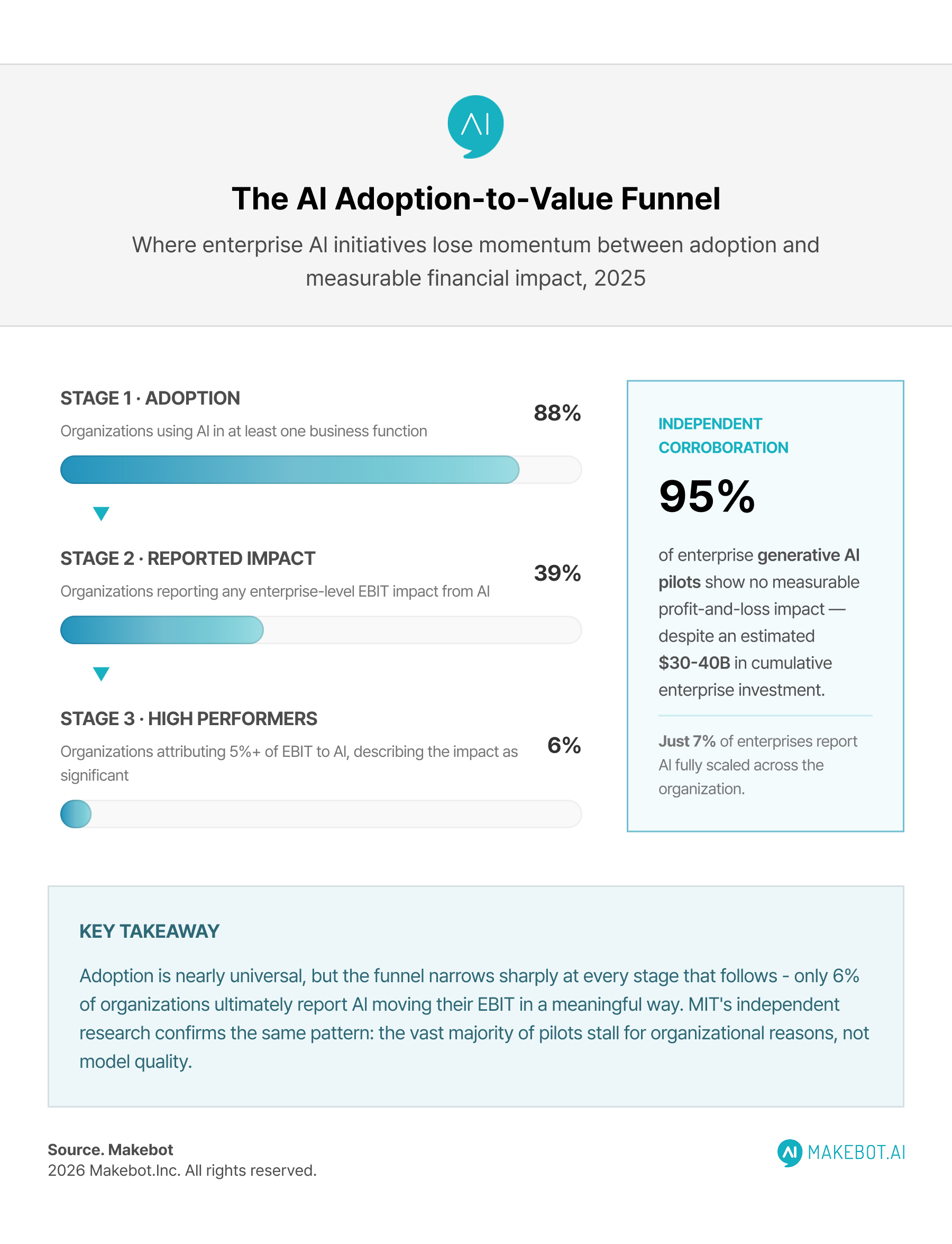
The headline number is no longer in question: enterprise AI adoption is close to universal. McKinsey's 2025 State of AI survey - fielded June 25 to July 29, 2025, with 1,993 respondents across 105 countries - found that 88% of companies now use AI in at least one business function, up from 78% a year earlier. Stanford HAI's 2025 AI Index corroborates the trend from a different angle, reporting that 78% of organizations used AI in 2024, up sharply from 55% in 2023, alongside a 44.5% jump in global corporate AI investment to $252.3 billion.
But adoption and impact have decoupled. McKinsey's same survey found that only 39% of organizations report any enterprise-level EBIT impact from AI at all, and most of those attribute less than 5% of EBIT to it. Just 6% qualify as "AI high performers" - reporting 5% or more of EBIT tied to AI and describing the impact as significant. BCG's AI Radar, surveying 1,803 C-suite executives across 19 countries, found an almost identical pattern from the leadership side: 75% name AI a top-three strategic priority, yet only 25% say they're realizing significant value. A separate, larger BCG maturity study (Build for the Future 2025, n=1,250 global firms) puts the top "future-built" tier at just 5% of companies, with roughly 4% self-reporting they've created substantial value from AI.
- 88% of organizations use AI in at least one function (McKinsey, 2025)
- 6% qualify as AI high performers with 5%+ EBIT impact (McKinsey, 2025)
- 25% of executives report significant value realization (BCG AI Radar, 2025)
- $252.3B in global corporate AI investment in 2024, up 44.5% YoY (Stanford HAI)
The consistency across three independent methodologies - surveys, executive interviews, and maturity scoring - is what makes this gap credible rather than anecdotal. This is not one consulting firm's narrative; it is a convergent finding.
Vibe Coding Got You to a Demo. It Won't Get You Past POC. Read the expert analysis here!
Why Most AI Pilots Never Reach the P&L
MIT's Project NANDA delivered the most blunt articulation of the problem in its 2025 report, The GenAI Divide: State of AI in Business. Drawing on a systematic review of more than 300 publicly disclosed enterprise AI initiatives, structured interviews with 52 organizations, and survey responses from 153 senior leaders, the researchers found that roughly 95% of enterprise generative AI pilots showed no measurable effect on profit and loss - this despite an estimated $30-40 billion in cumulative enterprise spending. Only about 5% of pilots were extracting meaningful value. This is a preliminary, industry-published study from MIT Media Lab's NANDA initiative rather than peer-reviewed academic research, and it relies partly on self-reported outcomes - but the headline 95%/5% split is consistently repeated across every outlet that has covered the report.
The report's authors were explicit that the failure isn't a model-quality problem. Two structural issues recur:
- Budget misallocation. Roughly half of surveyed generative AI budgets went to visible, high-profile functions like sales and marketing, while some of the clearest, most durable returns showed up in less glamorous back-office automation.
- Build-vs-partner mismatch. Pilots built on customized, externally partnered tools that could learn from workflow feedback reached deployment about twice as often as internally built, static tools, according to MIT's interview sample.
Deloitte's own tracking tells a compatible story, drawn from two of its survey waves. In its quarterly State of Generative AI in the Enterprise research (surveying roughly 2,800 leaders), 74% of organizations say their most advanced generative AI initiatives meet or exceed ROI expectations, with about 20% reporting returns above 30%. Yet Deloitte's broader 2025 State of AI in the Enterprise survey - 3,235 business and IT leaders across 24 countries, fielded August-September 2025 - found only 34% of organizations are truly reimagining their business around AI, and just one in five have a mature governance model for autonomous AI agents. In other words: where companies do invest with discipline, ROI on the most advanced initiatives shows up - but that discipline, and the organizational redesign behind it, is still the exception rather than the rule.
Why AI-Powered Customer Journey Mapping Is Becoming Essential for Enterprise Growth. Discover what’s next here!
What the High Performers Actually Do Differently
Across McKinsey, BCG, and MIT, the same behavioral markers separate AI leadership from AI following. None of them are primarily about which large language model a company licenses.
1. They treat AI as transformation, not efficiency add-on.
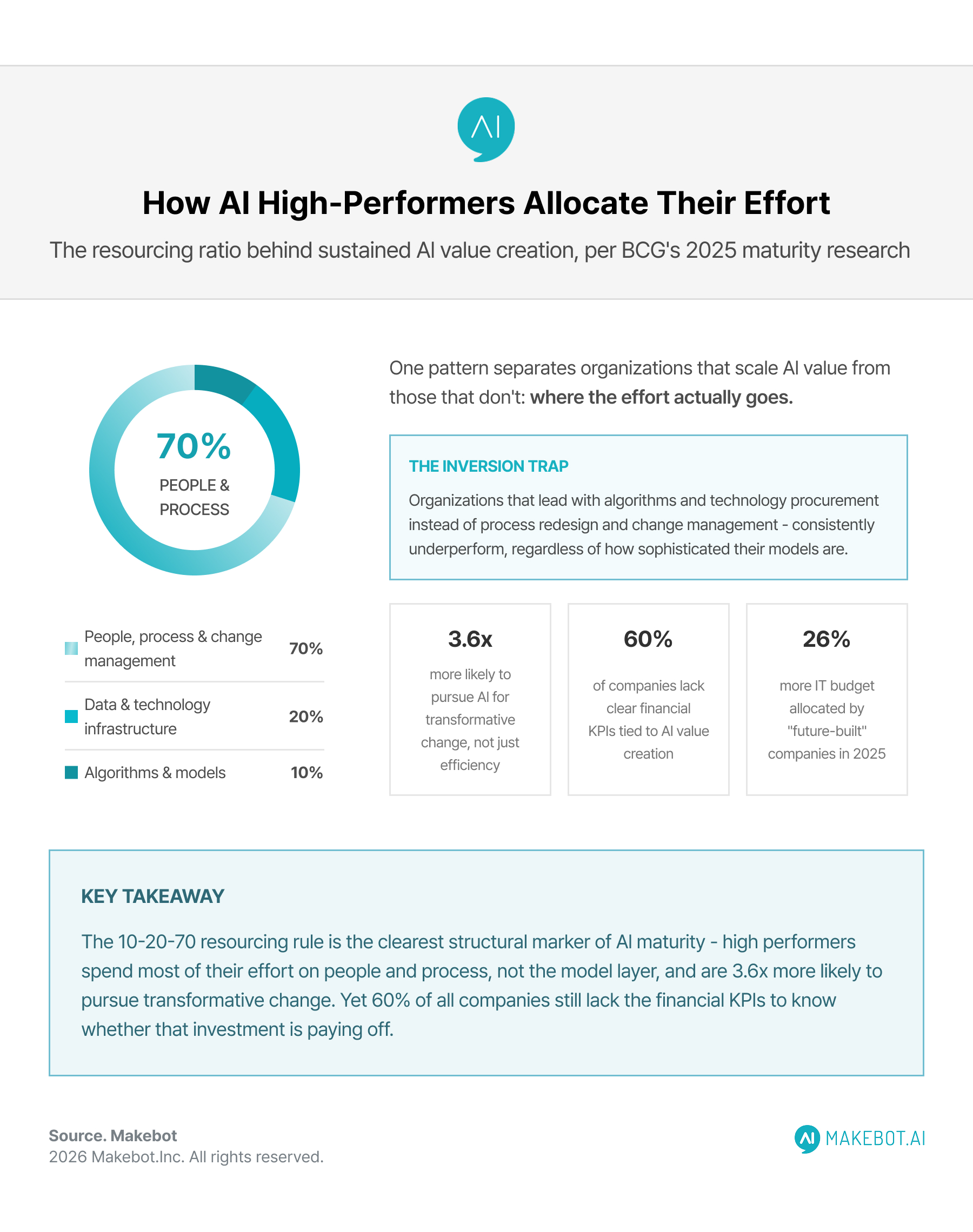
McKinsey found high performers are 3.6 times more likely to say they intend to use AI for transformative change over the next three years, rather than incremental efficiency. While 80% of all respondents cite efficiency as an objective, high performers layer in revenue growth and AI innovation as explicit goals - and 55% of them report fundamentally reworking workflows when deploying AI, rather than bolting it onto existing processes.
2. They resource people and process over algorithms.
BCG's research distills this into a simple ratio that recurs across its AI Radar and Build for the Future studies: successful organizations dedicate about 10% of AI effort to algorithms and models, 20% to data and technology infrastructure, and 70% to people, process redesign, and change management. Companies that invert this ratio - treating AI as primarily a technology procurement exercise - consistently underperform.
3. They measure value with financial discipline.
BCG found 60% of companies lack clear financial KPIs tied to AI value creation at all. High performers close that gap early, tracking use-case-level cost and revenue impact rather than adoption metrics like number of licenses or pilots launched.
4. They invest disproportionately once early signal appears.
BCG's "future-built" cohort - its top maturity tier - plans to spend roughly 26% more on IT overall and dedicate up to 64% more of that IT budget to AI in 2025 than the average firm. The report projects this cohort will see roughly double the revenue increase and 40% greater cost reduction by 2028 in the areas where they apply AI, versus laggards.
5. They govern agentic AI deliberately rather than reactively.
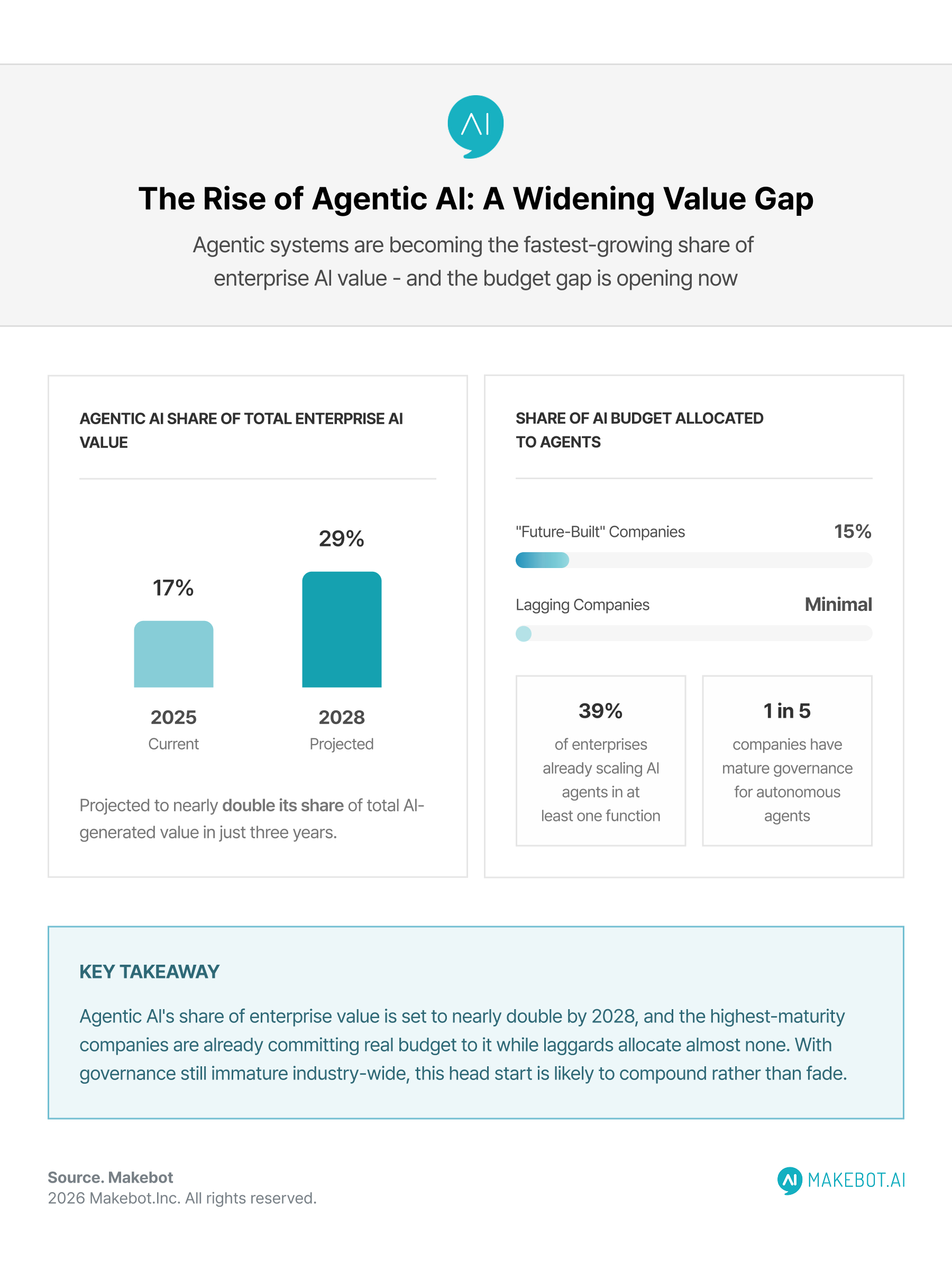
Agentic AI - systems capable of planning and executing multi-step tasks - is moving from pilot to production fastest among high performers. McKinsey found 23% of enterprises are already scaling AI agents in at least one function, concentrated in IT, knowledge management, and engineering. BCG estimates agents already account for about 17% of total AI-generated value in 2025, projected to reach 29% by 2028 - and future-built companies allocate roughly 15% of their AI budgets specifically to agents, versus almost none among lagging firms.
How Generative AI Is Reshaping Brand Strategy and Digital Advertising. Explore the future of AI here!
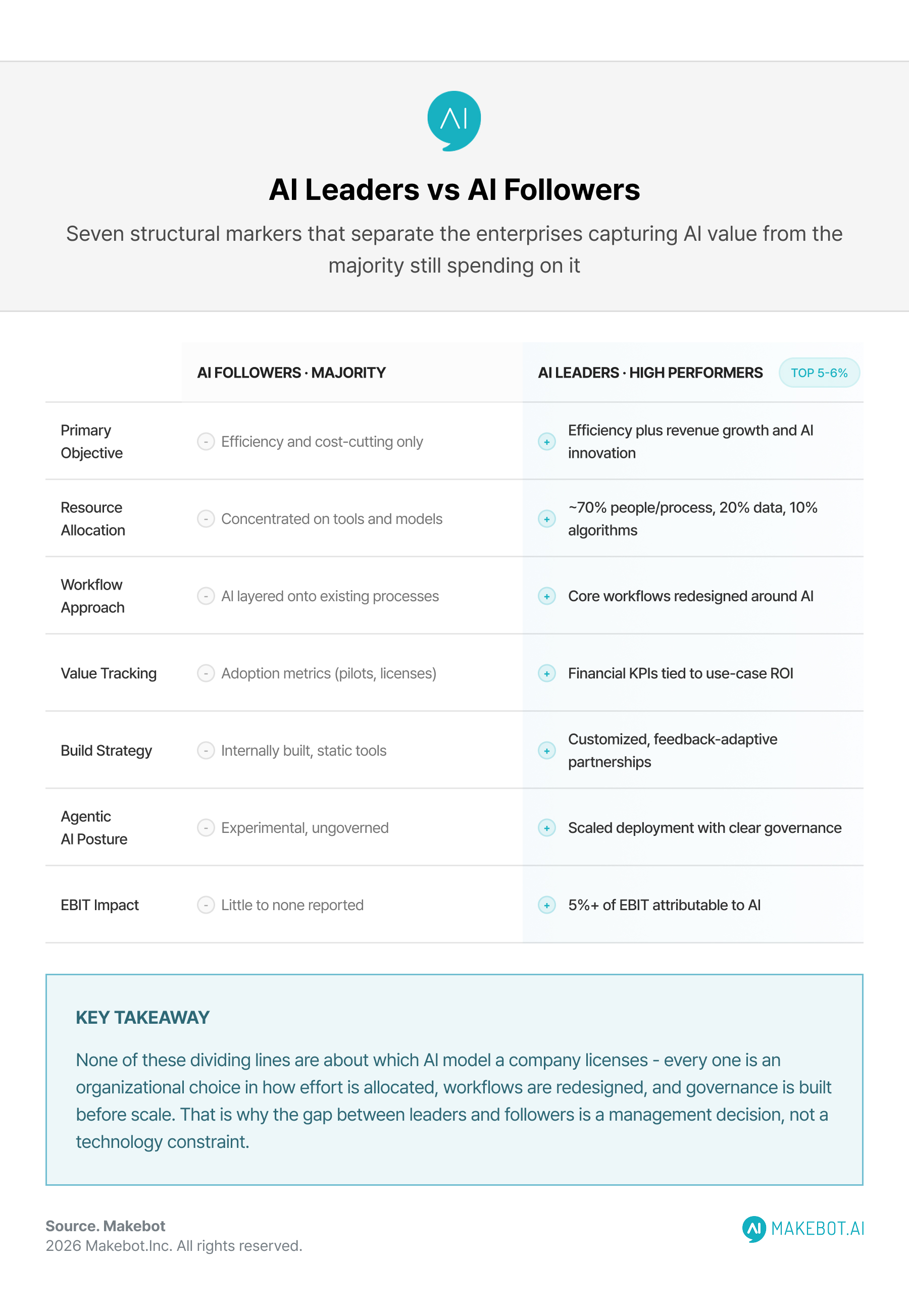
Sources: McKinsey, The State of AI: Global Survey 2025; BCG, Are You Generating Value from AI? The Widening Gap; MIT NANDA, The GenAI Divide 2025.
Common Failure Points When Scaling Enterprise AI
Even organizations with genuine ambition tend to stall at recognizable points in the journey:
- Pilot purgatory: McKinsey found roughly two-thirds of organizations have not begun scaling AI across the enterprise; only about a third have moved past isolated experiments, and just 7% report AI fully scaled.
- Data readiness gaps: Siloed, inconsistent, or poorly governed enterprise data routinely undercuts pilots built on clean, curated datasets that don't reflect production reality.
- The skills gap: Deloitte identifies the AI skills gap as the top barrier to further integration, ahead of budget or technology constraints.
- Shadow AI usage: MIT's research found employees in the large majority of surveyed firms use personal, unsanctioned AI tools even when official pilots underperform - a signal that official deployments aren't meeting real workflow needs.
- Governance lag on agents: Only about one in five companies report a mature governance model for autonomous AI agents, even as agentic deployment accelerates.
None of these are technology failures in the strict sense. They are organizational and operational failures wearing a technology label - which is precisely why simply upgrading to a newer LLM or adding RAG-based retrieval rarely closes the gap on its own.
7 Proven Factors That Drive AI ROI in 2026, According to a Survey of 1,000+ Executives. See how enterprises are transforming here!
The Strategic Case for Getting This Right Now
The compounding nature of the gap is the part boards tend to underweight. BCG's modeling suggests future-built companies aren't just ahead today - they're pulling away, projected to see roughly double the revenue growth and 40% greater cost reduction than laggards by 2028 in the business areas where AI is applied. That's a widening gap, not a stable one. Combined with Stanford HAI's finding that global corporate AI investment already exceeds $250 billion annually and continues compounding, the cost of staying in the 94% "follower" cohort is not stagnation - it's relative decline against competitors who are converting the same technology into structural advantage.
For enterprise decision-makers, the practical implication is straightforward: AI transformation decisions should be evaluated less on model selection and more on organizational readiness - data infrastructure, workflow redesign capacity, governance maturity, and whether financial KPIs exist before a pilot launches, not after it "succeeds" on adoption metrics alone.
Showcasing Korea’s AI Innovation: Makebot’s HybridRAG Framework Presented at SIGIR 2025 in Italy. Read here!
Conclusion
The evidence from McKinsey, BCG, Deloitte, MIT, and Stanford HAI converges on an uncomfortable but clarifying truth: near-universal AI adoption has not produced near-universal value. The enterprises pulling ahead are not doing so because they access superior models - frontier LLM capability is increasingly commoditized and available to everyone. They pull ahead because they treat AI as an organizational transformation program, backed by disciplined resourcing, workflow redesign, and financial accountability, rather than a technology deployment checked off a list. As agentic AI, RAG architectures, and AI-native workflows mature further, the gap between the disciplined 5-6% and everyone else is more likely to widen than close. The companies that internalize this now - treating AI leadership as an operating-model choice rather than a procurement decision - are the ones most likely to still be called leaders when the next survey cycle runs.






.jpg)


What Happens to Marketing When the C-Suite Starts Using AI Every Day?







Why AI Shopping Assistants Will Replace Traditional Ecommerce Search





.jpg)

























Why Generative AI Projects Fail and How to Achieve Scalable AI Success











.jpg)

.png)