From Rigidity to Ability: The Transition from Rule-Based Chatbot to LLM-Powered Intelligence.
95% of GenAI pilots fail to deliver P&L impact. MIT traces the root cause to the learning gap.

A Sneak Peek into the Makebot AI Strategy Whitepaper
This article is an introductory preview of our full strategy report, “From Rigidity to Ability.” Read on for key insights, or download the full whitepaper for detailed benchmarks and implementation roadmaps.
Key Takeaways
- Legacy decision-tree chatbots introduce heavy operational friction, rigid fallback loops, and escalating engineering maintenance debt as enterprise operations expand.
- Over 95% of enterprise Generative AI pilots fail to deliver measurable P&L impact due to structural “learning gaps”, systems that lack memory, workflow integration, and governance.
- The complete framework, technical benchmarks, and step-by-step execution roadmap are available exclusively in the full whitepaper.
DOWNLOAD THE FULL WHITEPAPER
Ready to move beyond rigid decision trees? Download the complete MakebotAI Whitepaper (From Rigidity to Ability) to access our implementation roadmaps, TCO comparison models, and enterprise architecture frameworks.
Download the Full Whitepaper:From Rigidity to Ability: The Transition from Rule-Based Chatbot to LLM-Powered Intelligence
The Hidden Cost of Legacy Automation
For over a decade, enterprise customer operations relied on deterministic decision trees, rule-based scripts mapping static inputs to hardcoded responses. While these systems offered predictable control, their structural brittleness created severe operational friction. As product lines and user bases expanded, these decision trees fractured under the weight of real-world conversational complexity.
When customer queries deviate from prescribed scripts, introducing typos, natural phrasing, or multi-part intent, rule-based bots default to generic fallback loops or force abrupt handoffs to live agents. This pattern generates three compounding costs for the enterprise:
- Escalating Operational Overhead: High fallback rates push routine inquiries back onto human support teams, inflating cost-per-resolution metrics.
- Compound Maintenance Debt: Updating static rule trees requires continuous developer intervention to build, test, and patch new intent branches.
- The Customer Experience Gap: Rigid self-service experiences alienate users, driving lower CSAT scores and increasing churn at critical digital touchpoints.
Why Most Enterprise AI Pilots Never Pay Off
If adoption of Generative AI is nearly universal, why does tangible business value remain so scarce? The most empirical answer comes from MIT’s Project NANDA. Their empirical report, The GenAI Divide: State of AI in Business, combined an evaluation of over 300 public enterprise deployments with 52 corporate interviews and survey data from 153 executive leaders. The findings challenge the assumption that deploying generative tools automatically yields strategic advantage:
- Unrealized Returns: Despite $30–40 billion in enterprise Generative AI expenditure, approximately 95% of pilots fail to deliver measurable P&L impact.
- Workflow Focus Drives Success: Only 5% of integrated pilots capture meaningful, scaled value, and those are built around narrow, well-defined operational workflows rather than generic conversational interfaces.
- The Root Cause: The primary barrier is what MIT researchers term the "learning gap", systems that cannot retain contextual memory, adapt to specific workflow parameters, or improve through continuous feedback loops.
Wrapping a generic LLM inside a support widget without context memory, retrieval pipelines, or backend integration inevitably hits the same operational ceiling as a legacy script.
McKinsey’s research reflects this scaling bottleneck: nearly two-thirds of organizations remain stuck in "pilot purgatory" due to compromised data quality, rigid process architecture, and an absence of financial KPI tracking.
Bridging the Execution Gap:
Overcoming these workflow drop-offs requires pairing conversational interfaces directly with enterprise transaction rails. To explore how integrated architectures eliminate buyer friction, read our analysis on why enterprise AI projects fail before they begin.
To access the full MIT and McKinsey data breakdowns along with our enterprise TCO calculation model, download the complete whitepaper.
The Architectural Shift: Context over Scripts
Overcoming the operational ceiling of legacy automation requires moving from deterministic scripts to probabilistic, context-aware frameworks. Large Language Model (LLM) architectures evaluate intent dynamically while maintaining multi-turn coherence, eliminating the "conversational amnesia" endemic to first-generation bots.
By replacing brittle flowcharts with dynamic intelligence, enterprise teams turn support infrastructure into revenue drivers.
(Note: The full structural comparison table and architectural breakdown between legacy decision trees and LLM-powered systems are detailed in the full whitepaper.)
Enterprise Governance: Conversational RAG
Deploying generative models in regulated, high-trust environments requires strict boundaries to prevent hallucinations and brand damage. Enterprise-grade Conversational Retrieval-Augmented Generation (RAG) solves this through a two-stage pipeline:
- History-Aware Retrieval: Synthesizing multi-turn dialogue into a contextualized query.
- Grounded Generation: Restricting LLM outputs strictly to verified, internal corporate knowledge bases.
This pipeline retains natural fluency while tethering all factual claims to audited enterprise records.
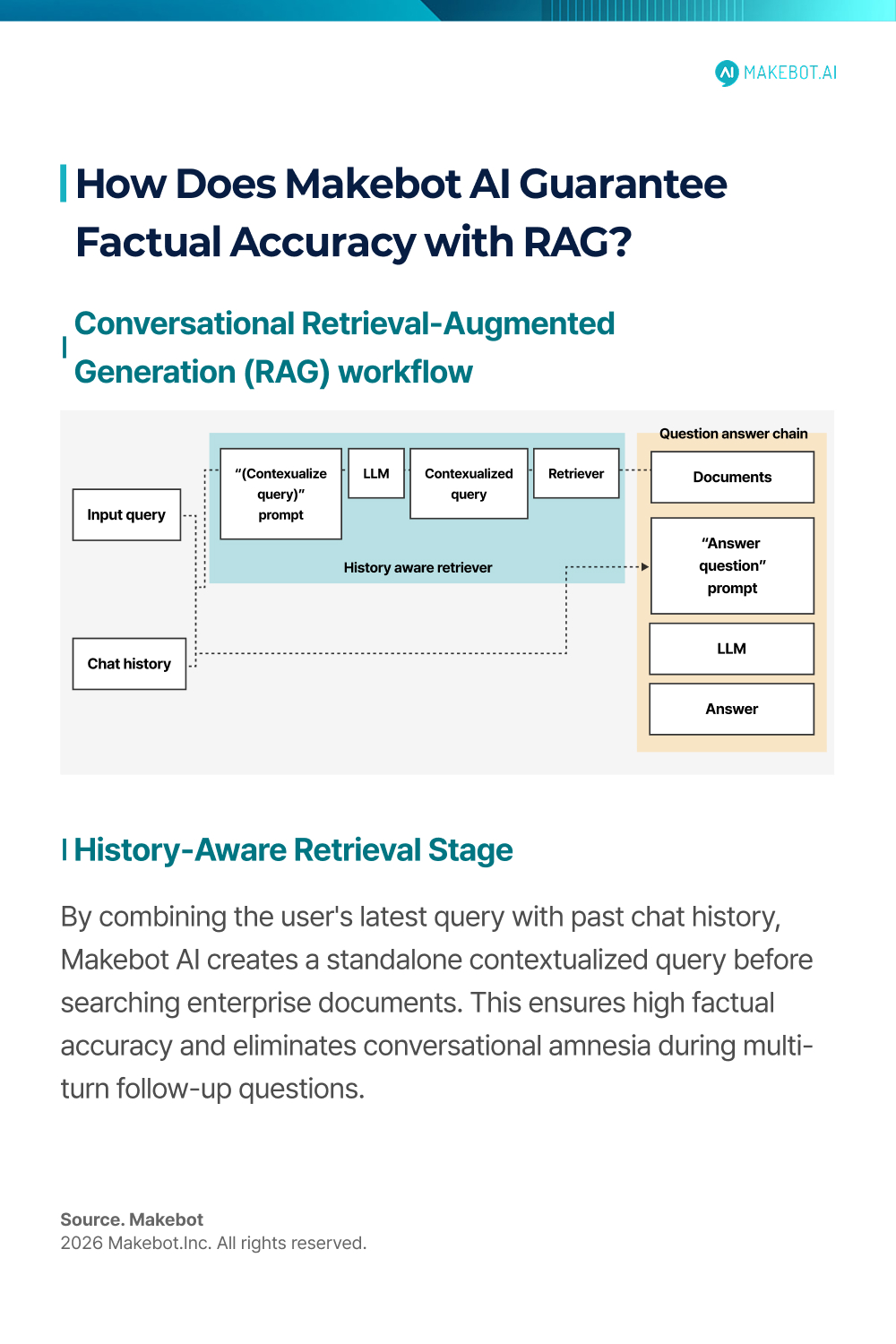
Figure 1: The History-Aware Retrieval-Augmented Generation Pipeline ensures enterprise data compliance.
(Note: The complete technical diagram and security protocol specifications for our permission-aware HybridRAG architecture are locked inside the full whitepaper.)
The Agentic Frontier: Autonomous Execution
The next phase of enterprise maturity transitions systems from passive Q&A tools into active task execution agents. However, Gartner projects that over 40% of agentic AI implementations will be canceled by late 2027 due to uncontrolled execution loops and unclear operational boundaries.
Deploying agentic workflows safely requires narrow operational scoping, permission-aware API rails, and human-in-the-loop validation structures from day one.
What Separates High Performers
A synthesis of research from McKinsey, MIT, and Gartner reveals that performance gaps stem from execution discipline rather than raw model weights:
- Process Redesign: Restructuring core workflows yields substantially higher returns than layering AI onto legacy systems.
- Data Infrastructure Readiness: Enterprise scaling fails when hand-curated pilot data meets production-level retrieval complexities.
- Governance Maturity: Gartner data shows 45% of high-maturity organizations sustain production AI for three years or longer, compared to only 20% of low-maturity peers.
Strategic Conclusion: Unlocking the Full Execution Roadmap
Transitioning from decision trees to governed, LLM-powered intelligence represents a fundamental shift in enterprise operating capability. However, technology deployment alone does not guarantee business impact. The organizations bridging the 95% pilot failure gap pair adaptive architectures with strict operational discipline, eliminating hallucinations, controlling execution rails, and measuring ROI through EBIT contribution.
Building this advantage requires strategic clarity and an actionable implementation blueprint.
What You Will Discover Exclusively in the Full Whitepaper:
- The Step-by-Step Implementation Timeline: Phase-by-phase execution roadmap for enterprise deployment.
- The Architectural RAG Diagram: Visual and technical workflow specifications for history-aware retrieval and grounded generation.
- Structural Feature & Comparison Table: Granular technical comparison between legacy decision trees and LLM-powered intelligence systems.

.jpg)


What Happens to Marketing When the C-Suite Starts Using AI Every Day?








Why AI Shopping Assistants Will Replace Traditional Ecommerce Search






.jpg)


























Why Generative AI Projects Fail and How to Achieve Scalable AI Success











.jpg)

.png)