The Hidden Gap in Your E-Commerce Conversion Data
68% of Google searches are zero-click. AI agent traffic grew 7,851% yet most goes untracked.


Key Takeaways
- AI browsers and AI shopping agents now send a large, fast-growing amount of traffic to online stores, but most of it never shows up correctly in normal analytics tools.
- Zero-click searches now make up 68% of all Google searches, and some AI agents can finish a purchase without ever loading a store's checkout page, so the sale never gets recorded.
- Companies keep spending more on AI even though most cannot prove it is paying off. McKinsey found only 6% of companies count as AI "high performers," a number that has not moved in a year.
- The gap between AI winners and everyone else comes down to organization and data, not better AI models. Accenture found only 7% of companies have built the AI-ready data that scaling AI actually requires.
- Stores that changed how they track AI traffic are already seeing the payoff. Shopify found AI-referred sessions convert at almost 50% higher rates than sessions from regular search.
Introduction
Picture this: a shopper compares products and checks out with help from an AI shopping agent. In Google Analytics, that sale gets logged as "Direct," as if the person had typed the store's web address straight into their browser. This is happening across the internet right now.
Agentic browsers, AI tools such as Perplexity Comet, OpenAI's Atlas, and Microsoft Copilot, now research products and, more and more, buy them on a shopper's behalf. During the 2025 holiday season, traffic from generative AI tools to U.S. retail sites jumped 693.4% compared to the year before, according to Adobe Analytics. Salesforce found AI and AI agents drove $262 billion in global holiday sales. This article looks at what is happening to agentic commerce analytics, and how leading brands are fixing it.
Why AI Browsers Changed the Shopping Journey
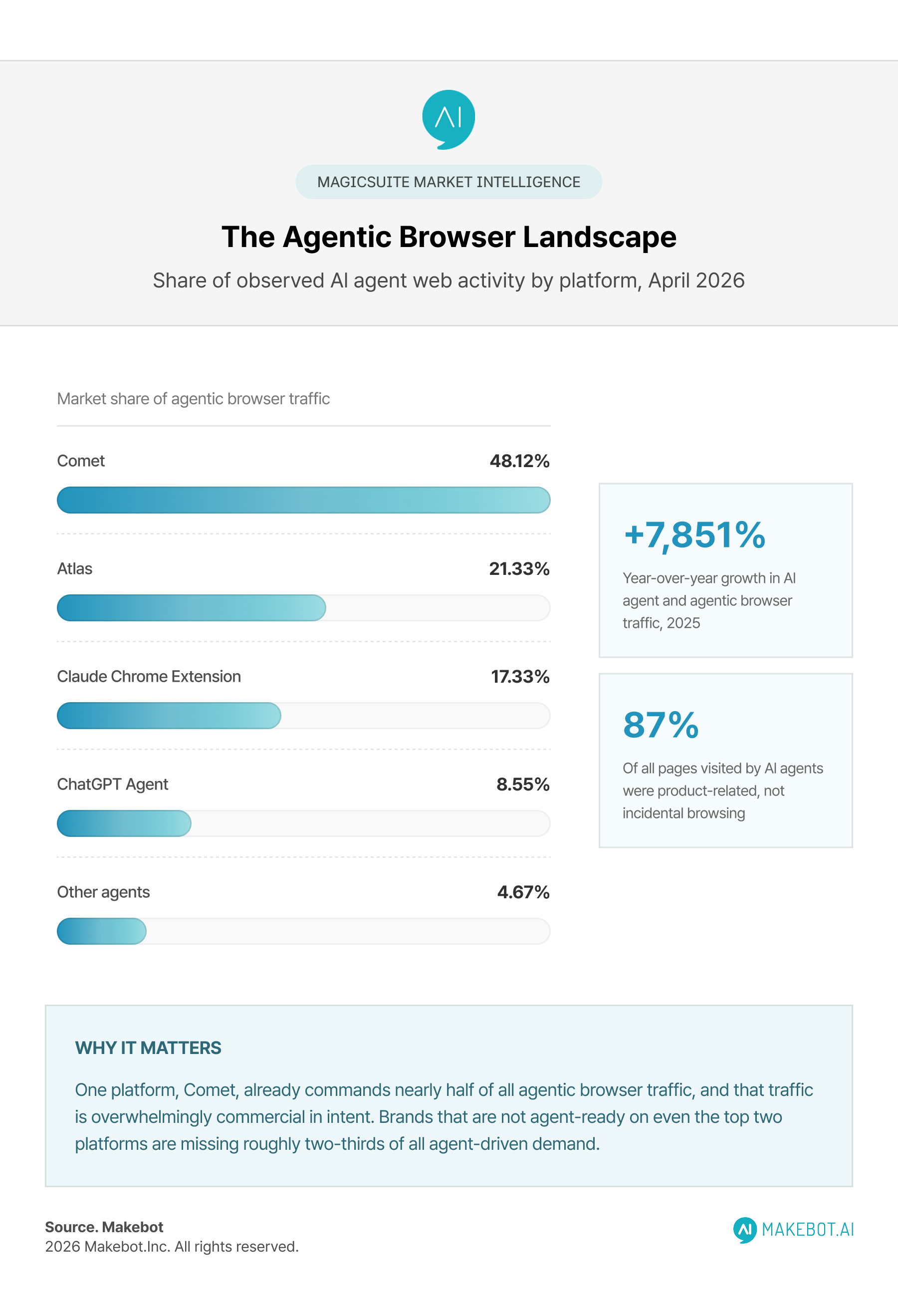
Generative AI in e-commerce went from a novelty to a real, measurable channel almost overnight. According to HUMAN Security's State of Agentic Traffic report for April 2026, one browser, Comet, made up 48% of all AI agent activity HUMAN observed, followed by Atlas (21%), the Claude Chrome extension (17%), and ChatGPT Agent (9%). Three industries, media, e-commerce, and travel, received 98% of all that traffic.
AI-driven traffic has grown fast. HUMAN Security found traffic from AI agents and agentic browsers grew 7,851% year over year in 2025, and automated traffic overall grew eight times faster than human traffic. Shopify's Q1 2026 data shows orders from AI referrals grew almost 13 times in a year. About 87% of pages AI agents visited were related to products: this traffic is not random. It is shopping.
Here is why it disappears. An AI agent researches and buys in ways a normal analytics tag cannot see. Similarweb's research on AI and zero-click search explains that an agent's product review may log as a bot visit with no session attached, and a purchase through a built-in checkout connection can go through without the store's checkout page ever loading. As Similarweb puts it, "your analytics dashboard is completely dark."
Where Your Conversion Data Breaks Down
The core problem with AI traffic attribution is not just that AI visits are invisible. The shift toward AI-powered search has changed how many visits get recorded at all, reshaping e-commerce attribution at its core. Similarweb's data shows zero-click searches now make up 68% of all Google searches, up from roughly 45% ten years ago. That means a large part of the shopping journey happens where analytics cannot see it.
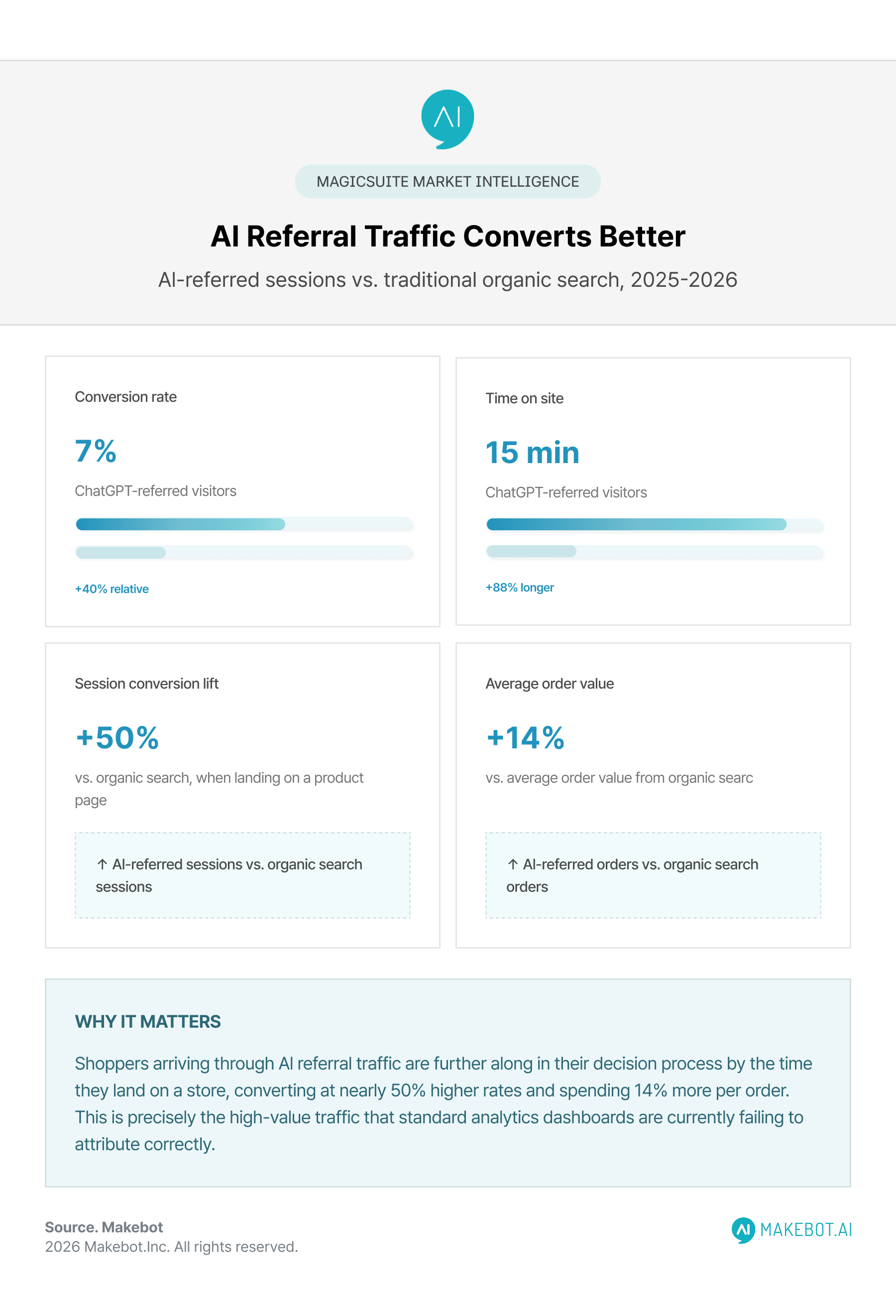
The traffic AI platforms do send matters more than standard reports suggest. Similarweb's 2025 Gen AI Landscape research found ChatGPT-referred visitors to U.S. shopping sites converted at 7%, versus 5% for Google visitors, and spent about 15 minutes on-site versus 8 minutes for Google traffic. Shopify's Q1 2026 data shows AI-referred sessions landing on a product page convert almost 50% higher than organic search, with 14% higher order values. Salesforce found AI and AI agents drove 20% of global retail sales, worth $262 billion, in the 2025 holiday season alone.
In practice, comparing "AI traffic" against paid search in a normal dashboard means comparing a mostly hidden number against a fully visible one. Content that earns AI citations gets no credit, inventory planning leans too heavily on visible channels, and companies that fix this early gain an edge, much like early mobile adopters did before everyone caught up.
The Big AI Spending Problem
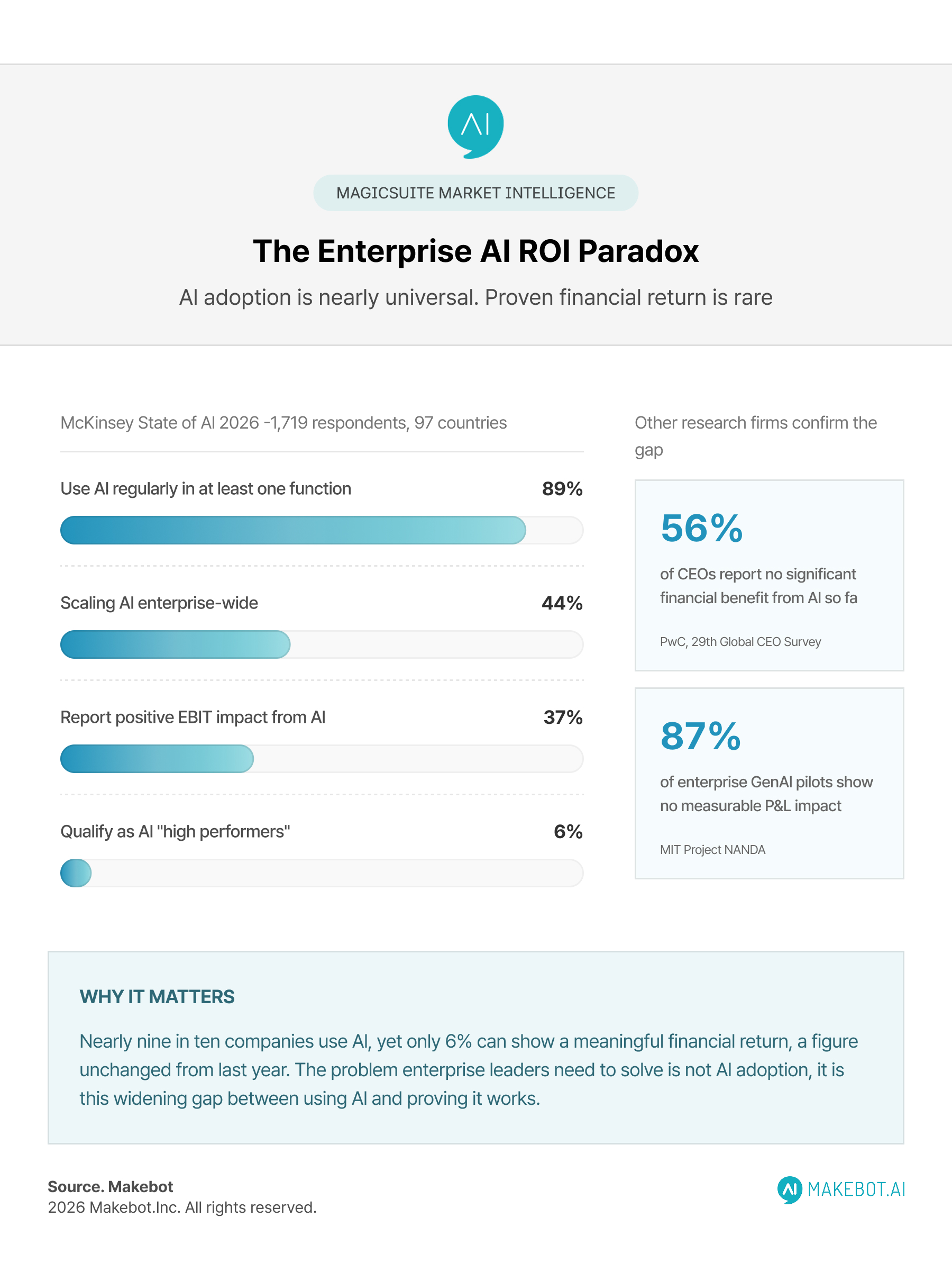
Messy e-commerce data is one symptom of a bigger pattern: companies keep spending more on AI, but proof that it works keeps falling behind. McKinsey's 2026 State of AI survey, covering 1,719 people in 97 countries, found AI use is now close to universal: nearly nine out of ten companies use it regularly, and 44% use it company-wide. Yet only 37% say AI has helped earnings, barely moved since 2025, and only 6% count as AI "high performers."
Other major research groups found the same story. PwC's 29th Global CEO Survey, covering 4,454 CEOs in 95 countries, found 56% have seen no significant financial benefit from AI, and only 12% report both revenue growth and cost cuts. Accenture's 2026 Pulse of Change research found 82% of leaders are increasing AI investment, but only 23% report widespread, lasting value, down from 32% earlier in the year. Deloitte's State of AI in the Enterprise 2026 report found two out of three organizations (66%) report productivity gains, its clearest benefit so far. MIT's Project NANDA found that despite $30 to $40 billion in AI spending, 95% of organizations saw no measurable financial impact from their pilots.
This does not mean AI spending is a mistake. It means most companies are spending well ahead of proof, and broken e-commerce tracking shows that gap clearly.
What Separates AI Winners From Everyone Else
A smaller group of companies has figured this out already. Research points to organization and data, not better AI models, as the reason.
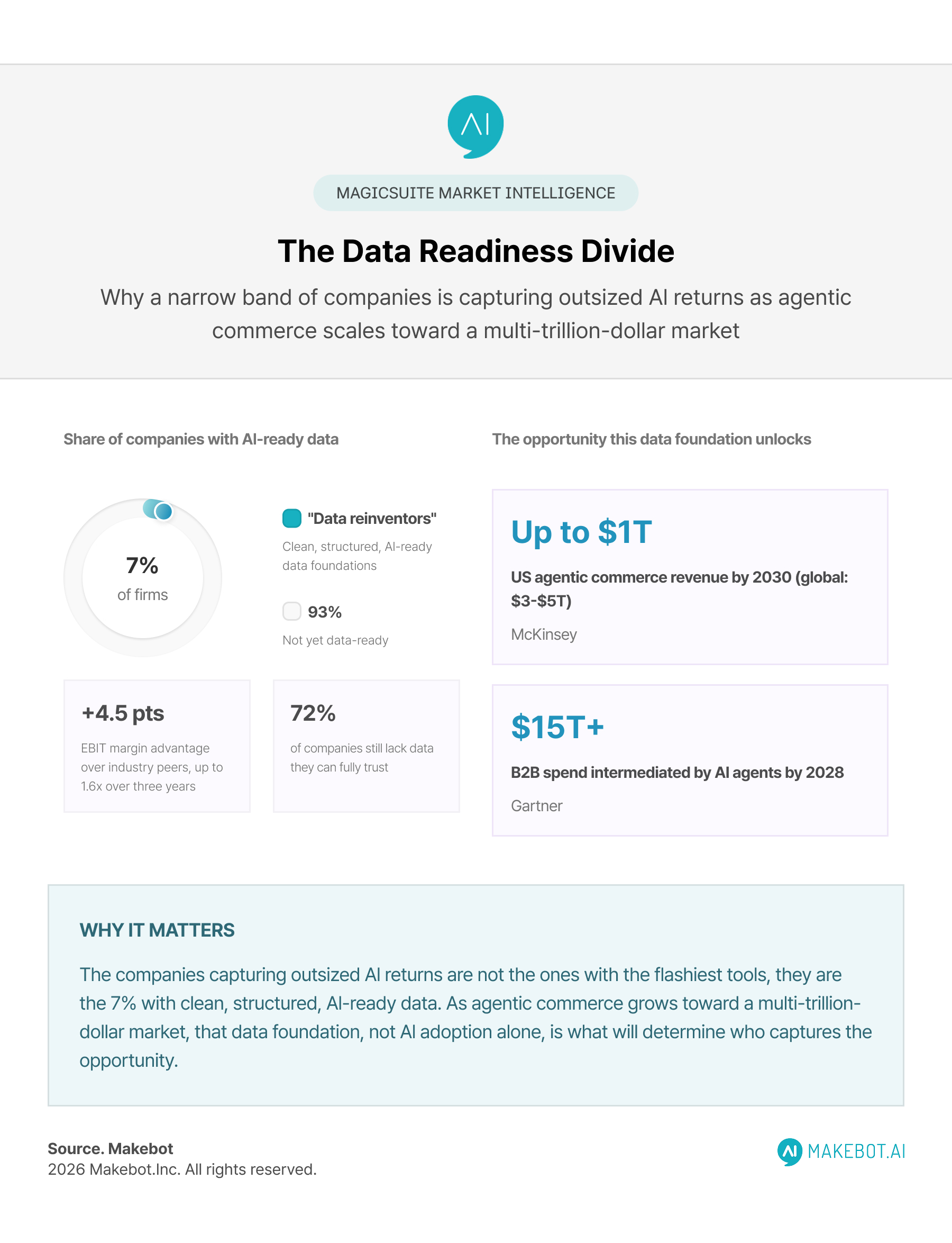
Accenture's AI-Ready Data research, covering 2,000 companies in 15 countries, found only 7% qualify as "data reinventors": companies with the clean, structured data AI needs to scale. Those companies reported a 4.5 percentage point profit margin advantage over competitors, and the same research found 72% of companies still lack data they can fully trust.
A few habits set the winners apart:
- Clean, structured product data. Shopify tells merchants to use detailed, well-organized product listings, since AI platforms recommend products based on data quality, not old-style keyword tricks.
- Track AI referral traffic as its own category. Shopify recommends filtering analytics reports by AI referral source and comparing conversion rate, order value, and revenue per session against organic search.
- Fix data before spending more on AI. Accenture's research ties real financial results to data readiness, not AI adoption alone.
- Redesign how work gets done. McKinsey found almost three out of four high performers redesigned their workflows because of AI, versus about one out of four other companies.
Where This Is Heading
Agentic commerce, shopping powered and completed by AI agents, is becoming a real part of online retail. McKinsey estimates that by 2030, it could generate up to $1 trillion in U.S. retail sales alone, with global sales reaching $3 to $5 trillion. Gartner predicts that by 2028, AI agents will handle 90% of B2B buying, worth more than $15 trillion.
That growth comes with a warning: Gartner also predicts more than 40% of current AI agent projects will be canceled by the end of 2027, due to rising costs and unclear value. The companies that benefit most will not be the fastest movers. They will be the ones who fixed their data first.
Conclusion
AI browsers have not just changed how people shop. They have quietly broken the assumptions e-commerce analytics tools were built on, adding to a bigger issue: heavy AI spending with uneven results. Closing that gap means tracking AI visits as their own category, cleaning up product data, and building for AI agents from the start. Companies doing this are not just seeing their AI referral traffic more clearly. They are converting more of it into sales.
Your Analytics Problem Has an Infrastructure Answer
AI agents are converting sales your current tools never record. The fix is not a bigger reporting dashboard. It is AI infrastructure built to operate in the same agentic environment your customers already use. Makebot is a leading generative AI and LLM solutions provider trusted by over 1,000 enterprise clients across retail, healthcare, finance, and the public sector. With a proprietary multi-LLM platform, HybridRAG architecture designed to retrieve and reason over structured data with precision, and deep expertise in deploying AI that integrates directly into production workflows, Makebot gives commerce teams the intelligent foundation needed to operate in an agent-first commerce environment, not just track it from the outside.
See how Makebot builds AI infrastructure for the agentic commerce era









.jpg)


What Happens to Marketing When the C-Suite Starts Using AI Every Day?







Why AI Shopping Assistants Will Replace Traditional Ecommerce Search






.jpg)

























Why Generative AI Projects Fail and How to Achieve Scalable AI Success










.jpg)

.png)