From SEO to GEO: How Enterprise Marketing Teams Are Optimizing Content for Generative AI Search
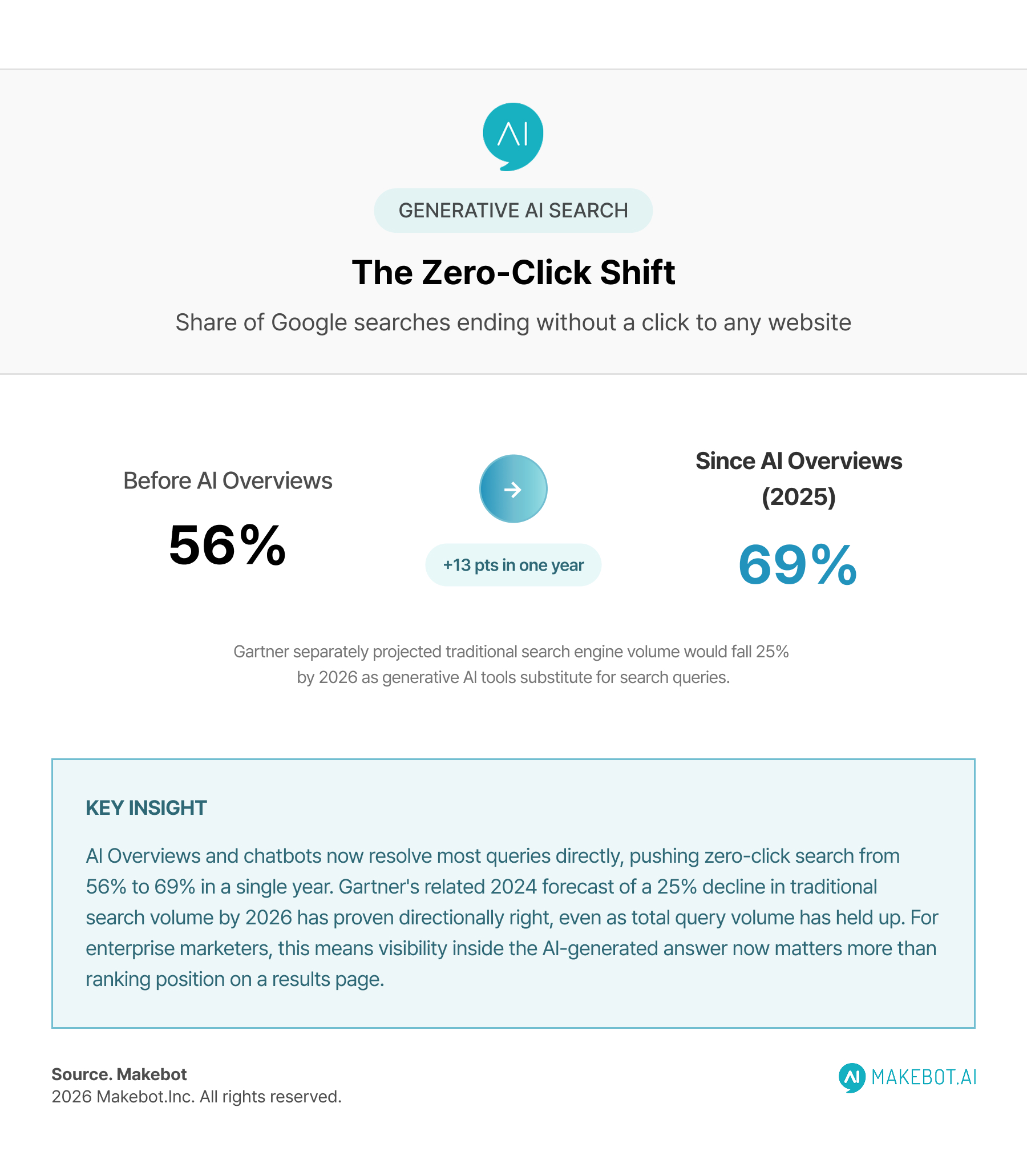
Zero-click search jumped from 56% to 69% in a year, forcing marketers toward GEO.

Introduction
For three decades, enterprise marketing measured success in rankings and clicks. That model is being quietly dismantled. As generative AI search systems like ChatGPT, Google AI Overviews, Perplexity, and Gemini increasingly answer questions directly (without sending users to a website), marketing teams face a structural problem: the traffic-based playbook no longer captures how buyers actually find and evaluate information.
This is the shift from Search Engine Optimization (SEO) to Generative Engine Optimization (GEO): optimizing not for a ranked position in a list of links, but for inclusion inside the answer itself. Marketers who are only now starting to prepare for Generative Engine Optimization are already behind the teams treating it as a 2026 priority. For enterprise marketing teams, this shift changes what "visibility" means, how ROI is measured, and which functions will own the next decade of buyer discovery.
What Actually Changed: From Ranked Links to Cited Answers
Traditional SEO optimized for a simple outcome: appear high enough in a list of blue links that a user clicks through. GEO optimizes for a fundamentally different outcome: that an AI system synthesizes your brand, statistic, or definition directly into its generated response, whether or not the user ever visits your site.
The scale of this shift is no longer speculative:
- Zero-click searches on Google grew from 56% to 69% within a single year following the rollout of AI Overviews, meaning a growing share of queries are now resolved without a single click to any website.
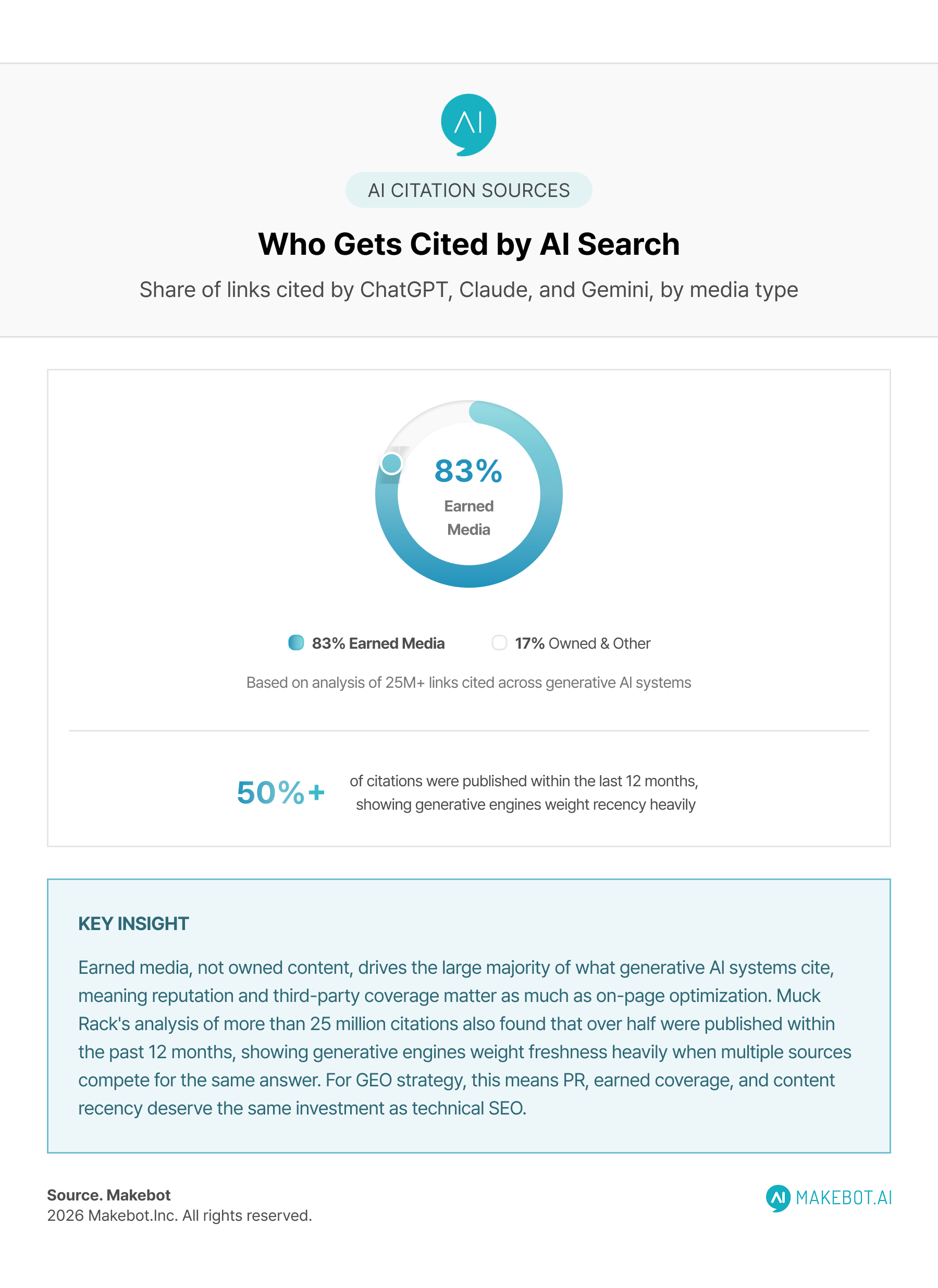
- Earned media accounts for roughly 82–84% of all AI citations, according to Muck Rack's "What Is AI Reading?" research analyzing more than 25 million links cited by ChatGPT, Claude, and Gemini, underscoring that GEO is as much about reputation and coverage as it is about on-page AI content optimization. This mirrors what HubSpot's research found about AI-powered content teams and marketing productivity: the brands investing in structured, high-quality content are the ones pulling ahead.
- Gartner projected in 2024 that traditional search engine volume would fall 25% by 2026 as generative AI tools substitute for search queries. That prediction has proven directionally right but not absolute: dominant search platforms have defended share by embedding AI answers directly into existing search experiences rather than being displaced outright. The practical lesson for marketers isn't that search is disappearing; it's that the surface where answers are consumed has fundamentally diversified.
For enterprise marketing leaders, this reframes the core question. It's no longer just "how do we rank," but "how do we become the source an AI system trusts enough to cite."
Why This Matters Now, Not Later
Industry analysis of the emerging GEO market points to a clear early-mover dynamic, echoing the broader trajectory behind the AI-driven marketing automation market's projected growth toward $81 billion by 2030. Because citation authority (like domain authority before it) tends to compound, teams that build measurement and AI search optimization capability now are positioned to widen that gap rather than close it later.
Enterprise AI Investment Performance: Why Some Organizations Win and Others Stall
GEO doesn't exist in a vacuum. It's one output of a much larger generative AI in marketing transformation, and the data on that broader transformation explains why some organizations are positioned to win at GEO while others struggle to get any AI initiative to deliver measurable value.
McKinsey's 2025 State of AI survey, drawn from nearly 2,000 organizations across roughly 105 countries, captured a defining paradox of the current moment: the overwhelming majority of organizations report regular AI use in at least one business function, yet only about 6% qualify as "high performers" attributing more than 5% of EBIT to AI. Two-thirds of organizations have not yet begun scaling AI across the enterprise; they remain in what researchers have called "pilot purgatory," running isolated experiments that never graduate into production workflows.
That said, function-level performance tells a more encouraging story. McKinsey's research found:
- Cost benefits are most commonly reported in software engineering, manufacturing, and IT functions where AI has been deployed with clear workflow redesign.
- Revenue increases are most commonly reported in marketing and sales, strategy and corporate finance, and product development, a direct signal for teams evaluating generative AI in marketing investment.
- Organizations report a meaningful lift in innovation capacity and competitive differentiation when AI is embedded into core workflows rather than treated as a bolt-on tool.
Deloitte's parallel research, based on a global survey of 3,235 senior leaders conducted in August–September 2025, reinforces the same divide: only about 34% of organizations are using AI to genuinely "reimagine" their business (creating new products and services or redesigning core processes), while the rest are capturing efficiency gains without reaching true transformation. The organizations that manage to convert investment into measurable outcomes share a distinguishing trait: they treat content and knowledge assets with the same governance rigor they apply to any other enterprise system.
.jpg)
What Separates High Performers from Everyone Else
Across McKinsey, Deloitte, and independent research, the same pattern of differentiators recurs:
- Workflow redesign over automation-of-the-old. Organizations that redesign processes around AI's actual capabilities outperform those that simply bolt AI onto existing workflows.
- Governance and human-in-the-loop discipline. High performers manage AI-related incidents through centralized oversight and clear executive accountability rather than ad hoc controls.
- Data and content infrastructure as a prerequisite, not an afterthought. Enterprises with siloed, inconsistent, or unstructured content cannot scale AI search visibility any more than they can scale internal AI pilots built on curated datasets.
- Enablement over shadow AI. McKinsey's research points to a disconnect between how much employees perceive they use AI and how much they actually do. Organizations that formalize training close that gap faster.
This is precisely the profile of organizations succeeding at GEO: they already treat structured content, governance, and measurement as core infrastructure: the same infrastructure that determines whether an AI system can reliably retrieve, trust, and cite their content.
LLM Optimization: The Technical Layer Behind AI Search Visibility
If GEO is the strategy, LLM optimization is the technical practice underneath it: the work of shaping content so that large language models can parse, trust, and reproduce it accurately inside a generated answer. This is a meaningfully different skill set from classic keyword optimization, and it's where many enterprise SEO teams are investing first, often starting with the same question retailers are asking about why enterprise retailers need their own LLM instead of generic AI.
Retrieval-augmented generation (RAG) architectures (the same systems generative engines use to ground answers in current, verifiable information) favor content with specific, structural properties:
- Clear, self-contained passages that answer one question fully rather than requiring the reader to piece together context across a page.
- Explicit, attributable statistics and claims rather than vague or unsourced assertions.
- Consistent terminology and clean semantic structure, so a retrieval system can confidently match a query to the right passage.
- Freshness signals (visible publication and update dates) since more than half of citations observed in generative AI answers were published within the last 12 months, per Muck Rack's analysis, showing generative engines weight recency heavily when multiple sources compete for a citation.
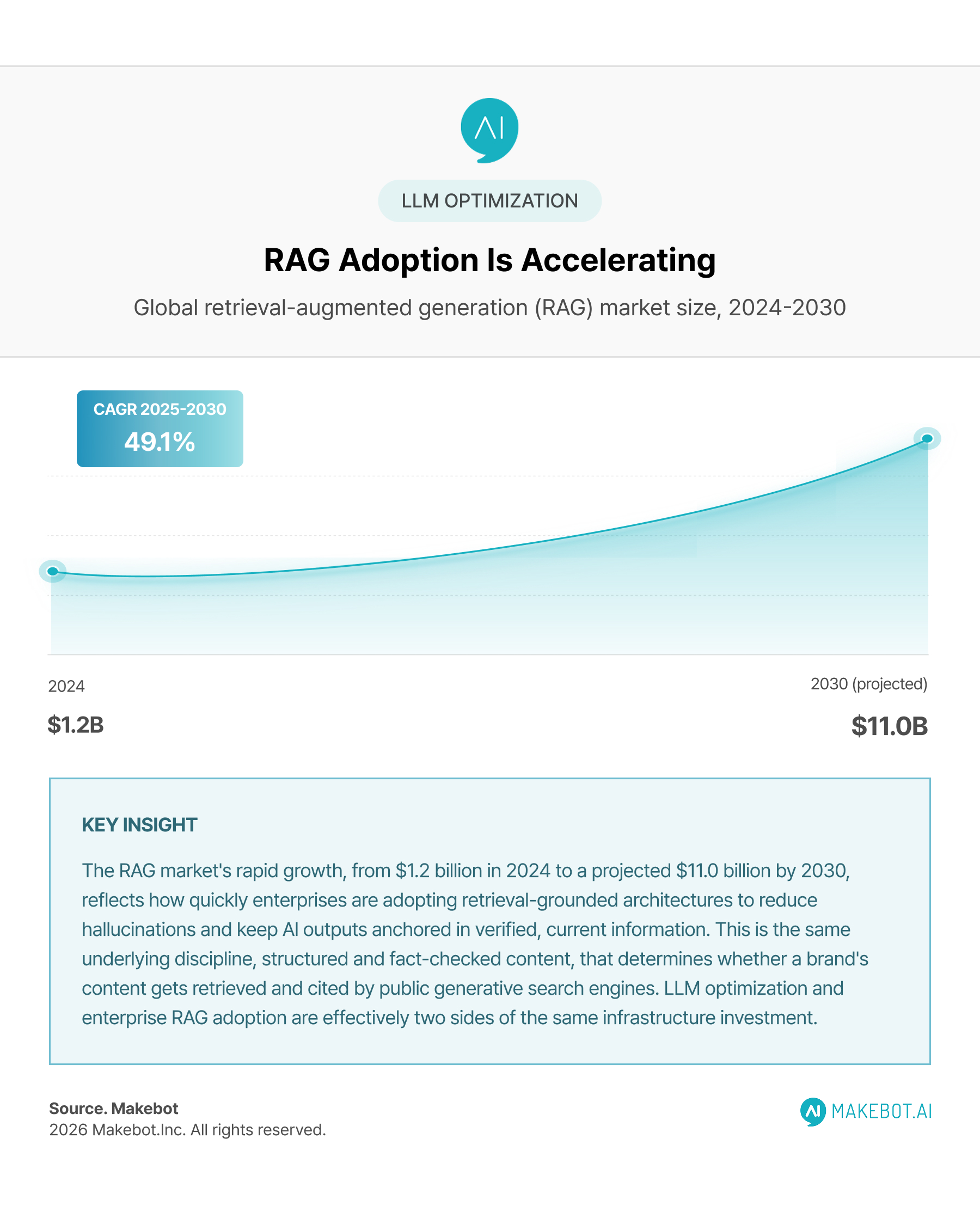
Grand View Research projects the RAG market will grow from $1.2 billion in 2024 to $11.0 billion by 2030 (a 49.1% CAGR), reflecting how fast enterprises are adopting retrieval-grounded architectures to reduce hallucinations and ground AI outputs in verified, current information. This is the same underlying shift explored in how hybrid RAG is transforming enterprise knowledge search, and the same underlying discipline, structured, fact-checked, clearly sourced content, is what makes a page more likely to be retrieved and cited by public generative engines, not just internal AI copilots.
Technical and Organizational Factors Shaping GEO Outcomes
Winning at GEO requires action on two fronts simultaneously: content architecture and organizational readiness. Neither alone is sufficient.
Technical factors that influence AI citation:
- Structuring content around direct question-and-answer formats (clear H2/H3 headers phrased as real user questions) increases the likelihood that an AI system extracts that passage as a citable answer.
- Embedding original data and clearly attributed statistics gives generative engines something concrete and defensible to cite. Generic paraphrased content is far less likely to be selected.
- Maintaining strong crawlability and clean canonical signals remains a technical prerequisite; if a model's retrieval systems can't reliably access or de-duplicate a page, it can't be cited from it.
- Structured data markup (FAQ and HowTo schema) continues to correlate with higher extraction rates in AI-generated answers.
Organizational factors that determine whether those tactics get executed:
- Executive sponsorship that treats GEO measurement (citation tracking, AI referral analysis) as a defined KPI rather than an experimental side project.
- Cross-functional coordination between content, SEO, PR, and product teams, since earned media and third-party mentions drive the large majority of AI citations rather than owned content alone.
- A documented editorial standard for fact-checking and sourcing, since generative engines favor content that can be independently verified against primary sources.
Common Challenges Enterprises Face When Scaling AI-Driven Content Strategy
Even well-resourced organizations run into a consistent set of obstacles when trying to operationalize GEO, the same pattern seen across the real drivers of workplace AI productivity, where most businesses use AI but struggle to scale it:
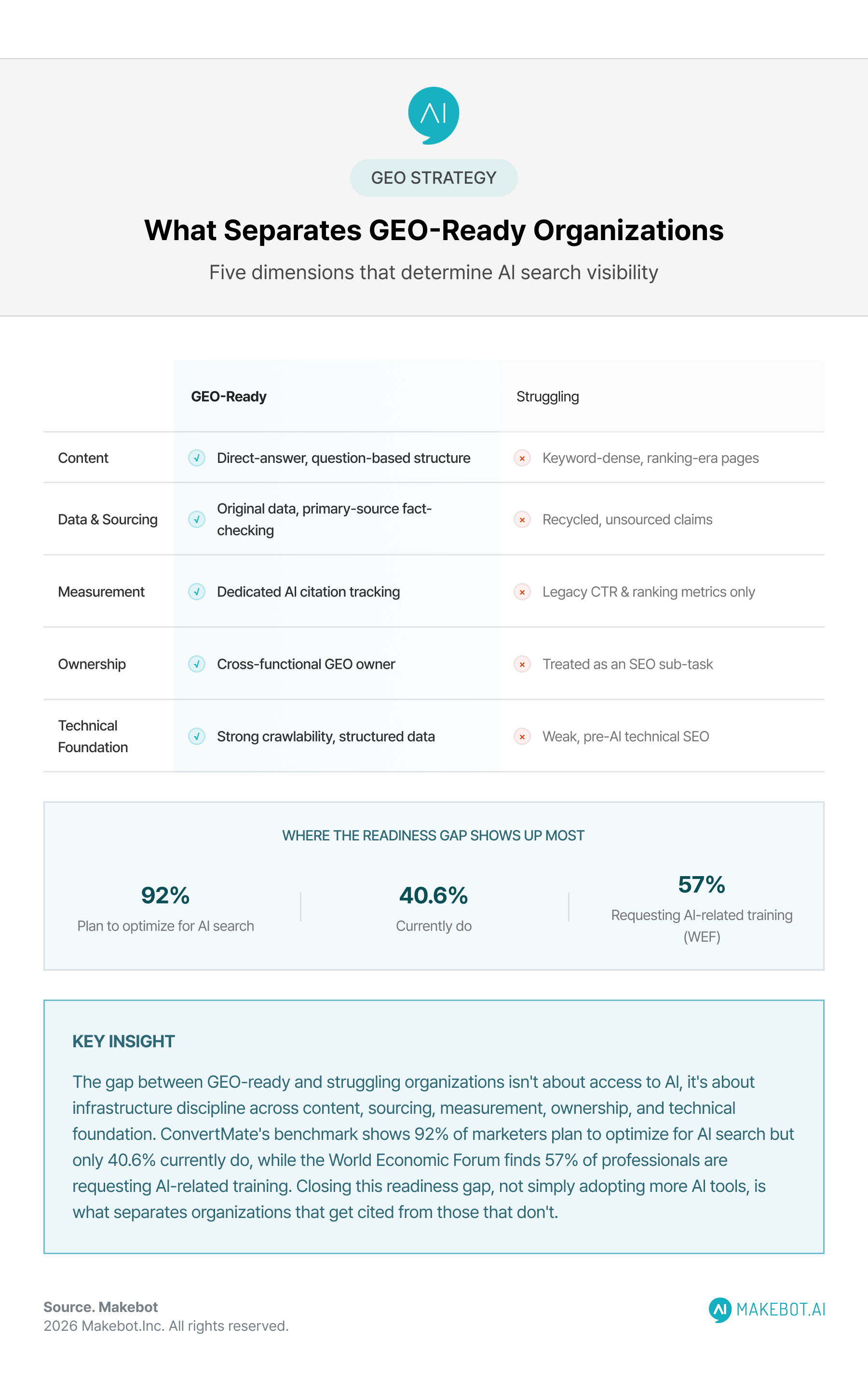
- Measurement immaturity. ConvertMate's GEO Benchmark 2026 study found that 92% of marketers plan to optimize for AI search, but only 40.6% currently are, because zero-click AI answers generate no referral session to track, and the most valuable AI influence (appearing on a buyer's mental shortlist) happens before any trackable interaction occurs.
- Skills gaps. According to the World Economic Forum, 57% of professionals are requesting AI-related training, yet only a minority of marketers are meaningfully trained in AI search optimization practices such as prompt-level content structuring.
- Fragmented ownership. GEO sits awkwardly between SEO, PR, content, and product marketing functions, and organizations without clear ownership tend to under-invest in the cross-functional coordination GEO requires.
- Legacy content debt. Years of content built for keyword-ranking logic rather than direct-answer logic often needs substantial restructuring, not just editing, to become citable.
Strategic Recommendations for Enterprise Marketing Teams
- Audit existing high-value content for direct-answer structure before creating anything new. Restructuring often outperforms fresh production.
- Build a citation-tracking practice across major generative engines now, even if the methodology remains imperfect; early data compounds into a durable measurement advantage.
- Invest in original research and data assets; generative engines consistently favor citable, attributable statistics over paraphrased secondary content, the same principle behind turning customer data into actionable marketing insights.
- Align GEO ownership across SEO, PR, and content functions explicitly, given how much AI citation activity originates from earned media.
- Treat LLM optimization and content governance as the same underlying discipline as any other enterprise system: the rigor that makes content trustworthy to a human reader is largely the same rigor that makes it citable by an AI system.
Conclusion: The Long-Term Stakes of Getting This Right
The shift toward SEO and GEO working side by side is not a marketing trend that will fade with the next algorithm update: it reflects a structural change in how information is discovered, synthesized, and trusted. Enterprises that treat this moment as simply "SEO with new acronyms" will likely find themselves in the same position McKinsey and Deloitte describe for broader AI adoption: heavy investment, wide usage, and disappointingly little measurable return.
The organizations pulling ahead share a common thread: they've stopped treating content, data governance, and AI infrastructure as separate initiatives. Whether the use case is generative AI in marketing, AI content optimization, or public-facing GEO strategy, the underlying capability is the same: structured, verifiable, well-governed content that both machines and humans can trust. Building that capability now, while most competitors are still treating GEO as an experiment, is the clearest source of durable advantage available to enterprise marketing teams in 2026 and beyond.










.jpg)


What Happens to Marketing When the C-Suite Starts Using AI Every Day?






Why AI Shopping Assistants Will Replace Traditional Ecommerce Search






.jpg)

























Why Generative AI Projects Fail and How to Achieve Scalable AI Success











.jpg)

.png)