How LLMs Are Transforming Unstructured Customer Feedback into Actionable Marketing Signals
95% of GenAI pilots miss ROI. LLMs turn unstructured feedback into real marketing signal.


Every day, enterprises generate a flood of customer language that traditional analytics tools were never built to read: support tickets, call transcripts, chatbot logs, app reviews, social mentions, survey verbatims, and NPS comments. For most organizations, this ocean of unstructured data has historically been a cost center to store, not an asset to mine. Large language models (LLMs) are changing that equation - not by replacing traditional Voice of the Customer (VoC) programs, but by making it possible, for the first time, to read, structure, and act on the full volume of what customers actually say, in something close to real time. This shift is already reshaping how LLMs are embedded into modern marketing automation platforms, moving feedback analysis from a support-desk afterthought to a core marketing capability.
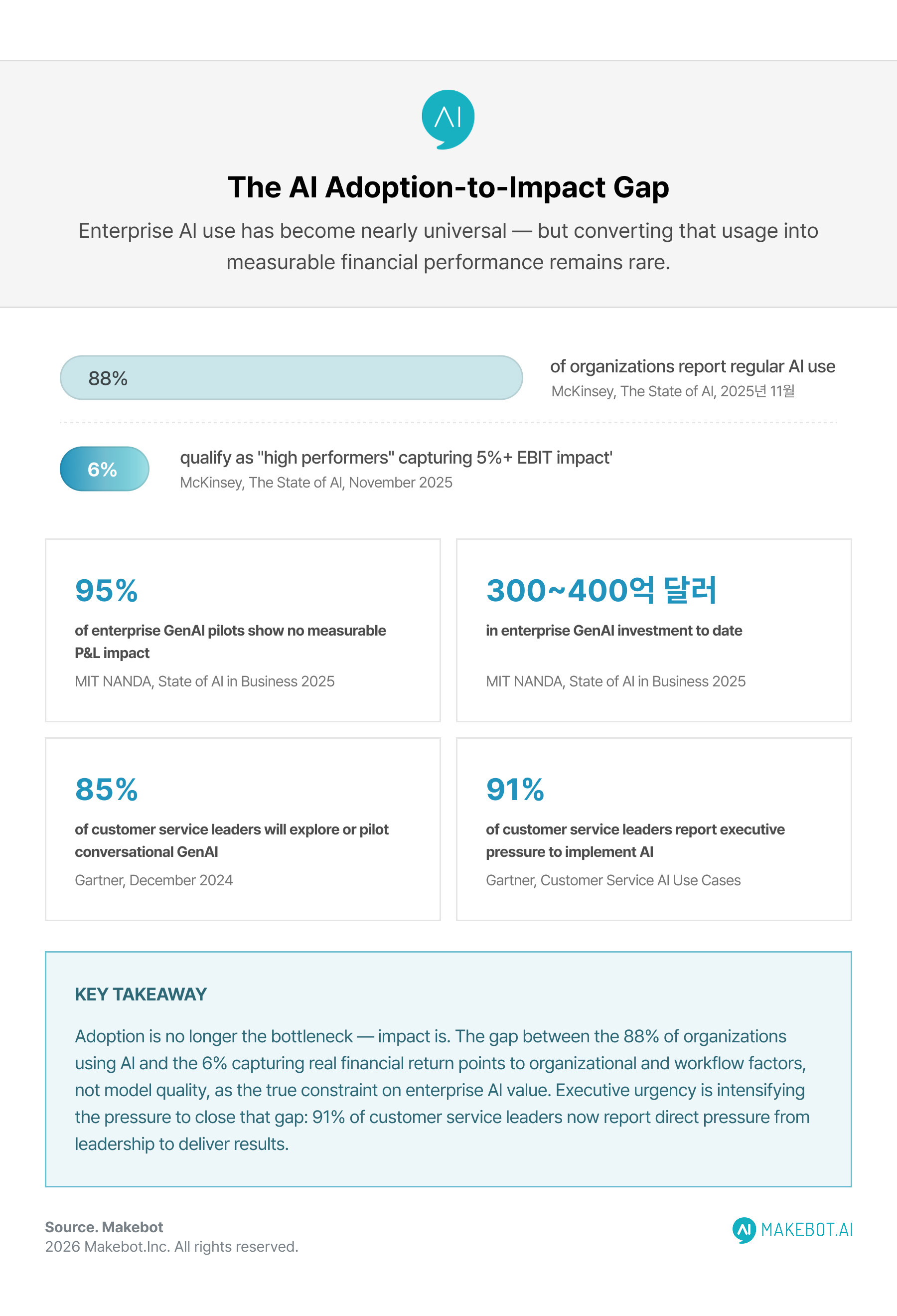
This shift matters now because the gap between AI adoption and AI impact has become the defining story in enterprise technology. Nearly nine in ten organizations report regular AI use, yet most are still failing to convert that usage into measurable business value. Understanding why - and what separates the marketing and CX teams that are winning with AI customer feedback analysis from those stuck in pilot purgatory - is the focus of this article.
The Unstructured Data Problem Marketing Has Always Had
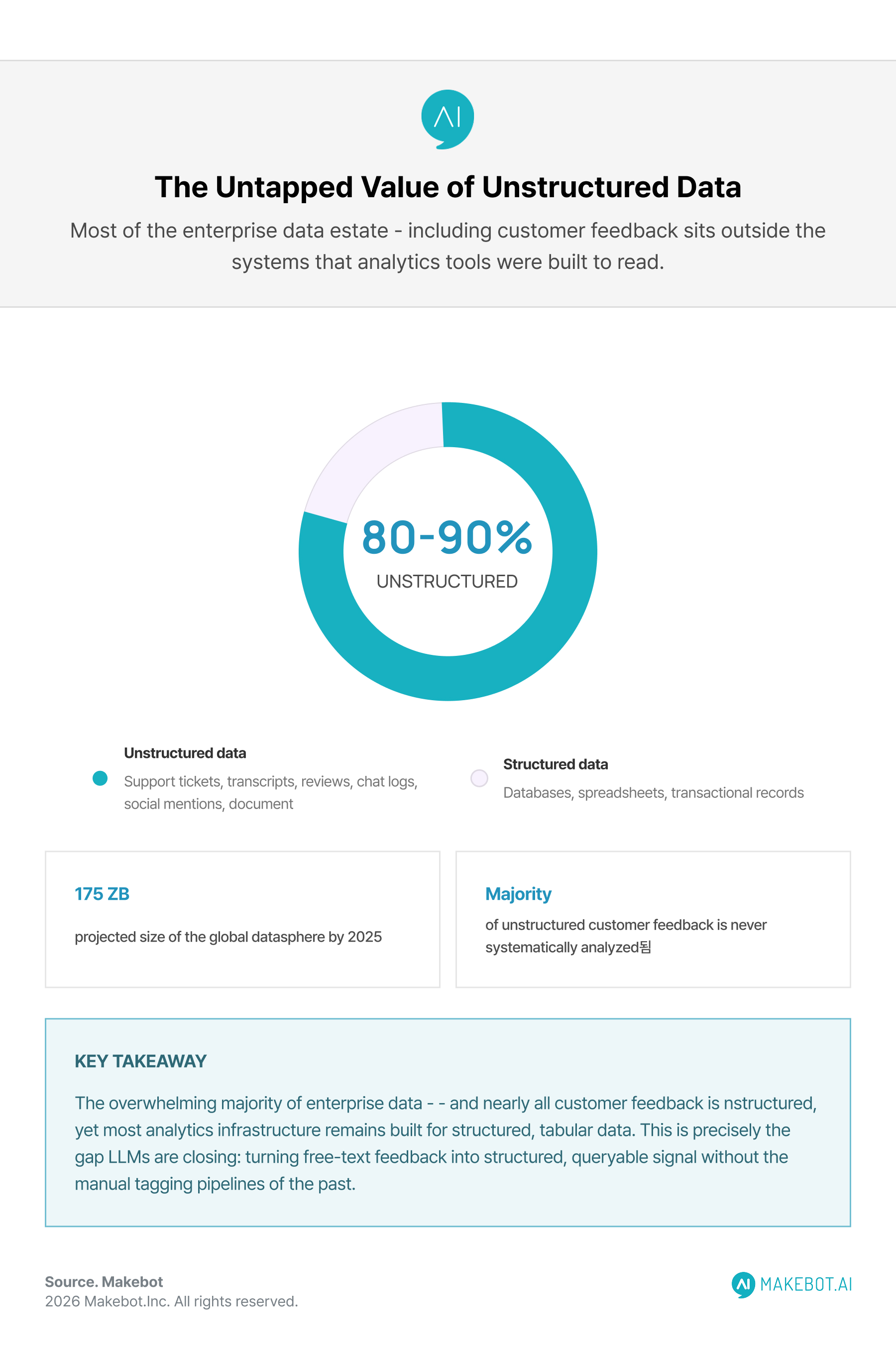
Marketing and CX teams have never lacked customer feedback - they've lacked the ability to process it at scale. Structured surveys and NPS scores capture a sliver of sentiment; the richer signal sits in open-text comments, support transcripts, and review threads that traditional keyword-based tools flatten into shallow "positive/negative/neutral" tags.
The scale of the problem is well documented. Research cited by Gartner and IDC consistently puts unstructured data at 80–90% of all enterprise data, and IDC has projected the global datasphere would reach into the range of 175 zettabytes by 2025, with unstructured formats - documents, transcripts, images, conversations - accounting for the large majority of that growth. Despite this volume, most enterprise data infrastructure and analytics tooling has historically been built around structured, tabular data. The result is a persistent blind spot: the words customers actually use rarely make it into the systems that shape marketing strategy.
This is precisely the gap LLMs are built to close. Unlike earlier natural language processing (NLP) approaches that relied on rigid keyword matching or sentiment lexicons, LLMs interpret context, sarcasm, mixed sentiment within a single comment, and domain-specific language - turning free-text feedback into structured, queryable data without the manual tagging pipelines that made large-scale Voice of the Customer analytics impractical just a few years ago. This is the same underlying shift explored in how retrieval-augmented generation unlocks the power of enterprise data: the technology finally exists to make unstructured information queryable at scale.
From Sentiment Scores to Marketing Signals
The practical shift enabled by generative AI in marketing is a move from static sentiment scoring to dynamic signal generation. Traditional customer sentiment analysis answered a narrow question - was this comment positive or negative? LLM-based systems answer a broader one: what is this customer actually telling us, why does it matter, and what should we do about it?
In practice, this looks like:
- Theme extraction at scale - automatically clustering thousands of support tickets or reviews into emerging topics (e.g., a spike in complaints about a specific checkout step) without predefined taxonomies.
- Root-cause surfacing - connecting scattered mentions of a problem across channels (chat, email, social) into a single actionable insight for product or marketing teams.
- Emotion and intent detection - distinguishing between a customer who is frustrated but still loyal and one who is signaling churn risk, which matters more for retention marketing than a flat sentiment score.
- Message and positioning feedback loops - feeding recurring language patterns from customer feedback directly into campaign copy, FAQ content, and product messaging so marketing reflects how customers actually talk, not how brand guidelines assume they talk. This same pattern shows up in how generative AI is reshaping brand strategy and digital advertising, where messaging is increasingly built from real customer language rather than top-down assumptions.
Gartner's own research into customer analytics highlights this trend directly: postinteraction AI use cases like case summarization and root-cause analysis are increasingly viewed as core inputs into customer journey and marketing analytics, not just support-desk efficiency tools. That reframing - from cost-reduction tool to marketing intelligence layer - is the real transformation underway, and it's the same shift covered in LLM optimization for B2B marketing, where RAG pipelines increasingly sit at the center of enterprise marketing architecture.
Why Some Organizations Are Winning While Most Are Stuck
The uncomfortable truth in the current data is that most enterprises deploying LLMs for customer feedback analytics are not seeing meaningful returns. MIT's Project NANDA "State of AI in Business 2025" report - based on interviews with over 50 executives, a survey of roughly 150 leaders, and analysis of 300 public AI deployments - found that about 95% of generative AI pilots delivered no measurable impact on profit and loss, despite an estimated $30–40 billion in enterprise GenAI investment. Only around 5% of pilots translated into real, scaled value. This is the exact pattern examined in why AI pilots stall after POC: promising proof-of-concept results that never survive contact with production workflows.
This "GenAI Divide," as MIT's researchers call it, is not primarily a technology problem. The research points to a consistent pattern separating the winners from the rest:
What high performers do differently:
- They buy from specialized vendors and build vendor partnerships rather than attempting fully custom in-house builds - MIT NANDA found external partnerships reach deployment about 67% of the time, versus roughly 33% for tools built entirely in-house.
- They prioritize tools that retain context and learn from feedback over time, rather than static, one-shot analysis tools.
- They redesign workflows around the AI output instead of bolting AI onto unchanged processes - McKinsey's analysis of 25 organizational attributes found workflow redesign has the largest measurable effect on whether AI use produces enterprise-level EBIT impact. This distinction - between organizations that redesign and those that merely automate - is explored further in what separates AI leaders from AI followers.
- They set growth and innovation objectives alongside cost-efficiency goals, rather than treating AI purely as a headcount-reduction tool.
What stalled organizations tend to share:
- Feedback-analysis tools deployed as standalone pilots, disconnected from marketing planning, CRM, or product roadmaps. As covered in AI adoption isn't the competitive advantage - problem definition is, the tool itself is rarely the bottleneck.
- Heavy investment in generic, off-the-shelf models without domain customization - MIT's research found budget misallocation is common, with more than half of GenAI budgets often directed at sales and marketing tools while the highest realized ROI frequently comes from back-office automation instead.
- No clear owner or KPI for translating extracted insights into action, so themes surface but never reach campaign or product decisions.
- Underestimating how slowly scaling actually happens - Deloitte's State of Generative AI research found that more than two-thirds of organizations expect 30% or fewer of their GenAI experiments to be fully scaled within three to six months, even though nearly three-quarters report their most advanced initiative is meeting or exceeding ROI expectations at the pilot level.
Enterprise Use Cases: Where the Signal Becomes Action
Applied well, LLM-driven feedback analysis is showing up in several concrete marketing and CX workflows:
- Churn-risk marketing triggers. Feedback classified by an LLM as containing frustration or disengagement language can automatically flag accounts for retention campaigns before a formal cancellation signal appears in CRM data - a pattern closely related to why the conversation breaks at checkout, where unresolved friction signals often surface first.
- Campaign and content refinement. Recurring language patterns extracted from reviews and support chats are used to rewrite product marketing copy so it mirrors the vocabulary and objections customers actually raise.
- AI chatbot feedback loops. Conversations handled by an AI chatbot are mined post-interaction not just for containment metrics (did the bot end the chat?) but for satisfaction signals - a distinction increasingly emphasized because deflection rate alone does not indicate whether the customer was actually satisfied. This ties directly into how AI chatbots are increasing e-commerce conversion rates, where satisfaction signals matter as much as resolution speed.
- Competitive and market intelligence. LLMs applied to public reviews and social mentions of competitors surface positioning gaps that inform go-to-market messaging, a capability increasingly central to how AI shopping assistants are replacing traditional ecommerce search.
- Executive and product reporting. Thematic summaries replace manual quarterly VoC decks, giving marketing and product leadership a continuously updated view of sentiment shifts rather than a lagging snapshot.
The demand for this capability is visible in adoption data. Gartner's 2025 research found 85% of customer service leaders planned to explore or pilot customer-facing conversational generative AI, and separate Gartner research finds 91% of customer service leaders report executive pressure to implement AI-driven solutions. That pressure is increasingly extending from the support function into marketing, where feedback-derived insight is now expected to inform campaigns, not just close tickets.
The Trust Gap: A Factor Marketers Can't Ignore
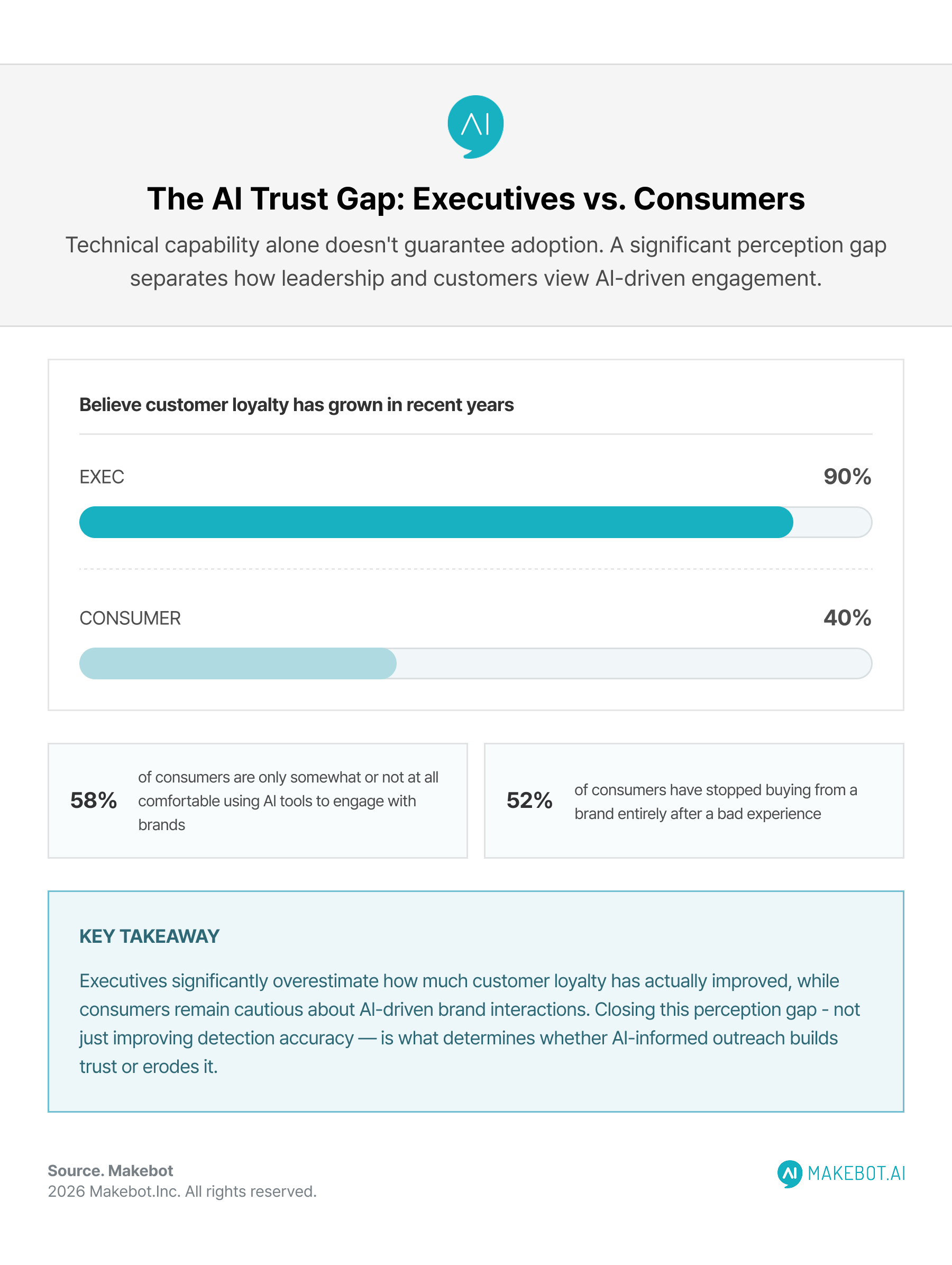
Technical capability is only half of the equation. PwC's 2025 Customer Experience Survey found a significant perception gap between executives and consumers: roughly nine in ten executives believe customer loyalty has grown in recent years, while only about four in ten consumers say the same. The same survey found 58% of consumers are only somewhat or not at all comfortable engaging with brands through AI tools, and that 52% of consumers have stopped buying from a brand entirely after a bad product or service experience.
This matters directly for marketing teams building on LLM-derived insights: the data pipeline can be technically sound while still missing the trust and tone considerations that determine whether customers respond positively to AI-informed outreach. Organizations getting this right tend to use AI to identify where to apply automation and where to route to human judgment, rather than defaulting to full automation across every touchpoint - a distinction PwC's research frames as central to sustaining loyalty in an AI-augmented CX model. This connects closely to why AI-powered customer journey mapping is becoming essential for enterprise growth, where sequencing automation correctly across the journey matters as much as the automation itself.
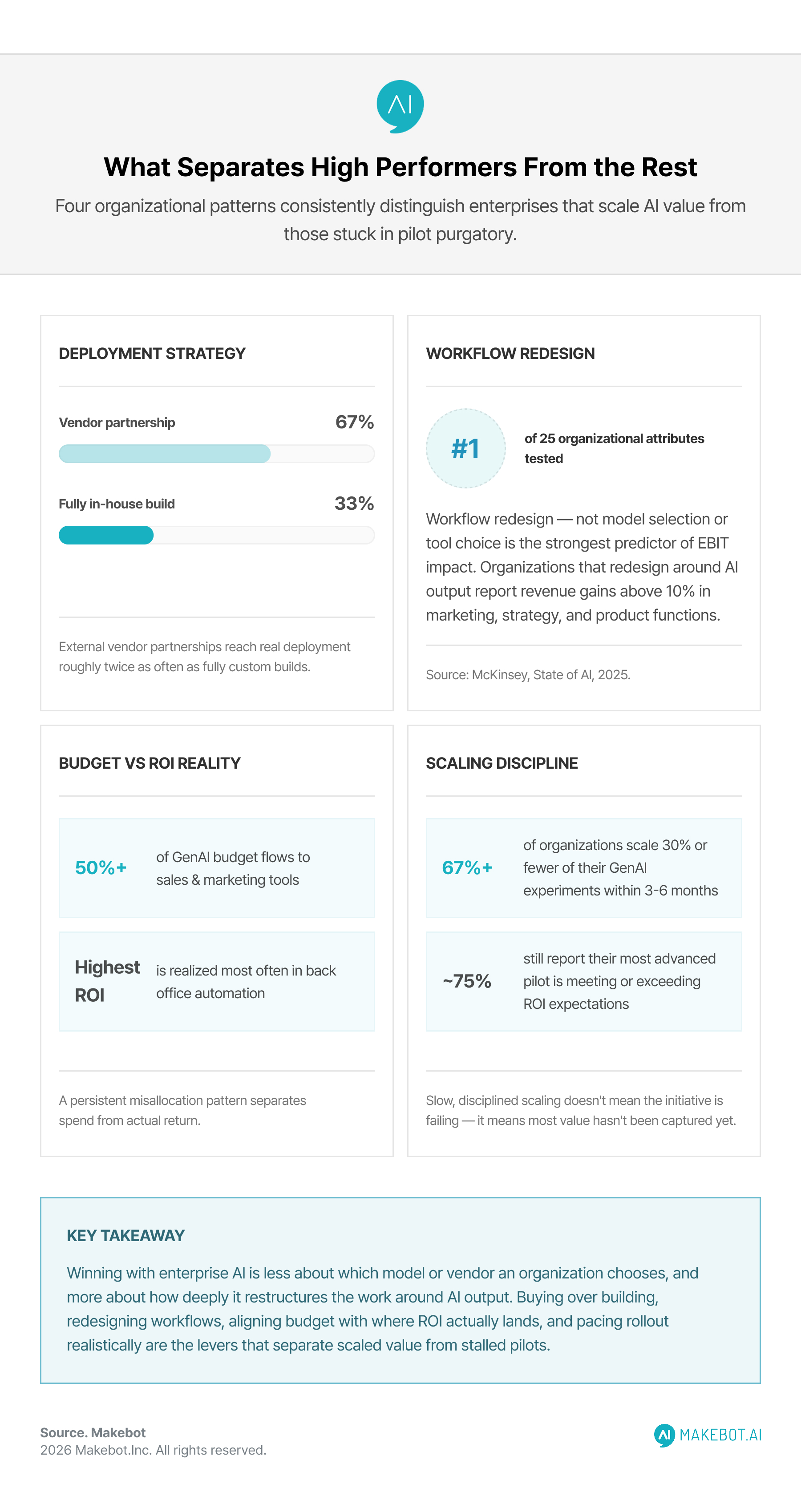
Comparing the Two Paths: Stalled Pilots vs. Scaled Value
Strategic Recommendations for Marketing and CX Leaders
- Start with a narrow, high-visibility use case - such as churn-signal detection in support transcripts - rather than attempting an enterprise-wide unstructured data analysis rollout on day one.
- Buy before you build. Given MIT's findings on vendor-partnership success rates, evaluate specialized AI-powered customer insights platforms before committing to custom model development, following the pattern outlined in how retrieval-augmented generation improves product recommendation accuracy in e-commerce.
- Assign clear ownership for insight-to-action conversion. A dashboard of themes has no marketing value until someone is accountable for turning it into campaign or product decisions.
- Redesign the workflow, not just the tool. McKinsey's research is explicit that workflow redesign - not model selection - is the strongest predictor of EBIT impact.
- Budget for trust, not just automation. Given PwC's findings on consumer discomfort with AI-brand interactions, pair sentiment automation with clear escalation paths to human teams.
- Set a realistic adoption timeline. Plan for scaling to take multiple quarters rather than weeks - Deloitte's research found most organizations scale only a minority of their GenAI experiments within the first three to six months, even when pilot-level ROI looks strong, a finding consistent with the seven proven factors that drive AI ROI in 2026.
Conclusion
The organizations extracting real marketing value from LLM customer feedback analysis are not simply the ones with access to the most advanced models - they are the ones treating unstructured customer language as a strategic asset and rebuilding workflows around it. The current data is sobering: a small minority of enterprises are capturing outsized returns from AI while the majority remain stuck in pilots that never scale. But the direction of travel is clear. As LLMs make it economically feasible to analyze the full volume of customer conversation rather than a sampled fraction, AI marketing analytics built on genuine Voice of the Customer signal - not just automation for its own sake - is becoming a durable competitive advantage. The enterprises that close the gap between adoption and impact in the next 12–24 months will be the ones that treat customer feedback not as a support-desk byproduct, but as a continuous marketing intelligence stream.





.png)








.jpg)


What Happens to Marketing When the C-Suite Starts Using AI Every Day?






Why AI Shopping Assistants Will Replace Traditional Ecommerce Search






.jpg)

























Why Generative AI Projects Fail and How to Achieve Scalable AI Success










.jpg)

.png)