How AI Sales Assistants Are Increasing Revenue Without Increasing Headcount
AI sales teams grew revenue 83% vs. 66% - Gartner: AI agents will outnumber sellers 10:1 by 2028.


Introduction
Every enterprise sales leader is being asked the same question this year: how do we grow revenue without growing headcount? The answer increasingly runs through the AI sales assistant - software that researches accounts, drafts outreach, coaches reps, and flags at-risk deals around the clock. But the data tells a more nuanced story than the marketing decks suggest. While AI-powered sales tools are now mainstream, most organizations are still struggling to convert adoption into measurable revenue. This article separates verified outcomes from hype, drawing on McKinsey, Gartner, Deloitte, Salesforce, and MIT research to explain where generative AI for sales is genuinely moving the revenue needle - and why a small minority of companies are capturing most of the value.
The Productivity Paradox: Why Headcount Alone No Longer Drives Revenue
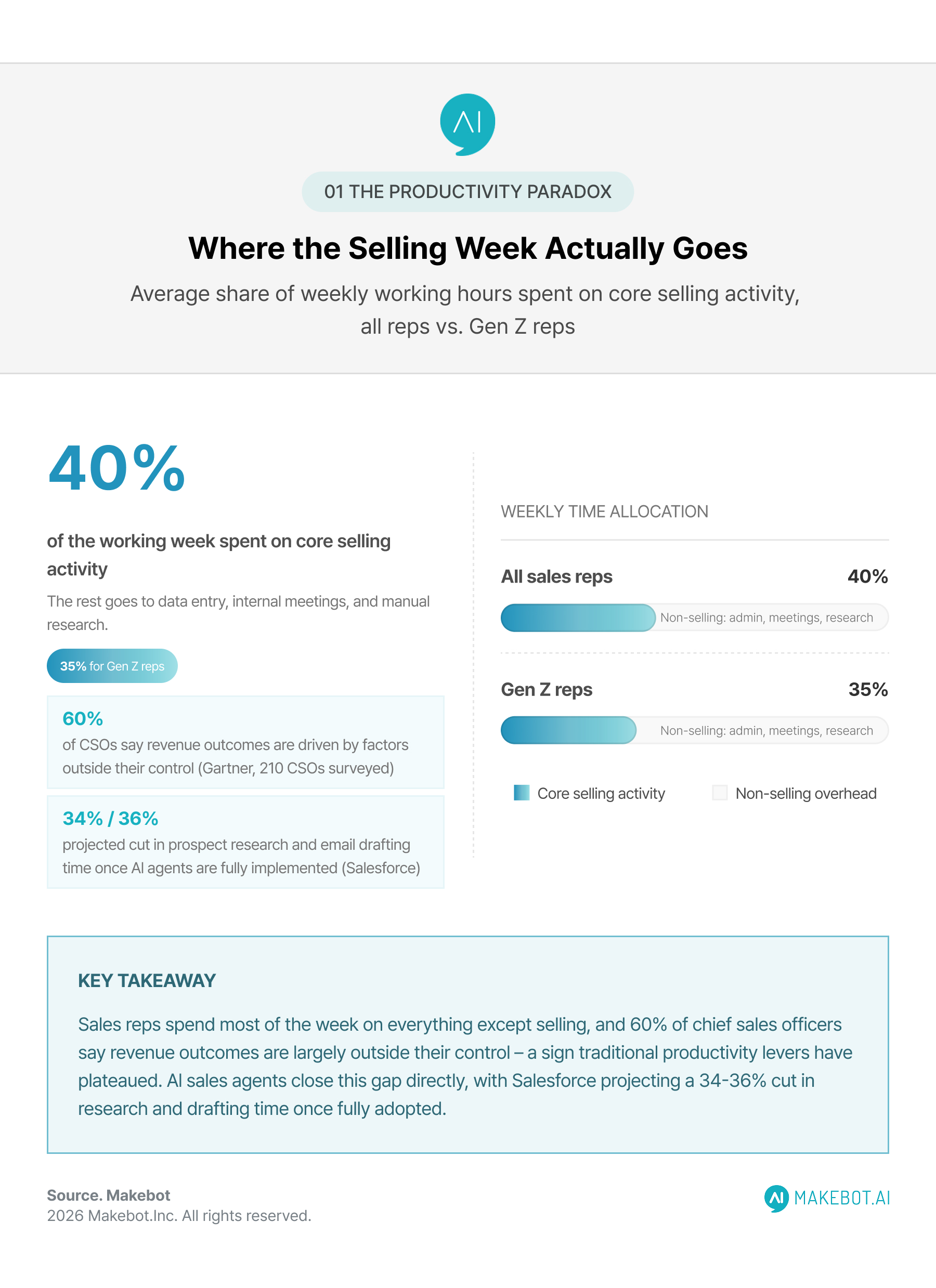
For years, the default response to a revenue shortfall was to hire more sellers. That logic is breaking down. Sales reps spend roughly 40% of their week on actual selling activity - and for Gen Z reps, that figure drops to 35%, with the rest consumed by data entry, internal meetings, and manual research, according to Salesforce's 2026 State of Sales report. Adding headcount simply multiplies the non-selling overhead rather than fixing it.
Gartner's research reinforces this. A survey of 210 chief sales officers found that 60% believe their revenue outcomes are largely driven by factors outside their control - a sign that traditional productivity levers (more reps, more tools, more process) have plateaued. This is the exact gap that AI sales automation is designed to close: not by replacing sellers, but by removing the administrative weight that keeps them from selling in the first place. The outcome that matters is capacity expansion rather than headcount reduction - the same team handling meaningfully more volume without a proportional cost increase.
What AI Sales Assistants Actually Do Inside the Revenue Engine
An AI sales assistant is not a single tool - it's a category spanning several distinct functions, often working together as AI sales agents inside the CRM and communication stack. In practice, deployments cluster around:
- Prospecting and enrichment - researching accounts, scoring intent signals, and building lists without manual SDR hours
- Personalized outreach at scale - an AI chatbot for sales or LLM-powered sales assistant drafting first-touch emails and follow-ups tailored to buyer context
- Conversation intelligence and coaching - transcribing and analyzing calls to replicate top-performer behavior across the team
- Forecasting and pipeline risk detection - surfacing deals that are stalling before a human notices
- CRM-native execution - auto-updating records from calls, emails, and notes so reps stop doing data entry
Salesforce reports that once fully implemented, sellers expect AI agents to cut prospect research time by 34% and email drafting time by 36%. That reclaimed time is the entire mechanism by which sales productivity gains convert into revenue: more hours in front of buyers, not more buyers hired to sit in front of. The underlying AI-powered chatbot infrastructure behind these gains typically sits inside the same platform sellers already use, rather than as a bolt-on tool.
The Revenue Evidence: What the Data Actually Shows
The revenue case for AI revenue growth is real, but it is uneven across organizations. McKinsey's 2025 Global Survey on AI found that revenue increases from AI are most commonly reported in marketing and sales - more than any other business function, a pattern that has held consistently across McKinsey's eight years of AI research. This mirrors what shows up at the channel level too: AI-powered chatbots deployed in e-commerce and online retail settings consistently correlate with higher conversion and repeat-purchase rates. Separately, Salesforce's State of Sales research - based on a global survey of thousands of sales professionals and still cited in the company's most recent published sales statistics - found that 83% of sales teams using AI saw revenue growth over the past year, compared with 66% of teams that did not use it. Gartner adds a productivity angle from its own 2024 survey of more than 1,000 B2B sellers: reps who effectively partner with AI tools are roughly 3.7 times more likely to hit quota than those who don't.
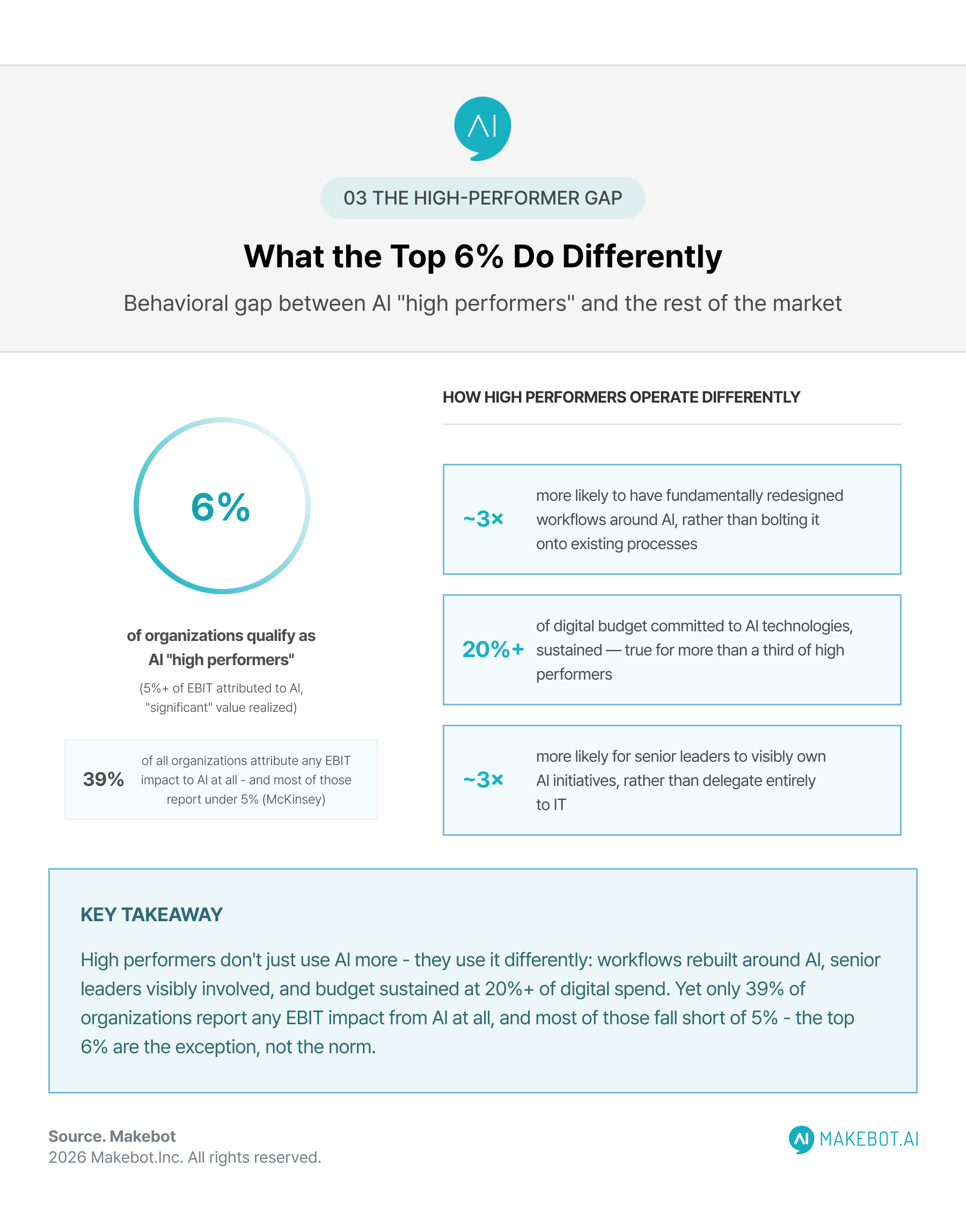
Yet these gains are not automatic or evenly distributed. McKinsey's same survey found that only about 39% of organizations attribute any EBIT impact to AI at all, and most of those report an impact below 5%. The revenue upside is concentrated among a specific group of adopters - and understanding what separates them from everyone else is the more important story.
Why a Small Minority Capture Most of the Return
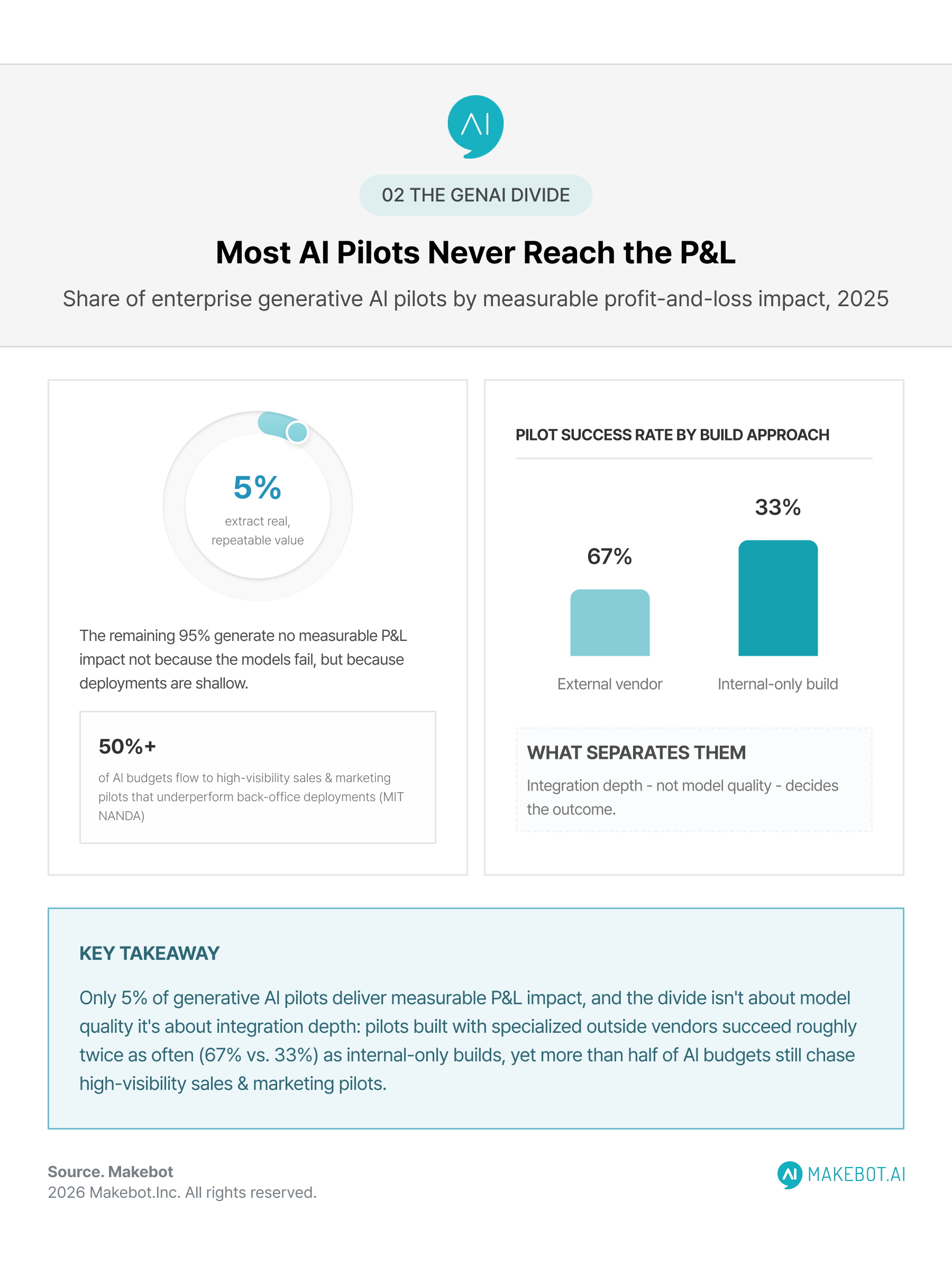
McKinsey's research identifies a group it calls enterprise AI "high performers" - roughly 6% of surveyed organizations that attribute 5% or more of EBIT to AI and report "significant" value. These companies aren't just using AI more; they're using it differently, and their approach to responsible AI governance tends to be far more mature than their peers':
- They are nearly three times more likely to have fundamentally redesigned workflows around AI rather than bolting it onto existing processes.
- More than a third commit over 20% of their digital budget to AI technologies, versus a small fraction of other companies.
- Their senior leaders are three times more likely to demonstrate visible ownership of AI initiatives, not delegate it entirely to IT.
MIT's Project NANDA reached a strikingly similar conclusion from a different angle. Its July 2025 report, "The GenAI Divide: State of AI in Business 2025," found that 95% of enterprise GenAI pilots generate no measurable profit-and-loss impact, while just 5% extract significant, repeatable value. The dividing line wasn't model quality - it was integration depth. Pilots built in partnership with specialized outside vendors succeeded roughly 67% of the time, compared with about 33% for tools built entirely in-house, and more than half of AI budgets in the MIT dataset flowed toward high-visibility sales and marketing pilots that ultimately underperformed better-scoped, less glamorous back-office deployments.
High-ROI Adopters vs. Struggling Adopters
Common Pitfalls When Scaling AI Sales Agents
Even well-resourced sales organizations run into predictable failure modes when scaling AI sales agents beyond an initial pilot. Gartner's own July 2026 forecast is blunt about the risk: by 2028, AI agents will outnumber human sellers ten to one, yet fewer than 40% of sellers will say those agents actually improved their productivity. The reason is what Gartner calls "agent sprawl" - deploying more AI without fixing the systems it operates within.
The recurring pitfalls include:
- Fragmented customer data. When intelligence is scattered across separate CRM, engagement, and conversation-intelligence tools, agents produce shallow or contradictory outputs instead of a coherent view of the deal - a problem hybrid retrieval architectures for enterprise knowledge search are specifically designed to solve.
- Treating AI like traditional software. Enterprises that skip integration work and expect generic, off-the-shelf chatbot tools to absorb enterprise-specific context see the lowest success rates.
- Measuring the wrong thing. Tracking only time saved, rather than seller capacity, deal quality, and revenue outcomes, hides whether AI is actually changing commercial results; the same KPI framework problem shows up in measuring customer support AI.
- Under-investing in governance. Deloitte's latest State of AI in the Enterprise research found only about one in five companies has a mature governance model for autonomous AI agents, even as agentic AI usage is set to expand sharply.
Technical and Organizational Factors Behind AI Investment Outcomes
The evidence points to two categories of factors that jointly determine whether enterprise AI investment converts into revenue - a pattern also visible across documented enterprise agentic AI use cases outside of sales.
Technical factors center on data architecture. AI sales agents are only as good as the context they can access - a centralized layer connecting CRM, conversation intelligence, and enrichment data consistently outperforms point solutions bolted onto legacy systems. MIT's research found that generic, off-the-shelf tools reach roughly 83% adoption for trivial tasks but stall the moment a workflow demands memory, customization, or judgment - precisely the conditions of enterprise sales.
Organizational factors are arguably more decisive. Deloitte's 2026 State of AI in the Enterprise survey of 3,235 business and IT leaders found that while worker access to AI rose by roughly 50% in 2025 and twice as many leaders report transformative impact compared with the prior year, only about 34% say they are genuinely reimagining how the business operates - the rest are still automating existing steps rather than redesigning them. That distinction between automation and transformation is the clearest fault line between organizations capturing real AI revenue growth and those stuck reporting flat results.
The Road Ahead: AI Agents and the Future Sales Organization
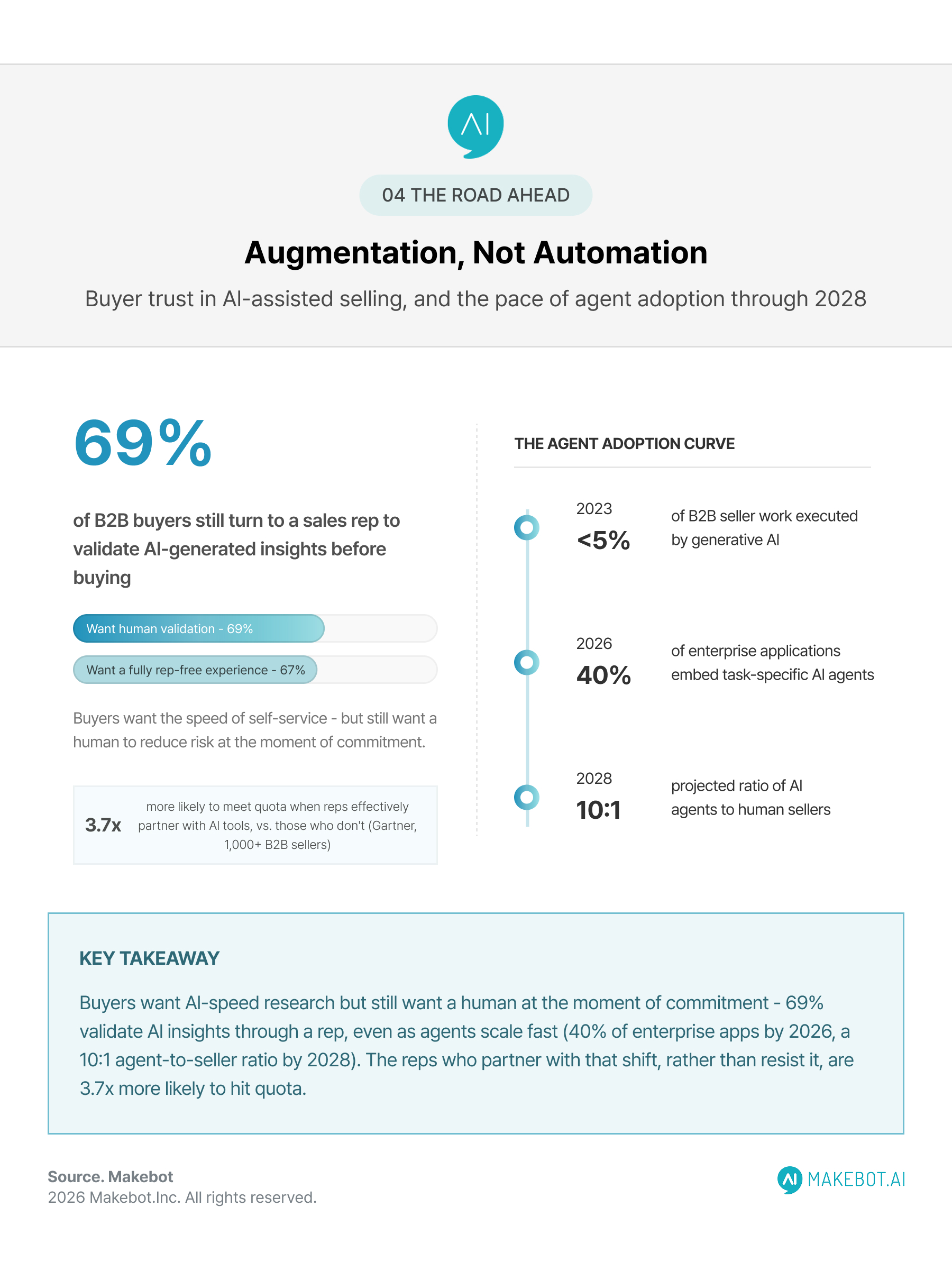
The trajectory is not toward replacing sellers but toward a smaller, more capacity-rich sales organization supported by a growing layer of AI agents. Gartner projects that AI agents will outnumber sellers by 10 to 1 within two years, and separately forecasts that 40% of enterprise applications will embed task-specific agents by the end of 2026, up from under 5% just a year earlier. Gartner's broader sales research also finds that roughly 60% of B2B seller work could be executed through generative AI by 2028, up from less than 5% in 2023.
Even so, humans retain a clear and durable role. A May 2026 Gartner survey of 645 B2B buyers found that 69% still turn to a sales rep to validate AI-generated insights before committing to a purchase - even though a similar share of buyers (67%) say they'd prefer a completely rep-free buying experience if they could get one. That tension is the point: buyers want the speed of self-service and AI research, but still want a human to reduce risk at the moment of commitment - the same balance already playing out in how AI chatbot conversations escalate to human agents in customer-facing settings generally. The realistic model emerging across the data isn't full automation - it's augmentation, where LLM-powered sales assistant tools absorb research, drafting, and administrative load so that human judgment concentrates on negotiation, trust-building, and complex problem-solving.
Conclusion
The evidence is consistent across McKinsey, Gartner, Deloitte, Salesforce, and MIT: AI sales assistant technology can meaningfully increase revenue without proportional headcount growth, but only for organizations willing to treat it as an operating-model change rather than a software purchase. The 5-6% of companies capturing outsized returns share the same pattern - unified data, redesigned workflows, sustained investment, and visible leadership ownership. For everyone else, the risk isn't that AI fails to work; it's that AI simply scales whatever fragmentation already existed. As agentic AI moves from pilot to default infrastructure over the next two to three years, the gap between these two groups is likely to widen well before it narrows - making the choice to invest in foundations, not just features, the defining strategic decision for sales organizations today.










.jpg)


What Happens to Marketing When the C-Suite Starts Using AI Every Day?





Why AI Shopping Assistants Will Replace Traditional Ecommerce Search






.jpg)

























Why Generative AI Projects Fail and How to Achieve Scalable AI Success











.jpg)

.png)