Cleveland Clinic AI Summit 2026 Shows How AI Is Transforming Hospital Operations
50% of U.S. hospitals use GenAI now. Only 21% have scaled it. Cleveland Clinic maps the gap.


On August 28, 2026, Cleveland Clinic and CHIME convene the Second AI Summit for Healthcare Professionals at Cleveland's InterContinental Hotel, a gathering that arrives at a pivotal moment for AI in hospital operations. Health systems are no longer debating whether to adopt generative AI; they're wrestling with how to scale it responsibly, measure its return, and avoid the pilot purgatory that has trapped so many other industries.
The timing matters. McKinsey's fourth-quarter 2025 survey found that half of U.S. healthcare organizations have now implemented generative AI, a milestone reached faster than almost anyone predicted in 2023. Yet research from MIT's Project NANDA tells a more sobering story: across industries, the vast majority of AI pilots still fail to produce measurable financial return. Cleveland Clinic's summit sits directly at the intersection of these two realities: genuine momentum and genuine risk.
Inside Cleveland Clinic's Second AI Summit for Healthcare Professionals
Now in its second year, the Cleveland Clinic AI Summit 2026 brings together clinicians, CIOs, nurses, and health system executives from across North America, in partnership with CHIME. Jame Abraham, MD, FACP, chairman of Hematology and Medical Oncology at Cleveland Clinic's Taussig Cancer Institute, and Scott R. Steele, MD, MBA, FACS, FASCRS, President of Main Campus at Cleveland Clinic, serve as the summit's lead directors. A welcome reception on August 27 preceded the full-day program on August 28.
The agenda reflects where hospital leadership attention has shifted: from whether AI belongs in healthcare, to the operational mechanics of enterprise healthcare AI, how clinical and IT leaders evaluate vendors, integrate tools into existing workflows, and scale AI safely across service lines. Sponsors including Viz.ai, Rhapsody, and RSM showcased platforms built for hospital workflow automation, underscoring how vendor strategy has matured alongside provider demand.
The State of Generative AI in Hospital Operations
McKinsey's fourth-quarter 2025 survey of 150 healthcare leaders offers the clearest snapshot yet of generative AI in healthcare adoption:
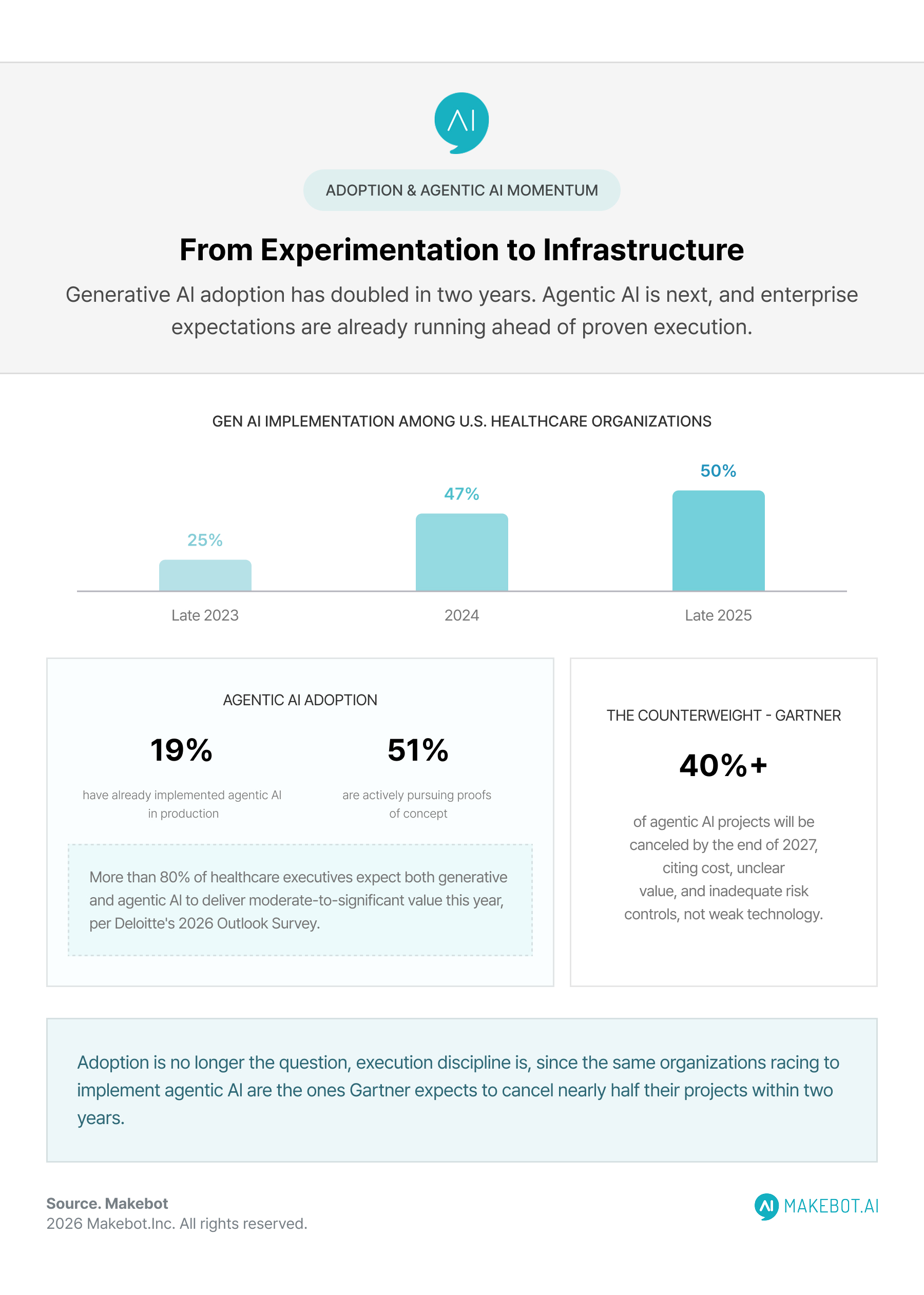
- Gen AI implementation reached 50% of organizations by late 2025, up from 25% in 2023 and 47% in 2024.
- More than 80% of leaders say their organizations have deployed at least one gen AI use case directly to end users.
- Half of respondents deployed their first use case more than six months ago, suggesting gen AI has moved from experiment to operational baseline.
Adoption varies sharply by subsector, though: healthcare services and technology firms lead, while payers and hospitals themselves are still building the internal muscle to operationalize AI across complex clinical environments.
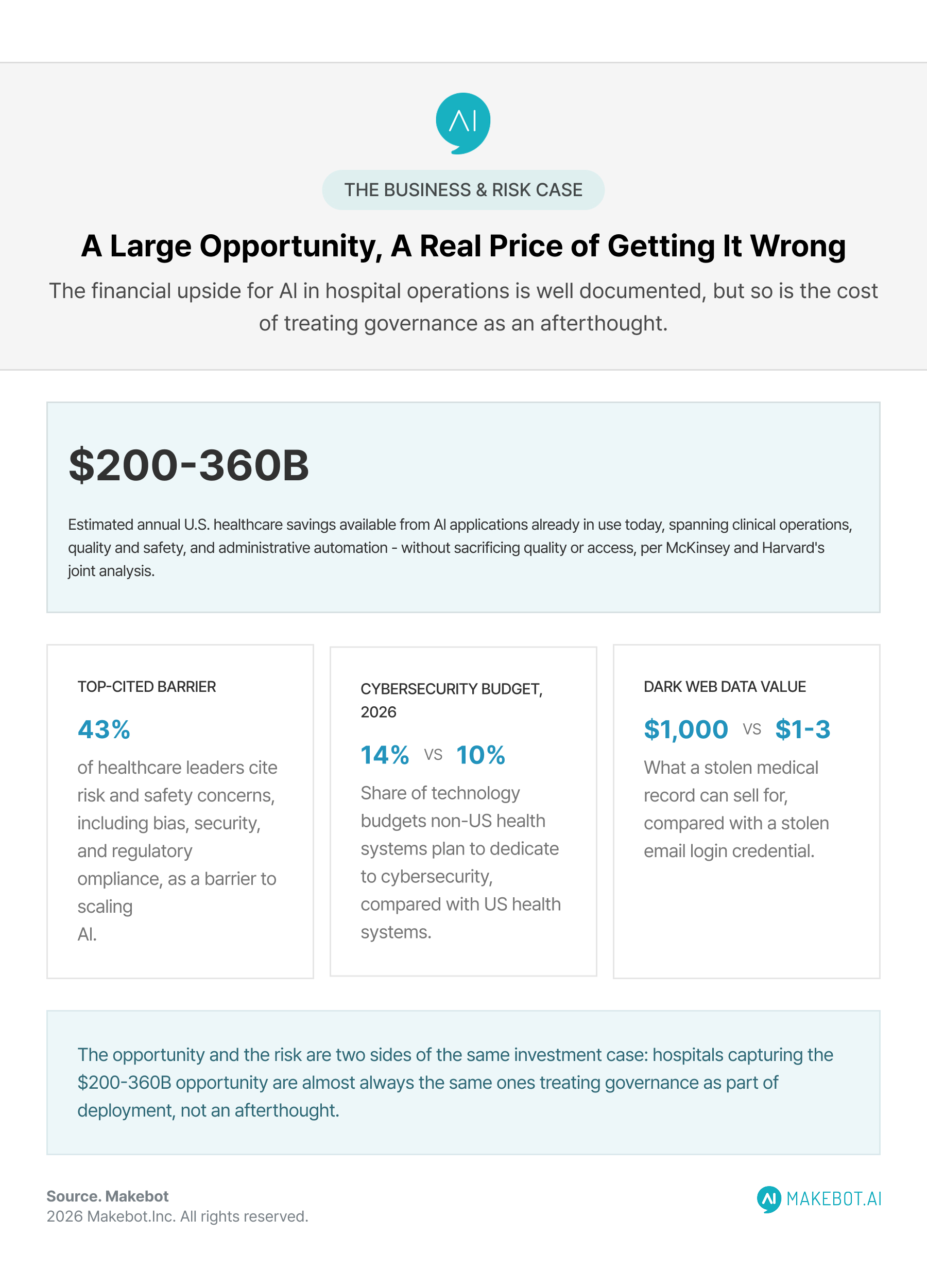
Administrative efficiency is the domain leaders most frequently cite as having the greatest potential, but clinical productivity is where implementation is furthest along, with 54% of care-delivery organizations already using gen AI there. Ambient clinical documentation is the clearest example of measurable impact: Stanford's 2026 AI Index Report found physicians spending up to 83% less time writing notes and meaningful reductions in burnout. At the macro level, a widely cited McKinsey and Harvard analysis estimated that available AI applications could generate $200 billion to $360 billion in annual U.S. healthcare savings, largely through clinical operations improvements such as patient-flow optimization, quality and safety gains, and administrative automation.
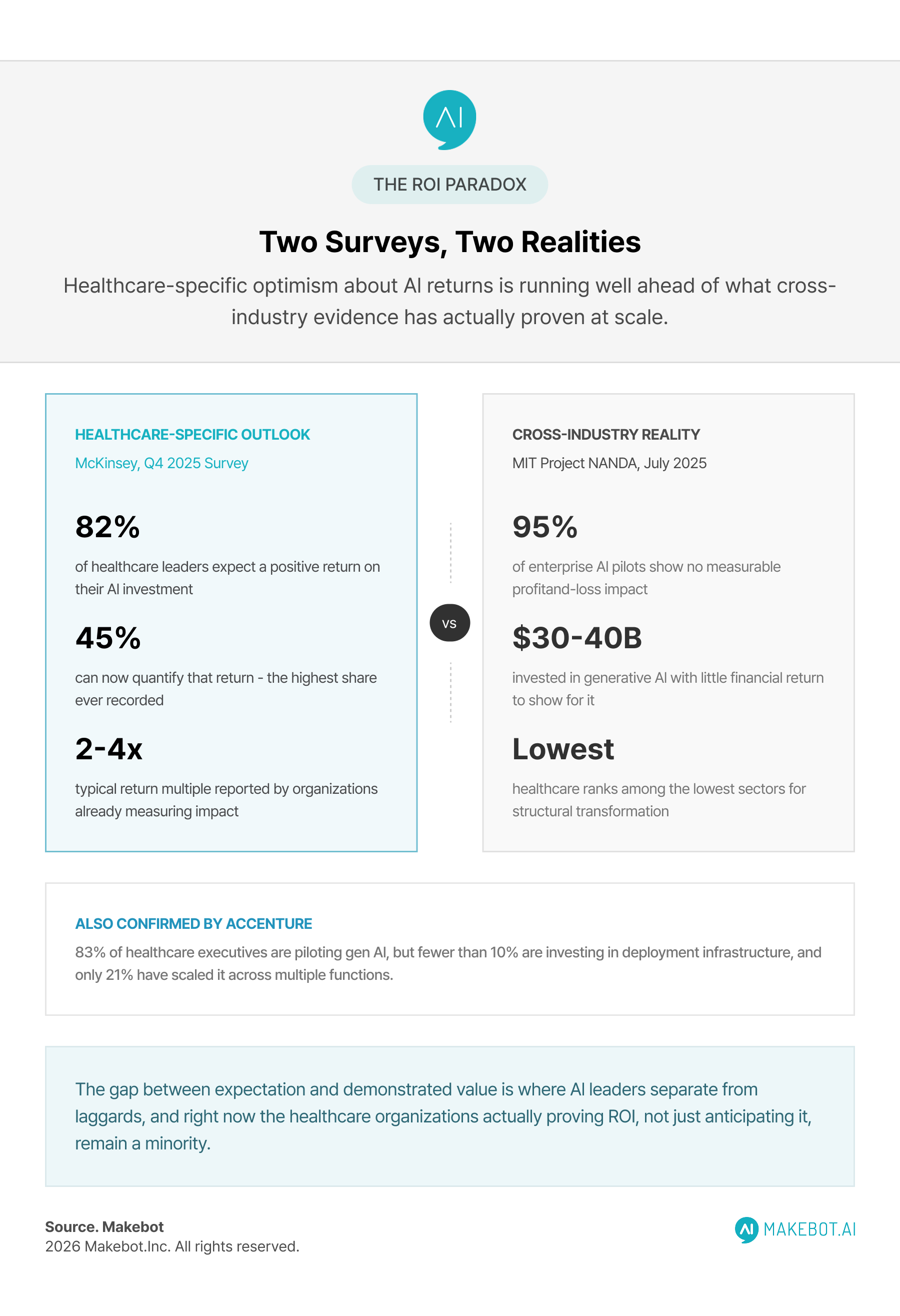
The ROI Paradox: Why Healthcare's AI Optimism Doesn't Match Reality
McKinsey's survey paints an optimistic picture: 82% of leaders expect positive ROI, and 45% can now quantify that return, both the highest figures McKinsey has recorded since 2023. Yet a broader study tells a different story. MIT's Project NANDA analyzed over 300 AI deployments and found that despite $30 billion to $40 billion in enterprise generative AI investment, 95% of organizations saw no measurable profit-and-loss impact, with healthcare ranking among the lowest-performing sectors for structural transformation.
That tension matters: healthcare leaders' optimism about AI's potential return is running ahead of what most organizations have actually proven. Accenture's research confirms the gap: 83% of healthcare executives are piloting generative AI, but fewer than 10% are investing in the infrastructure for organization-wide deployment, and only 21% have scaled it across multiple functions. Expecting ROI and proving ROI are two different disciplines, and most of the industry is still closer to the former, which is exactly why events like Cleveland Clinic's summit matter: they're where hospital leaders compare notes on what has actually worked, not just what a vendor promises.
What Separates AI Leaders from Laggards
McKinsey and Accenture research point to a consistent pattern separating health systems that convert AI investment into performance from those stuck in perpetual pilot mode.
Integration challenges, not model quality, are now the top barrier to scaling AI in hospitals, according to McKinsey, ahead of internal capabilities and risk concerns, a reversal from earlier surveys where risk dominated the conversation. That shift is itself a signal of organizational maturity: the constraint has moved from "should we do this" to "how do we embed this in a legacy hospital IT environment." Deloitte found that demonstrated AI value, rather than anticipated value, rose from 9% of public coverage in 2023 to 19% in 2026, though only 18% of CFOs at scaling organizations say they consistently measure financial impact.
Agentic AI and the Next Phase of Hospital Workflow Automation
McKinsey found that 19% of healthcare organizations have implemented agentic AI, systems that take action and coordinate multi-step workflows rather than simply generating content, while 51% are pursuing proofs of concept. Deloitte's 2026 Outlook Survey found more than 80% of executives expect both generative and agentic AI to deliver significant value this year.
That enthusiasm needs a counterweight. Gartner predicts more than 40% of agentic AI projects will be canceled by 2027, citing escalating costs, unclear business value, and inadequate risk controls, not weak underlying technology. Gartner analysts have also flagged widespread "agent washing," where vendors rebrand existing chatbots and robotic process automation tools as agentic AI without delivering genuine autonomous capability, a distinction hospital IT leaders evaluating vendor claims need to watch for closely.
McKinsey's research offers a useful design principle here: high performers across industries pursue a domain-based, end-to-end workflow approach with agentic AI, rather than scattering narrowly function-specific deployments. Applied to hospitals, that means targeting a complete process, such as patient discharge coordination, prior authorization, or revenue-cycle denial management, rather than inserting an agent into an isolated task.
Governance, Trust, and Risk
No conversation about healthcare digital transformation can ignore risk, and Cleveland Clinic's partnership with CHIME, built around healthcare IT governance, reflects that directly. Deloitte found non-US health system executives expect to dedicate close to 14% of technology budgets to cybersecurity in 2026, versus about 10% among US counterparts, and for good reason: stolen medical record data can sell for up to $1,000 on the dark web, compared with $1 to $3 for email credentials.
McKinsey confirms that risk and safety concerns, particularly inaccuracies, bias, security exposure, and regulatory compliance, remain a top-cited barrier, reported by 43% of healthcare leaders. The organizations succeeding with AI aren't the ones ignoring these risks; they're the ones building governance into deployment itself rather than treating it as an afterthought, a distinction that separates a defensible, auditable AI program from a liability waiting to surface during a regulatory review.
What the Summit Signals for the Next Phase of Hospital AI
Cleveland Clinic's summit isn't a research report, and it doesn't generate new statistics on its own. What it offers is a concentrated view of where hospital and health-system leadership attention is pointed in 2026, and that focus tracks closely with the broader research: the conversation has moved from adoption to integration, from pilots to production, and from hope to proof. The organizations that define the next phase of AI in hospital operations won't be the ones running the most pilots simultaneously.
They'll be the ones that pick a small number of high-value workflows, invest in unglamorous integration and data infrastructure work, and hold themselves to the same P&L discipline they'd apply to any other capital investment. For an industry operating on thin margins and facing chronic workforce shortages, that discipline, more than any individual algorithm, is what will ultimately determine whether AI becomes a durable operational advantage or another expensive experiment.
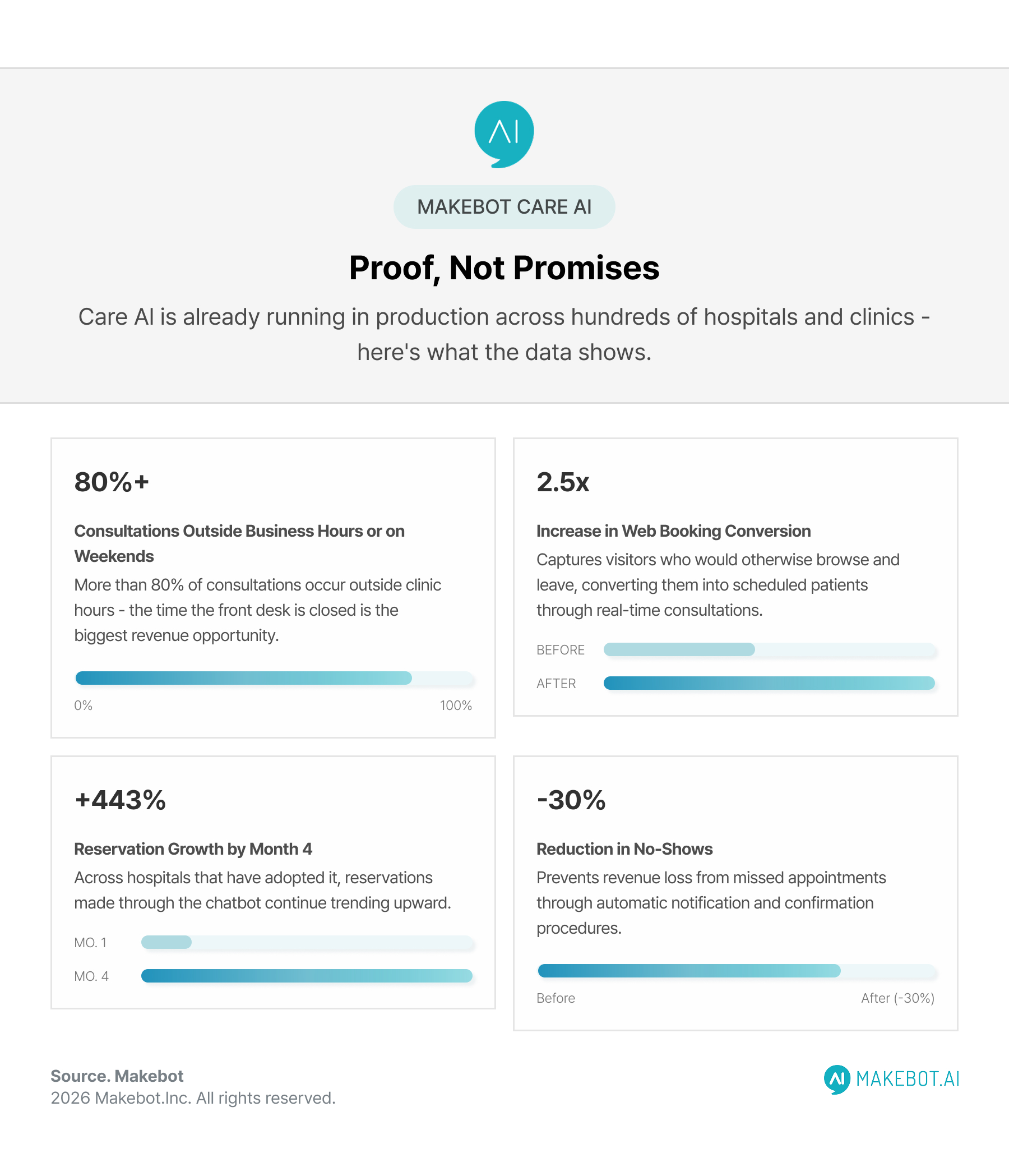
A Working Example: Demonstrated Value at the Patient-Engagement Layer
Much of the AI activity at Cleveland Clinic's summit sits deep inside the hospital. But the same standard, demonstrated value over anticipated value, applies at the front door too: patient scheduling, intake, and communication.
Makebot is one example already running in production. Deployed across more than 500 hospitals and clinics, Care AI unifies chat, web, and voice channels into a single AI system connected to hospital EMR platforms, handling booking and patient inquiries around the clock. Health systems using it report a 2.5x increase in web booking conversion, a 30% reduction in no-shows, and a 50% drop in front-desk call volume.




.jpg)


What Happens to Marketing When the C-Suite Starts Using AI Every Day?







Why AI Shopping Assistants Will Replace Traditional Ecommerce Search






.jpg)

























Why Generative AI Projects Fail and How to Achieve Scalable AI Success











.jpg)

.png)