How AI Agents Are Cutting Claims Appeal Turnaround From 16 Days to 2
AI agents cut claims appeals from 16 days to 2. Only 14% of providers have deployed a fix.

.png)
Key Takeaways
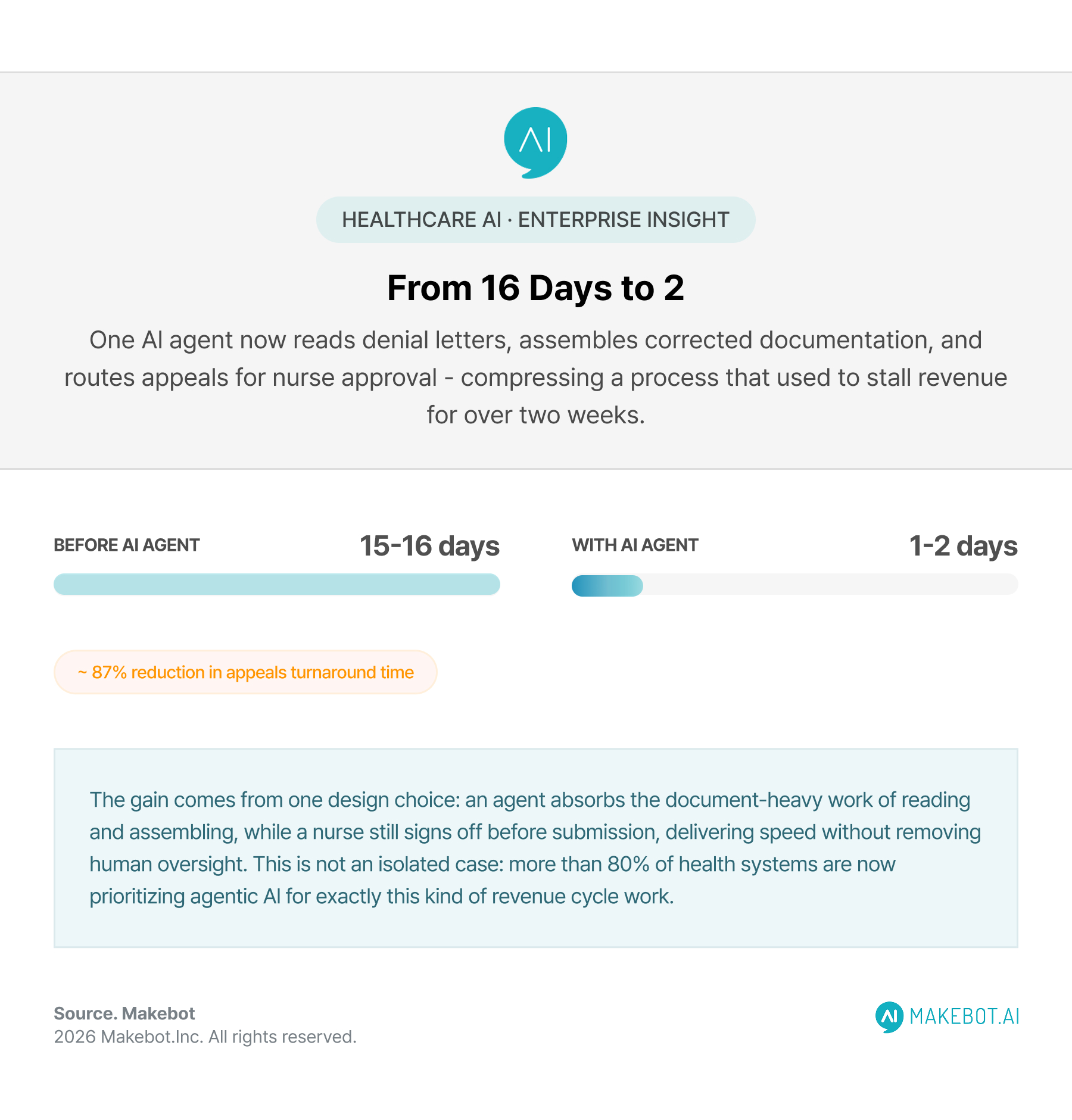
- One hospital executive says that AI agents in healthcare cut a claims appeals process that "sometimes took 15 to 16 days" down to one or two days. The agent reads denial letters and puts together the right paperwork on its own (HealthTech Magazine, 2026).
- More than 80 percent of hospitals are now putting agentic AI in healthcare to work on revenue cycle management and clinical operations, according to a 2026 Deloitte survey of 100 health care technology leaders (Deloitte).
- Claim denials keep rising. 41 percent of providers now say at least 10 percent of their claims get denied, up from 30 percent in 2022. Yet only 14 percent have actually put AI to work on the problem (Experian Health).
- The return on investment picture is split. McKinsey's 2026 survey found that only 37 percent of companies see any real profit impact from AI, about the same as 2025. MIT's NANDA group separately found that 95 percent of generative AI pilots fail to show any measurable result, and Gartner predicts more than 40 percent of agentic AI projects will be shut down before the end of 2027, mostly because of unclear payoffs and "agent washing," not because the technology fails to work.
- The organizations getting ahead all share one thing: healthcare revenue cycle automation built by changing how the work actually gets done, not by bolting a tool onto the old process. That difference is what separates a two day appeals process from a stalled pilot.
Introduction
For years, claim denials and appeals have quietly drained hospital finances. A single appeal could take 16 days, with a nurse tracking down paperwork while payment sits on hold. At Hackensack Meridian Health, an AI agent now reads the denial letter, figures out what is missing, assembles the paperwork, and sends it to a nurse for approval. A process that "sometimes took 15 to 16 days" now takes one or two. This is part of a bigger shift toward healthcare claims automation, backed by data from McKinsey, Deloitte, Gartner, and MIT, which also shows a divide: most companies investing in AI still see little return, while a small group pull ahead. This article covers how that result works, and what separates those who can repeat it.
The Claims Appeal Bottleneck: Why 16 Days Became the Norm
Claim denials have been climbing for years. Experian Health's third annual State of Claims survey found that 41 percent of providers now report denial rates of 10 percent or higher, up from 30 percent in 2022, mostly from missing claims data and authorization errors. This creates a manual workload: nurses and coders read every denial letter by hand and submit packets through payer portals with no way to track which appeals are getting old.
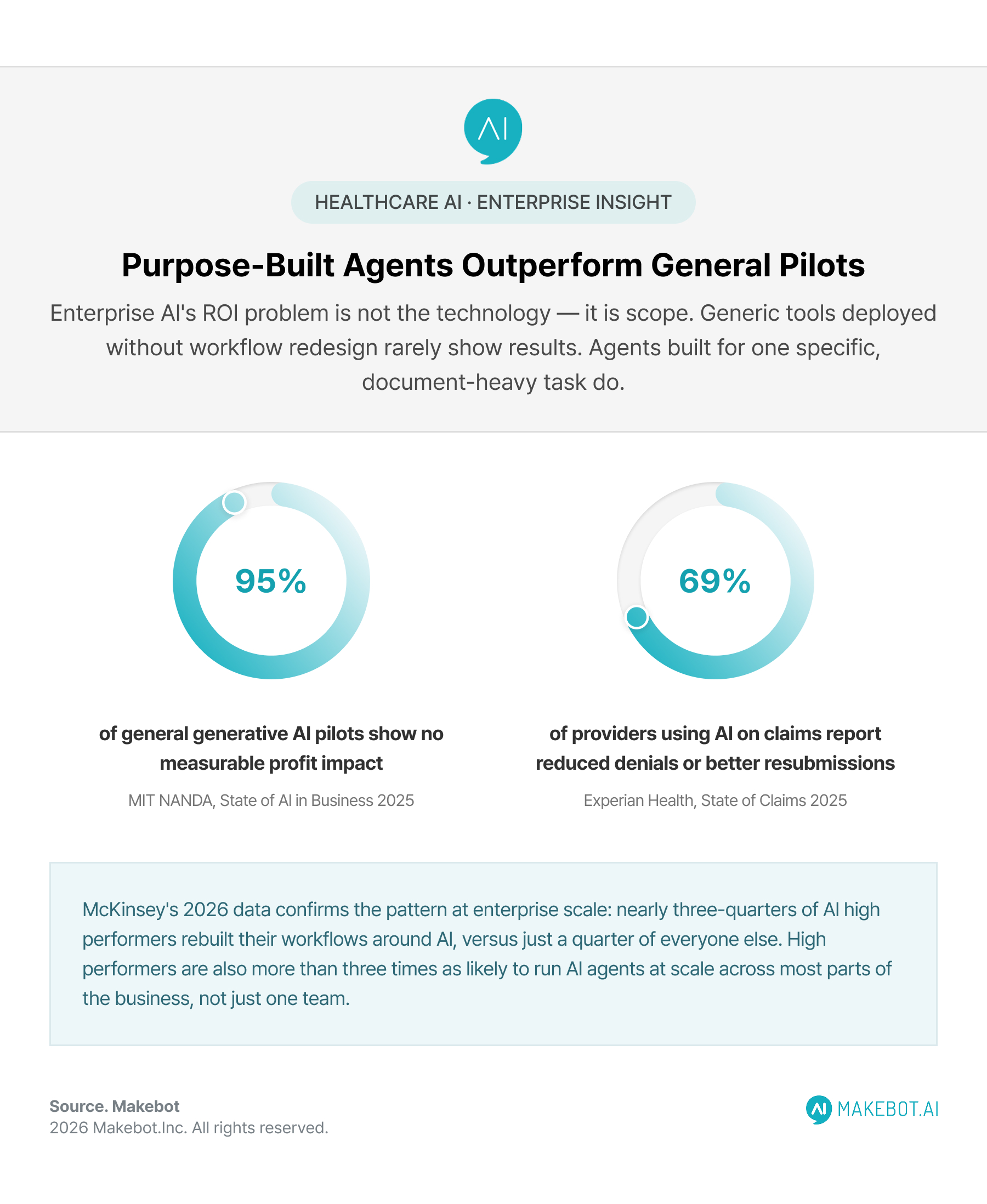
Despite this, AI healthcare automation has not caught on as fast as expected. Experian Health found 67 percent believe AI can improve claims, but only 14 percent have used it, and of that group, 69 percent say AI has already reduced denials or improved resubmission odds.
Inside the Turnaround: How AI Agents Compress 16 Days Into 48 Hours
The case comes from Hackensack Meridian Health. Sameer Sethi, its chief AI officer, calls it "automation plus" in an interview with HealthTech Magazine.
"We are now processing more appeals," Sethi said. "Our whole appeals process sometimes took 15 to 16 days. Now, we do it in one or two days."
- What the agent does. Built for AI claims denial management, it reads the denial letter, works out what is missing, assembles the corrected packet, and sends it to a nurse for final sign-off.
- Why the human step stays. A person still checks the work; the agent just removes the slow work before it.
- The same pattern elsewhere. Deloitte's Center for Health Solutions found that MUSC Health has deployed AI agents to complete 40 percent of prior authorizations without any human involvement.
- Why it works now. IDC's Mutaz Shegewi calls this part of a bigger maturity curve, where stabilizing IT systems first lays "the foundation for more advanced automation."
- What actually compresses the timeline. An agent that reads messy denial-letter text, checks it against payer rules, pulls the right EHR records, and assembles a packet ready to submit before a person opens the file.
Beyond One Health System: The Enterprise Data on Agentic AI in Healthcare
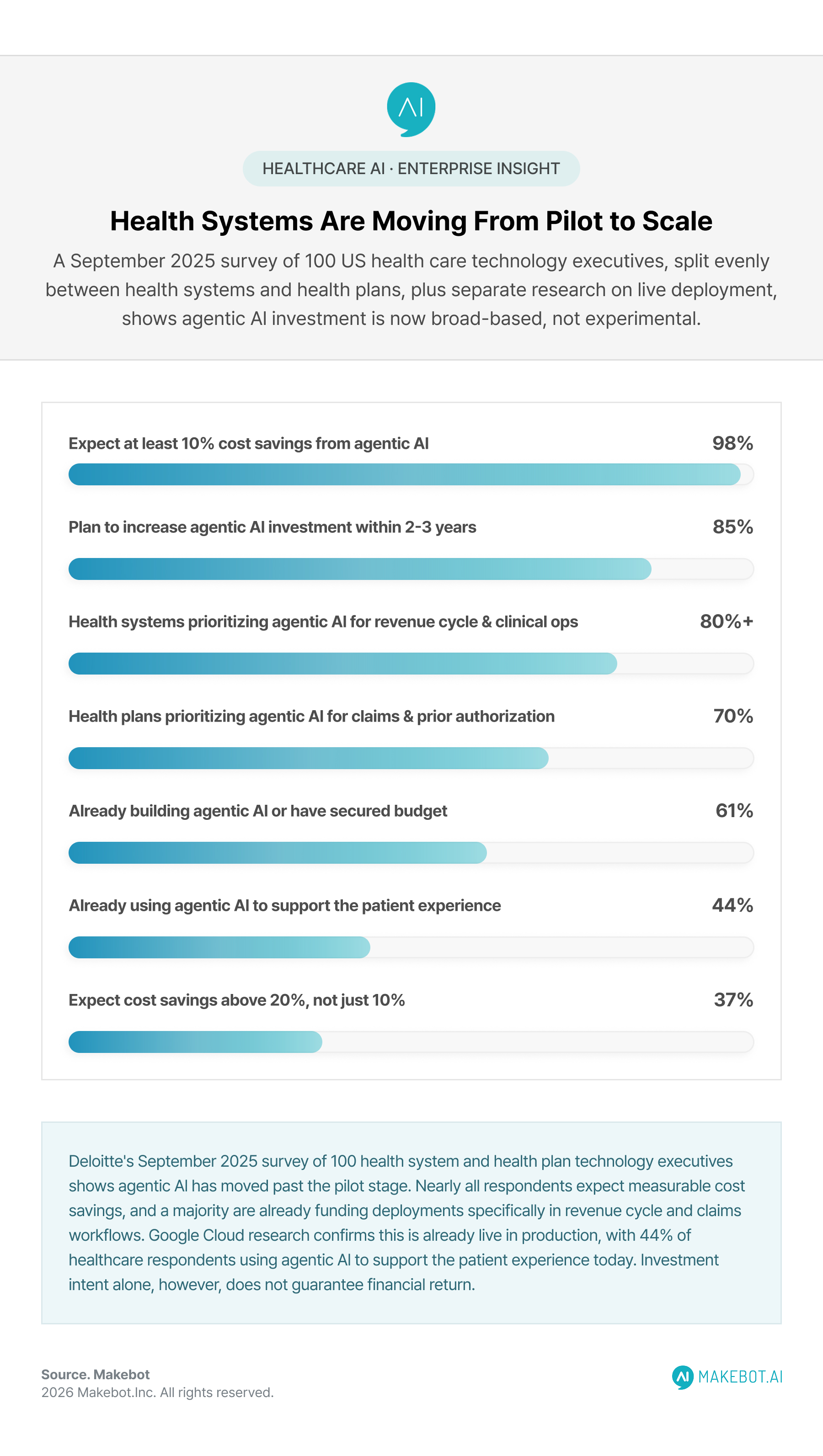
Hackensack Meridian's result would be a good story on its own. What makes it more is that Deloitte's broader survey of 100 US health care technology executives shows the pattern spreading industrywide: 61 percent are already building agentic AI projects or have budget secured, and 98 percent expect at least 10 percent in cost savings. More than 80 percent of health systems prioritize agentic AI for AI revenue cycle management; 70 percent of health plans prioritize it for claims.
Deloitte's 2026 Outlook Survey of 120 C-suite leaders agrees: over 80 percent expect agentic AI and generative AI in healthcare to deliver real value this year. Google Cloud's research found 44 percent already use agentic AI for the patient experience, part of a bigger wave of hospital workflow automation.
The ROI Divide: Why Some Health Systems Capture Value and Others Do Not
The optimism in these adoption surveys sits next to a harder set of numbers on actual returns:
- McKinsey's most recent Global Survey on AI. Nearly nine in ten organizations now use AI regularly, and 44 percent report it at full scale, yet only 37 percent say AI has made any real difference to their bottom line, unchanged from 2025. Just 6 percent count as "AI high performers," and nearly three-quarters of them rebuilt their workflows around AI, versus a quarter of everyone else.
- MIT's Project NANDA. The GenAI Divide: State of AI in Business found that 95 percent of generative AI pilots show no measurable profit effect, despite billions in spending. The 5 percent that succeed adapt to a workflow; the rest use generic tools that do not fit the work.
- Gartner's forecast. More than 40 percent of agentic AI projects will be shut down before the end of 2027, mostly from rising costs and unclear value, not model failure, a pattern Gartner calls "agent washing."
- Deloitte's 2026 Healthcare CFO Survey. 44 percent count as "AI scalers," but only 18 percent measure financial impact regularly.
High Performers vs. Stalled Adopters
High performers and stalled adopters diverge in how they actually operate. High performers rebuild the process around the AI agent, run multiple agents across departments, track and report the financial impact, choose tools built for their specific workflow, and invest steadily, often 20 percent or more of the digital budget. Stalled adopters add AI on top of the old process, run one tool for one narrow problem, assume it is working without checking, rely on generic, one-size-fits-all tools, and keep small pilot budgets that get cut easily.
Common Challenges Enterprises Face Scaling Claims Automation
Even well-intentioned companies hit the same problems scaling claims denial automation:
- Messy data. Denial letters and payer portals rarely share a format, which MIT calls the biggest barrier to scaling.
- No clear ROI owner. Most AI scalers do not track financial impact consistently.
- Sticking with the old workflow, the clearest gap between high performers and everyone else.
- Vendors overselling tools through "agent washing."
- Weak oversight. Removing the human check too early raises risk with no real speed gain.
Strategic Recommendations for Revenue Cycle and Claims Leaders
- Start with one high-volume denial type instead of automating everything at once
- Measure financial impact from week one, not after the pilot wraps up
- Keep a clear human check before every appeal
- Judge vendors against Gartner's agent-washing signs
- Budget for redesigning workflow, not just buying software
Conclusion
The 16-to-2-day result is real, documented, and repeatable, but it does not happen automatically. It comes from one design choice: an agent that takes on the document-heavy work, paired with a person who still signs off before anything goes out. The data from McKinsey, Deloitte, Gartner, and MIT points to the same conclusion: it is not the organizations running the most pilots or spending the most money that get ahead, but the ones willing to redesign the work, measure financial impact from day one, and hold vendors to a real standard.
AI That Works for Your Hospital
Healthcare operations teams dealing with claims denials can find a proven starting point with CareAI, Makebot's hospital AI platform trusted by 500+ clinics and hospitals across Korea, including Seoul National University Hospital and Severance Hospital. With real-time EMR integration and a 24/7 AI call bot, CareAI reduces front-desk workload by up to 50% while keeping human staff in control of every final decision. To explore how Makebot's full suite of AI solutions fits your revenue cycle and clinical operations goals, visit Makebot.












.jpg)


What Happens to Marketing When the C-Suite Starts Using AI Every Day?







Why AI Shopping Assistants Will Replace Traditional Ecommerce Search






.jpg)
























Why Generative AI Projects Fail and How to Achieve Scalable AI Success











.jpg)

.png)