Why Product Data Quality Is Becoming a Marketing Problem in the Age of AI Shopping Agents
AI referral traffic grew 693% in 2025. Poor product data costs B2B firms 12% of online revenue.

.jpg)
Key Takeaways
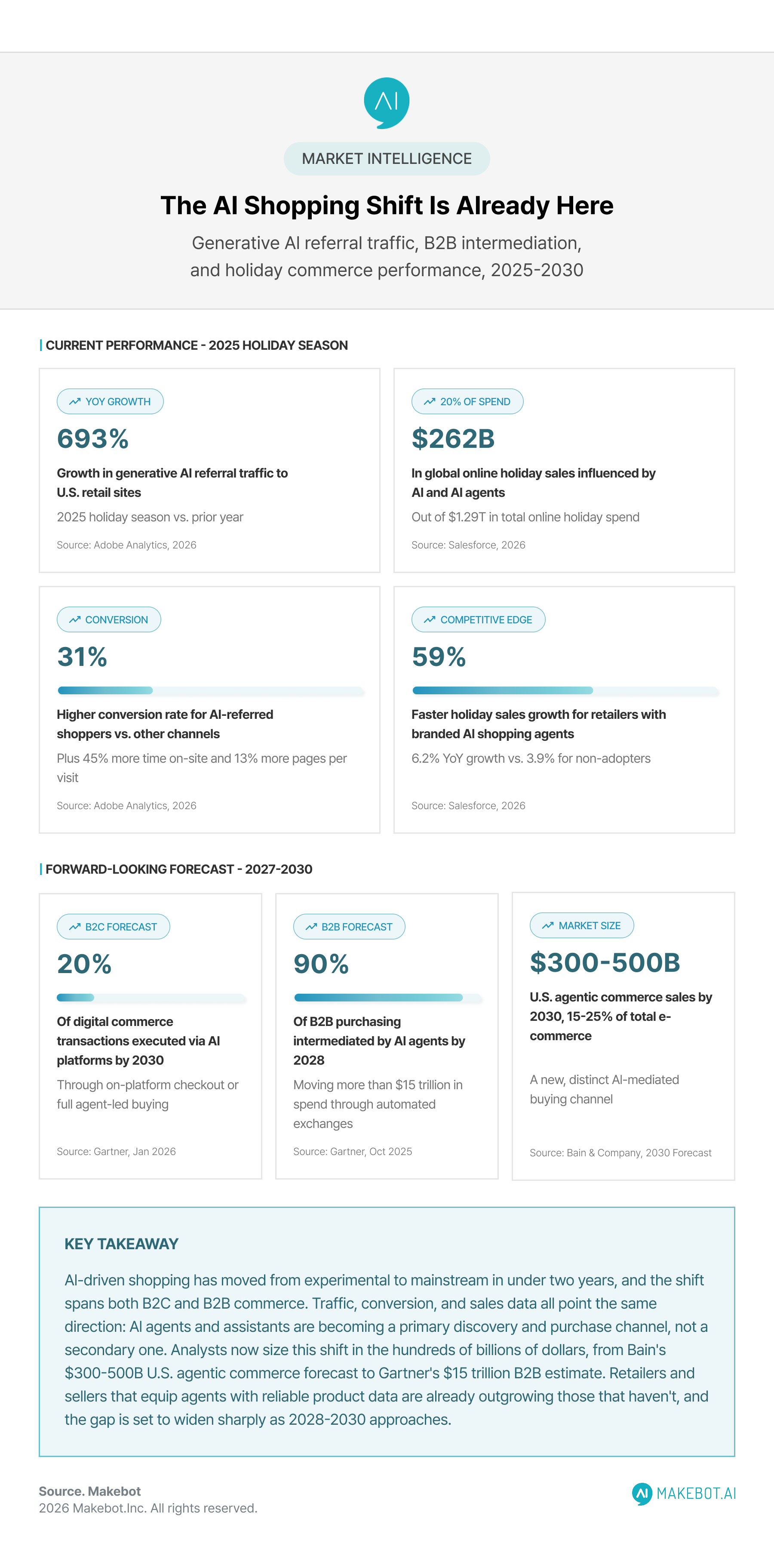
- Generative AI referral traffic to U.S. retail sites grew 693% year over year during the 2025 holiday season, and Salesforce's post-season results show AI and agents influenced 20% of global online holiday sales, worth $262 billion.
- Gartner projects that by 2030, 20% of digital commerce transactions will run through AI platforms using on-platform checkout or AI agents, and forecasts that more than 50% of consumers will rely on AI personal shoppers regularly by 2027.
- Poor product data isn't a back-office problem anymore: Salsify's 2025 consumer research found 71% of shoppers have returned a product because it didn't match its online listing, and 54% have abandoned a purchase over inconsistent product content.
- McKinsey's 2025 State of AI survey found that 88% of organizations use AI somewhere in the business, yet only about 6% qualify as "high performers" capturing significant EBIT impact. The gap traces back to data and workflow readiness, not model quality.
- MIT's NANDA initiative found that roughly 95% of enterprise generative AI pilots fail to produce measurable P&L impact, a pattern researchers link directly to fragmented, unstructured, or unreliable underlying data.
Introduction
For twenty years, e-commerce marketing meant winning a human's attention: better copy, sharper images, a search box tuned for keywords. That playbook is being rewritten. Shoppers increasingly delegate research and comparison to AI shopping agents, tools that read product data directly and recommend or transact on a customer's behalf without ever rendering a webpage. When the customer is a language model instead of a person, the old marketing lures stop working; what matters is whether your product data is structured, accurate, and machine-readable enough for an agent to trust it. This article examines why product data quality has quietly become one of the AI era's most consequential marketing problems, and what separates the enterprises capturing real value from the rest.
The Shift From Search Engines to Shopping Agents
Retail traffic patterns are changing faster than most marketing teams have adjusted for. Adobe Analytics, which tracks over a trillion visits to U.S. retail sites, found that generative AI referral traffic jumped 769% year over year in November 2025 and 673% in December, outpacing every other industry it measures. That traffic also converts better: AI-referred visitors convert 31% more often, spend 45% more time on-site, and view 13% more pages per visit.
Salesforce's post-holiday results add scale to the picture: AI and AI agents influenced 20% of the $1.29 trillion in global online holiday spend in 2025, worth $262 billion in sales. Retailers who had already deployed their own branded shopping agents saw holiday sales grow 59% faster than those without one, 6.2% versus 3.9% year over year.
This isn't a temporary spike. Gartner forecasts that by 2027, more than half of consumers will use AI personal shoppers regularly, and by 2030, one in five digital commerce transactions will run through AI platforms via on-platform checkout or agent-led buying. Separately, Gartner predicts that by 2028, 90% of B2B purchasing will be AI-intermediated, moving over $15 trillion through automated exchanges. Generative AI in e-commerce has gone from experimental feature to primary discovery channel in about two years.
Why AI Shopping Agents Depend on Product Data Quality
How Retrieval-Augmented Generation Changes Product Discovery
Most AI shopping assistants don't "know" your catalog from training data; they retrieve it live. This is RAG for e-commerce: an agent receives a query, retrieves relevant records from a feed, API, or structured content source, and generates a recommendation grounded in what it just pulled, only as reliable as the data behind it.
This differs fundamentally from traditional SEO. A search engine ranks a page; a shopping agent extracts specific facts (price, material, dimensions, compatibility, stock status) and reasons over them to recommend a product or complete a transaction. If those facts are missing or buried in unstructured copy, the agent guesses, skips the product, or surfaces a competitor's cleaner listing instead. AI product discovery rewards precision and machine-readability over persuasive language.
What "Agentic-Ready" Product Data Actually Means
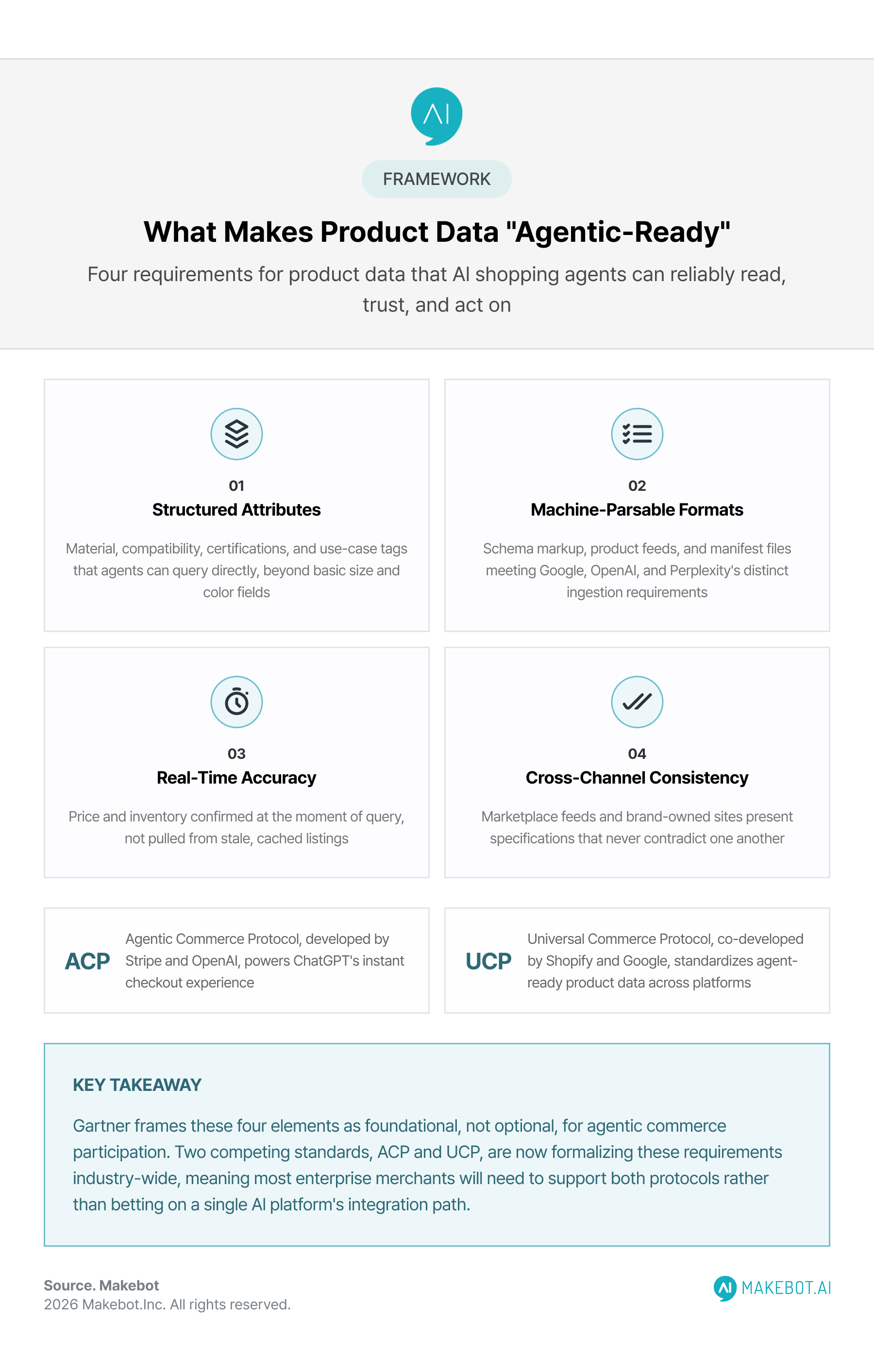
Gartner's January 2026 research, "Optimize Product Data for Agentic Commerce," frames structured, enriched, and accessible product data as foundational, not optional, for agent-driven buying journeys. In practice, agentic-ready data typically requires:
- Structured attributes beyond basic size/color fields: material, compatibility, certifications, and use-case tags that agents can query directly.
- Machine-parsable formats such as schema markup, product feeds, and manifest files that meet each AI platform's ingestion requirements (Google, OpenAI, and Perplexity each specify different formats).
- Real-time accuracy on price and inventory, since agents increasingly check stock and pricing at the moment of query rather than relying on cached listings.
- Cross-channel consistency, so an agent pulling data from a marketplace feed and a brand's own site never surfaces contradictory specifications.
Two competing open standards are emerging to formalize this: the Agentic Commerce Protocol (ACP) from Stripe and OpenAI, which powers ChatGPT's instant checkout, and the Universal Commerce Protocol (UCP), co-developed by Shopify and Google. Most enterprise merchants will eventually need to support both, raising the operational stakes of product data management considerably.
The Hidden Cost of Poor Product Data in the Age of AI Shopping
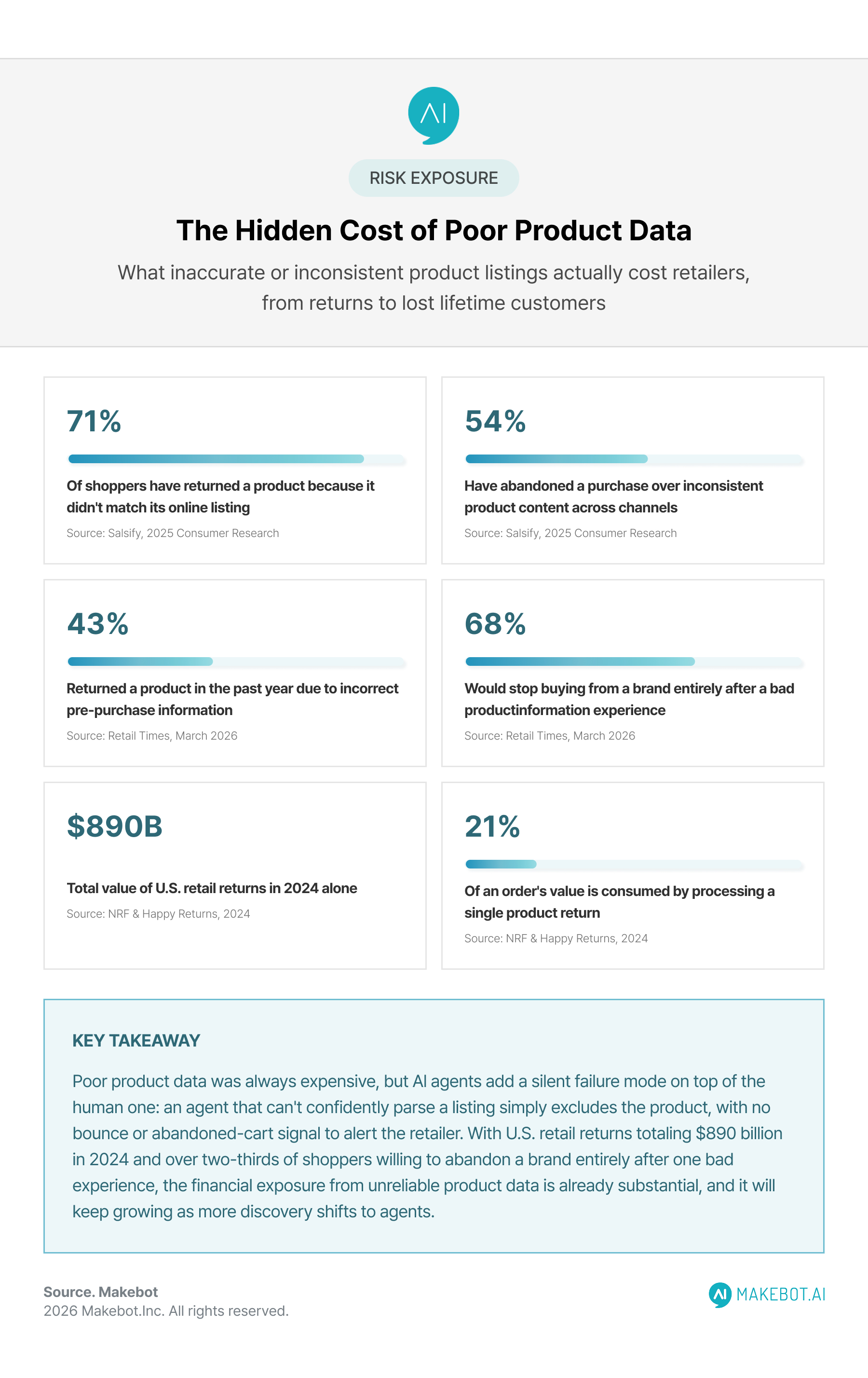
Bad product data has always cost money, but the agentic era raises the penalty. Salsify's 2025 consumer research, surveying roughly 1,900 shoppers across the U.S. and U.K., found:
- 71% have returned a product because it didn't match its online listing.
- 54% have abandoned a purchase because product content was inconsistent across channels.
Similar research from Retail Times in March 2026 found that 43% of consumers had returned a product in the past year due to incorrect pre-purchase information, and 68% would stop buying from a brand entirely after a bad experience. These numbers compound at scale: the National Retail Federation and Happy Returns put total U.S. retail returns at $890 billion in 2024, with processing costs alone exceeding 21% of an order's value.
For e-commerce product data specifically, AI adds a new failure mode on top of the human one: an agent that can't parse your specifications may simply exclude your product entirely, a silent loss with no bounce-rate metric to flag it. Bain & Company forecasts agentic commerce could reach $300–500 billion in U.S. sales by 2030, 15–25% of total e-commerce, meaning the cost of being invisible to agents will only grow.
Enterprise AI Investment Performance: Why Some Companies Win and Others Don't
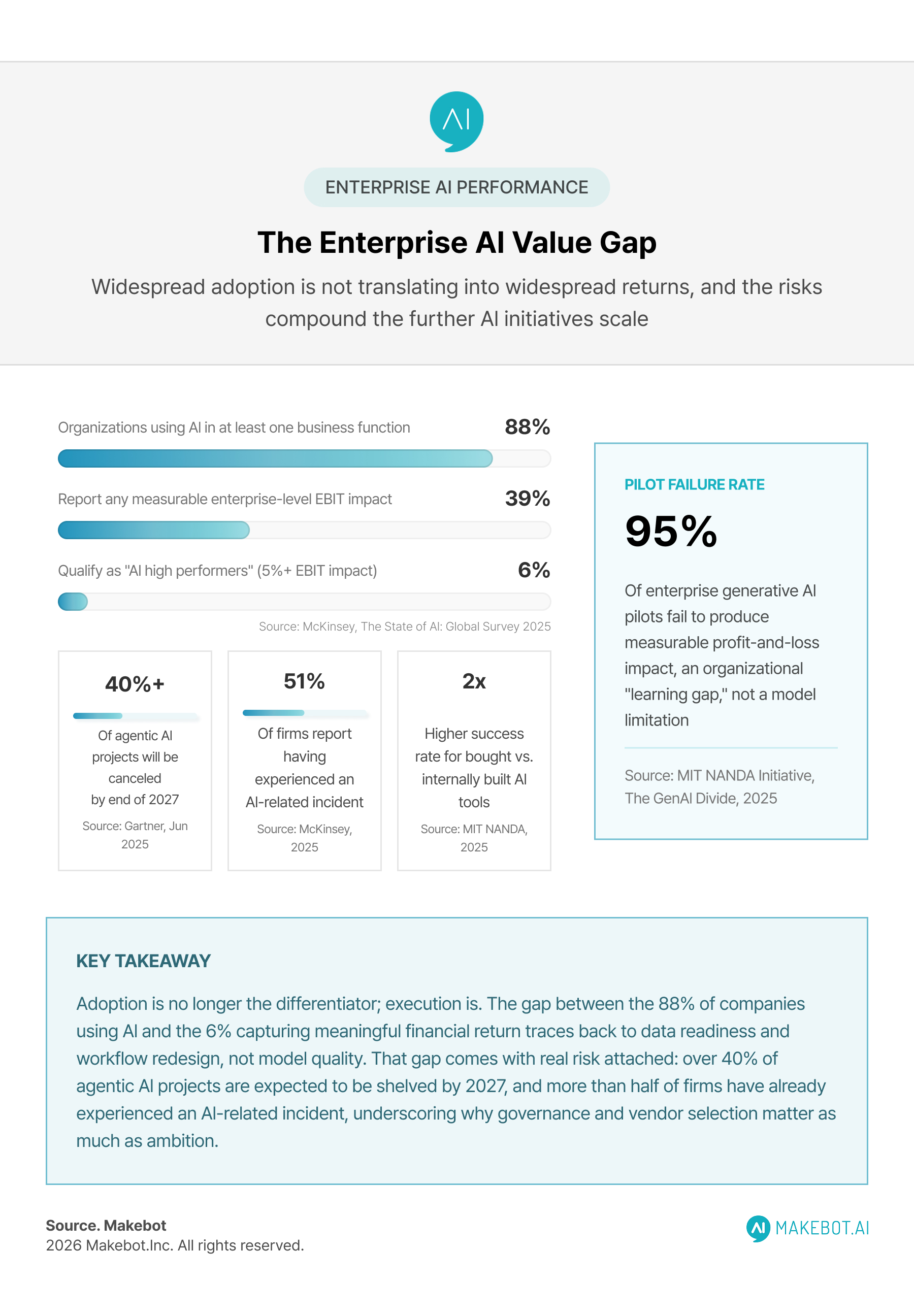
The product data problem reflects a bigger pattern: widespread adoption, uneven returns. McKinsey's 2025 State of AI survey found that 88% of organizations now use AI in at least one business function, up from 78% the prior year, yet only 39% report measurable enterprise-level EBIT impact, and just 6% qualify as "AI high performers." The gap traces back to data and workflow readiness, not model quality. Cost benefits concentrate in engineering and IT; revenue gains show up in marketing and product development, but rarely aggregate enterprise-wide.
MIT's NANDA initiative, in its widely cited 2025 report "The GenAI Divide," found that roughly 95% of enterprise generative AI pilots fail to produce measurable profit-and-loss impact, a pattern the researchers attribute to a "learning gap," an organizational failure to integrate AI into real workflows, not weak models. Gartner reinforces this, predicting that over 40% of agentic AI projects will be canceled by the end of 2027 due to rising costs, unclear value, or inadequate risk controls.
Technical Factors Separating High Performers from Laggards
- Data readiness. McKinsey and MIT both point to fragmented, siloed, or poorly governed data as a leading blocker to scaling AI past the pilot stage.
- Buy versus build. Externally sourced, proven AI tools succeed roughly twice as often as internal builds, largely because they integrate faster with existing systems.
- Integration depth. PwC Ireland's 2025 AI Agent Survey found 40% of respondents cited data issues as their top barrier to agentic AI adoption, and 36% struggled integrating agents with existing systems, mirroring the data-readiness gaps McKinsey and MIT identify globally.
Organizational Factors: Governance, Workflow Redesign, and Talent
- Executive ownership. PwC Ireland's 2026 AI Business Predictions describe AI front-runners as organizations running top-down, centrally governed programs rather than crowdsourced, bottom-up initiatives.
- Workflow redesign, not automation-on-top. McKinsey notes that treating AI as a bolt-on to existing processes caps its value; high performers redesign the underlying workflow.
- Risk governance. McKinsey found that 51% of firms report AI-related incidents; high performers differentiate through human-in-the-loop controls and centralized oversight, not unmanaged experimentation.
AI Shopping Leaders vs. Laggards: What Separates Them
The gap between AI leaders and everyone else comes down to a consistent set of structural differences:
What Enterprises Must Do Now
Closing the gap between AI adoption and AI value starts with treating product data as strategic infrastructure rather than a content afterthought:
- Audit product data against agent requirements first, not just human-readable storefront standards: check schema completeness, attribute depth, and feed accuracy across every channel.
- Consolidate ownership of product data under a single governance function so pricing, inventory, and specifications stay synchronized in real time.
- Prioritize the highest-traffic, highest-return categories for cleanup first: electronics, appliances, and other research-heavy categories see the largest share of AI-referred traffic.
- Build for both major agentic protocols (ACP and UCP) rather than betting on a single AI platform's integration path.
- Tie AI and data investments to measurable outcomes (conversion rate, return rate, and revenue per visit) rather than adoption counts alone.
Enterprises that treat AI-powered product search and AI shopping assistants as customers to serve with trustworthy data, not channels to persuade, are the ones capturing these gains.
Conclusion
The organizations winning in AI-mediated commerce aren't necessarily the ones with the flashiest campaigns or the biggest AI budgets; they're the ones whose product data an agent can actually trust. As LLM product discovery becomes default shopping behavior, businesses that treat data quality as a marketing function, not just an IT concern, will be the ones agents keep recommending. The gap between the 6% of companies capturing real AI value and the 94% still searching for it traces back to a deceptively unglamorous discipline: getting the underlying data right, structured, and current. In an agent-mediated market, clean product data isn't a nice-to-have; it's the price of being discoverable at all.








.png)








What Happens to Marketing When the C-Suite Starts Using AI Every Day?







Why AI Shopping Assistants Will Replace Traditional Ecommerce Search






.jpg)

























Why Generative AI Projects Fail and How to Achieve Scalable AI Success











.jpg)

.png)


















Interview Feature: Why Companies Are Betting Big on Generative AI