New Studies Show AI Can Improve Medication Safety by Detecting Prescription Risks Earlier
AI cuts undetected medication errors 55% in trials - 47% of patients have errors at admission.

Introduction
Prescription errors remain one of the most persistent, and most preventable, threats to patient safety. Every hospital admission requires reconstructing a patient's full medication history in real time, often from incomplete records or a rushed verbal account, and that reconstruction process is where risk concentrates. New clinical research quantifies the scale of the problem and the value of catching it earlier: AI clinical decision support systems are now identifying dangerous drug interactions, dosing errors, and omissions before they reach a patient - not after. This article examines what the latest peer-reviewed studies and enterprise AI research reveal about AI medication safety, why some health systems achieve measurable results from AI prescription risk detection while others stall, and what separates high-performing adopters of healthcare AI from those still stuck in pilot mode.
Stanford's MedAgentBench: Why Healthcare AI Agents Still Struggle in Real Clinical Workflows. Read here!
Why Prescription Errors Remain a Persistent Safety Gap
Medication reconciliation is the point in care where the most iatrogenic risk accumulates, and it is still, in most settings, a manual process.
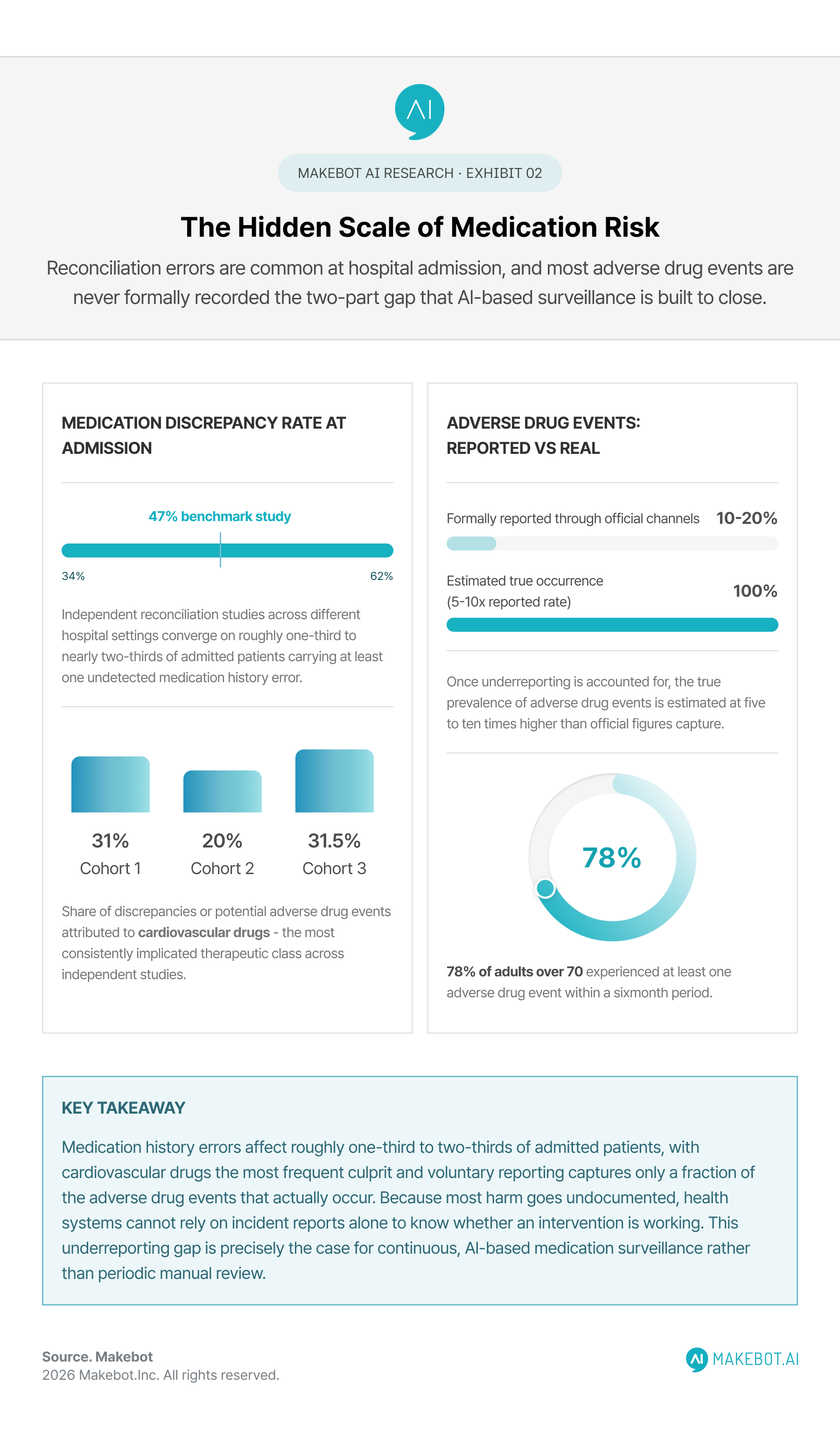
- A peer-reviewed Swedish hospital study using pharmacist-led medication reconciliation identified at least one medication history error in 47% of admitted patients (95% CI 43–51%), with omitted drugs and wrong doses the most common error types.
- That 47% figure is not an isolated outlier. Independent reconciliation studies across different hospital settings consistently find discrepancy rates ranging from roughly 34% to 62% of admitted patients, with medication omission the most frequent single error type in nearly all of them.
- Cardiovascular drugs are the most consistently implicated class across this research, showing up as the top category in study after study - 31% of discrepancies at admission in one cohort, 20% of potential adverse drug events in another, and 31.5% of discrepancies in a third - even though the exact share varies by hospital population and methodology.
- A higher number of drugs at admission was itself a statistically significant predictor of medication history errors, confirming that polymedicated and chronically ill patients carry the highest risk.
Signal: Manual medication reconciliation is the weak point in patient safety. Evidence: Independent studies converge on roughly one-third to one-half of admitted patients carrying at least one undetected medication history error, with cardiovascular drugs the most frequent culprit. Implication: Any technology that can verify a patient's medication list against pharmacological rules before a clinician acts on it addresses the single largest, most consistently documented source of preventable prescribing risk.
This is precisely the gap that AI-powered medication safety tools are built to close, and it explains why hospital systems are prioritizing this use case over more speculative generative AI applications.
Philips Survey: Most Clinicians Use AI but Lack Formal Training. Learn more here!
What the Latest Clinical Studies Show About AI and Prescription Risk Detection
AI prescription analysis is not a new concept, but the accuracy and specificity of detection has improved meaningfully as machine learning has replaced first-generation rule-based alerting.
Error Reduction Backed by Clinical Trials
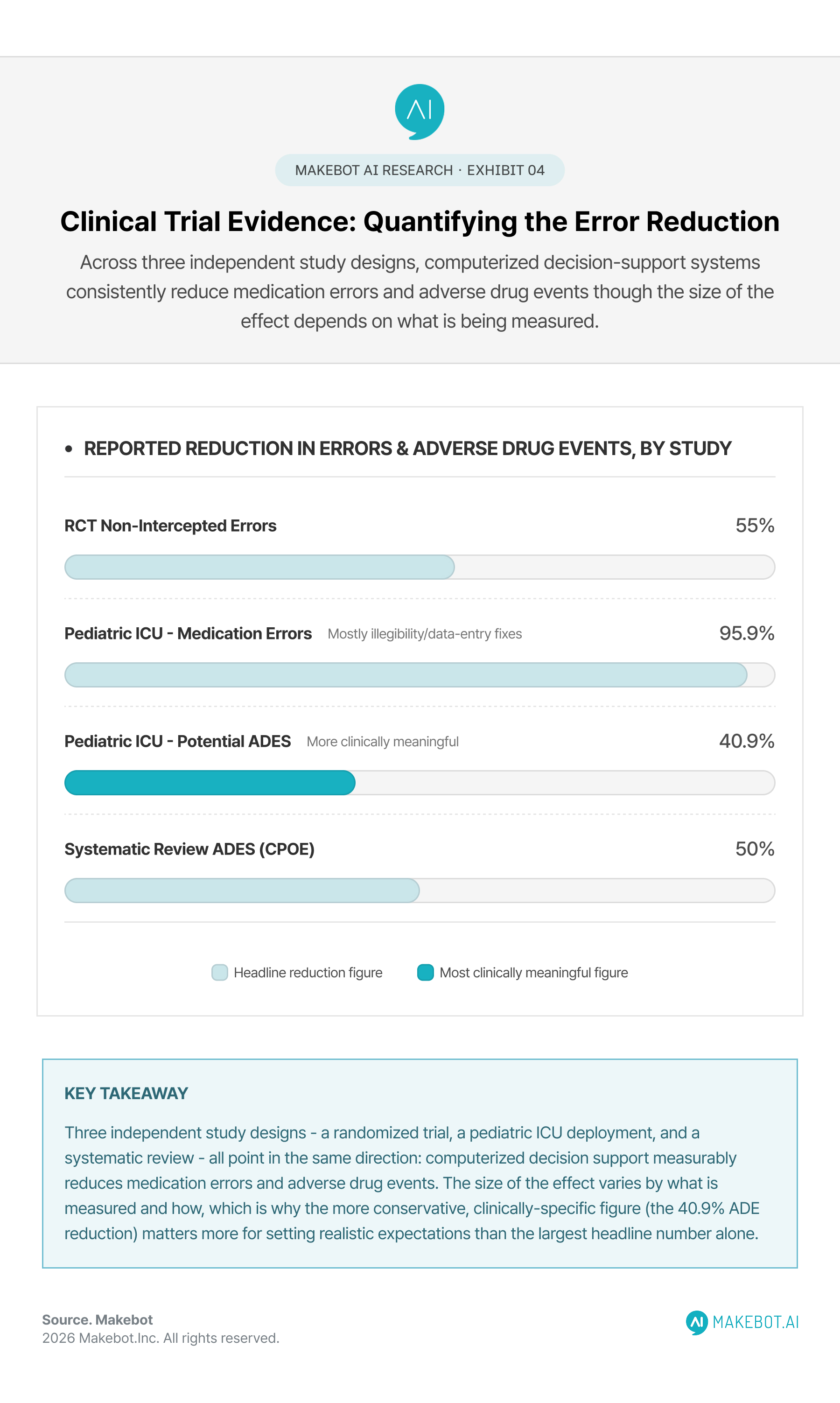
- Randomized trials of computerized decision-support systems have demonstrated substantial reductions in medication errors and adverse drug events, including a 55% reduction in non-intercepted errors in one early randomized trial.
- A pediatric intensive care study found that computerized physician order entry with decision support reduced medication errors by 95.9%, with potential adverse drug events reduced by 40.9% - though the study notes most of the corrected errors were illegibility or missing-information issues rather than complex clinical errors, so the more clinically meaningful figure is the 40.9% ADE reduction.
- One study within a broader systematic review of decision-support tools reported a 50% reduction in adverse drug events using computerized physician order entry, consistent with the general direction of the wider evidence base even if the magnitude varies by setting.
Machine Learning Improves Alert Precision
A core limitation of legacy CDSS platforms has been "alert fatigue" - too many low-value warnings that clinicians learn to ignore. Newer probabilistic and machine-learning approaches are solving that problem directly:
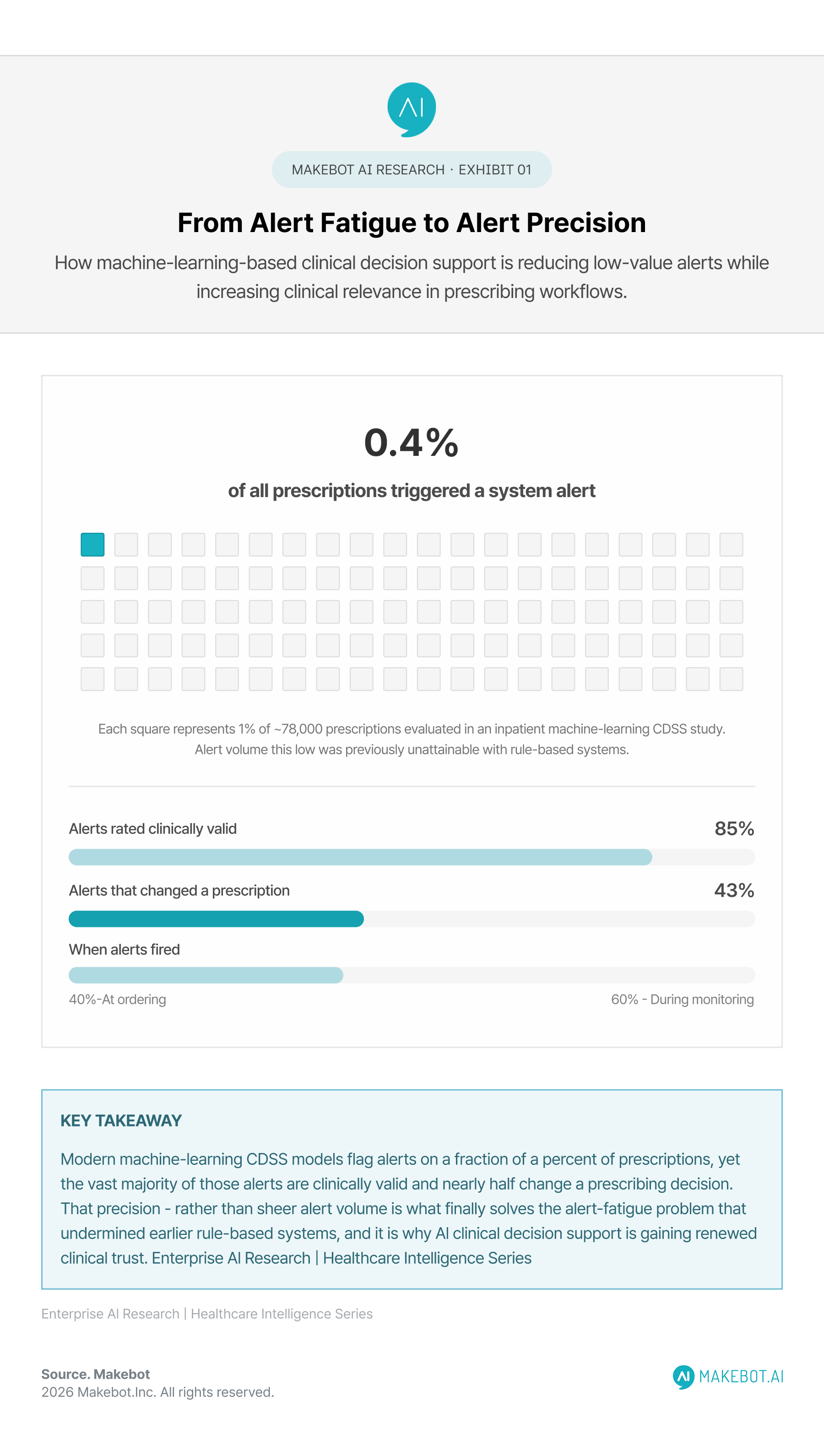
- One machine-learning-based system, evaluated across roughly 78,000 prescriptions in an inpatient setting, generated alerts on only 0.4% of prescriptions, with high accuracy and a low false-positive rate - and a review of that same generation of alerting models found 85% of alerts were rated clinically valid and 43% resulted in an actual prescription modification, a strong clinical-relevance rate for a low-volume alert stream.
- Forty percent of alerts fired synchronously during the ordering process itself, while 60% surfaced later during monitoring - evidence that AI-powered surveillance catches risk both at the point of prescribing and afterward.
This shift toward precision - fewer, more clinically relevant alerts - is what separates modern AI clinical decision support from the alert-heavy systems that frustrated clinicians a decade ago.
The Scale of Undetected Risk
Even with better detection tools, researchers caution that most adverse drug events (ADEs) still go unrecorded. A study of adults over 70 found 78% had experienced at least one ADE within a six-month period, and broader estimates suggest only 10% to 20% of medication errors are ever formally reported, meaning true ADE prevalence may be five to ten times higher than documented figures show. That reporting gap is precisely why AI-based surveillance - which continuously scans structured and unstructured records rather than relying on voluntary reporting - is drawing investment from health systems and regulators alike.
Can AI Health Assistants Reduce Unnecessary Clinic Visits? What Early Data Suggests. Continue reading here!
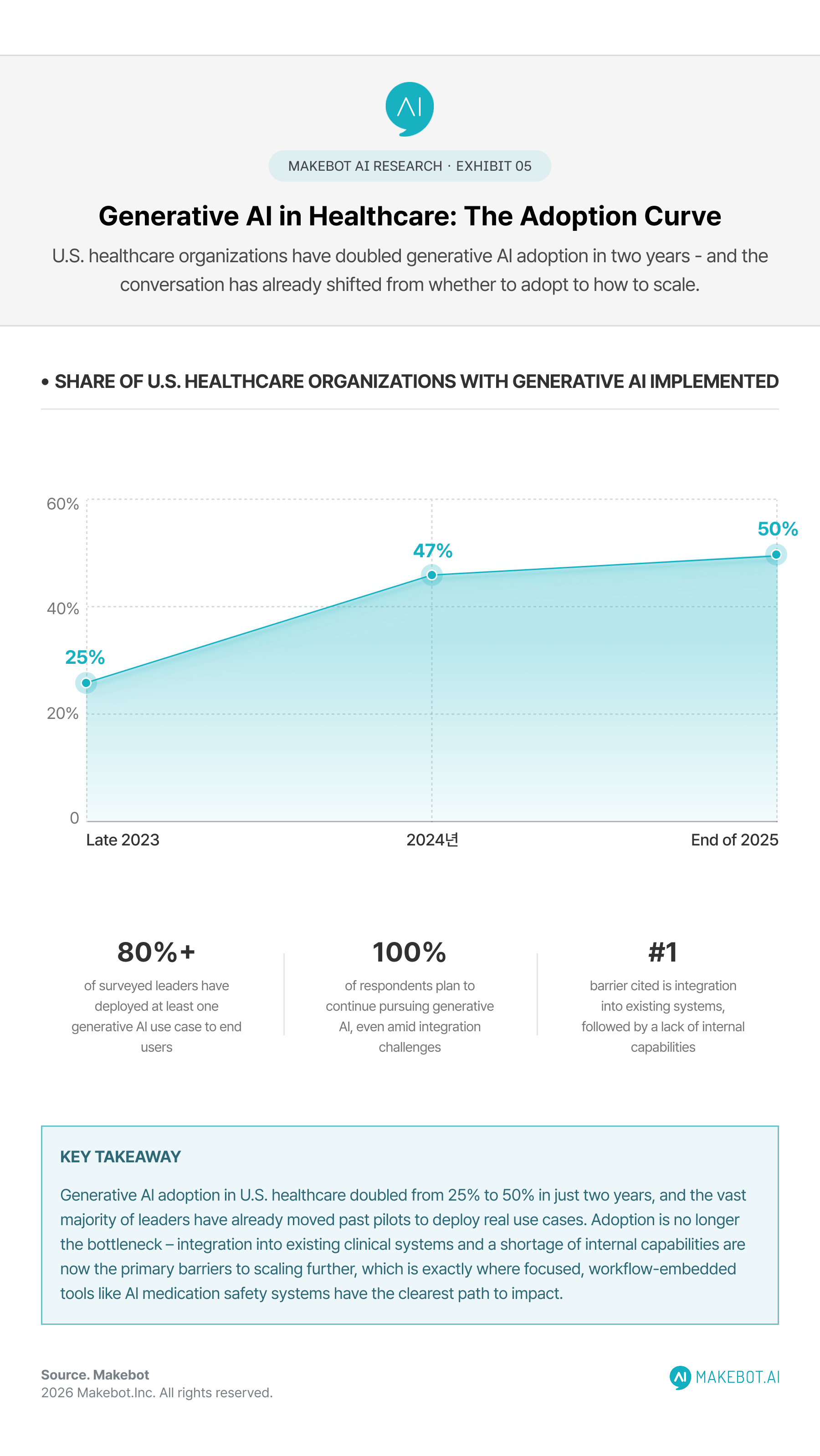
Generative AI in Healthcare: Adoption Is Accelerating
Generative AI in healthcare has moved well past the pilot stage, and medication safety is one of the use cases benefiting most directly from that maturity curve.
- Fifty percent of U.S. healthcare organizations had implemented generative AI by the end of 2025, up from 25% in late 2023 and 47% in 2024.
- More than 80% of surveyed leaders reported deploying at least one generative AI use case to end users, and all respondents reported plans to continue pursuing the technology.
- As adoption has matured, healthcare leaders are shifting focus toward scaling and integration, citing integration into existing systems and a lack of internal capabilities as the primary operational barriers.
Signal: Adoption is no longer the bottleneck in healthcare AI. Evidence: Half of organizations have moved from pilot to implementation, and integration challenges - not skepticism - are now the top-cited barrier. Implication: The competitive question for hospitals and health systems is shifting from "should we adopt AI" to "can we operationalize it inside existing clinical workflows," and medication safety tools are a natural proving ground because the ROI (fewer adverse events, shorter admissions) is directly measurable.
1 in 7 People Have Used AI Instead of Seeing a Health Provider, Study Finds. Discover more here!
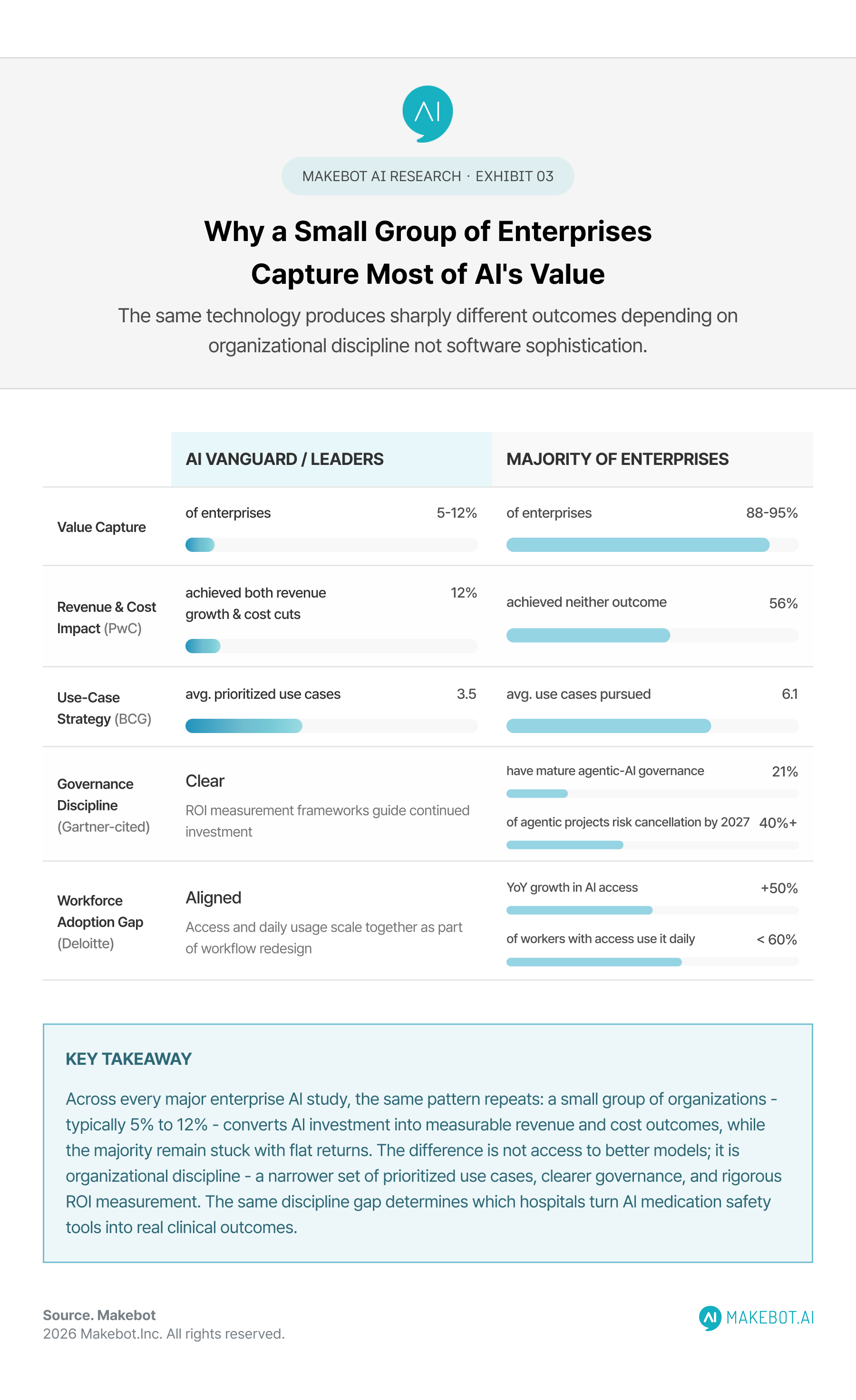
Why Some Organizations Get More Value From AI Than Others
The pattern that shows up in healthcare AI deployment mirrors a broader trend across every industry studied by major research firms: a small group of organizations captures most of the value, while the majority remain stuck in pilots.
- A narrow elite of 5% to 12% of enterprises captures disproportionate value from AI, according to a synthesis of research from McKinsey, BCG, Deloitte, Accenture, and PwC.
- PwC's 29th Global CEO Survey found that 56% of chief executives report AI has produced neither increased revenue nor decreased costs over the past twelve months, while only 12% - the so-called "AI Vanguard" - achieved both.
- Deloitte's 2026 enterprise survey found workforce access to sanctioned AI tools expanded 50% in a single year, from under 40% to around 60% of workers - yet fewer than 60% of workers with access actually use it in their daily workflow, a usage gap that limits realized returns even where access has scaled.
- Future-built companies - the small group generating substantial AI value - reinvest their AI returns into stronger people and technology capabilities, spending 26% more on IT and directing up to 64% more of their IT budget to AI. As a result, they expect twice the revenue increase and 40% greater cost reductions by 2028 than laggards achieve in the same areas.
Technical and Organizational Factors That Separate Winners From Laggards
The same discipline gap plays out at the clinical level. Health systems that treat AI-powered medication safety tools as a workflow redesign - integrating alerts directly into prescribing screens, tuning models to reduce false positives, and training pharmacists and physicians on how to act on flagged risks - see the error-reduction outcomes described above. Systems that bolt an alerting tool onto an unchanged ordering process tend to see the alert-fatigue problem persist, regardless of how sophisticated the underlying model is.
Why Healthcare AI Governance Matters More as Models Become More Powerful. Explore the full article here!
Common Challenges When Scaling AI Prescription Safety Initiatives
Enterprises and health systems scaling AI in healthcare initiatives aimed at improving prescription safety consistently report similar obstacles:
- Integration friction - connecting AI models to existing electronic health record systems and pharmacy platforms, which healthcare leaders now cite as a leading barrier to further adoption.
- Data quality and fragmentation - incomplete or siloed patient records limit a model's ability to reconstruct an accurate medication history, particularly for polymedicated patients.
- Alert fatigue - first-generation rule-based systems generate enough low-value warnings that clinicians begin overriding them by default, undermining the safety case for adoption.
- Workforce readiness - the AI skills gap is now seen as the biggest barrier to integration across enterprise AI deployments generally, and clinical staff are no exception.
- Underreporting of outcomes - because only 10% to 20% of medication errors are formally reported, health systems often lack the baseline data needed to measure whether an AI deployment is actually reducing harm.
How Enterprise Hospitals Are Combining RAG with GPT-5 for Safer Healthcare AI Systems. Find out more here!
What This Means for Health Systems and Enterprise Decision-Makers
The direction of the evidence is consistent: AI prescription risk detection works best when it is treated as a clinical workflow investment, not a standalone software purchase. The health systems seeing the strongest results are the ones pairing model deployment with process redesign, clinician training, and clear measurement of downstream outcomes - the same combination that separates high-performing enterprises from the majority still waiting for AI to pay off.
For decision-makers evaluating AI clinical decision support platforms, three questions matter more than any vendor's feature list:
- Does the system reduce false-positive alerts enough that clinicians will actually act on the ones that remain?
- Is the model integrated at the point of prescribing, or does it operate as a disconnected after-the-fact review?
- Is there a measurement framework in place to track adverse-event reduction over time, given how poorly these events are captured through voluntary reporting alone?
Organizations that can answer all three affirmatively are positioned to join the narrow group of adopters - in healthcare and across every other sector - that convert AI investment into measurable, durable outcomes rather than another underused pilot.
Showcasing Korea’s AI Innovation: Makebot’s HybridRAG Framework Presented at SIGIR 2025 in Italy. Read here!
Conclusion
The evidence from recent clinical research is unambiguous: AI medication safety tools, when properly integrated into prescribing workflows, materially reduce the errors and adverse drug events that manual reconciliation processes routinely miss. At the same time, enterprise research on AI investment performance makes clear that technology alone does not guarantee that outcome. The organizations achieving real returns - clinical or commercial - are the ones pairing AI deployment with workforce readiness, focused use-case selection, and disciplined outcome measurement. As generative AI in healthcare continues its shift from pilot to production, the health systems that treat medication safety as a measurable, ongoing transformation effort - rather than a one-time software rollout - will be the ones setting the standard for what AI-powered medication safety can actually deliver.
Better Medication Safety Starts with Better Clinical Systems.
The latest clinical evidence points in the same direction: AI can significantly reduce prescription risks, medication errors, and adverse drug events—but only when it becomes part of a well-designed clinical workflow. The organizations seeing the greatest improvements are not simply adopting AI; they are redesigning how clinicians, data, and decision support work together to deliver safer patient care.
At Makebot, we help healthcare organizations build that foundation. From secure LLM-powered AI assistants and HybridRAG knowledge systems to enterprise-grade clinical AI workflows, we help hospitals transform fragmented clinical information into actionable intelligence that supports safer decisions, stronger governance, and measurable operational outcomes.
The question is no longer whether healthcare will adopt AI. It's whether your organization is building the systems that allow AI to improve patient safety, strengthen clinical decision-making, and deliver lasting value.
.jpg)

What Happens to Marketing When the C-Suite Starts Using AI Every Day?









Why AI Shopping Assistants Will Replace Traditional Ecommerce Search





.jpg)


























Why Generative AI Projects Fail and How to Achieve Scalable AI Success









.jpg)

.png)