How AI Is Transforming Hospital Command Centers Through Predictive Capacity Management
Hospital command centers market hits $47.2B by 2035 - AI predicts bottlenecks hours in advance.

Introduction
Every hospital operations leader knows the scene: an emergency department boarding patients in hallways, an operating room waiting on a bed that hasn't opened yet, a transfer center juggling calls from referring hospitals with nowhere to send them. For decades, this was managed with spreadsheets, phone trees, and institutional memory. That model is breaking under rising patient volumes, chronic workforce shortages, and thinner margins. Hospital command centers - once simple dashboards - are now being rebuilt around AI in healthcare, using predictive capacity management to anticipate bottlenecks hours before they occur. This article examines the verified data behind this shift: what the technology actually delivers, why some health systems achieve outsized returns while others stall in pilot purgatory, and what separates the winners.
Why Healthcare AI Governance Matters More as Models Become More Powerful. Explore the latest insights here!
The Capacity Crisis Driving Command Center Investment
Hospital operations have hit a structural breaking point. Patient volumes are rising while workforce shortages and financial pressure squeeze the resources available to manage them. This isn't a temporary strain - it's the new operating baseline for most health systems, and it's driving one of the fastest-growing categories of enterprise healthcare AI investment.
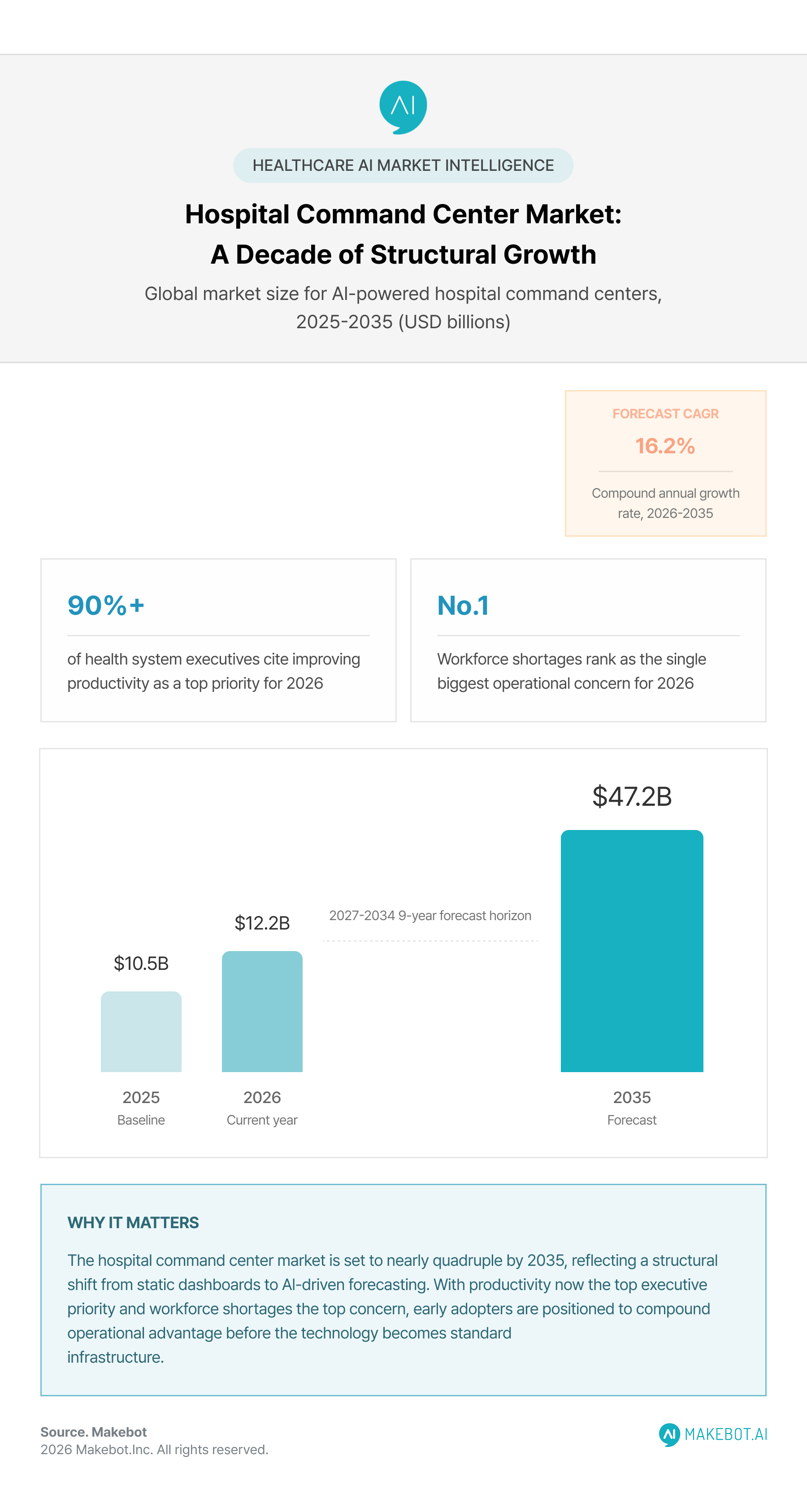
- The global healthcare command centers market is projected to grow from an estimated $10.5 billion in 2025 to $12.2 billion in 2026, reaching approximately $47.2 billion by 2035 at a 16.2% compound annual growth rate.
- Deloitte's 2026 healthcare outlook found more than 90% of health system executives cite improving productivity as a top priority, with workforce constraints ranked as their single biggest concern heading into the year.
- Julia Strandberg, chief business leader for Connected Care at Philips, has observed that with more than 1,000 AI-powered tools already FDA-cleared, the industry conversation is shifting from AI's potential to its measurable impact on efficiency and care coordination.
Hospital operations teams are no longer being asked simply to "do more with less." They're being asked to predict demand before it materializes - a fundamentally different operating model that legacy bed-management tools were never designed to support.
How Enterprise Hospitals Are Combining RAG with GPT-5 for Safer Healthcare AI Systems. Read the expert analysis here!
From Reactive Dashboards to Predictive Intelligence
Traditional command centers centralized information: real-time bed counts, discharge queues, transfer requests, all visible on a wall of monitors. That was a meaningful step forward, but it was still fundamentally reactive - it told staff what was happening, not what was about to happen.
Predictive healthcare analytics changes that equation. Machine learning models trained on historical admission, discharge, and transfer (ADT) data, combined with live census feeds, now forecast:
- Anticipated boarding risk in the emergency department, often flagged hours before a threshold is breached
- Operating room case completion times and downstream PACU occupancy
- Discharge likelihood by unit, enabling proactive bed turnover planning
- Regional transfer demand across multi-hospital systems, so capacity can be balanced before any single facility is overwhelmed
Industry analysts describe this as a maturity curve: reactive, to predictive, to increasingly prescriptive - where the system doesn't just forecast a problem but recommends the specific operational move to resolve it. Generative AI in healthcare is accelerating the last stage of that curve, allowing command center staff to query operational data conversationally and receive synthesized recommendations rather than raw dashboards.
Deloitte: 75% of Healthcare Leaders Are Scaling Generative AI to Transform Care and Operations. Discover what’s next here!
Inside the Predictive Capacity Management Stack
A mature AI hospital management deployment typically layers three components on top of existing infrastructure:
- Data integration layer - pulling structured and unstructured data from EHRs, bed management systems, and scheduling platforms into a unified operational data model.
- Predictive layer - machine learning models generating census forecasts, length-of-stay predictions, and discharge propensity scores, refreshed continuously rather than in daily batches.
- Decision-support and agentic layer - increasingly built on specialized AI agents assigned to discrete workflows (bed assignment, transfer triage, staffing alerts) rather than a single monolithic model, giving command centers modular, auditable logic instead of a black box.
This architecture matters because it directly shapes outcomes. Health systems that bolt predictive models onto poor-quality, siloed data tend to generate alerts nobody trusts. Those that first invest in clean, integrated ADT and EHR pipelines see far higher adoption of the resulting predictions among frontline staff - a pattern consistent with what enterprise AI research finds across every industry, not just healthcare.
Can LLM-Powered Conversational AI Provide Safe and Effective Mental Health Support? Explore the future of AI here!
Measurable Outcomes: What the Data Shows
The strongest case for AI-powered healthcare command centers isn't theoretical - it's a growing body of operational results from systems that have run these programs for years.
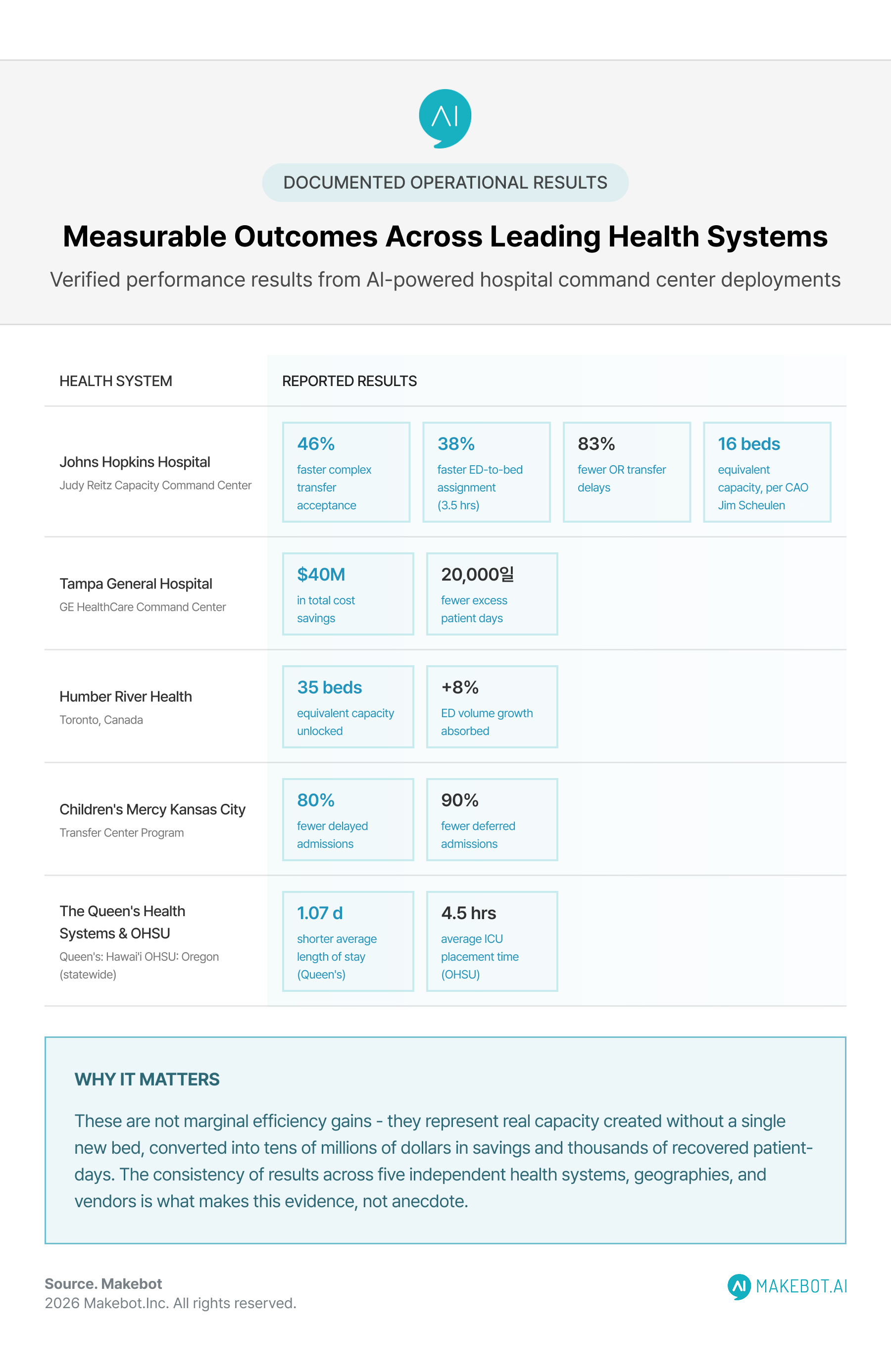
- Johns Hopkins Hospital's Judy Reitz Capacity Command Center, built with GE HealthCare, marked its fifth anniversary with Johns Hopkins Medicine reporting a 46% improvement in accepting complex-condition transfer patients from other hospitals, beds assigned 38% faster (3.5 hours sooner) after an emergency department admission decision, and an 83% reduction in operating room transfer delays. Separately, in earlier remarks about the center's operational impact, chief administrative officer Jim Scheulen described the efficiency gains as equivalent to "16 additional beds of capacity, without actually opening 16 beds."
- Tampa General Hospital's command center implementation, in partnership with GE HealthCare, was credited with roughly $40 million in savings and 20,000 fewer excess patient days through reduced length of stay.
- The Queen's Health Systems reported a 1.07-day reduction in average length of stay following command center deployment, while Children's Mercy Kansas City reported an 80% reduction in delayed admissions and a 90% reduction in deferred admissions through its transfer center, according to GE HealthCare's published outcomes data.
- Humber River Health in Toronto reported that its command center unlocked inpatient capacity equivalent to 35 additional beds and reduced emergency department wait times, even while absorbing 8% growth in ED visit volume over the same period.
- Oregon Health & Science University's statewide command center reduced average ICU placement time for unplaced patients to roughly 4.5 hours, alongside a reduced length of stay for targeted patient populations, per reporting in Becker's Hospital Review.
These are not marginal efficiency gains. They represent hospital capacity management outcomes - beds effectively created, staff hours redirected, and transfer bottlenecks resolved - that translate directly into revenue capture and cost avoidance at enterprise scale.
McKinsey: How AI in Healthcare Can Improve Consumer Experiences. See how enterprises are transforming here!
The Enterprise AI ROI Divide: Why Some Hospitals Win and Others Stall
Here is where the industry narrative gets more complicated, and more useful. The success stories above are real, but they are not yet the norm.
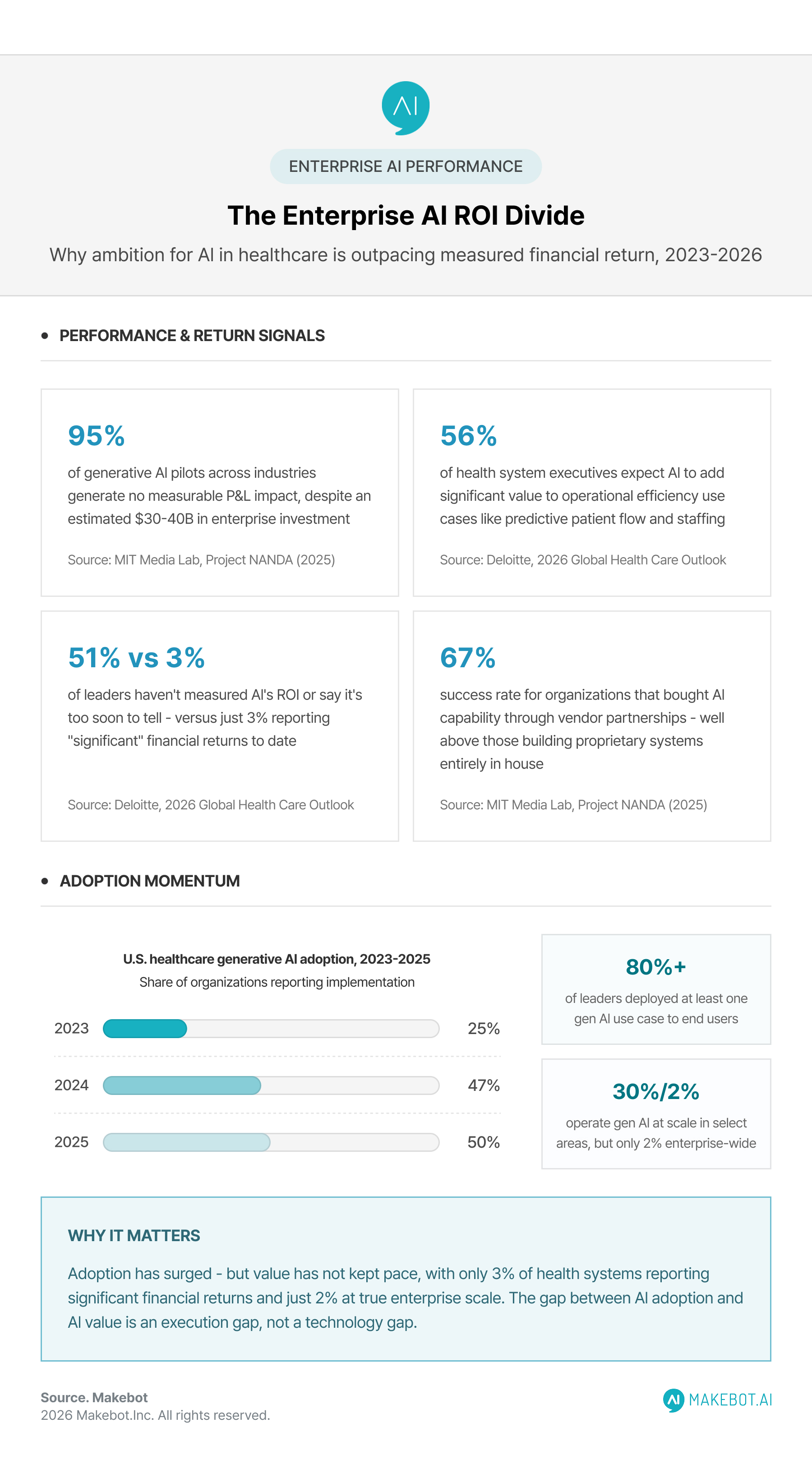
- Deloitte's 2026 Global Health Care Outlook survey of 180 C-suite health system executives found 56% expect AI to add significant value to operational efficiency use cases like predictive patient flow and staffing - yet 51% of leaders said they either haven't measured ROI or believe it's too soon to tell, and only 3% reported "significant" financial returns to date.
- A separate Deloitte 2026 outlook found roughly 30% of health systems operate generative AI at scale in selected areas, but only 2% have achieved enterprise-wide deployment.
- More broadly across industries, MIT's Project NANDA found that despite an estimated $30–40 billion in enterprise generative AI investment, 95% of pilots generated no measurable P&L impact - with only about 5% of integrated deployments extracting significant, sustained value.
- That same research found organizations that bought AI capability from specialized vendors and built structured partnerships succeeded roughly 67% of the time, compared with a much lower success rate for organizations attempting to build proprietary systems entirely in-house.
The pattern is consistent: the gap between AI adoption and AI value is an execution gap, not a technology gap. Hospitals that treat command center AI as a bolt-on reporting layer see disappointing results. Hospitals that treat it as a redesigned operating workflow - with clear ownership, clean data, and staff trained to act on predictions - are the ones showing up in the case studies above.
Why High-ROI Organizations Pull Ahead
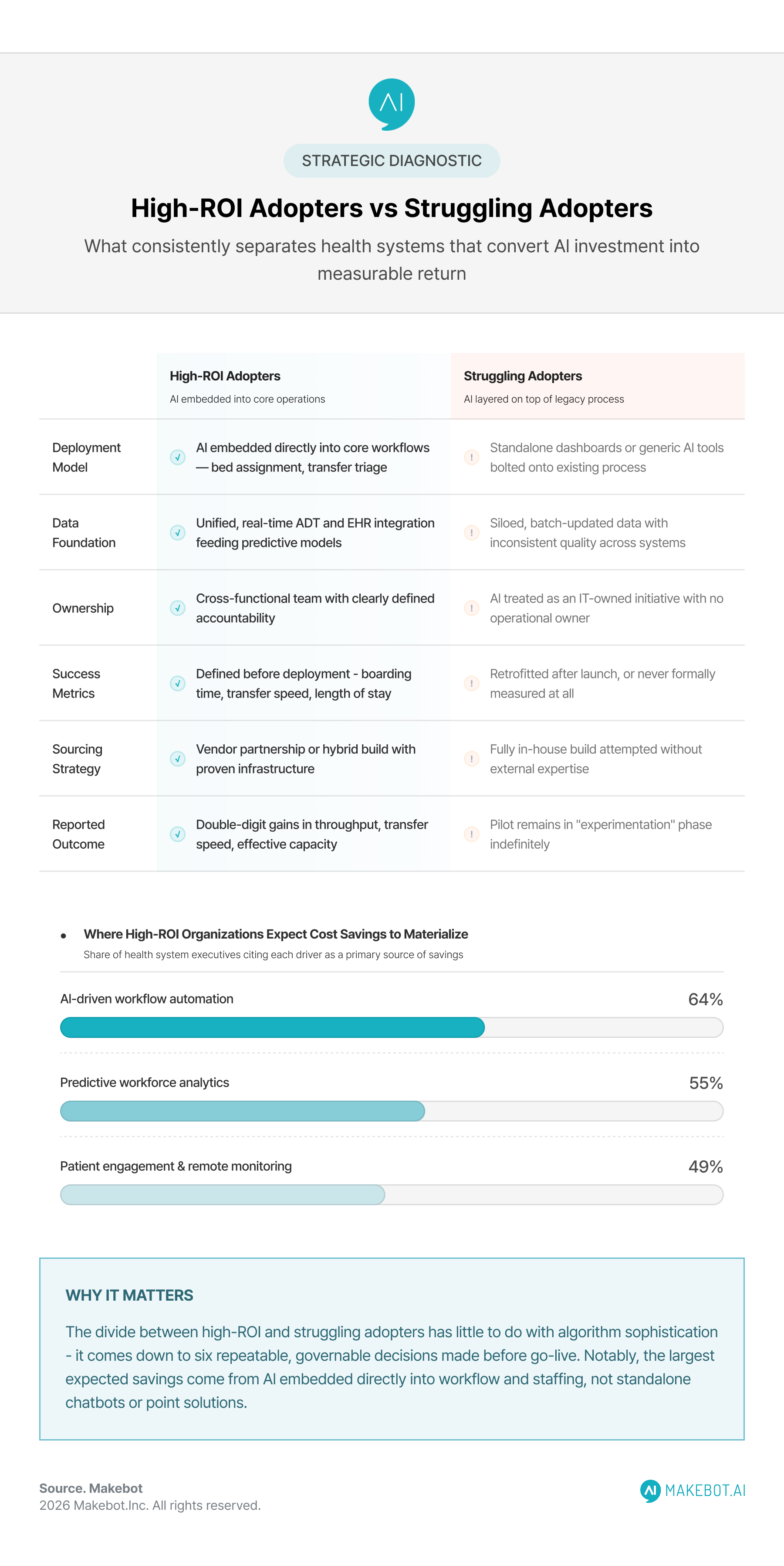
Deloitte's research points to where health systems expect cost savings to actually materialize, and the ranking is instructive:
- AI-driven workflow automation (cited by 64% of executives as a primary savings driver)
- Predictive workforce analytics (55%)
- Tech-enabled patient engagement and remote monitoring (49%)
Notice what's absent from the top of that list: generic chatbots and standalone point solutions. The highest-confidence savings come from AI embedded directly into operational workflow - precisely the model that predictive capacity management represents.
Conversational AI for Remote Patient Monitoring in Chronic Care. Learn how industry leaders are adapting here!
Technical and Organizational Factors Affecting AI Investment Outcomes
Two categories of factors consistently separate high performers from stalled pilots.
Technical factors:
- Data quality and integration maturity across EHR, ADT, and scheduling systems
- Real-time (not batch) data pipelines feeding predictive models
- Model governance and auditability, particularly as agentic systems take on more autonomous decision-making
- Interoperability between the command center platform and downstream bed management and staffing tools
Organizational factors:
- Executive sponsorship that treats the command center as an operating model change, not an IT project
- Cross-functional staffing - Johns Hopkins built its command center around representatives from physician referral services, critical care transport, admissions, and bed management working side by side
- Clearly defined success metrics established before deployment, rather than retrofitted afterward
- Frontline trust-building, so staff act on AI-generated alerts rather than overriding them by default
McKinsey's healthcare-specific research echoes this: generative AI adoption in U.S. healthcare organizations rose from 25% in late 2023 to 50% by the end of 2025, with more than 80% of surveyed leaders reporting at least one deployed use case reaching end users. Adoption is no longer the bottleneck - organizational readiness to operationalize it is.
Reducing Diagnostic Errors with Retrieval-Augmented Generation (RAG) in Clinical Decision Support. Explore the data and findings here!
Common Challenges When Scaling AI Initiatives
Even well-resourced systems run into the same recurring obstacles when moving predictive capacity management from pilot to enterprise scale:
- Fragmented data ownership across departments, delaying the real-time feeds predictive models require
- Alert fatigue, when predictive systems generate more flags than operations teams can realistically act on
- Unclear accountability for acting on a prediction once it's issued - a forecast without an owner rarely changes an outcome
- Regulatory and governance uncertainty, particularly as agentic AI takes on more autonomous scheduling and triage decisions
- Underinvestment in change management, treating the rollout as a software launch rather than a workflow redesign
Gartner's 2026 healthcare predictions frame this directly: agentic AI has the potential to transform provider workforce, operations, and patient experience - but only where organizations pair the technology with clear governance and a defined vision for outcomes before scaling it.
Stanford's MedAgentBench: Why Healthcare AI Agents Still Struggle in Real Clinical Workflows. Read here!
High-ROI Adopters vs. Struggling Adopters: A Comparative Snapshot
Strategic Recommendations for Health System Leaders
For executives evaluating or scaling AI hospital management initiatives, the evidence points toward a consistent playbook:
- Start with a single, measurable operational bottleneck (ED boarding, OR turnover, transfer acceptance) rather than a broad, undefined AI strategy
- Invest in data integration before investing in predictive models - the model is rarely the constraint
- Define ROI metrics and ownership before go-live, not after
- Favor proven vendor partnerships for core predictive infrastructure while building internal capability for governance and workflow adaptation
- Build cross-functional teams that include clinical, operational, and IT leadership from day one
- Treat the first deployment as a workflow redesign, not a software rollout
Philips Survey: Most Clinicians Use AI but Lack Formal Training. Learn more here!
The Road Ahead: Toward Prescriptive, Agentic Command Centers
The next phase of this transformation is already visible in the leading systems. Rather than a single AI model producing forecasts, hospitals are increasingly deploying specialized AI agents assigned to discrete functions - one tracking admissions and discharges in real time, another predicting bed availability, another managing OR-to-PACU handoffs - coordinated within the command center rather than operating as isolated tools.
This shift toward agentic command centers moves the technology from predictive (telling staff what's likely to happen) to prescriptive (recommending the specific action to take). It is also where governance discipline matters most: as these systems take on more autonomous decision-making, the technical and organizational safeguards discussed above become non-negotiable rather than optional.
Showcasing Korea’s AI Innovation: Makebot’s HybridRAG Framework Presented at SIGIR 2025 in Italy. Read here!
Conclusion
The data tells a two-part story. On one side, a small but growing group of health systems - Johns Hopkins, Tampa General, Humber River, OHSU, and others - have converted predictive capacity management into measurable capacity gains, cost savings, and faster patient flow, all without adding physical infrastructure. On the other side, broader enterprise AI research from MIT, Deloitte, and McKinsey shows that most organizations, healthcare included, are still struggling to convert AI investment into measurable financial return. The dividing line between these two outcomes isn't the sophistication of the algorithm - it's data readiness, workflow integration, and organizational discipline. For hospital leaders, the strategic implication is clear: the technology to transform command centers already exists and is proven. The long-term winners will be the systems that treat AI as an operating model change worth governing carefully, not a dashboard worth buying quickly.







.jpg)

What Happens to Marketing When the C-Suite Starts Using AI Every Day?







Why AI Shopping Assistants Will Replace Traditional Ecommerce Search





.jpg)

























Why Generative AI Projects Fail and How to Achieve Scalable AI Success











.jpg)

.png)