Dario Amodei on Building Safe Frontier AI: Anthropic's Vision for the Next Generation of Enterprise Intelligence
Anthropic bets safety drives ROI - McKinsey: only 6% of firms see real AI returns.


Introduction
Enterprise AI has crossed a threshold few technologies reach: near-universal adoption. Nearly nine in ten organizations now use AI somewhere in their business. Yet measurable, enterprise-wide financial impact remains rare, concentrated among a small cohort of "high performers." That paradox sits at the center of how Anthropic, led by CEO Dario Amodei, is positioning itself in the frontier AI market - not merely as a model provider, but as a company betting that safe AI and enterprise intelligence are not competing priorities but the same discipline. This article examines Amodei's public thinking on frontier AI, AI safety, and AI governance, and pairs it with the latest verified research from McKinsey and Deloitte to explain why responsible AI development is emerging as a genuine driver of enterprise ROI - not just a compliance cost.
Deloitte: 70% of Leaders Prioritize Agility as AI Reshapes Business Strategy. Explore the latest insights here!

The Adoption Boom Nobody Asked to Prove
Generative AI adoption has moved faster than almost any enterprise technology in recent memory. According to McKinsey's State of AI in 2025 survey of nearly 2,000 organizations across 105 countries, AI use in at least one business function jumped to 88 percent of respondents, up from 78 percent a year earlier. Two-thirds of organizations now use AI in more than one function, and half report use across three or more.
But adoption breadth has outpaced adoption depth. The same survey found that approximately one-third of organizations have begun to scale their AI programs beyond pilots, leaving the majority in what researchers now commonly describe as "pilot purgatory." Even more telling: just 39 percent of respondents report any enterprise-level EBIT impact from AI, and most of those attribute less than 5% of EBIT to AI use.
This is the backdrop against which Anthropic has built its enterprise strategy - not chasing adoption numbers, but trying to close the value gap through architecture, reliability, and trust.
- 88% of organizations now use AI in at least one function (McKinsey, 2025)
- ~33% have scaled AI programs beyond pilots
- Only 6% are classified as "AI high performers" (>5% EBIT impact)
- Nearly half of $5B+ revenue companies have reached the scaling phase, vs. 29% of sub-$100M firms
LLM Optimization for B2B Marketing: Architecture, RAG Pipelines, and AI Strategies for Enterprise Growth. Read the expert analysis here!
Anthropic's Bet: Safety as Infrastructure, Not an Afterthought
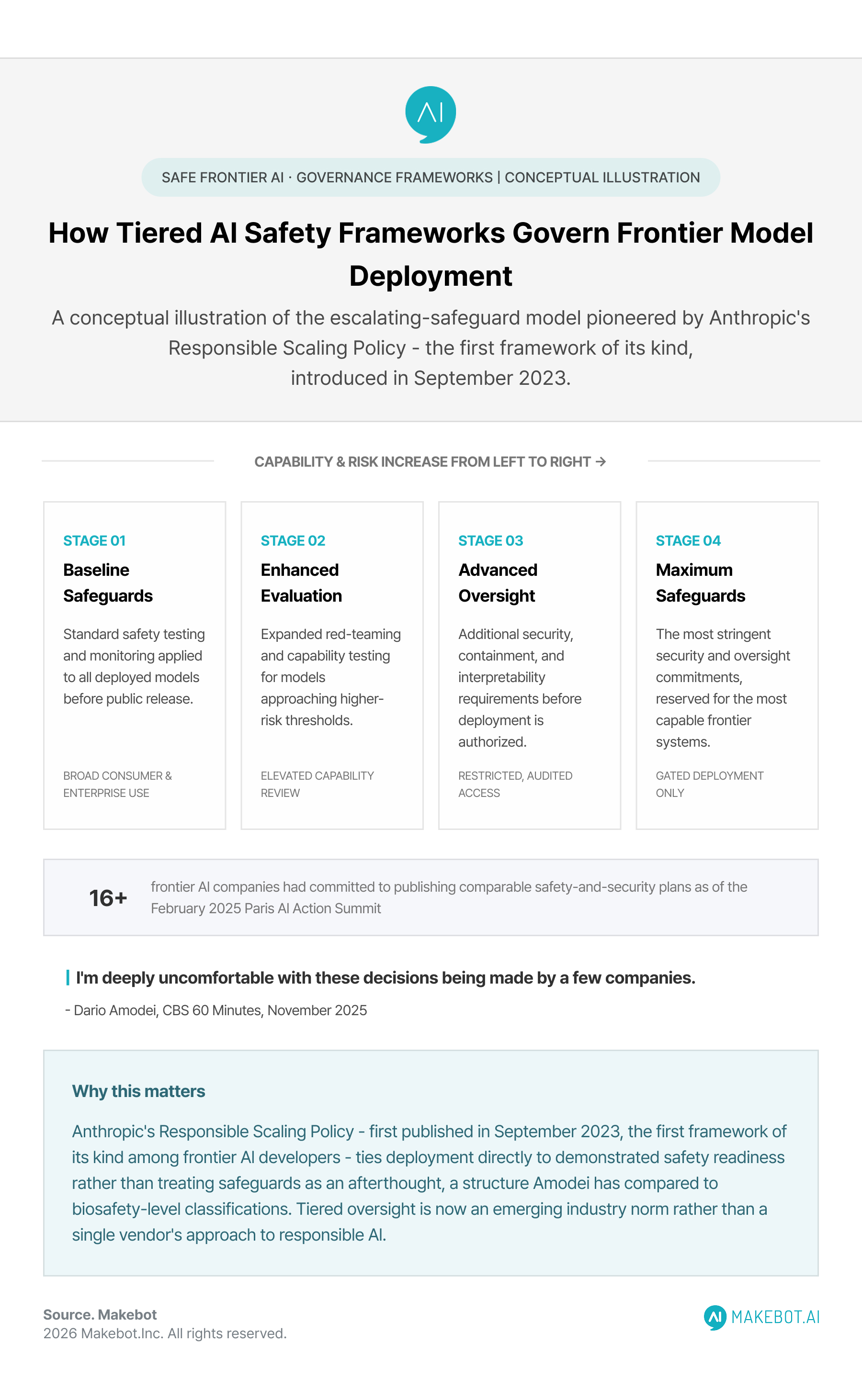
Amodei has repeatedly framed Anthropic's mission around a specific wager: that the safest path through the AI transition is to build frontier systems deliberately, with safeguards engineered in from the start, rather than bolted on after deployment. Anthropic's Responsible Scaling Policy (RSP), first released in September 2023, was the first policy of its kind among frontier AI developers, establishing tiered "AI Safety Levels" that gate the deployment of increasingly capable models behind escalating safeguards - a framework Amodei has compared directly to biosafety-level classifications for hazardous pathogens.
That structure has since shaped a broader industry response: as of the February 2025 Paris AI Action Summit, over 16 frontier AI companies had committed to publishing comparable safety-and-security plans of their own, according to Anthropic's own account of the gathering.
Amodei has also been unusually candid about the risks of concentrated power in AI development - including his own company's. In a November 2025 CBS 60 Minutes interview with Anderson Cooper, he said, "I'm deeply uncomfortable with these decisions being made by a few companies," adding that it's a core reason he has consistently pushed for external regulation rather than self-policing by AI labs. He struck a similar note in a June 2025 New York Times op-ed opposing a proposed decade-long freeze on state-level AI regulation, warning that "AI is advancing too head-spinningly fast" for a blanket moratorium with no federal alternative in place.
This dual posture - building at the frontier while advocating for external guardrails - is central to how Anthropic markets itself to enterprise buyers navigating AI governance requirements of their own.
Why This Resonates with Enterprise Buyers
Enterprise procurement teams evaluating frontier AI vendors increasingly weigh trustworthiness alongside raw capability. When a Fortune 500 buyer places Anthropic AI systems side by side with competing frontier models, the comparison increasingly hinges less on benchmark scores and more on whether the vendor can document, in auditable form, how it constrains model behavior at each capability tier. For regulated industries - financial services, healthcare, the public sector - a documented, auditable safety framework is no longer a nice-to-have. It's becoming a procurement gate, particularly as:
- Regulatory scrutiny of AI-driven decisions intensifies across jurisdictions
- Boards demand documented risk mitigation before approving large-scale AI deployments
- Customers and employees expect explainability in AI-assisted decisions
- Cyber and data-governance risks scale alongside model capability
How AI Chatbots Are Increasing E-Commerce Conversion Rates. Discover what’s next here!
The Performance Gap: What Actually Separates AI Leaders from Laggards
The most consequential finding in recent enterprise AI research isn't about which tools organizations use - it's about how they use them. McKinsey's analysis of AI high performers (organizations attributing more than 5% of EBIT and "significant value" to AI) found stark behavioral differences from the rest of the market:
- Workflow redesign: High performers are nearly three times more likely than others to have fundamentally redesigned their workflows around AI (55% vs. 20%)
- Ambition beyond cost-cutting: High performers are more than three times as likely to intend transformative - not just incremental - business change through AI
- Leadership ownership: High performers are three times more likely to report senior leaders demonstrating true ownership of AI initiatives, including actively role-modeling AI use
- Investment intensity: High performers commit more than 20% of digital budgets to AI roughly five times more often than other organizations
- Human-in-the-loop discipline: High performers are substantially more likely to have defined processes determining when model outputs require human validation
(Figures above from McKinsey's Global Survey on the State of AI, 2025.)
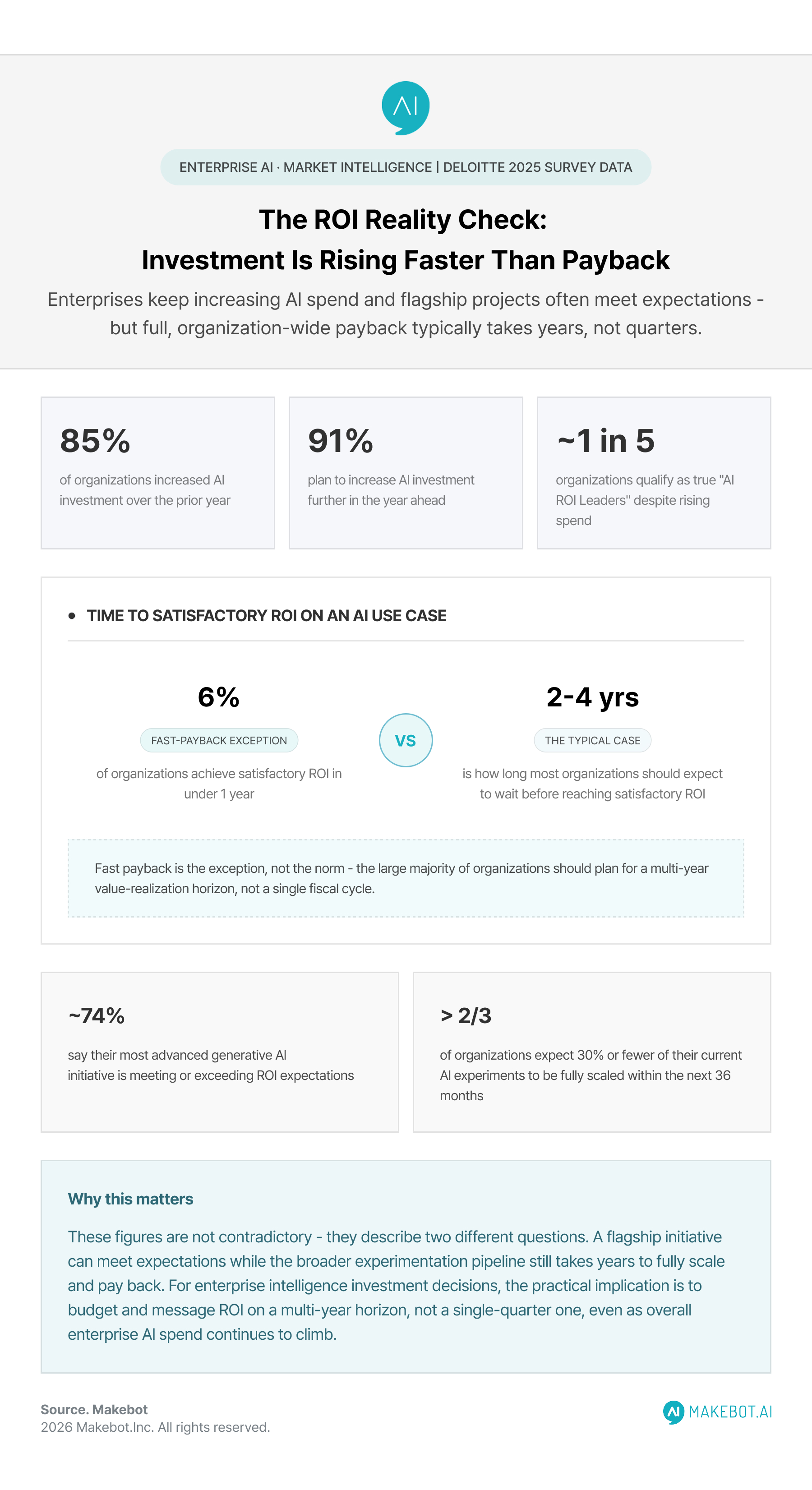
Deloitte's parallel research reinforces the pattern, though it also complicates the ROI picture. In its State of Generative AI in the Enterprise Q4 report (January 2025), Deloitte found that nearly three-quarters of organizations said their most advanced generative AI initiative was meeting or exceeding ROI expectations - even as more than two-thirds expected 30 percent or fewer of their current AI experiments to be fully scaled within the following three to six months. A separate, more recent Deloitte survey of 1,854 executives across Europe and the Middle East (October 2025) found the typical AI use case takes two to four years to deliver satisfactory ROI, with only 6 percent of organizations seeing payback in under a year - a reminder that "meeting expectations" on a flagship project and achieving fast, organization-wide payback are two different things. That same survey found 85 percent of organizations increased AI investment over the prior year and 91 percent planned to increase it again, even as only about one in five qualified as true "AI ROI Leaders."

Source: McKinsey Global Survey on the State of AI, 2025
Can LLMs Work Without RAG? Explore the future of AI here!
Governance as a Growth Lever, Not a Brake
A persistent myth in enterprise AI strategy treats AI governance and responsible AI as friction that slows deployment. The data suggests the opposite: disciplined governance correlates with faster, more durable scaling. McKinsey found that 51 percent of organizations using AI report experiencing at least one negative consequence - most commonly inaccuracy, cybersecurity exposure, and intellectual-property risk - and that high performers, despite deploying roughly twice as many AI use cases, report more of these incidents simply because they operate at greater scale and in more mission-critical contexts. Crucially, high performers also mitigate a wider range of risks than their peers, treating governance as a scaling enabler rather than a bottleneck.
Deloitte's research on AI ROI echoes this: organizations still struggling to prove value often describe AI adoption as reactive - driven by fear of falling behind rather than a clear strategy - while leaders who invest deliberately in data readiness, change management, and governance infrastructure report stronger, more sustainable returns over 6-to-12-month scaling horizons.
Common patterns behind stalled AI initiatives:
- Fragmented AI strategy without a unifying transformation roadmap
- Legacy workflows automated rather than redesigned around AI's capabilities
- Underinvestment relative to peers (5% vs. 20%+ of digital budget)
- Absent or informal human-validation processes for model outputs
- Governance treated as a late-stage compliance exercise rather than a design principle
Patterns behind sustained value capture:
- Growth and innovation objectives layered on top of efficiency goals
- Senior leadership actively modeling and championing AI use
- Structured, auditable safety and validation frameworks built in from the start
- Cross-functional data and technology infrastructure built for scale, not pilots
How LLMs Are Embedded into Modern Marketing Automation Platforms. See how enterprises are transforming here!
Enterprise Intelligence's Next Phase: Agentic Systems, Governed Carefully
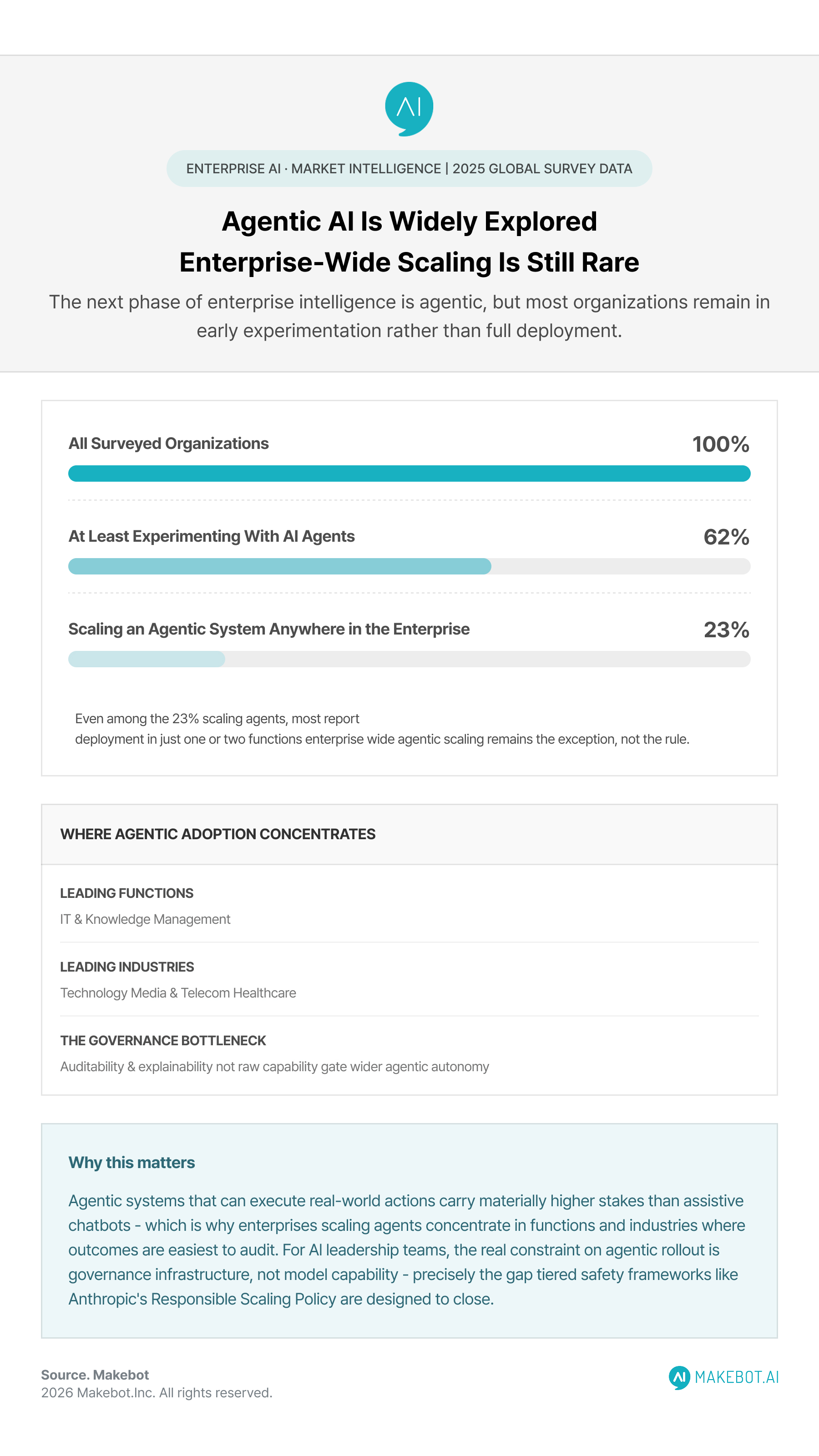
The next frontier for enterprise AI is agentic - systems capable of planning and executing multi-step work with limited human intervention. McKinsey's 2025 data shows 62 percent of organizations are at least experimenting with AI agents, though only 23 percent report scaling an agentic system anywhere in the enterprise, and even among that group, most are scaling agents in just one or two functions rather than enterprise-wide. Adoption concentrates in IT and knowledge management, with technology, media and telecommunications, and healthcare leading by industry.
This is precisely the terrain where Amodei's safety-first framing becomes operationally relevant rather than philosophical. Agentic systems that can take real-world actions - executing transactions, modifying records, interacting with external systems - carry materially higher stakes than a chatbot generating draft text. Anthropic's tiered AI Safety Level framework, and its emphasis on model interpretability research (understanding why a model produces a given output, not just what it produces), directly addresses the auditability enterprises need before granting agentic systems meaningful autonomy over business-critical processes.
Amodei has publicly acknowledged that even his own company doesn't fully understand how its most capable models arrive at their outputs - a candor rare among frontier AI leadership - and has pointed to interpretability breakthroughs as the most promising path toward safely deploying more autonomous systems. For enterprise buyers, that translates into a practical governance question: can a vendor explain and constrain agentic behavior before it scales, or only after something goes wrong?
Showcasing Korea’s AI Innovation: Makebot’s HybridRAG Framework Presented at SIGIR 2025 in Italy. Read here!
Conclusion: Safety and Scale Are Converging, Not Competing
The enterprise AI market has spent three years proving that adoption is easy and value is hard. What Amodei's public record - and the broader research from McKinsey and Deloitte - increasingly suggests is that the organizations closing that gap are not simply the ones deploying AI fastest, but the ones deploying it most deliberately: redesigning workflows, investing at real scale, and building governance into their AI programs from day one rather than retrofitting it after an incident.
For Anthropic, that same logic operates at the model layer. Betting that AI safety and commercial competitiveness reinforce rather than trade off against each other is, as Amodei has framed it, a wager rather than a settled fact - one that will be tested as models grow more autonomous and the stakes of getting governance wrong grow correspondingly higher. For enterprise leaders, the practical takeaway is the same regardless of which vendor they choose: the coming decade of enterprise intelligence will reward organizations that treat trust, transparency, and disciplined scaling as competitive infrastructure - not compliance overhead bolted on at the end.
Governance-First AI That Performs Where It Matters Most
The research Amodei and McKinsey are both pointing to is the same: enterprises that treat governance as infrastructure — not an afterthought — are the ones closing the gap between AI adoption and measurable value. Makebot is a leading generative AI and LLM solutions provider trusted by over 1,000 enterprise clients across healthcare, finance, public institutions, and beyond. With a proprietary multi-LLM platform, a hybrid RAG architecture engineered to minimize hallucinations and support auditability, permission-aware search, closed-network deployment, and human-in-the-loop design built in from day one — not retrofitted after an incident — Makebot delivers the kind of governed, explainable AI infrastructure that separates organizations capturing durable value from those still waiting for their pilots to scale.
See how Makebot builds enterprise AI that earns trust before it asks for autonomy




.png)







.jpg)


What Happens to Marketing When the C-Suite Starts Using AI Every Day?







Why AI Shopping Assistants Will Replace Traditional Ecommerce Search






.jpg)
























Why Generative AI Projects Fail and How to Achieve Scalable AI Success











.jpg)

.png)