1 in 7 People Have Used AI Instead of Seeing a Health Provider, Study Finds
1 in 7 UK adults skipped their GP for AI - ECRI named chatbot misuse the #1 health tech hazard 2026.


Introduction
When people reach for their phones to ask a chatbot about chest pain, medication interactions, or a concerning skin lesion - instead of calling their doctor - something fundamental is shifting in how healthcare is accessed. That shift is now measurable, documented, and raising serious alarms.
A major new study published in May 2026 by King's Health Partners, Responsible AI UK, and the Policy Institute at King's College London found that 1 in 7 people have already used AI in healthcare contexts as a direct replacement for professional consultation. The study, which surveyed more than 2,000 UK adults, arrives alongside a wave of parallel research from the United States painting a consistent picture: AI health assistants are no longer a novelty. They are becoming a de facto layer of the healthcare system - one that operates without clinical training, regulatory oversight, or liability accountability. Understanding what is driving this trend, where it creates value, and where it introduces dangerous risk is now one of the most pressing issues in digital health AI policy and practice.
Can Generative AI Improve Early Disease Detection Through Predictive Healthcare Analytics? Explore the latest insights here.
The Numbers Behind the Shift
The King's College London study provides some of the clearest data to date on how consumer healthcare AI is being used - and misused. Key findings from the research include:
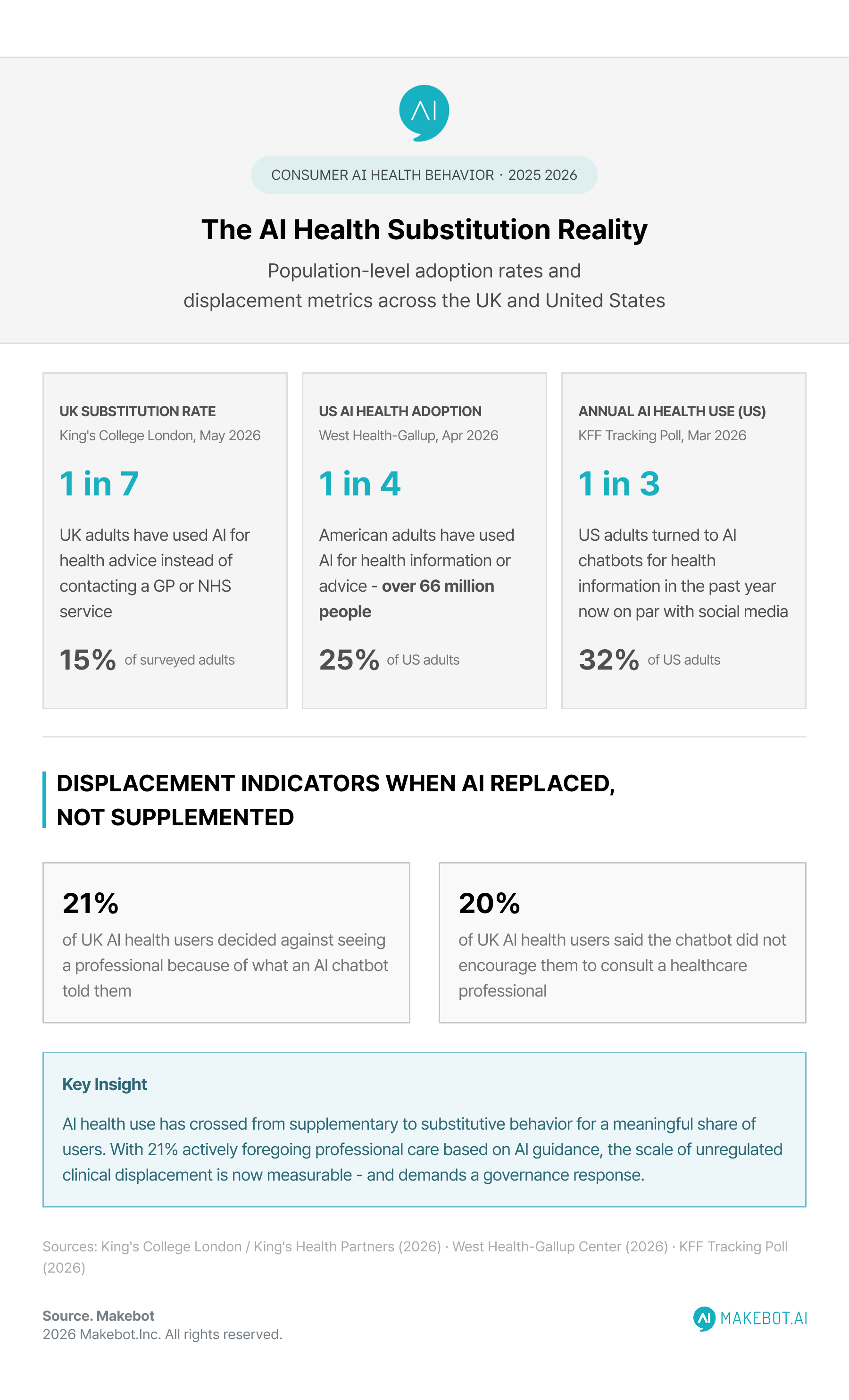
- 15% of the public have used AI chatbots for health advice instead of contacting a GP or other NHS service
- 10% have used AI for mental health therapy or wellbeing support in place of seeing a trained mental health professional
- 21% of AI health users report that something an AI chatbot told them caused them to decide against seeking professional healthcare advice
- 20% of those who sought health advice from AI say the tool did not encourage them to consult a professional
These figures represent a marked departure from the idea that AI for health advice functions purely as a pre-consultation research tool. For a meaningful portion of users, it is functioning as the final word.
The pattern holds across the Atlantic. A nationally representative West Health–Gallup Center survey - conducted from October through December 2025 among more than 5,500 U.S. adults - found that 1 in 4 Americans (25%) have used an AI tool or chatbot for health information or advice. Among recent users, the most common applications were checking physical symptoms (58%), researching nutrition or exercise (59%), understanding medication side effects (46%), and interpreting medical information (44%). A separate KFF Tracking Poll on Health Information and Trust, conducted in early 2026, found that 32% of U.S. adults turned to AI chatbots for health information in the past year - a figure now on par with those who say they use social media for the same purpose.
Can Generative AI Analyze Medical Data Faster Than Human Researchers? Read the expert analysis here.
Why People Are Turning to AI Instead of Their Doctors
The motivations behind healthcare AI use are not monolithic - and that complexity matters for how the industry and policymakers respond. The King's College London research identified several distinct drivers:
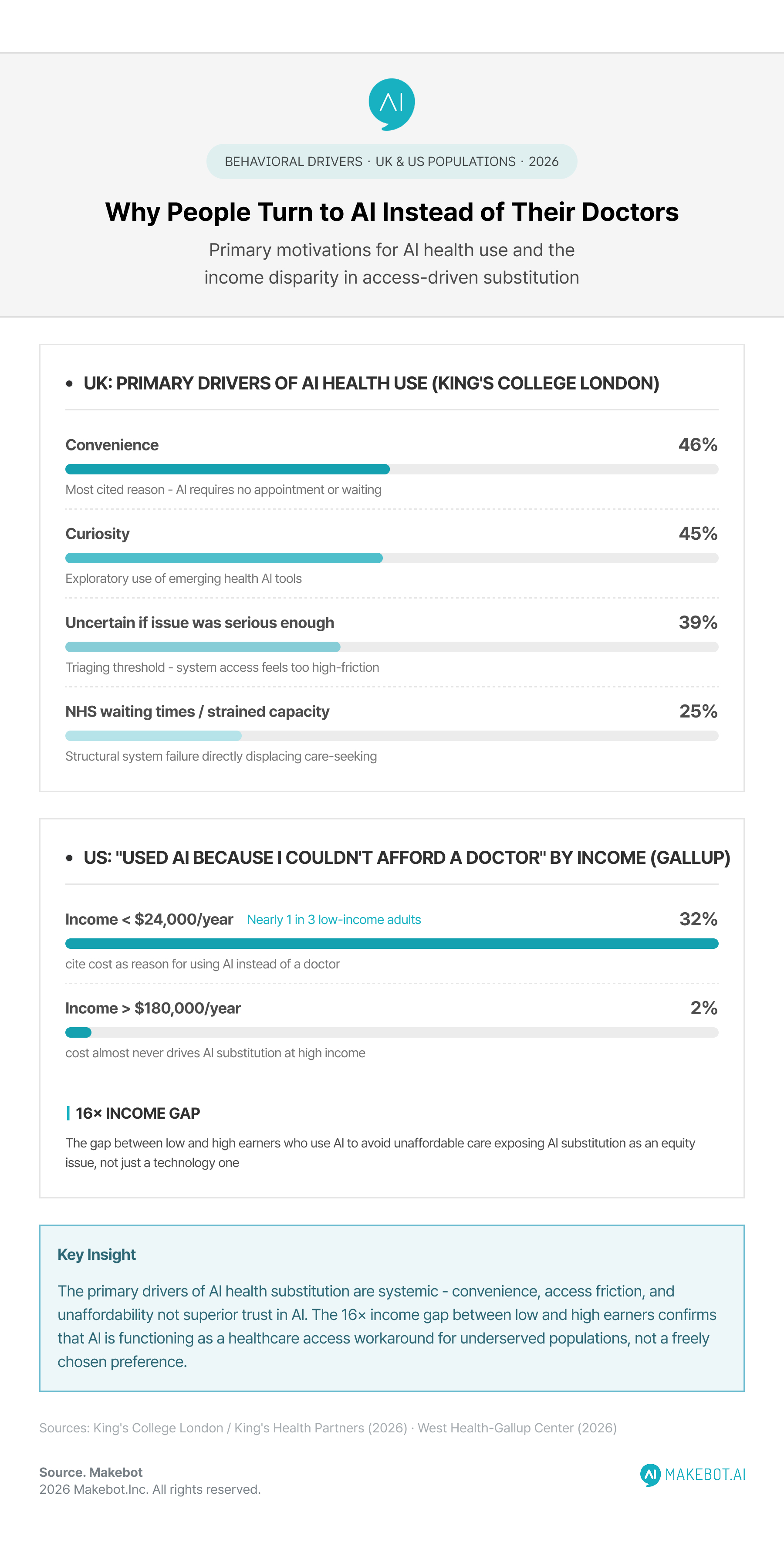
- Convenience was the most commonly cited reason, reported by 46% of respondents
- Curiosity was nearly as influential, at 45%
- Uncertainty about whether the issue was serious enough to warrant a GP visit was cited by 39%
- NHS waiting times and strained capacity were named by 25% of respondents
This combination is revealing. It suggests people are not primarily turning to AI because they trust it more than their doctors. Rather, they are using it because accessing a doctor has become sufficiently inconvenient, uncertain, or delayed that AI fills a perceived vacuum. The system's friction is driving the behavior.
In the United States, cost and access barriers tell an equally stark story. The Gallup survey found that among adults earning less than $24,000 annually, 32% say they have used AI because they could not pay for a doctor's visit, compared with just 2% of those earning $180,000 or more. The KFF poll found that about 1 in 5 adults who use AI for health cite inability to afford care or inability to get an appointment as a major reason. For younger adults under 30, those figures rise to 29% citing cost and 38% citing access. In this light, AI is functioning less as a technology innovation story and more as a symptom of healthcare system strain - a workaround adopted by the underserved.
Deloitte 2026: 80% of Healthcare Executives Expect Agentic AI to Deliver Value. Discover what’s next here.
The Safety Gap No One Is Governing
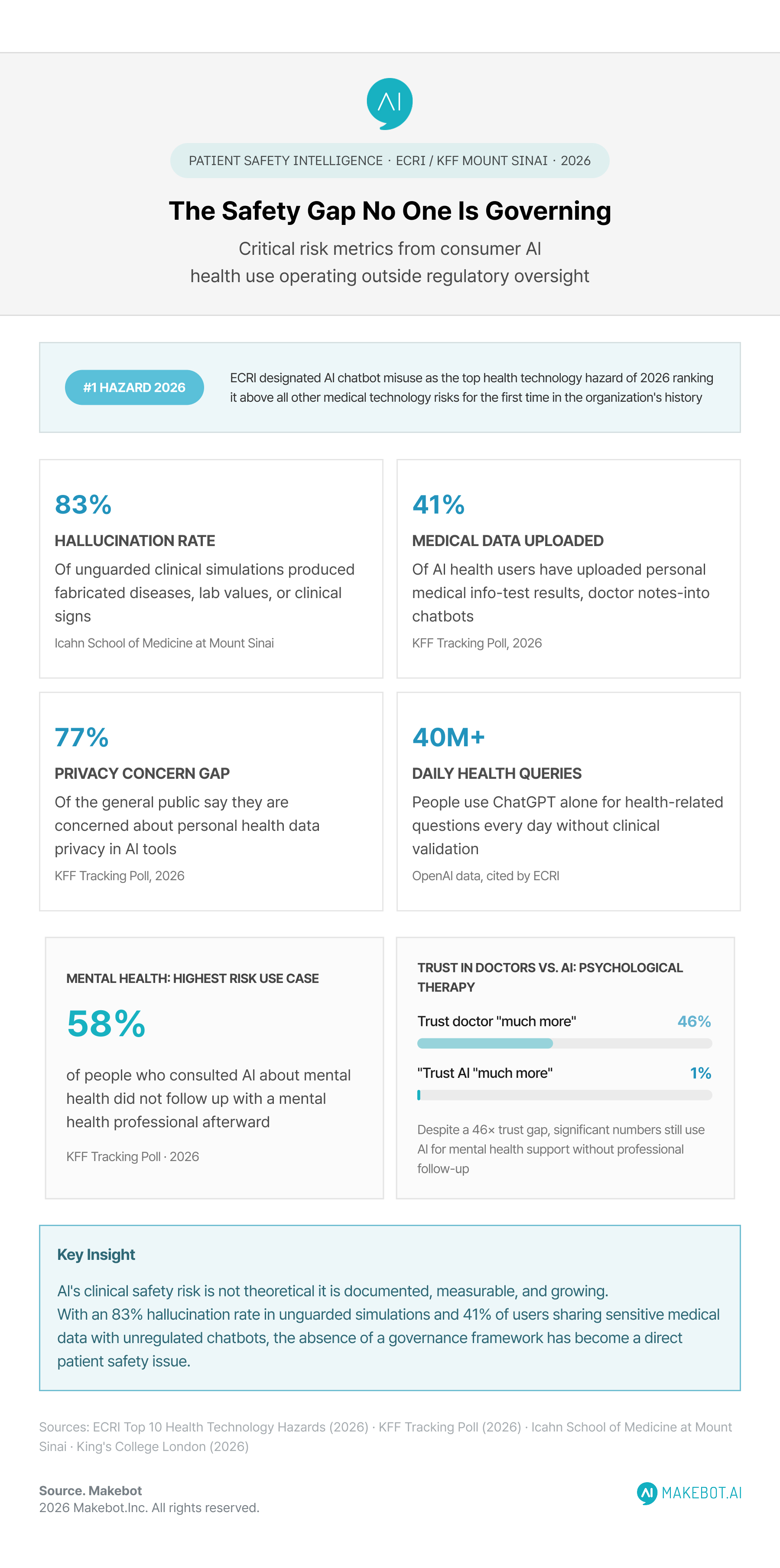
The widespread adoption of AI healthcare tools by the public is happening in a regulatory and clinical governance vacuum. ECRI - a nonpartisan patient safety organization - ranked AI chatbot misuse as the single most significant health technology hazard for 2026, a designation it does not assign lightly.
The reasons are substantive. General-purpose large language models like ChatGPT, Gemini, and Copilot - the tools most commonly used by the public for health queries - are not regulated as medical devices. They are not validated against clinical outcome data. They are not required to disclose uncertainty, and they are architecturally designed to produce confident, fluent responses regardless of whether the underlying information is accurate.
Several specific failure modes stand out:
- Hallucination in medical contexts is well-documented and dangerous. Research from the Icahn School of Medicine at Mount Sinai found that AI chatbots hallucinated fabricated diseases, lab values, and clinical signs in up to 83% of simulated cases when no safety guardrails were in place. A single made-up medical term was sufficient to trigger a detailed, authoritative-sounding response built entirely on fiction.
- AI chatbots are designed to agree, not to challenge. As ECRI experts noted, these systems are built to keep users engaged. They have a known bias toward producing the response a user wants to hear, not the most clinically accurate one. They rarely say "I don't know" or "see a doctor immediately."
- Biases embedded in training data can widen health disparities. ECRI noted that chatbots may respond in ways that reinforce existing stereotypes and inequities - potentially delivering lower-quality guidance to the demographic groups already most vulnerable in the healthcare system.
- Privacy risks remain largely invisible to users. The KFF poll found that 41% of AI health users have uploaded personal medical information - including test results and doctors' notes - into AI chatbots, while 77% of the general public say they are concerned about the privacy of such data. Trust in the AI's privacy practices appears to diverge sharply from stated concern.
ECRI's President and CEO Marcus Schabacker stated plainly: "Medicine is a fundamentally human endeavor. While chatbots are powerful tools, the algorithms cannot replace the expertise, education and experience of medical professionals."
Why AI Fails to Scale in Healthcare-and How to Fix It. Explore the future of AI here.
The Mental Health Dimension
Among all the use cases for AI-powered healthcare, none carries more sensitivity - or more risk - than mental health. The King's College London study found that 1 in 10 people have used AI for mental health therapy or wellbeing support instead of seeing a trained professional. The KFF poll found that 58% of those who consulted AI about mental health did not follow up with a mental health professional afterward.
Public trust data underscores how deeply uncomfortable this should make clinicians and policymakers. In the King's College London study, psychological therapy was the area of greatest trust in human doctors over AI - 46% said they trust a doctor "much more" for psychological therapy, with just 1% saying the same for AI. Yet that same population is using AI health assistants for this exact purpose, in significant numbers, without follow-up.
Emerging evidence from 2025 raised documented cases of AI chatbots contributing to psychological distress and ideation spiraling - not through malice, but through the systems' inability to recognize crisis signals and their tendency to reinforce the framing users bring to them. Unlike a trained therapist, a general-purpose AI cannot observe tone, affect, behavioral cues, or changes over time. It responds to tokens, not people.
Why Healthcare CIOs Need Enterprise Architecture to Scale AI. See how enterprises are transforming here!
The Trust Paradox: High Use, Low Confidence
One of the most striking findings across the full body of recent research is the trust paradox: use is rising even as trust remains fragile.
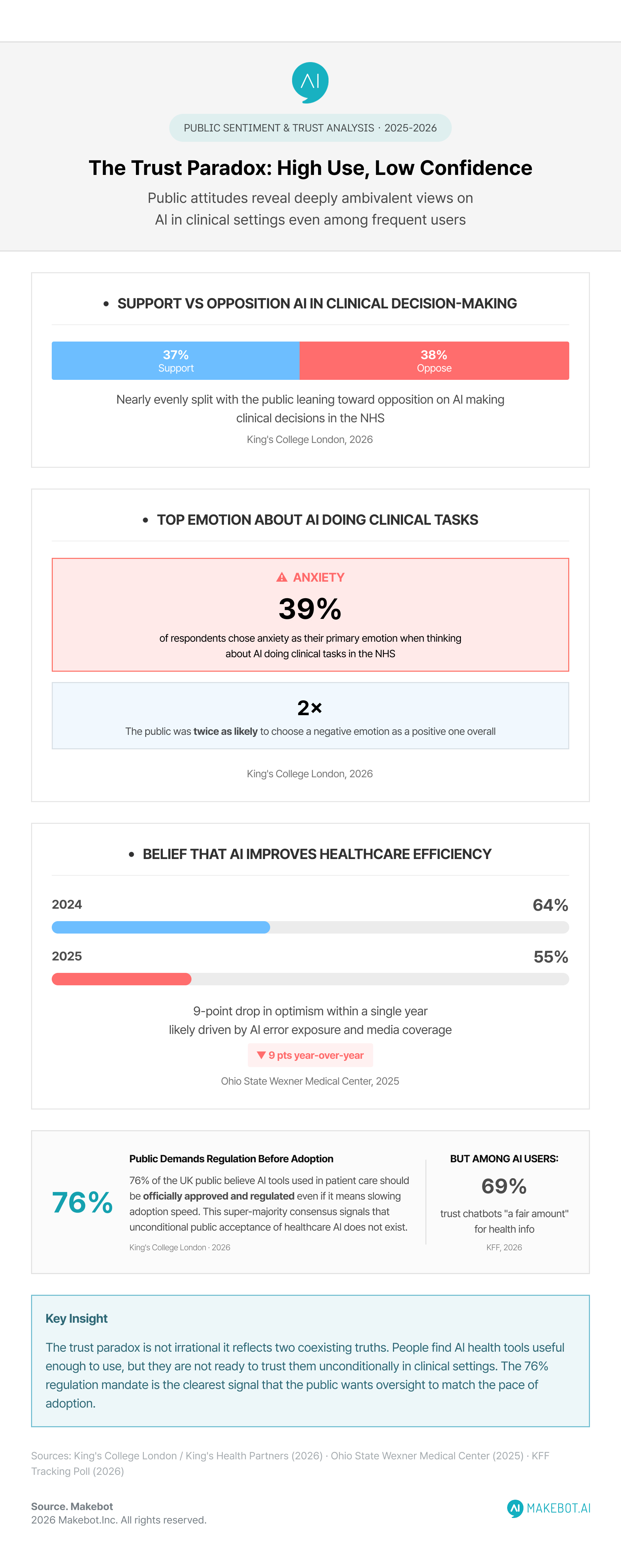
The King's College London study found that public support and opposition to AI in clinical decision-making were nearly evenly split - 37% in favor versus 38% opposed - and that the top emotion associated with AI doing clinical tasks in the NHS was anxiety, cited by 39% of respondents. Overall, the public was twice as likely to choose a negative emotion as a positive one when asked how they feel about AI being used for clinical purposes.
Critically, 76% of the public said AI tools used in patient care should be officially approved and regulated - even if that slows adoption. This finding suggests public acceptance of AI in healthcare is not unconditional: it is contingent on oversight structures that currently do not fully exist.
The Ohio State Wexner Medical Center's 2025 poll found a related pattern: the proportion of respondents who believe AI can make health processes more efficient fell from 64% in 2024 to 55% in 2025 - a significant erosion of optimism in a single year, likely reflecting early public exposure to AI errors and media coverage of AI failures.
That said, trust asymmetry exists among actual users. The KFF poll found that among those who have used AI for health advice, 69% say they trust these chatbots "a great deal" or "a fair amount" for physical health information - suggesting that familiarity breeds trust, even where caution may be more appropriate.
Gemini in Healthcare: Multimodal Intelligence Reshaping Clinical and Biomedical Systems. Learn how industry leaders are adapting here!
The Healthcare System Behind the Numbers
It would be intellectually incomplete to frame AI health use purely as a patient behavior problem. The data from across multiple studies consistently shows that people are turning to AI health information tools not because they distrust doctors, but because accessing doctors has become genuinely difficult.
The NHS in the UK is operating under pressure that has made prompt GP access a practical impossibility for many. In the U.S., the combination of high out-of-pocket costs, inadequate insurance coverage, and long appointment wait times - particularly in primary care and mental health - creates a healthcare access gap that people are filling with whatever tools are available. AI chatbots are free, available at 3 AM, and require no appointment.
This context does not make AI substitution safe. But it does mean that policy responses focused purely on restricting AI use - without addressing the access failures driving that use - will likely be both ineffective and inequitable. The burden of healthcare access failure is already falling disproportionately on lower-income and younger populations; blaming them for using available tools without improving the alternatives serves no one.
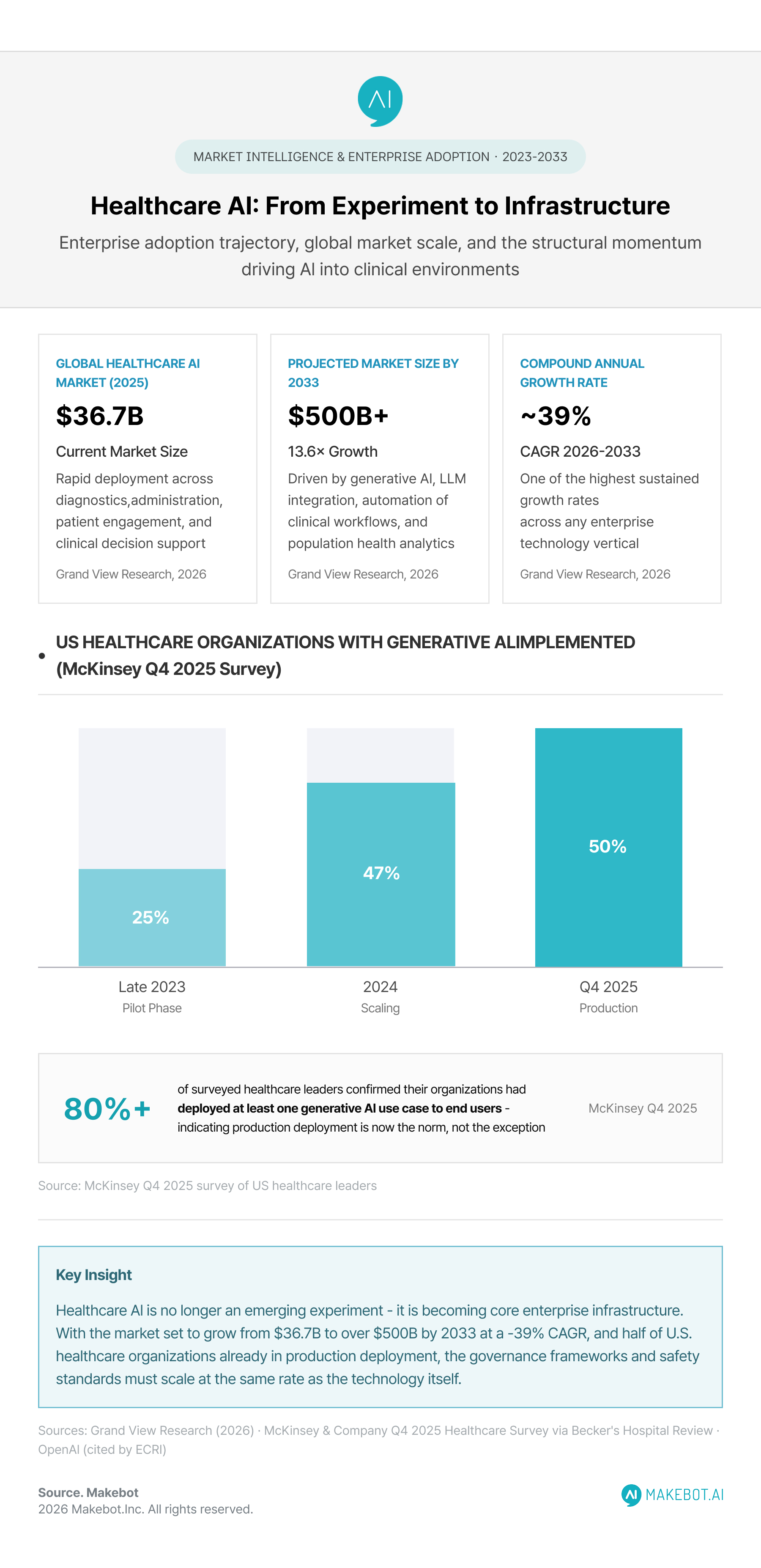
At the same time, Generative AI in healthcare is undergoing rapid formalization at the provider level. According to McKinsey's Q4 2025 survey of U.S. healthcare leaders, 50% of healthcare organizations have now implemented generative AI, up from 25% in 2023 and 47% in 2024. The global AI in healthcare market - estimated at $36.67 billion in 2025 by Grand View Research - is projected to reach over $500 billion by 2033, growing at a CAGR of nearly 39%. More than 40 million people turn to ChatGPT alone for health-related queries every day, according to OpenAI's own data. The technology is embedded in the healthcare landscape whether the regulatory framework has caught up or not.
McKinsey: AI Could Save the Healthcare Industry $360 Billion Annually. Explore the data and findings here!
What Responsible AI Health Use Looks Like
The challenge for the industry, policymakers, and patients is not whether to permit AI in healthcare - that ship has sailed. The challenge is how to establish the conditions under which AI health information use becomes safe, equitable, and genuinely useful. Several principles emerge from the evidence:
- Regulation must precede normalization. The King's College London study found 76% of the public supports official approval and regulation of AI clinical tools. Regulatory frameworks - particularly the EU AI Act's high-risk classification system and the FDA's evolving guidance on AI as a medical device - need to be extended and enforced to cover consumer-facing healthcare AI.
- AI should supplement, not replace, the clinical relationship. Gallup found that more than half of recent AI health users report using the technology to supplement their care - researching before or after appointments - rather than replacing it. That supplementary model is where AI healthcare tools have the best evidence base and the lowest risk profile.
- Transparency about limitations is non-negotiable. Users deserve clear, prominent disclosure that AI chatbots cannot examine patients, order tests, take clinical responsibility, or provide the equivalent of a professional consultation. Systems designed to sound confident must be counterbalanced with explicit acknowledgment of uncertainty.
- Access reform must accompany AI governance. The populations most likely to substitute AI for care are those with the least access to care. Effective policy cannot address AI misuse without simultaneously improving the healthcare access landscape that makes AI misuse rational.
Showcasing Korea’s AI Innovation: Makebot’s HybridRAG Framework Presented at SIGIR 2025 in Italy. Read here!
Conclusion
The headline number - 1 in 7 people substituting AI for their GP - should not be read as a statement about technology's promise. It is a statement about a healthcare system under pressure and a regulatory environment that has not kept pace with behavioral reality.
AI health assistants and digital health AI platforms are demonstrably useful when positioned correctly: as accessible, always-on tools that help people understand health information, prepare for appointments, or navigate complex medical language. That value is real. But the same tools become genuinely dangerous when they substitute for the clinical encounter, particularly for complex, acute, or mental health conditions where human judgment, examination, and accountability are not optional.
What this moment calls for is not a binary choice between embracing or rejecting AI in healthcare. It calls for governance frameworks that match the pace of adoption, transparency standards that match the confidence of AI outputs, and serious investment in the healthcare access infrastructure whose inadequacy is making AI substitution feel rational to millions of people. The tools are not the problem alone. The system that pushed people toward them is equally implicated.






.jpg)

What Happens to Marketing When the C-Suite Starts Using AI Every Day?







Why AI Shopping Assistants Will Replace Traditional Ecommerce Search






.jpg)
























Why Generative AI Projects Fail and How to Achieve Scalable AI Success











.jpg)

.png)