Gartner Predicts That Agentic AI Will Solve 80 Percent of Customer Problems by 2029
Gartner predicts agentic AI will autonomously resolve 80% of customer issues by 2029, cutting costs.


Introduction
Customer service has always been a pressure point — high in volume, variable in quality, and expensive to scale. For decades, businesses layered on human agents, knowledge bases, and rule-based chatbots to manage the load, with incremental gains at best. Then came generative AI, which improved conversational interfaces dramatically but still required humans to act on what the AI suggested. Now, a more consequential shift is underway.
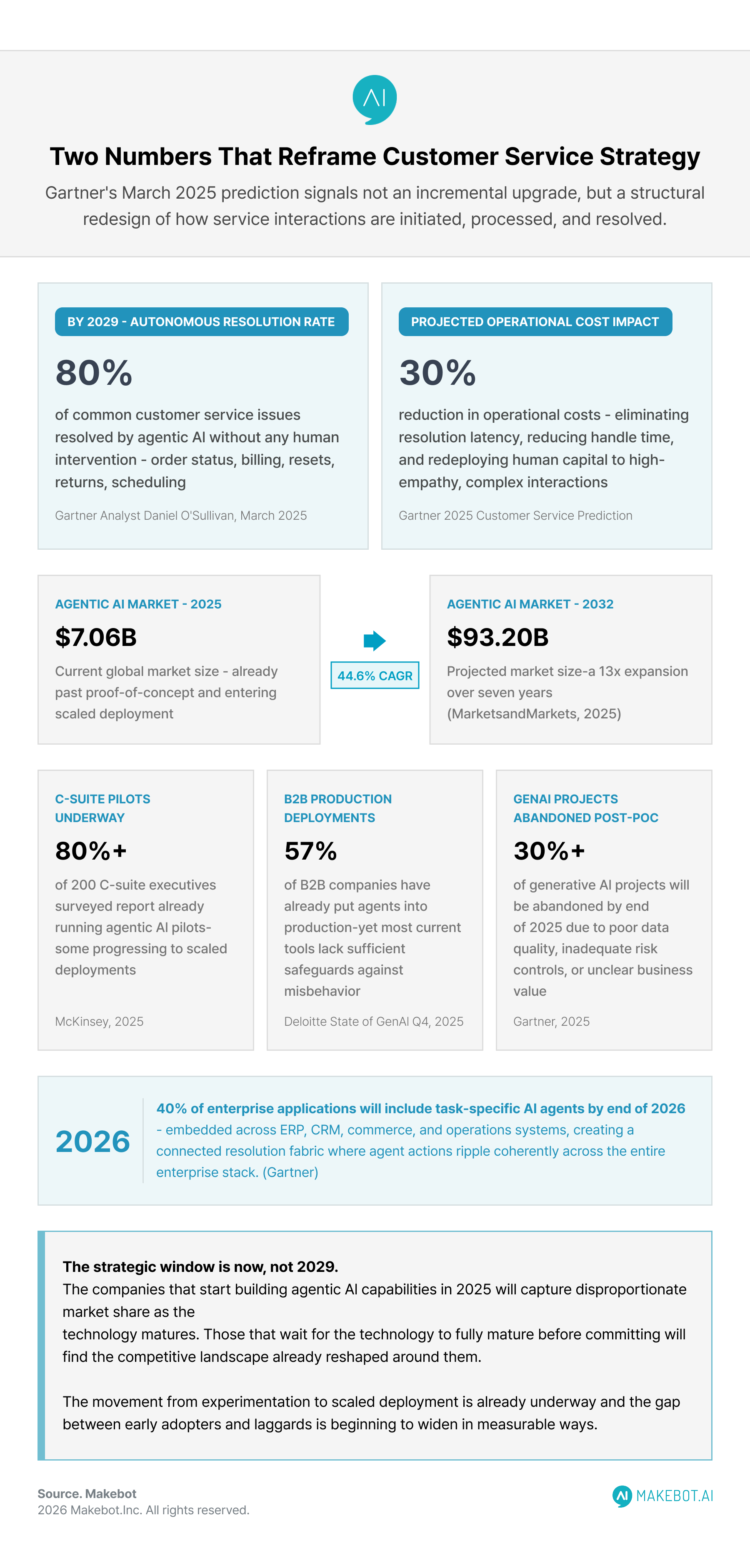
In March 2025, Gartner released a prediction that reframed the entire customer service conversation: by 2029, agentic AI will autonomously resolve 80 percent of common customer service issues — without any human intervention. The implication is not merely operational. It signals a structural redesign of how businesses and customers interact, how service teams are built, and how competitive differentiation through customer experience will be won or lost over the next four years.
This article unpacks what that prediction means in practice, how agentic AI actually works, what it promises for businesses, and — critically — where the real risks lie beneath the headline.
Agentic AI vs Generative AI: Why the Difference Will Define Enterprise Strategy in 2026. Read more here!
What Is Agentic AI? Moving From Responses to Actions
To understand why Gartner's prediction carries weight, you first need to understand what separates agentic AI from every AI system that came before it.
Traditional AI models — including first-generation chatbots and most generative AI deployments — are reactive. They receive a prompt, generate a response, and stop. They can describe how to cancel a subscription but cannot cancel it. They can explain the refund policy but cannot issue the refund. The gap between what AI can say and what AI can do has defined the ceiling of automation in customer service for years.
Agentic AI closes that gap. Unlike traditional generative AI models that rely on user prompts, agentic AI systems can plan, decide, and execute tasks across workflows, APIs, and external tools without direct human input. These autonomous agents can perform complex, multi-step operations such as managing customer support tickets, orchestrating business processes, or even writing and deploying code.
The architecture behind agentic AI combines large language models (LLMs) for reasoning and language understanding with orchestration frameworks that manage perception, memory, planning, and action loops. Rather than a single AI responding to a query, agentic systems can chain multiple specialized agents — one retrieves account data, another checks policy eligibility, a third executes the resolution — all within a single customer interaction.
The power of agentic AI lies in its architecture, which blends multiple technologies into a cohesive, autonomous system. These models provide natural language understanding, reasoning, and contextual fluency, enabling agents to comprehend customer queries, interpret intent, and generate responses that feel both accurate and empathetic. This is where generative AI plays its most important supporting role: it is the conversational and reasoning layer that makes agentic systems feel natural and contextually intelligent, even as the execution layer operates beneath the surface.
The distinction matters enormously in practice. A customer asked "Why was I charged twice, and can you reverse it?" no longer triggers a support ticket. An agentic system can query billing records, verify the duplicate charge, apply refund logic, process the transaction, and confirm resolution — all before a human agent even sees the case.
Deloitte 2026: 80% of Healthcare Executives Expect Agentic AI to Deliver Value. More here!
Gartner's 80 Percent Prediction, Explained
In March 2025, Gartner Analyst Daniel O'Sullivan published a forecast that sent a clear signal to the industry. O'Sullivan stated: "Agentic AI has emerged as a game-changer for customer service, paving the way for autonomous and low-effort customer experiences. In addition to handling assigned tasks, agentic AI has the capacity to proactively identify and resolve issues before a customer reaches out. Soon, such pre-emptive customer service — not just proactive customer service — will become the gold standard."
It is worth being precise about what "80 percent" actually means here. The prediction applies to common customer service issues — the type of requests that make up the bulk of contact center volume: order status checks, password resets, billing inquiries, simple returns, and appointment scheduling. The word "autonomously" is doing real work in that sentence. This is not chatbot-style deflection — answering a question and hoping the customer goes away. This is full-cycle resolution: the agent acts, completes, and confirms.
The cost dimension of the prediction deserves equal attention. A 30 percent reduction in operational costs would represent a transformative financial outcome for most large enterprises. Contact centers are among the most labor-intensive operations in business — high headcount, 24/7 coverage requirements, multilingual demands, and high attrition rates. If agentic AI can absorb 80 percent of the resolution workload, the remaining human agents can be redirected toward genuinely complex, high-empathy interactions where human judgment is irreplaceable.
The technology also allows customers to ask multi-faceted questions, fundamentally redefining how customers engage with service teams. This is a subtle but important shift. Current AI-assisted service optimizes for deflection — getting customers to self-serve so they do not need to reach a human. Agentic AI optimizes for resolution — completing the task regardless of its complexity, channel, or the number of systems it must touch.
Microsoft CEO Satya Nadella On How AI Is Transforming Organizations, Teams And Leadership. Read here!
How Agentic AI Transforms Customer Service Operations
The operational transformation that agentic AI enables extends well beyond replacing chatbots with smarter chatbots. It restructures the entire service delivery model.
From Reactive to Pre-emptive Service
One of the most commercially significant capabilities Gartner highlighted is pre-emptive resolution. Rather than waiting for a customer to call about a delayed shipment, an agentic system can detect the delay proactively, determine whether it breaches a service-level agreement, issue a compensation voucher, reroute the package if feasible, and notify the customer — before the frustration becomes a complaint. Agentic AI will usher in the next level of customer experiences through proactive and adaptive engagement, tackling complex, multistep tasks that defy a simple predefined path and adapting to real-time decision-making.
AI-to-AI Service Interactions
AI agents will not only provide information but will also take action, such as navigating websites to cancel memberships or negotiating optimal shipping rates on behalf of business customers. This points to a structural shift that most organizations have not yet fully processed: customers will increasingly deploy their own AI agents to interact with business AI agents. O'Sullivan explained that organizations will need to "rethink their approach" to managing inbound service interactions, preparing for a future where AI-driven requests "become the norm."
This AI-to-AI interaction model changes the nature of customer engagement fundamentally. Service teams will no longer primarily field human-initiated queries. They will manage and govern AI-initiated ones — requiring new automation strategies, new protocols, and new performance metrics built around machine-speed interaction rather than human-paced conversation.
Workforce Redesign, Not Workforce Replacement
Despite the headline numbers, the more defensible industry position is workforce redesign rather than wholesale elimination. For enterprises, this is not about replacing people, but upgrading how work gets done, while keeping humans in the loop for oversight and accountability. Human agents shift from tier-one resolution work toward exception handling, emotional de-escalation, and quality governance of the agentic systems themselves — roles that require judgment, empathy, and accountability that autonomous systems cannot reliably replicate.
Deloitte Insights: AI Fluency Becomes the Most Valuable Workforce Skill. Continue Reading here!
Benefits and Business Opportunities
The business case for AI customer support automation at this scale is compelling across multiple dimensions.
Cost Efficiency at Scale
The 30 percent operational cost reduction Gartner projects is not a soft estimate. It reflects the compounding effect of eliminating resolution latency, reducing average handle time across high-volume tickets, and redeploying human capital toward higher-value functions. Year-over-year spending on AI is expected to grow by 31.9% between 2025 and 2029, according to IDC, pushing AI investments to $1.3 trillion by 2029. For enterprises that move early, the ROI is front-loaded: the infrastructure investment pays down as resolution volumes scale.
Hyper-Personalization as a Competitive Differentiator
Organizations say the breakthrough experience they are chasing is highly personalized in real time (80%), seamless across digital and physical touchpoints (72%), and AI-powered while still human and brand-aligned (60%). Agentic AI, backed by generative AI's contextual reasoning capabilities, is uniquely positioned to deliver on all three. Unlike static rule engines, agentic systems can adapt resolution paths dynamically based on customer history, sentiment signals, and real-time context — creating individualized service experiences at scale.
24/7 Resolution Without Premium Cost
Human coverage across time zones requires shift premiums, multilingual staffing, and significant management overhead. Agentic AI systems operate continuously and across languages without incremental cost per interaction — a structural advantage that compounds with every additional customer served.
Enterprise Adoption Is Already Accelerating
McKinsey recently reported that 72% of organizations worldwide have adopted at least one AI-based automation solution, with AI agents among the featured use cases. Approximately 57% of large enterprises have utilized AI agents for customer support, marketing, analytics, and other capabilities. The movement from experimentation to deployment is already underway, and the gap between early adopters and laggards is beginning to widen in measurable ways.
Why Generative AI Projects Fail and How to Achieve Scalable AI Success. Read more here!
Challenges and Ethical Considerations
Gartner's prediction is not a guarantee — it is a directional forecast contingent on organizations solving problems that are currently unsolved at scale. The path from today's agentic AI pilots to 80 percent autonomous resolution is neither linear nor risk-free.
The Hallucination Problem at Scale
AI hallucinations can disrupt service, damage trust, and create real business risk. Detecting and managing hallucinations is critical to ensure reliability, maintain customer trust, and support agent decision-making. In a generative AI context, a hallucination is a contained failure — a wrong answer in a chat window. In an agentic context, a hallucination can trigger an action: a refund issued incorrectly, a policy committed to that does not exist, a cancellation processed in error. The consequence of agentic failure is not a bad response — it is a bad transaction.
Data Quality as a Foundational Dependency
According to Informatica's 2025 CDO Insights Report, 43% of AI leaders cite data quality and readiness as their top obstacle. Outdated training data can lead to inaccurate answers in customer support interactions, while poor data pipelines can cause agents to hallucinate — leading to unreliable outputs that erode customer trust. Agentic systems are only as reliable as the data environments they operate within, and many enterprise data infrastructures are not yet agentic-ready.
Governance, Accountability, and the Ethics of Autonomy
When an autonomous agent takes an action, questions arise about who is accountable — the developer, the operator, or the system owner. This ambiguity challenges traditional notions of responsibility and governance. Agents that inherit biases from underlying machine learning algorithms can make discriminatory or unethical decisions at scale.
At least 30% of generative AI projects will be abandoned after proof of concept by the end of 2025, due to poor data quality, inadequate risk controls, escalating costs, or unclear business value, according to Gartner. The same failure modes apply with compounded stakes when autonomous agents move from generating text to taking actions with real-world consequences.
Trust Infrastructure Is Lagging Deployment Ambition
Even companies on the cutting edge of deployment do not fully grasp how to use AI agents to maximize productivity and performance. The collective understanding of the societal implications of agentic AI on a larger scale remains nascent, if not nonexistent. Governance frameworks, audit mechanisms, and rollback protocols are still being designed at the same time as deployment accelerates — a sequencing risk that demands deliberate organizational attention.
Deloitte: 70% of Leaders Prioritize Agility as AI Reshapes Business Strategy. More here!
The Future of Customer Experience: What 2029 Actually Looks Like
Looking toward 2029, the trajectory points toward a customer experience ecosystem that is fundamentally different from what exists today — not incrementally better, but architecturally different.
60% of organizations say AI-powered service and support will define breakthrough CX over the next two to three years. The organizations that will lead in this environment are not simply those that adopt agentic AI earliest, but those that build the underlying infrastructure to deploy it reliably: unified customer data platforms, clean integration layers, governance protocols, and human-in-the-loop oversight for high-stakes decisions.
Gartner projects that by the end of 2026, 40% of enterprise applications will include task-specific AI agents. This means agentic capabilities will not exist in isolated customer service platforms — they will be embedded across ERP, CRM, commerce, and operations systems, creating a connected resolution fabric where agent actions ripple coherently across the entire enterprise stack.
The competitive implications are stark. The companies that start building their agentic AI capabilities in 2025 will capture disproportionate market share as the technology matures. For customer experience leaders, the question is no longer whether agentic AI will reshape their function — it is whether their organization will be a beneficiary of that reshaping or a casualty of it.
Critically, the human element does not disappear. It evolves. The best-performing service organizations by 2029 will likely be those that deploy AI for resolution velocity and deploy humans for relationship depth — a complementary model where each layer operates at its natural advantage. The brands that customers trust most will not be the ones that removed human judgment from the equation, but the ones that applied it most thoughtfully.
How AI Chatbots Are Increasing E-Commerce Conversion Rates. Read here!
Key Takeaways for Decision-Makers
- Start the data foundation now. Agentic AI is only as trustworthy as the data infrastructure beneath it. Investment in data quality, integration, and governance is not preparatory work — it is the core work.
- Pilot on bounded, high-volume use cases first. Order tracking, password resets, billing inquiries, and return processing offer high resolution frequency with manageable risk exposure — ideal entry points for agentic deployment.
- Build governance before you scale. Accountability frameworks, hallucination monitoring, human escalation paths, and audit logging should be designed before agents are deployed at volume, not retrofitted afterward.
- Reframe the workforce conversation. Agentic AI eliminates tier-one volume work, not customer service as a function. Organizations that invest in reskilling human agents toward judgment-intensive roles will outperform those that simply reduce headcount.
- Track AI-to-AI interaction volumes. As customers increasingly deploy their own AI agents to interact with business systems, organizations will need new service protocols designed for machine-speed, machine-initiated requests.
Showcasing Korea’s AI Innovation: Makebot’s HybridRAG Framework Presented at SIGIR 2025 in Italy. Read here!
Conclusion
Gartner's prediction is striking in its specificity: 80 percent autonomous resolution, 30 percent cost reduction, by 2029. But the more important story is not the number — it is the direction it signals. Agentic AI is not an incremental improvement on existing customer service automation. It is a structural redesign of how service interactions are initiated, processed, and resolved.
The convergence of generative AI's reasoning power, agentic AI's execution capability, and enterprise-grade data infrastructure is creating the conditions for this transformation to reach scale within the decade. For customer experience leaders, the window for strategic positioning is now. Those who wait for the technology to fully mature before committing will find the competitive landscape already reshaped around them.
The path to 2029 is not without difficulty. Data quality, governance, trust, and hallucination risk are real constraints that require deliberate investment. But the organizations that build agentic AI capabilities with discipline — grounding deployment in reliable data, accountable governance, and thoughtful human-AI collaboration — will not just reduce costs. They will redefine what exceptional customer experience means in the era of intelligent AI agents for support.










.jpg)


What Happens to Marketing When the C-Suite Starts Using AI Every Day?







Why AI Shopping Assistants Will Replace Traditional Ecommerce Search






.jpg)
























Why Generative AI Projects Fail and How to Achieve Scalable AI Success










.jpg)

.png)