OpenAI Releases GPT-5.5 Instant: A New Default Model for ChatGPT
GPT-5.5 Instant cuts hallucinations by 52% and redefines ChatGPT's daily reliability standard.

Introduction
When OpenAI updates the default experience for hundreds of millions of ChatGPT users, it signals something more than a routine release cycle. On May 5, 2026, OpenAI released GPT-5.5 Instant as the new default ChatGPT model, replacing GPT-5.3 Instant across all user tiers. This is not a frontier reasoning model designed for elite edge cases — it is the everyday engine that powers daily conversations, professional queries, and creative tasks for a global user base.
What makes this OpenAI ChatGPT update notable is its deliberate focus on reliability over raw capability. The team did not chase benchmark headlines alone. Instead, GPT-5.5 Instant targets the persistent friction points that users have flagged over time: hallucinations in sensitive domains, cluttered verbose responses, and a lack of meaningful context awareness. This article examines what the model does differently, why OpenAI made these design decisions, and what the release means for users, developers, enterprises, and the broader large language model (LLM) ecosystem.
What Is GPT-5.5 Instant?
GPT-5.5 Instant is OpenAI's updated default conversational model — the version of ChatGPT that every user interacts with unless they explicitly select another option. It sits in a distinct product tier from the full GPT-5.5 frontier model, which was released in April 2026 and is optimized for complex agentic tasks, long-horizon coding, and scientific research workflows.
The Instant variant is purpose-built for daily use. OpenAI describes it as a model that "matches the scale of the task" — giving streamlined answers to casual questions while still handling nuanced professional queries with depth and accuracy. The distinction matters because the tradeoffs involved in building a frontier reasoning model (slower inference, higher computational cost, heavier response formatting) work against the experience needed at scale for everyday interaction.
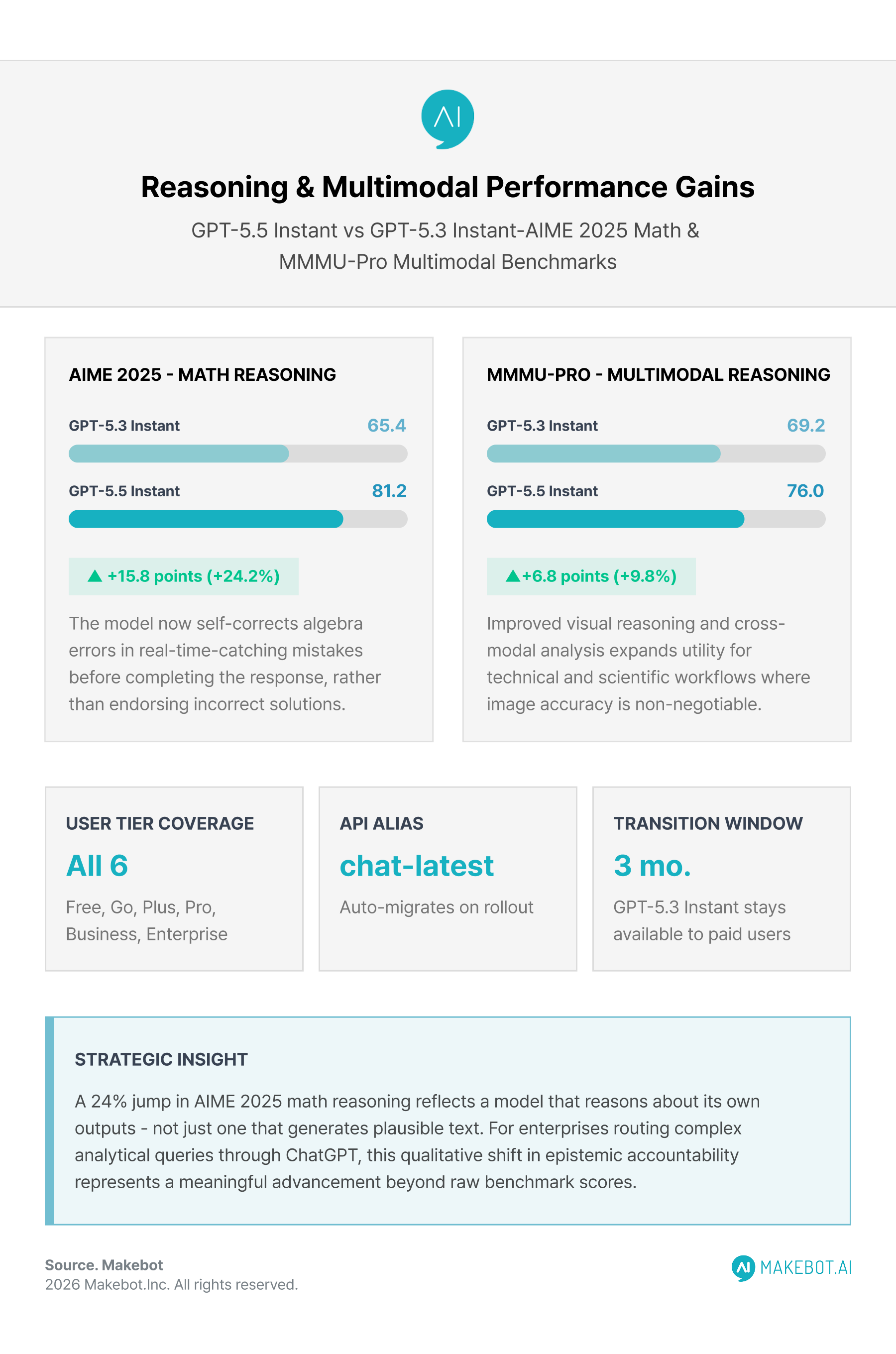
This new ChatGPT model — now the ChatGPT default model for every user tier globally, including Free, Plus, Pro, Go, Business, and Enterprise — represents the broadest simultaneous rollout of any GPT-5 series Instant model to date. In the API, it is available under the label chat-latest, allowing developers to automatically receive the latest default-tier model without requiring manual version updates.
OpenAI Report Reveals Accelerating Enterprise AI Adoption in Healthcare. Read more here!
Why OpenAI Made This the New Default
Replacing a default model is not a decision taken lightly. OpenAI learned this lesson concretely when GPT-4o was retired in February 2026, prompting an unusual level of emotional backlash from users who described the model as a "best friend" or "a mirror." The strength of that response reflected a deeper truth: users form functional relationships with the model they interact with daily, and design decisions at the default tier carry outsized psychological and practical weight.
The GPT-5.5 release was timed to address a specific set of documented complaints. Post-session feedback, flagged conversations, and behavioral evaluation data all pointed toward the same pattern: users were frustrated by hallucinations in high-stakes contexts, fatigued by over-formatted responses, and underwhelmed by the model's inability to leverage context from prior conversations. OpenAI used those signals as design constraints.
The result is a model that reflects a more mature philosophy of AI product development — one where user trust and reliability are treated as engineering targets, not just aspirational values.
Deloitte: 70% of Leaders Prioritize Agility as AI Reshapes Business Strategy. More here!
Core Improvements: GPT-5.5 Instant Features That Matter Most
Factuality and Hallucination Reduction
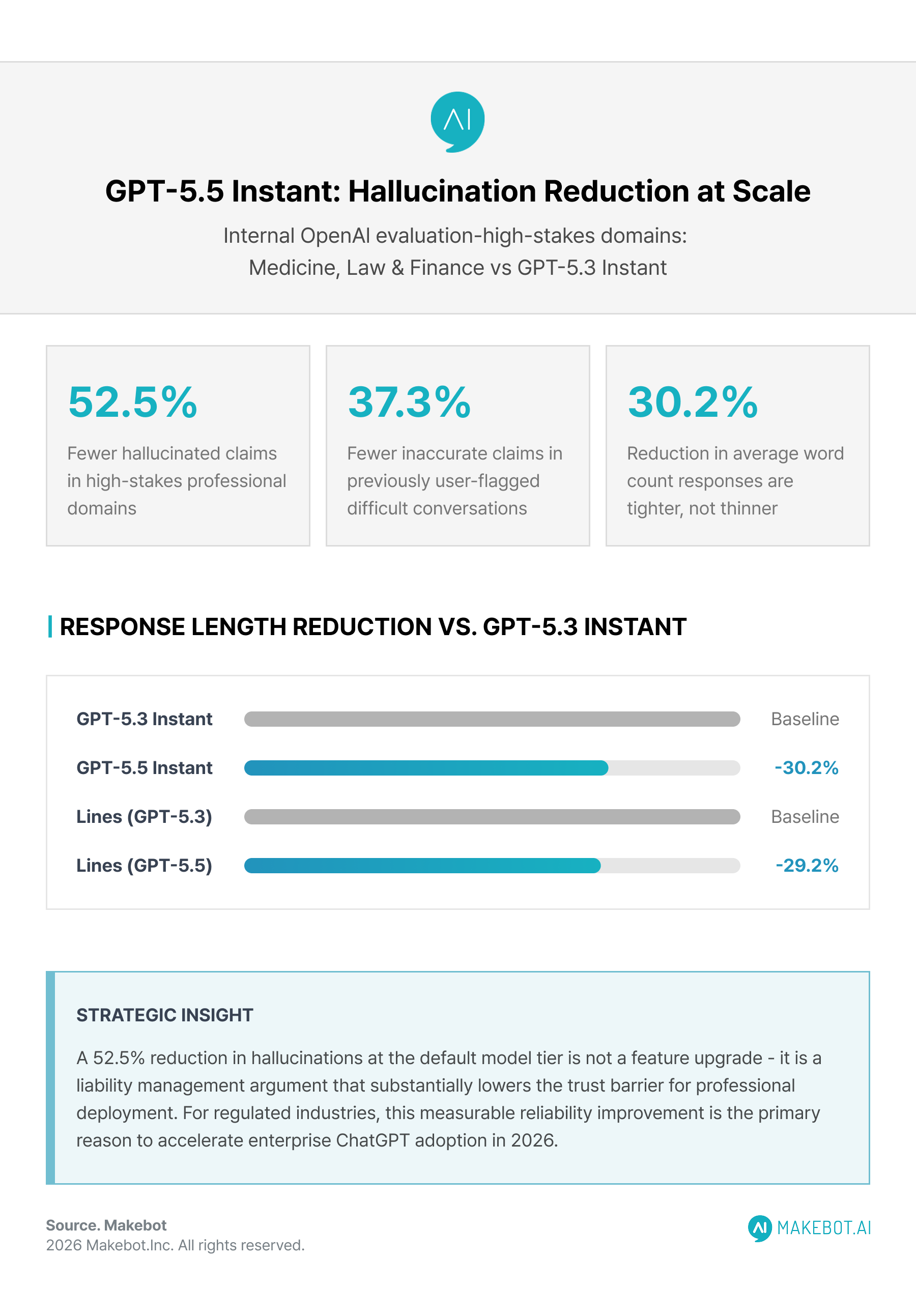
The single most impactful improvement in GPT-5.5 Instant is its advancement in factual reliability. In internal evaluations:
- The model produced 52.5% fewer hallucinated claims than GPT-5.3 Instant on high-stakes prompts covering medicine, law, and finance.
- It reduced inaccurate claims by 37.3% in especially difficult conversations users had previously flagged for factual errors.
These are not marginal gains. For professionals using ChatGPT to research regulatory interpretations, draft clinical summaries, or analyze financial disclosures, the difference between a 52% reduction in hallucinations and no reduction at all is the difference between a trustworthy tool and a liability. OpenAI is effectively lowering the barrier for responsible professional deployment.
That said, as Axios noted in its coverage of the release, lower hallucination rates carry a subtle risk: users may over-trust answers even when the model is still capable of error. The appropriate response is calibrated trust, not uncritical reliance.
Stronger Reasoning and Benchmark Performance
Beyond reliability, GPT-5.5 Instant demonstrates genuine reasoning gains across structured evaluations:
- AIME 2025 Math Test: Scored 81.2, up from 65.4 in GPT-5.3 Instant.
- MMMU-Pro Multimodal Reasoning Benchmark: Scored 76, up from 69.2.
The reasoning improvement is not just quantitative — it's qualitative. OpenAI's blog post illustrates this with a quadratic equation example. When presented with an incorrect algebraic solution, GPT-5.5 Instant initially endorses it, then self-corrects by plugging the value back into the equation, identifying the algebra error, and applying the quadratic formula to arrive at the correct answer. The older model identified the problem but incorrectly concluded there was no real solution, failing to revisit the underlying math.
This capacity for real-time self-correction reflects a model that reasons about its own outputs rather than simply generating fluent text. It is a meaningful step toward the kind of epistemic accountability that professionals require.
Conciseness and Response Quality
User feedback data shaped how OpenAI approached the model's communication style. The result:
- Responses use 30.2% fewer words on average.
- Response length is reduced by 29.2% fewer lines.
- Gratuitous emojis are removed by default.
- Unnecessary follow-up questions are significantly reduced.
OpenAI's stated goal was to make responses "tighter and more to-the-point without losing substance, while keeping the warmth and personality that makes ChatGPT enjoyable to use." For enterprise users who route ChatGPT outputs into downstream workflows or customer-facing documentation, this reduction in noise translates directly to productivity gains.
Image Understanding and STEM Capabilities
The OpenAI GPT-5.5 Instant model also brings material improvements in multimodal capability. According to OpenAI, the update delivers:
- Better photo and image analysis, improving accuracy and descriptive quality for vision-based tasks.
- Stronger performance on STEM-related questions, including math, physics, and chemistry.
- Smarter web search triggering — the model now makes better contextual decisions about when to invoke search versus responding from internal knowledge.
These improvements extend the model's utility into technical and scientific workflows where accuracy is non-negotiable.
Microsoft CEO Satya Nadella On How AI Is Transforming Organizations, Teams And Leadership. Read here!
Enhanced Personalization: Memory Sources
Perhaps the most architecturally interesting new feature in the GPT-5.5 Instant release is the introduction of memory sources — a transparency layer that gives users visibility into what context the model is drawing from to personalize their responses.
When GPT-5.5 Instant tailors a response based on saved memories, past conversations, or connected third-party data (such as Gmail), it now surfaces those sources explicitly. Users can:
- View which memories or past chats informed a response.
- Delete sources that are outdated or no longer relevant.
- Correct inaccurate context entries.
- Control sharing — memory sources remain private even when a chat is shared with another user.
The enhanced personalization capability itself — pulling context from past chats, uploaded files, and connected Gmail accounts — is rolling out initially to Plus and Pro users on the web, with mobile availability and broader tier access (Free, Go, Business, Enterprise) planned for the coming weeks.
This positions ChatGPT as a genuinely persistent assistant rather than a stateless chat interface. For professionals managing ongoing projects, client relationships, or iterative research, the ability to reduce repetitive context-setting across sessions is a meaningful workflow improvement.
Deloitte Insights: AI Fluency Becomes the Most Valuable Workforce Skill. Continue reading here!
What This Means for Developers
For developers, the GPT-5.5 Instant release introduces a clean API upgrade path. The model is accessible under the alias chat-latest, which means applications configured to use that label will automatically receive the updated model without version-specific reconfiguration.
Key developer considerations:
- GPT-5.3 Instant remains available to paid API users for three months before retirement, providing a structured migration window.
- The model's improved self-correction and factuality make it a stronger candidate for applications that previously required aggressive prompt engineering to reduce hallucinations.
- The reduction in response verbosity may require revisiting downstream parsing logic for applications that relied on specific output formatting conventions from the prior model.
- Developers building personalized or context-aware applications will want to evaluate the new memory source APIs as they become available, particularly for use cases in professional services, healthcare documentation, and financial advisory.
The broader GPT-5.5 frontier model — a separate, more capable OpenAI AI model — generated significant early momentum at launch. Posts circulated on X (unconfirmed by OpenAI officially) claimed API revenue was growing at more than twice the pace of prior model launches and that Codex revenue had doubled within seven days. While these figures have not been independently verified, they reflect the strong early developer appetite for the GPT-5.5 generation. The Instant tier update is expected to sustain and broaden that adoption across a wider range of use cases and budget levels.
LLM Optimization for B2B Marketing: Architecture, RAG Pipelines, and AI Strategies for Enterprise Growth. Read more here!
Enterprise Implications: Trust, Governance, and Competitive Pressure
The enterprise AI landscape in 2026 is not short on options. Google Gemini, Anthropic's Claude, Microsoft Copilot, and Amazon's AI stack are all competing aggressively for enterprise mindshare. Against this backdrop, the OpenAI latest model update at the default tier carries specific strategic implications.
The 52.5% reduction in hallucinations for high-stakes prompts is not just a feature — it is a liability management argument. For regulated industries, where AI-generated errors in medical, legal, or financial content carry real compliance risk, a model that is measurably more reliable at the default tier substantially lowers the trust barrier for wider deployment.
However, enterprise adoption faces structural challenges that model quality alone cannot resolve. Research from Futurum Group highlights that:
- 78% of organizations planning AI budget increases still cite trust, reliability, and data privacy as adoption barriers.
- 53% of enterprises identify data privacy as their second-ranked challenge.
- 43% report difficulty measuring business value from AI implementations.
The memory sources feature addresses the trust and transparency dimensions of this directly. By showing users what data informed a response, OpenAI gives enterprise administrators a clearer audit trail — something that governance-focused buyers have explicitly demanded. At the same time, the integration of third-party data like Gmail raises the stakes around data handling policy and organizational controls, particularly for Business and Enterprise deployments managing sensitive information.
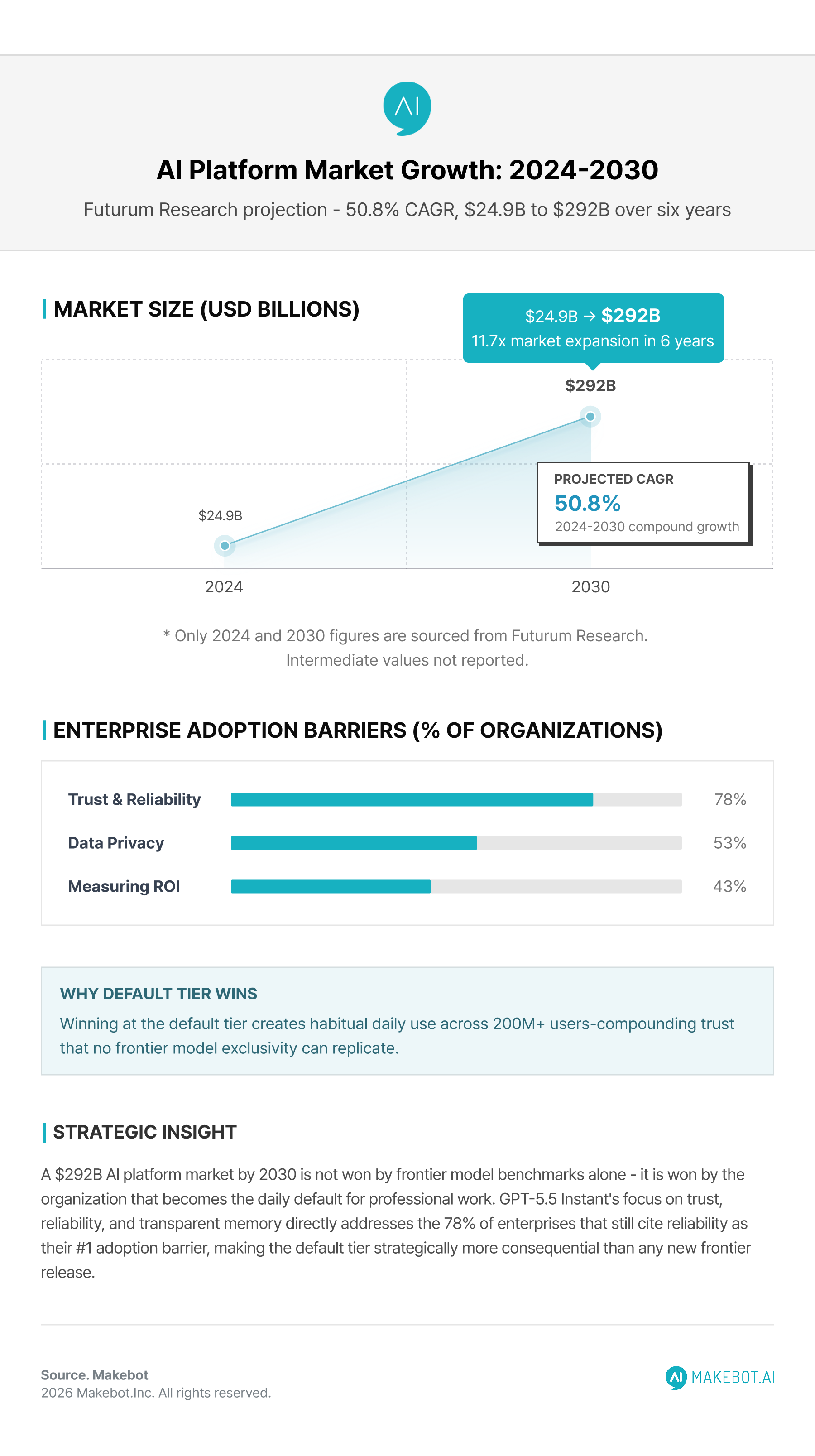
The AI platform market Futurum projects will grow from $24.9 billion in 2024 to $292 billion by 2030 at a 50.8% CAGR. Winning at the default tier is how OpenAI captures a disproportionate share of that growth — not through frontier exclusivity, but through the reliability and daily habituation that comes from being the model hundreds of millions of people rely on for routine professional work.
How LLMs Are Embedded into Modern Marketing Automation Platforms. More here!
Competitive Landscape: Where GPT-5.5 Instant Fits
The ChatGPT AI model ecosystem is no longer competing in isolation. Each major AI lab is updating its default conversational models at an accelerating pace, and the differentiation between them is increasingly defined not by raw parameter scale but by reliability, personalization depth, and integration breadth.
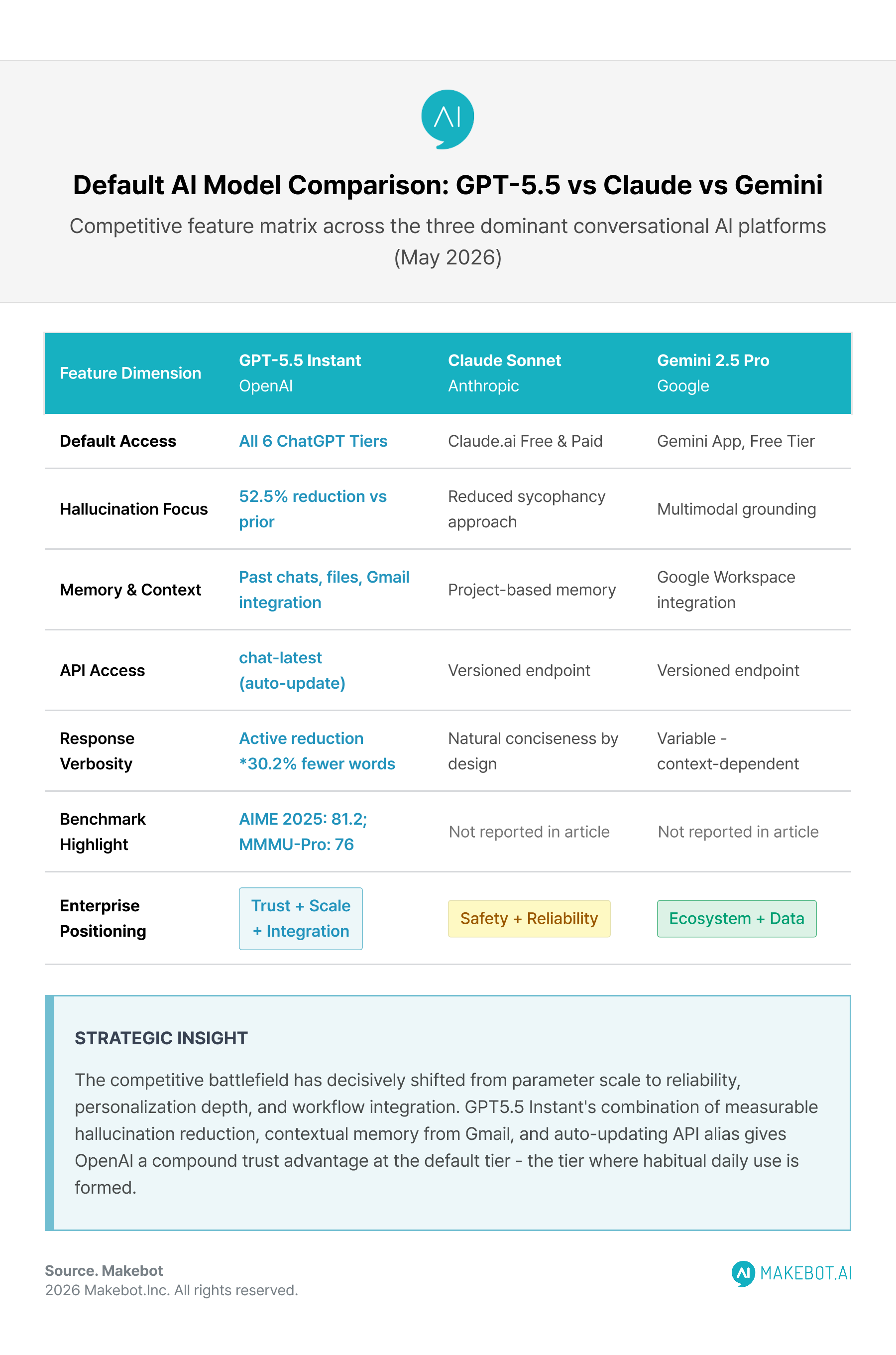
The pattern across all three labs is clear: the competitive battlefield has shifted from "which model is smarter" to "which model is most dependable, personalized, and integrated into the user's existing workflow." GPT-5.5 Instant's emphasis on factuality, conciseness, and contextual memory positions it squarely within that frame.
What OpenAI has over its competitors at the default tier is scale of habituation. When a model becomes the daily default for a user base exceeding 200 million people, trust compounds over time. That trust is both an asset and a responsibility — and the design decisions in this release reflect an understanding of both.
Limitations and Considerations
No model release is without caveats, and intellectual honesty requires naming them.
- Trust calibration risk: Lower hallucination rates may cause users to trust the model's outputs uncritically. The model is significantly more reliable — not infallible. Professional verification remains essential in legal, medical, and financial contexts.
- Personalization and privacy tradeoffs: The enhanced memory and Gmail integration improve relevance but expand the data surface area exposed to the model. Users and organizations should review OpenAI's data retention and privacy settings before enabling these features at scale.
- Tier-gated rollout: The most compelling personalization features — contextual memory from past chats, files, and Gmail — are initially limited to Plus and Pro users on web. Free and enterprise users will access them later, creating a temporary experience gap.
- Model transitions: The three-month deprecation window for GPT-5.3 Instant is reasonable but requires developers to proactively audit and test downstream applications that may depend on the prior model's specific response characteristics.
The Broader Trajectory: What GPT-5.5 Instant Signals
The GPT-5.5 release at the Instant tier is a strategic statement about where OpenAI believes the next phase of AI value will be created. Not at the frontier of maximum capability, but at the foundation of daily reliability. Every organization that routes professional tasks through ChatGPT — whether drafting legal summaries, analyzing financial filings, answering customer queries, or generating code documentation — benefits disproportionately from a model that is measurably more trustworthy, more concise, and more contextually aware.
The model also signals a maturing relationship between AI systems and the humans who use them. Memory sources, self-correction, and calibrated verbosity are not just features — they are design choices that treat users as professionals who can evaluate AI outputs, not passive recipients of generated content. That shift in philosophy, if sustained, will define how conversational AI evolves through the remainder of this decade.
As the LLM landscape continues to advance at speed, the competitive moat will increasingly belong to the organizations that deliver trustworthy AI at scale. With GPT-5.5 Instant, OpenAI is making a credible claim to that position — while also acknowledging, through the nuance of its rollout strategy and its transparency features, that trust is earned incrementally, not declared.
Showcasing Korea’s AI Innovation: Makebot’s HybridRAG Framework Presented at SIGIR 2025 in Italy. Read here!









.jpg)

What Happens to Marketing When the C-Suite Starts Using AI Every Day?







Why AI Shopping Assistants Will Replace Traditional Ecommerce Search






.jpg)
























Why Generative AI Projects Fail and How to Achieve Scalable AI Success











.jpg)

.png)