Claim Status, Not Claim Decisions: Where Insurers and Banks Should Start With Customer-Facing AI
Insurers give good claim status updates only 22% of the time. AI fixes that at the lowest risk.


Key Takeaways
- Using AI is not the same as profiting from it. In McKinsey's 2026 State of AI survey, only 37% of respondents say AI has added anything to their company's profit, and just 6% count as top performers.
- Claimants want updates. J.D. Power found that insurers give people good enough digital updates on their claims only 22% of the time.
- Claim status is the safest place to start. Answering "Where is my claim?" carries little risk and comes up constantly, which makes it a strong first project for AI customer service in banking and insurance.
- People accept AI if they can still reach a person. In a 2026 Gartner survey, 87% of customers said a way to reach a human agent is essential when a company uses generative AI for service.
- The winners change how work gets done. Top performers are far more likely to redesign their workflows around AI instead of adding it to old processes.
Introduction
Almost every insurer and bank now uses AI. Far fewer are making money from it.
Many companies want to aim Generative AI in financial services (AI that can write text and hold conversations) at their biggest decisions first: approving claims, settling disputes and deciding who gets credit. These are usually the wrong place to start.
During a claim, most customers are not asking "Will you pay?" They are asking "Where is my claim, and what happens next?" That question can be answered from company records, carries little risk and comes up constantly. This article explains why claim status is the best starting point for customer-facing AI.
Most Companies Use AI. Few Profit From It.
McKinsey's The state of AI in 2026 shows how far AI has spread. Nearly nine in ten respondents say their company uses AI regularly. Yet only 37% say AI has contributed to EBIT (a common measure of operating profit), a number that has barely moved in a year.
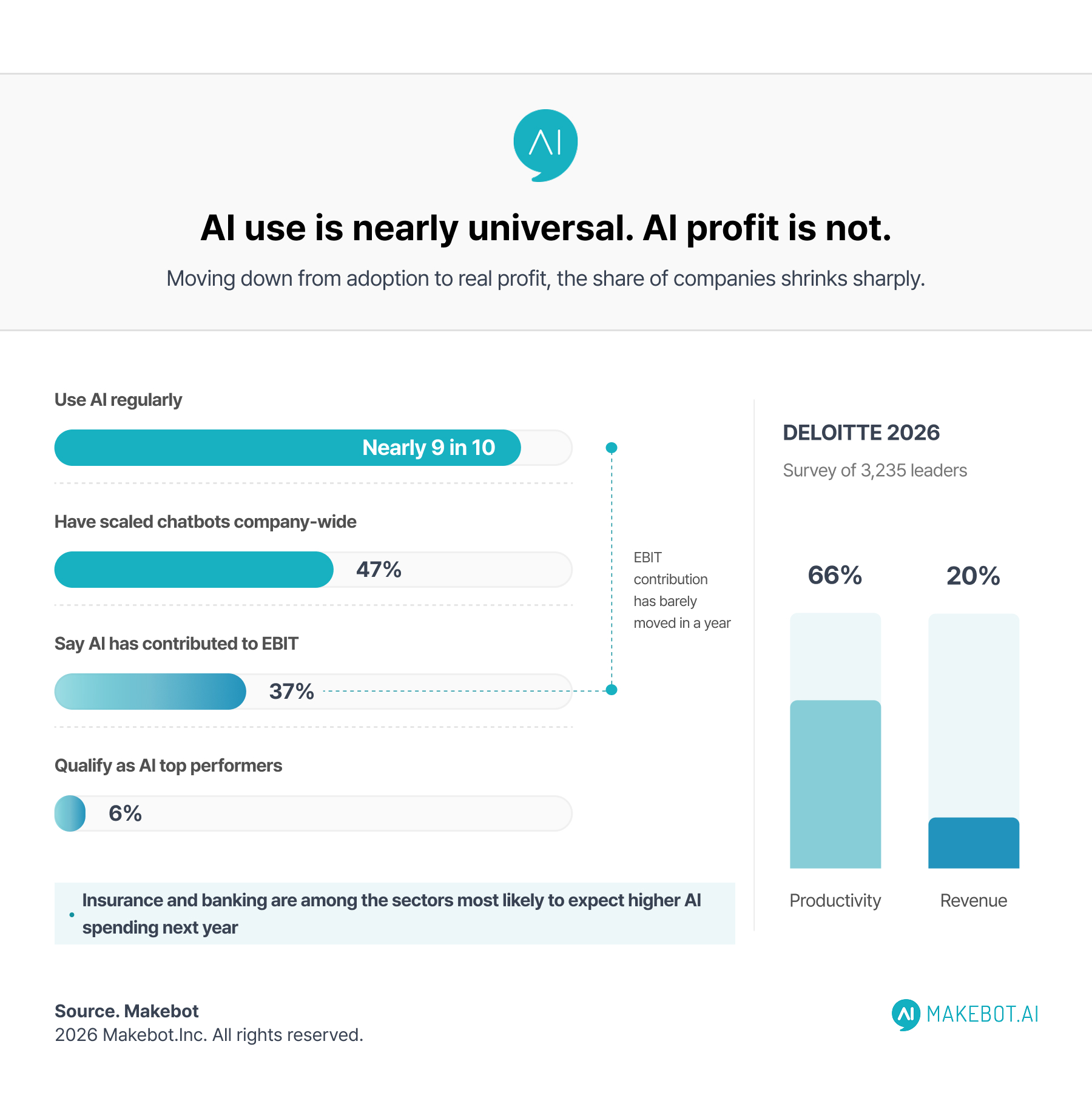
Chatbots are the most widely scaled AI tool, with 47% of respondents rolling them out company-wide, and insurance and banking respondents are among the most likely to expect higher AI spending in the coming year.
In Deloitte's 2026 survey of 3,235 leaders, 66% report productivity gains, but only 20% report revenue growth from AI.
In customer-facing finance, a big part of this gap comes from picking the wrong first project: tasks that need judgment companies are not ready to hand over to AI.
Why Claim Status Is the Best First Step
A good first AI project handles many requests, has clear answers and causes little harm when it is wrong. Claim status meets all three.
Customers want updates and are not getting them
The J.D. Power 2025 U.S. Claims Digital Experience Study (5,958 reviews from auto and home insurance customers) points straight at the status problem:
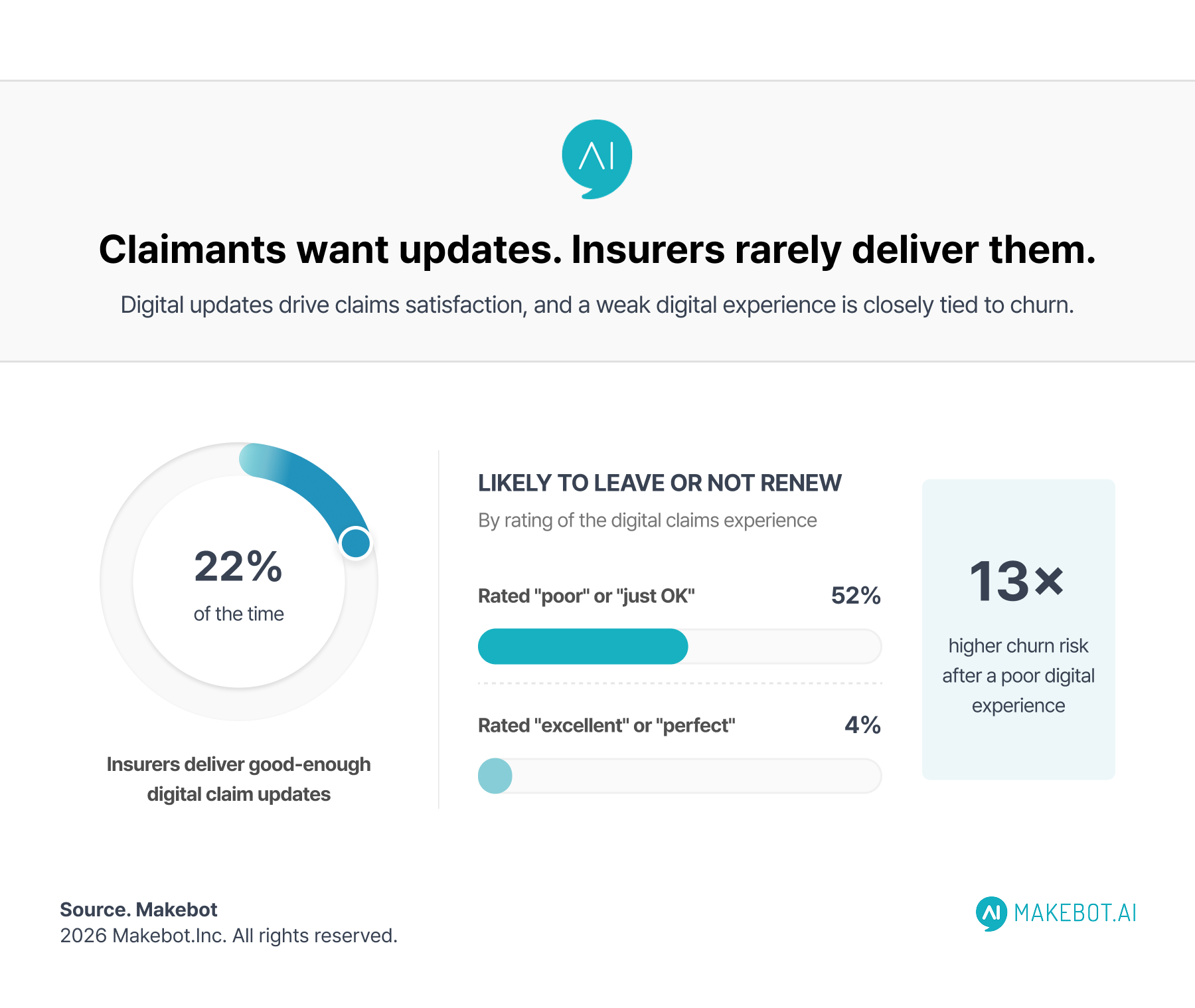
- Good digital updates are one of the biggest drivers of satisfaction, yet insurers deliver them only 22% of the time.
- Among customers who rate their digital experience "poor" or "just OK," 52% are likely to leave or not renew, compared with 4% of those who rate it "excellent" or "perfect."
An unanswered status question turns into a call or an email. AI claims status tracking turns that frustration into a reason for customers to stay.
Looking something up is much safer than deciding something
A status answer is looked up, not worked out, and it can be checked against the record. A claim decision means reading the policy, checking for fraud and calculating a payout. That is why the NAIC Model Bulletin, guidance from U.S. state insurance regulators, expects insurers' AI programs to cover claim handling, payment and fraud detection. As of October 8, 2026, 27 states plus the District of Columbia and Puerto Rico had adopted it.
In Europe, Annex III of the EU AI Act labels AI used to judge creditworthiness, or to assess risk and set prices in life and health insurance, as "high-risk." The European Commission's May 2026 draft guidelines on high-risk classification give practical examples. An assistant that only finds and explains a claim's progress makes none of those judgments. After the Council of the EU gave final approval to the AI Omnibus in June 2026, the high-risk rules for these systems start on December 2, 2027.
In Moffatt v. Air Canada, 2024 BCCRT 149, a Canadian tribunal held Air Canada liable after its website chatbot gave a customer wrong bereavement fare information. A wrong status update is easy to fix. An Insurance AI Chatbot that gets coverage, eligibility or policy terms wrong creates the kind of legal risk the Moffatt case shows.
Status vs. Decisions at a Glance
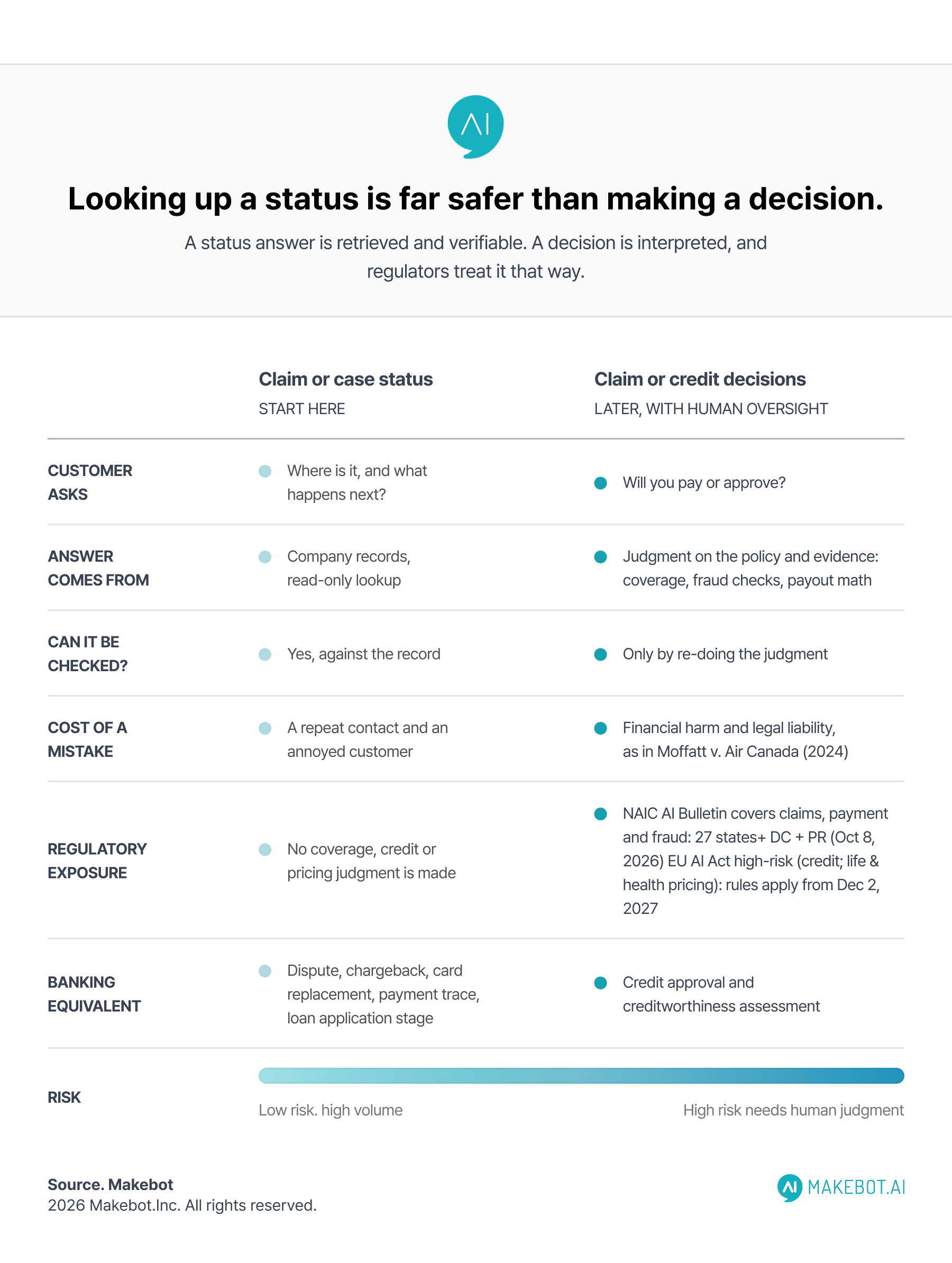
Banks have the same kind of questions. Where is my dispute? What stage is my loan application in? AI in banking can answer each of these from data the bank already has.
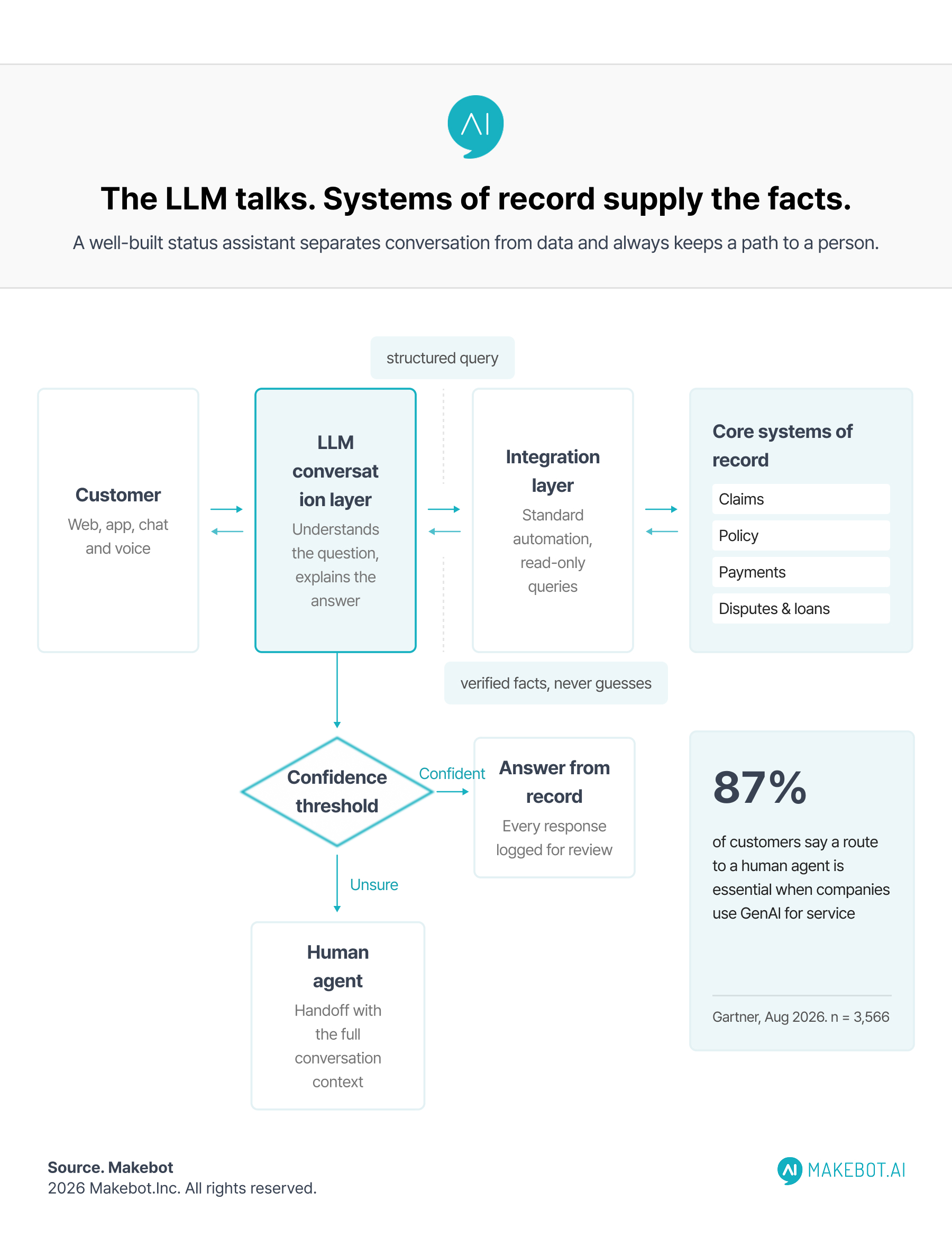
How the system is built matters too. A Large Language Model (LLM) is the type of AI behind modern chatbots. In a well-built status assistant, the LLM handles the conversation while standard software pulls the real facts from the company's systems. Gartner recommends this setup, with traditional automation completing the task in the background.
What the Top Performers Do Differently
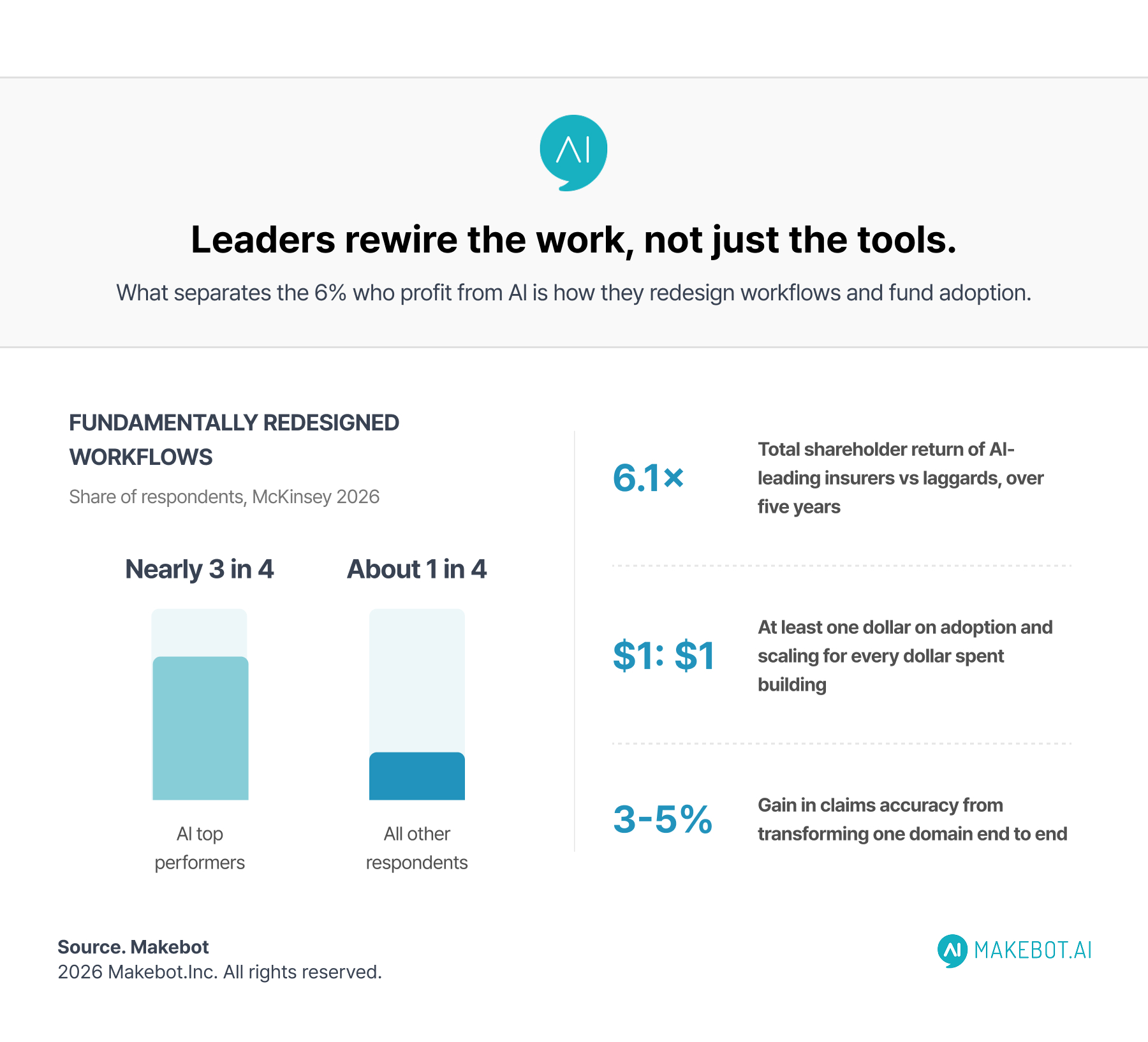
McKinsey's 2026 data shows that the 6% of top performers stand out because of how they use AI. Nearly three in four have fundamentally redesigned their workflows around AI, compared with about one in four other respondents.
The gap is even wider in insurance. McKinsey's The future of AI in the insurance industry found that over five years, insurers leading in AI delivered 6.1 times the total shareholder return of those lagging behind.
On the technical side, leaders:
- Connect the AI to the core claims systems, so it can see every update.
- Make sure answers come from real data, not from the AI guessing.
- Let the AI answer only when it is confident, with a clear path to a human otherwise, as Gartner advises.
On the people and process side, leaders:
- Transform one area of the business from start to finish. McKinsey reports this has delivered a 3% to 5% gain in claims accuracy.
- Spend at least one dollar on adoption and scaling for every dollar spent building the AI.
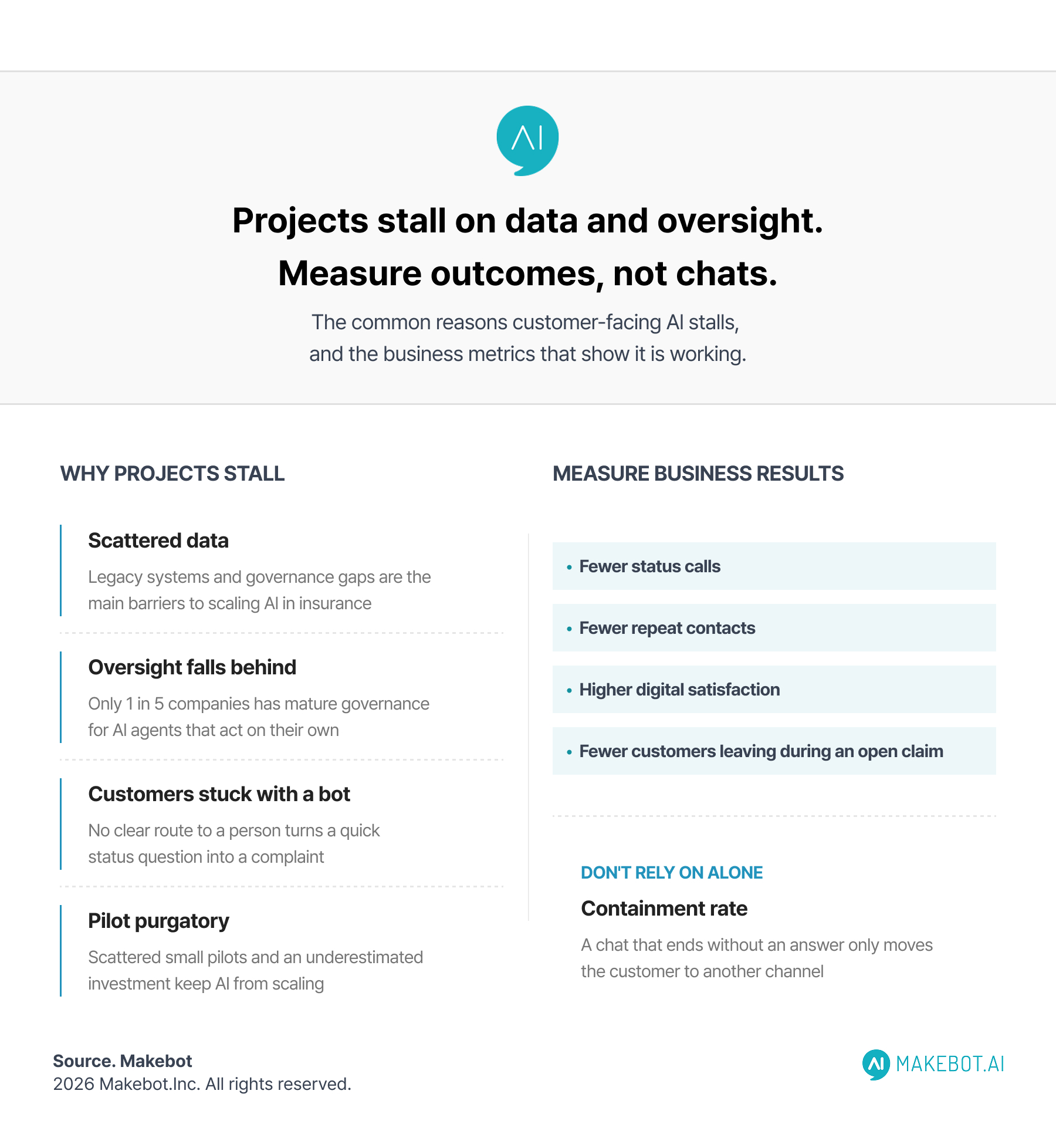
Struggling insurers do the opposite. McKinsey says they are stuck in "pilot purgatory": they run scattered small projects and underestimate the investment needed.
Where Things Go Wrong
Even a smart AI customer service project can stall. Common reasons include:
- Data is scattered. McKinsey lists old legacy systems and gaps in governance among the main barriers to scaling AI in insurance.
- Oversight falls behind. Deloitte finds only one in five companies has a mature way to govern AI agents that act on their own.
- Customers get stuck with a bot. In Gartner's 2026 survey of 3,566 customers, 87% see a human option as essential.
Real-World Examples
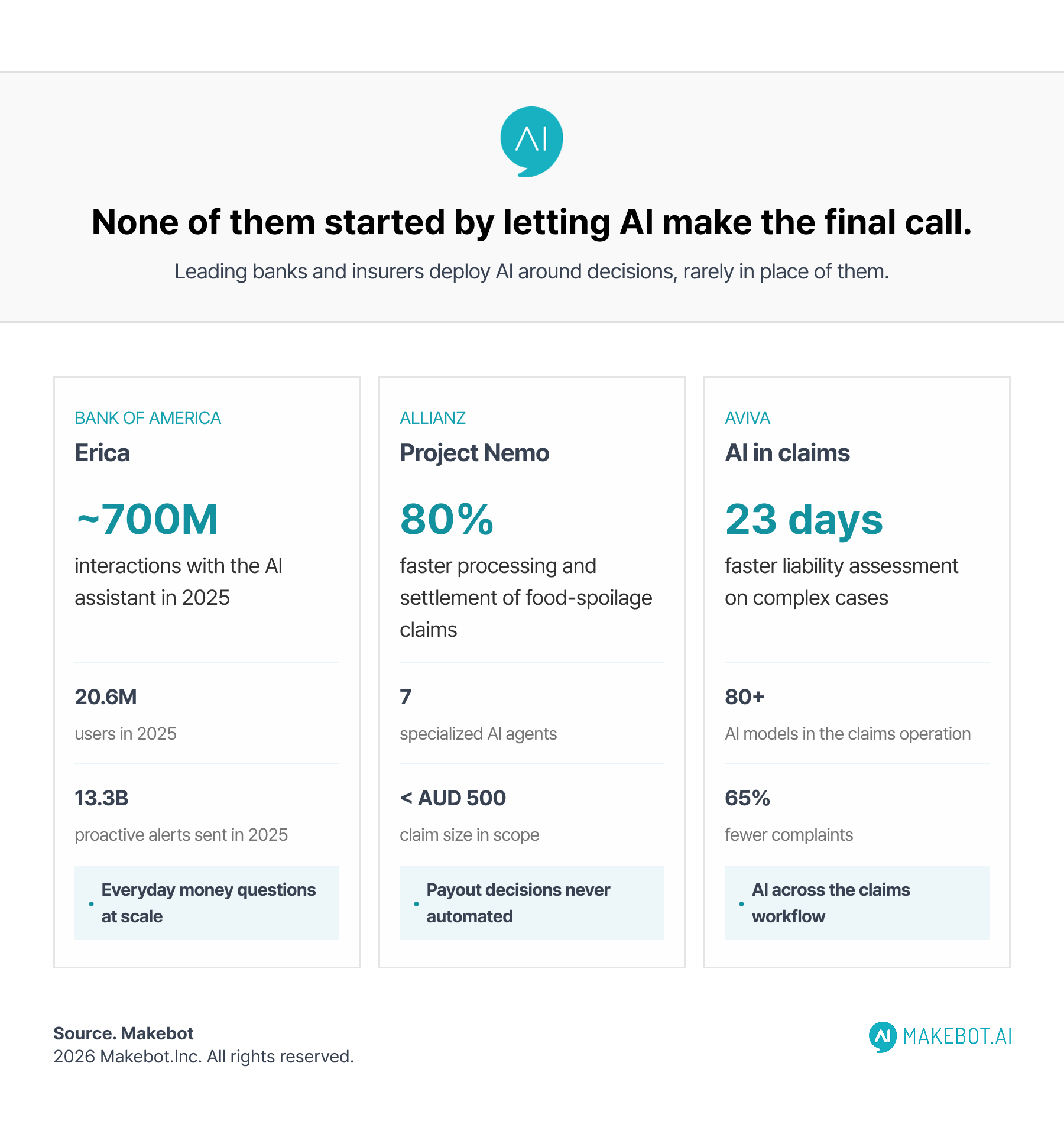
None of these companies started by letting AI make the final call.
- Bank of America's Erica: In 2025, 20.6 million users interacted with Erica, the bank's AI-powered virtual financial assistant, nearly 700 million times. This is AI-powered customer support working at huge scale on everyday money questions.
- Allianz Project Nemo: Allianz uses seven specialized AI agents to process food spoilage claims under AUD 500. Processing and settlement time has dropped by 80%. Payout decisions are never automated by design. This is AI claims automation that stops right before the decision.
- Aviva: According to McKinsey, Aviva rolled out more than 80 AI models in its claims operation, cutting liability assessment time on complex cases by 23 days and complaints by 65%.
A Step-by-Step Roadmap
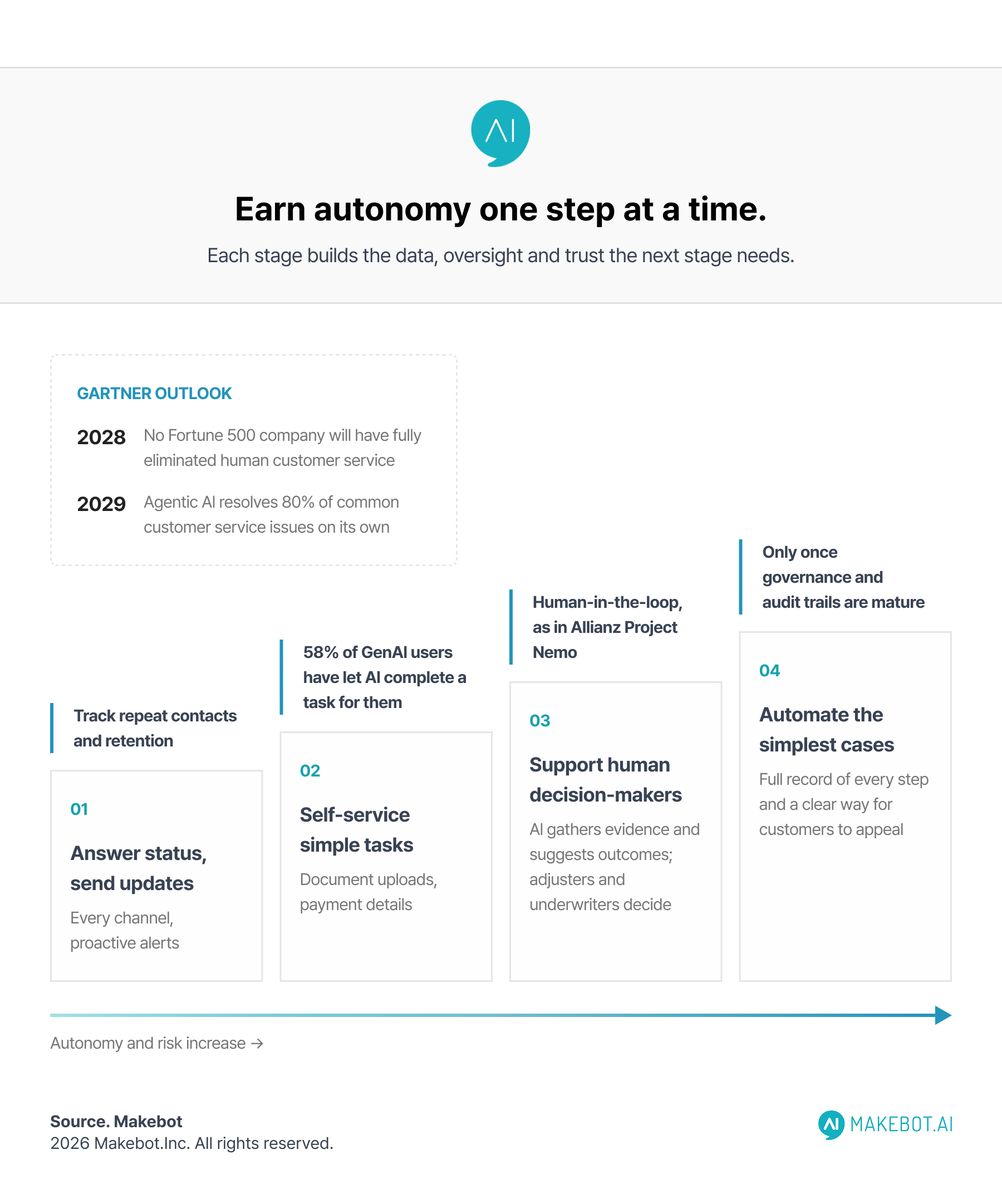
Status work lays the groundwork for an AI Chatbot for insurance or banking that earns the right to do more.
- Answer status questions and send updates. Cover every channel and track repeat contacts and retention.
- Let customers handle simple tasks themselves, such as uploading documents or updating payment details. Gartner found that 58% of customers who use generative AI have already used it to complete a task for them.
- Support the people who make decisions. Use AI agents in financial services (AI that can carry out multi-step tasks) to gather evidence and suggest outcomes, while adjusters and underwriters make the final call. This mirrors Allianz's human-in-the-loop design.
- Automate only the simplest cases, with a record of every step and a way for customers to appeal.
Gartner predicts that by 2029, agentic AI will resolve 80% of common customer service issues on its own. Gartner also predicts that no Fortune 500 company will have fully eliminated human customer service by 2028.
Conclusion
The banks and insurers that win with customer-facing AI will first build the data connections, oversight and customer trust that make bigger decisions safe to automate later. Starting with status does exactly that. It cleans up data, builds handoff habits and gives customers a reason to trust the assistant before it touches a payout. The gap between the 6% of top performers and everyone else will likely grow. For most insurers and banks, closing it should start with the claim status page.
Makebot’s AI Strategic Whitepaper Vol.02, From Scattered AI to a Single Core: CX·EX Innovation with a Unified Intelligence Core, lays out the operating model behind this approach. It argues that the AI performance gap comes from the operating model rather than the model itself, and that Human-in-the-Loop should be the standard way AI work is executed, not an exception. AI proposes, and people approve at clear control points, with every action recorded for audit. For insurers and banks deciding how far to trust customer-facing AI, download the whitepaper for a practical framework for managed autonomy.
Start Where the Trust Is
Insurers and banks are increasing AI spending faster than any other business function, yet only 24% can show positive financial returns. The gap almost always comes down to the same mistake: starting with the highest-stakes decisions before the data connections, governance, and customer trust are in place. The companies pulling ahead begin with what customers actually need most — clear, reliable answers about where their claim or case stands — and build from there. MagicSuite gives financial services teams the AI-powered customer engagement infrastructure to do exactly that: connect to live data, resolve the questions that come up constantly, and earn the right to automate more over time.

























What Happens to Marketing When the C-Suite Starts Using AI Every Day?






Why AI Shopping Assistants Will Replace Traditional Ecommerce Search
































Why Generative AI Projects Fail and How to Achieve Scalable AI Success






























Interview Feature: Why Companies Are Betting Big on Generative AI