The Returns Dividend: Why AI-Assisted Shoppers Could Be Retail's Most Profitable Holiday Customers
AI shoppers convert 31% more and 68% say they return less. Adobe data on the returns dividend.


Key Takeaways
- AI shopping traffic is small but growing fast. Adobe expects AI-referred visits to U.S. retail sites to rise 130% this holiday season, after a 693% jump in 2025.
- AI shoppers act like better customers. They buy more often, stay longer, and leave less quickly than shoppers from other sources.
- Fewer returns could be the hidden reward. Most AI shoppers say they are less likely to send things back, in a year when U.S. returns were projected to reach $849.9 billion.
- Success depends on how a company works, not how much it spends. Only about 6% of McKinsey survey respondents qualify as AI high performers, and most of them changed how work gets done.
- AI agents that shop for people will raise the stakes. Stores whose product details cannot answer an agent's questions may lose sales before a person ever sees the page.
Introduction
Holiday sales look great until the returns arrive. Returns decide how much of the season's revenue a store actually keeps.
More shoppers now start their holiday research by asking an AI chat tool. PwC found that 29% of U.S. consumers plan to use AI for holiday shopping this year, up from 22% in 2025. Early data suggests these AI shopping assistants bring stores better-informed customers who say they are less likely to return what they buy.
We call this the returns dividend: the extra profit a store keeps when fewer purchases come back.
Why Returns Are Such a Big Problem
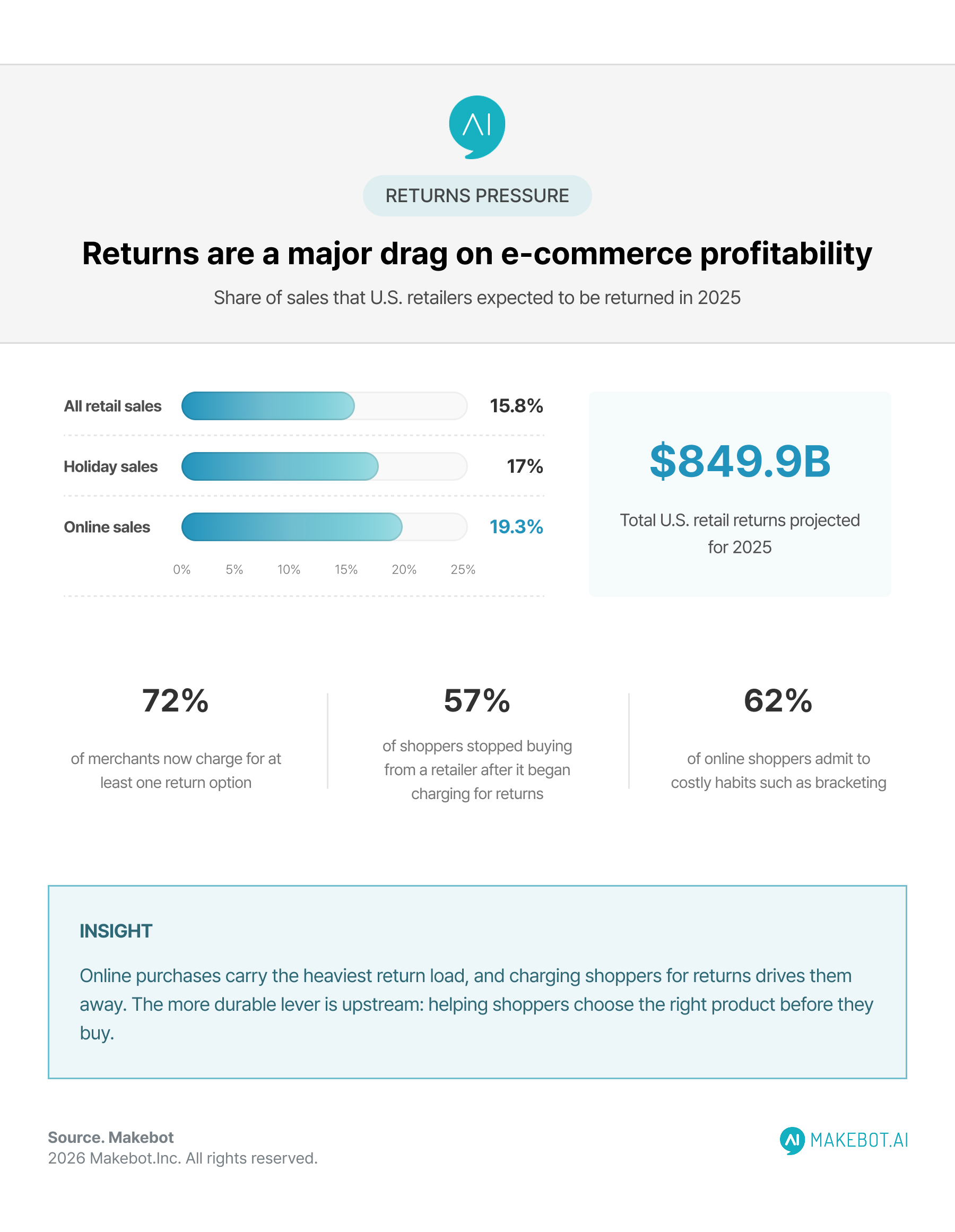
Returns take a large bite out of e-commerce profitability. The NRF and Happy Returns 2025 Retail Returns Landscape estimated that 15.8% of 2025 retail sales would be returned, worth $849.9 billion. E-commerce returns run higher, at an expected 19.3% of online sales, and retailers expected 17% of holiday sales to come back.
Stores feel stuck. 72% of merchants now charge for at least one return option, yet 57% of shoppers say they have stopped shopping with a retailer after it began charging. Meanwhile, 62% of surveyed online shoppers admit to costly habits such as "bracketing" (buying several sizes and returning most). The better fix for e-commerce returns is to help shoppers pick the right item the first time.
What the Data Shows About AI Shoppers
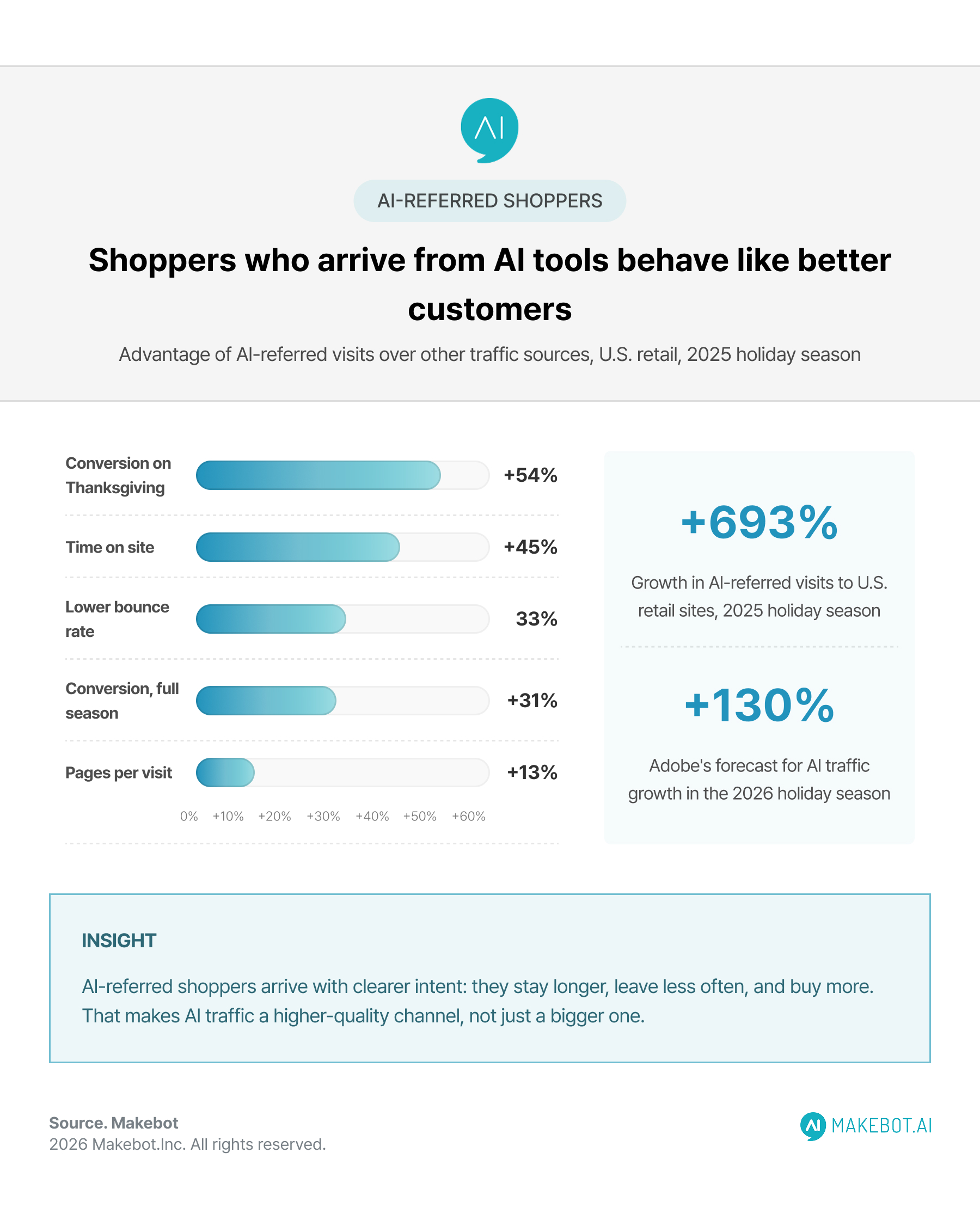
This is where generative AI in retail starts to help. Adobe, whose forecasts draw on over one trillion U.S. retail site visits, tracked shoppers arriving from AI tools in its Quarterly AI Traffic Report (January 2026):
- More visits: AI-referred store visits rose 693% year over year.
- More buying: These visitors converted 31% more than visitors from other sources, and 54% more on Thanksgiving.
- More interest: They had a 33% lower bounce rate, stayed 45% longer, and viewed 13% more pages.
- Fewer planned returns: 68% said they were less likely to return a product bought with AI's help.
Adobe's holiday recap also reported that returns were down 1.2% year over year in the 2025 season. That does not prove AI caused the drop, but it is worth watching.
In a July 2026 Adobe survey of 5,000 consumers, 77% of AI shoppers felt more confident about their purchases and 69% said they were less likely to return an item.
Why AI Shoppers May Return Less
Many returns happen because a product is not what the shopper expected. NRF notes that shoppers often buy the same item in several sizes, colors, or styles because they are unsure. AI product discovery closes that gap before checkout: among AI users, 75% research products and 55% compare prices. Confident shoppers order one size instead of three.
An Important Warning
These figures describe what shoppers say, not what they did, and AI shoppers may simply be more serious buyers. Adobe also notes that the number of AI users is still modest. Test the returns dividend with your own data.
What the Returns Dividend Could Be Worth
The graphics below is a made-up example for this article, not a forecast. It imagines a store with $100 million in online holiday sales.
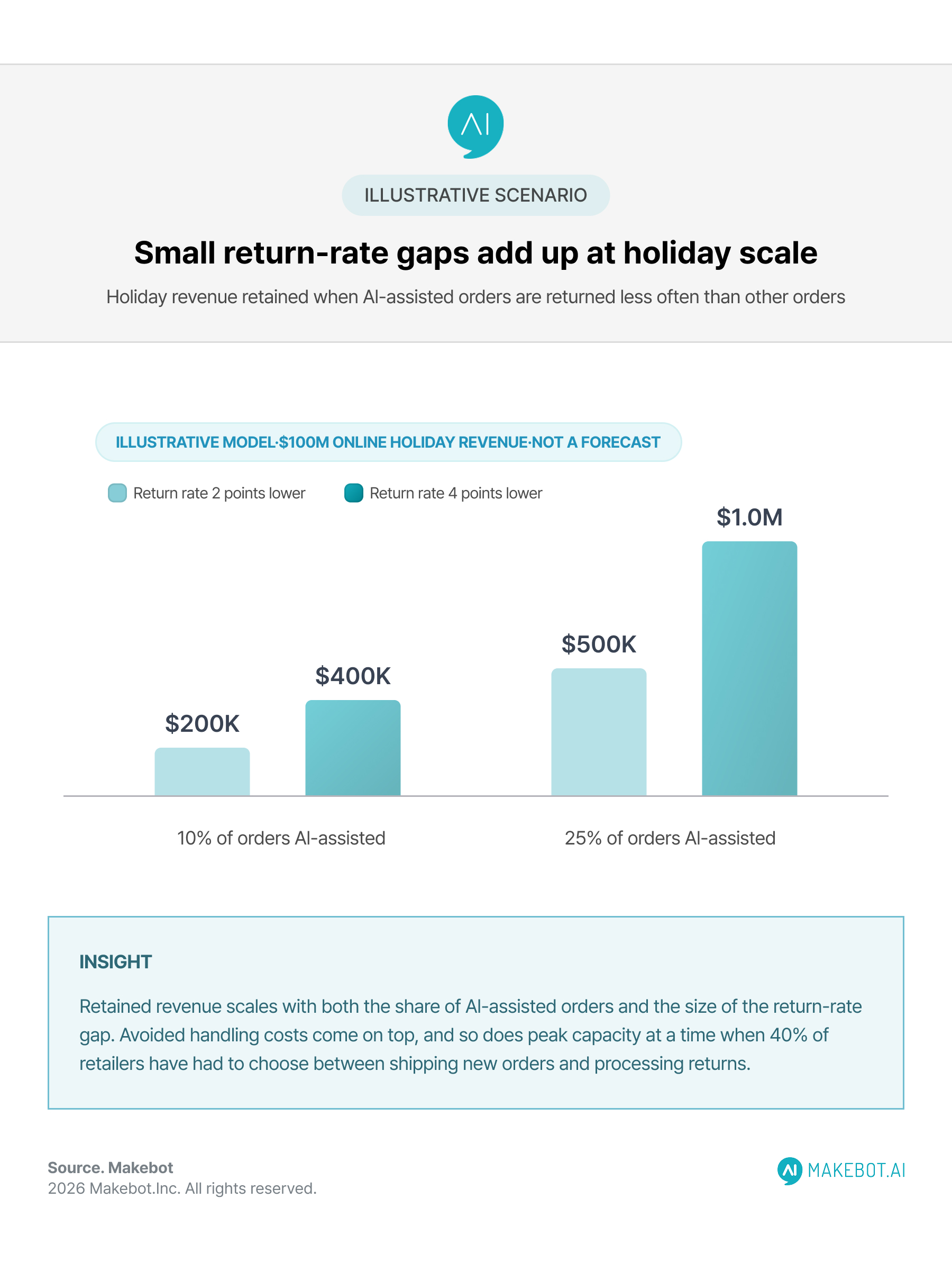
Every avoided return also saves handling costs and customer service calls, and frees capacity at a time when 40% of retailers had to choose between shipping new orders and processing returns in the past year. Add higher conversion, and AI shoppers become a higher-margin customer segment.
Why Most Retailers Will Miss Out
Very few companies get real financial results from AI, and retail is unlikely to be different. McKinsey's The State of AI in 2026: On the Road to ROI, a survey of 1,719 respondents, found that:
- Nearly nine in ten report regular AI use.
- Only 37% report any effect on EBIT (earnings before interest and taxes).
- About 6% qualify as high performers: they credit AI with at least 5% of EBIT and call the impact significant.
Gartner predicts that over 40% of agentic AI projects will be canceled by the end of 2027 because of rising costs, unclear business value, and weak risk controls. ("Agentic" AI is AI that can take actions on its own.)
Technical Problems
- Missing product details: Without sizes and fit notes, AI tools have to guess.
- Return data that goes nowhere: Return reasons rarely reach product pages or AI-powered product recommendations.
- No tracking by source: Few stores compare return rates by where shoppers came from.
People and Process Problems
McKinsey finds that high performers stand out more for how they use AI than for how much they spend. Nearly three-quarters of AI high performers have fundamentally redesigned workflows around AI, compared with about one-quarter of other companies.
What the company does
AI high performers compared with everyone else
Redesigned how work gets done
Nearly three-quarters vs. about one-quarter
Plans to transform the business with AI within three years
3.3 times more likely
Senior leaders own AI initiatives
2 times more likely
Has a clear process to measure AI results
2 times more likely
Source: McKinsey, The State of AI in 2026
Adding an AI chatbot for e-commerce to an unchanged website is unlikely to lower returns. Rethinking the path from discovery to returns, with one owner, can.
Getting Ready for AI Agents That Shop for People
Today, AI mostly advises and people still buy. PwC found that 64% of consumers using AI for gift ideas still go to a website to buy, and only 4% expect to buy gifts through AI tools.
That will change. In agentic commerce, AI agents search, compare, and buy for a person. McKinsey estimates it could handle $900 billion to $1 trillion in U.S. B2C retail sales by 2030, and names returns among the areas retailers must rebuild.
Once AI shopping agents buy for people, they will favor stores whose products match their descriptions. Retail AI that lowers returns will then also shape which stores get recommended.
Steps to take this season:
- Measure first. Track return rates for AI-referred visits separately.
- Fix product information. Stores fighting bracketing already add more sizing information (41%) and sizing tools such as AI fit tools (36%). Make that data structured so agents can read it.
- Use return reasons. Feed them into AI-powered product recommendations.
- Help where shoppers hesitate. Answering questions at the moment of hesitation can save a sale, so place an AI chatbot for e-commerce or guided AI product discovery on high-return pages such as clothing.
Conclusion
Most talk about generative AI in retail this season is about traffic. The bigger story may be what happens after the purchase. The 2025 season already saw returns drop 1.2% as AI traffic jumped.
But only about one-quarter of companies outside McKinsey's top group have redesigned their work around AI. Retailers that link discovery, product data, and returns into one measurable system can capture the returns dividend. As agentic commerce grows, the stores that sell the right product the first time will also be the stores AI shopping agents recommend.
Most marketing teams are producing more content with AI. The ones pulling ahead have done something harder: they rebuilt how their entire content operation works.
Only 6% of organizations are achieving transformative AI returns in marketing, and the gap comes down to one thing: workflow design, not tool access. Brands using GenAI extensively across their full content pipeline exceeded revenue goals by 22% on average. Those running AI as an individual shortcut are capturing a fraction of that value.
MagicSuite gives your team the AI-powered content infrastructure to move from isolated tasks to an integrated production system: faster content, sharper personalization, stronger campaign performance, and the measurement frameworks that turn every iteration into organizational learning. Built for teams that are serious about being on the right side of that 6%.
See how MagicSuite powers high-performing content teams
Makebot’s AI Strategic Whitepaper Vol.02, From Scattered AI to a Single Core: CX·EX Innovation with a Unified Intelligence Core, builds out this argument for the whole enterprise. It shows why AI results depend on the operating model around the technology, and why Human-in-the-Loop should be the standard way AI work is executed: AI proposes, and people approve at clear control points. It also explains how one Unified Intelligence Core connects customer and employee experience in a single flow. For retailers preparing for AI shopping agents, download the whitepaper for a practical guide to scaling AI without losing control.
























What Happens to Marketing When the C-Suite Starts Using AI Every Day?






Why AI Shopping Assistants Will Replace Traditional Ecommerce Search
































Why Generative AI Projects Fail and How to Achieve Scalable AI Success
































Interview Feature: Why Companies Are Betting Big on Generative AI