How a 24/7 Hospital Callbot Can Handle Reservations, Changes and Cancellations at Peak Hours
How an AI hospital callbot handles bookings, changes and cancellations at peak hours.


Key Takeaways
- When the phones get busy, the problem is not only a shortage of staff. Simple tasks like booking, moving and canceling appointments eat up the time. In one poll, 31% of practice leaders said scheduling is the phone task that takes their staff the most time. An AI hospital callbot can take over much of this work.
- Patients often reach out when the office is closed. In a peer-reviewed Mayo Clinic study, almost 4 out of 10 scheduling responses came at night or on weekends.
- Half of surveyed US healthcare organizations now use generative AI, and 82% of the leaders surveyed expect it to pay off.
- Across all industries, though, only 37% of survey respondents say AI has added anything to their operating profit. The small group that does well redesigns its work around AI.
- Canceled appointments hide lost revenue. A callbot that quickly offers an open slot to patients on a waitlist can turn an empty slot into a real visit.
Introduction
It is 8:30 on a Monday morning, and every phone line at a hospital's scheduling desk lights up at once. Callers want to move follow-up visits or cancel procedures without waiting on hold. When a caller gives up and hangs up, a slot may stay empty, care gets delayed, and staff are pulled away from the patients in front of them.
This is the problem hospital call center automation is meant to solve. A 24/7 AI hospital callbot is a program that answers calls and talks with patients in normal speech. It handles many calls at once, books or moves appointments directly in the scheduling system, and offers canceled slots to other patients.
Why the Phones Get Overwhelmed at Busy Times
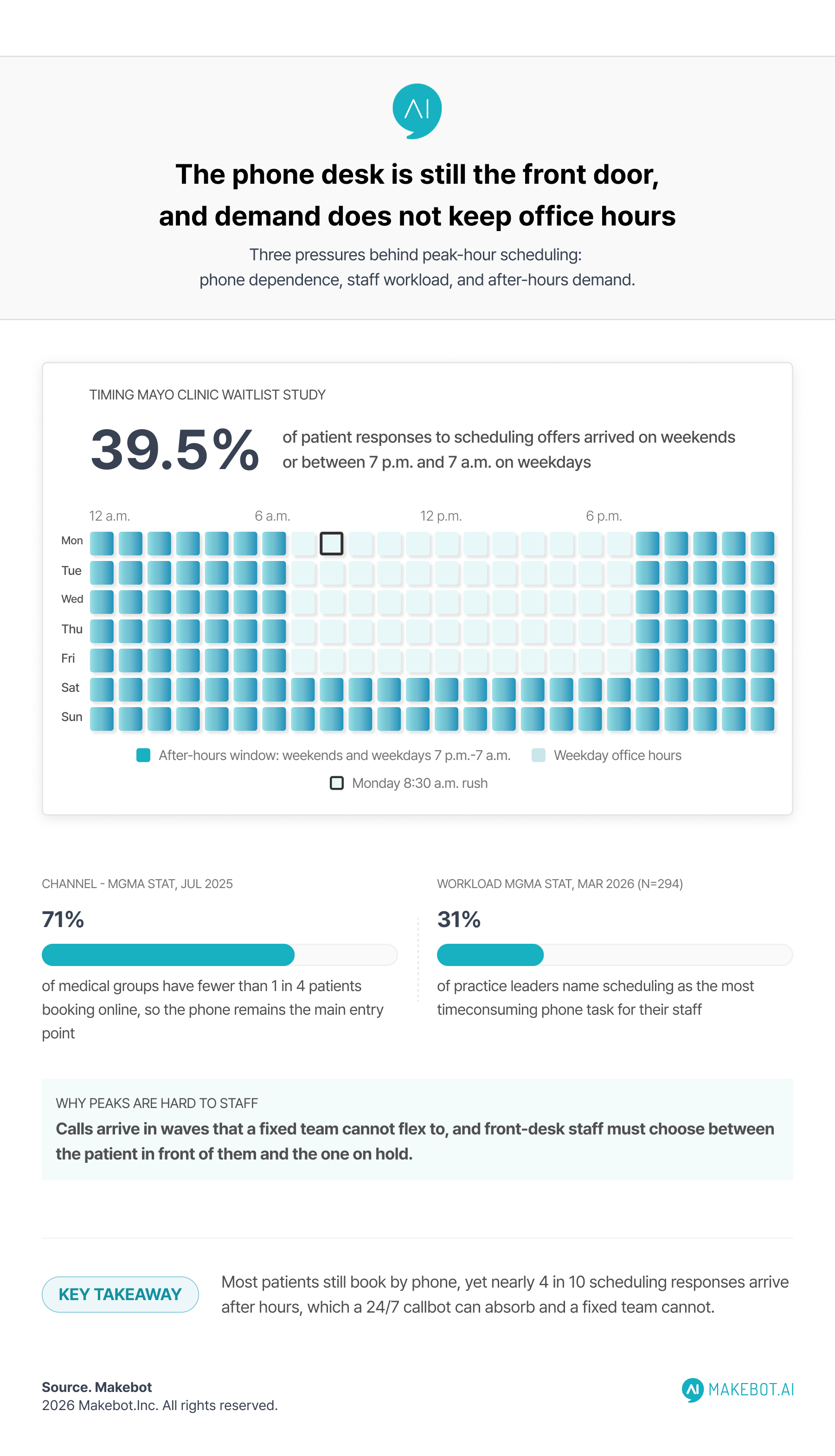
Many patients still pick up the phone, which makes it the main entry point for hospital appointment scheduling. A July 2025 MGMA Stat poll found that 71% of medical groups have fewer than one in four patients using online tools to book appointments. In a March 2026 poll of 294 practice leaders, 31% said scheduling is the most time-consuming phone task for their staff.
Three things make busy hours especially hard:
- Patients need help outside office hours. In a Mayo Clinic study, 39.5% of patient responses to scheduling offers came on weekends or between 7 p.m. and 7 a.m. on weekdays.
- Calls come in waves. Some practices are adding staff during peak times to reduce hold times and dropped calls, but fixed teams cannot flex as fast as call volume.
- Phone work competes with in-person work. Front-desk staff must choose whether to serve the patient in front of them, or the patient on hold.
The after-hours point is the strongest reason for 24/7 AI patient support. Without it, those requests simply wait until the phones open again.
How a Callbot Books, Changes and Cancels Appointments
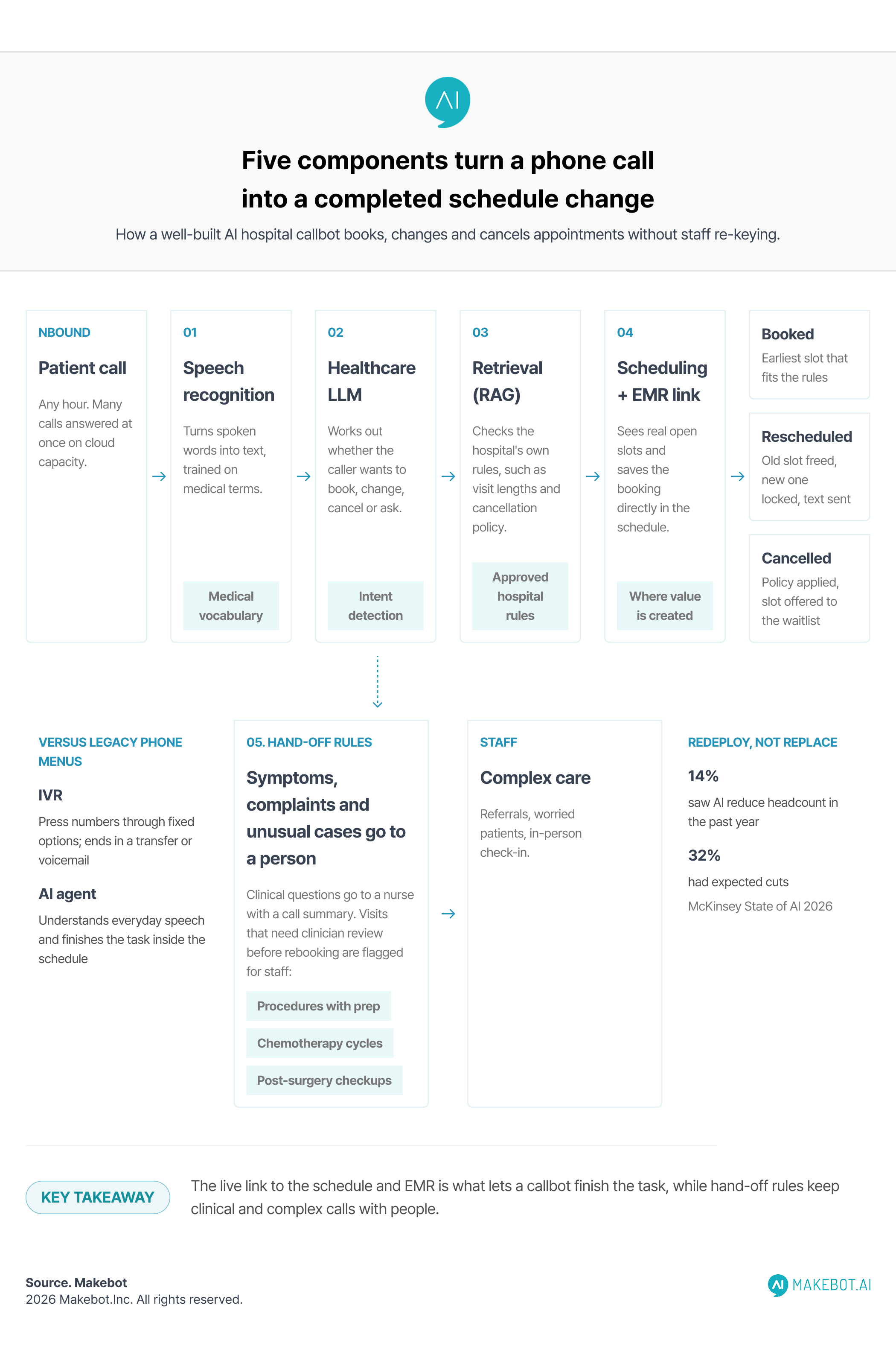
Older phone menus (IVR) make callers press numbers through fixed options. Modern healthcare AI voice agents understand everyday speech and finish the task inside the hospital's systems. A well-built callbot has five parts:
- Speech recognition turns spoken words into text and is trained on medical terms.
- A healthcare LLM (large language model) works out whether the caller wants to book, change, cancel or ask a question.
- Retrieval-augmented generation (RAG) makes the AI look up the hospital's own rules, such as visit lengths and cancellation policy, before it answers.
- A connection to the scheduling system and EMR (electronic medical record) lets the callbot see real open slots and save bookings.
- Hand-off rules send calls about symptoms, complaints or unusual cases to a person, with a short summary.
With cloud capacity, a callbot can answer many calls at once, which clears the 8:30 a.m. rush.
Booking New Appointments
The callbot confirms who the patient is, matches the request to the right visit type and offers the earliest slots that follow the rules. This matters because MGMA's March 2026 poll found that complicated rules and unclear visit types are major reasons scheduling calls run long. A good AI appointment scheduling system applies those rules the same way every time.
Changing Appointments
Rescheduling is the trickiest request, because one slot must be freed and another locked in. A connected callbot does both at once and sends a text confirmation.
Cancellations and Filling Open Slots
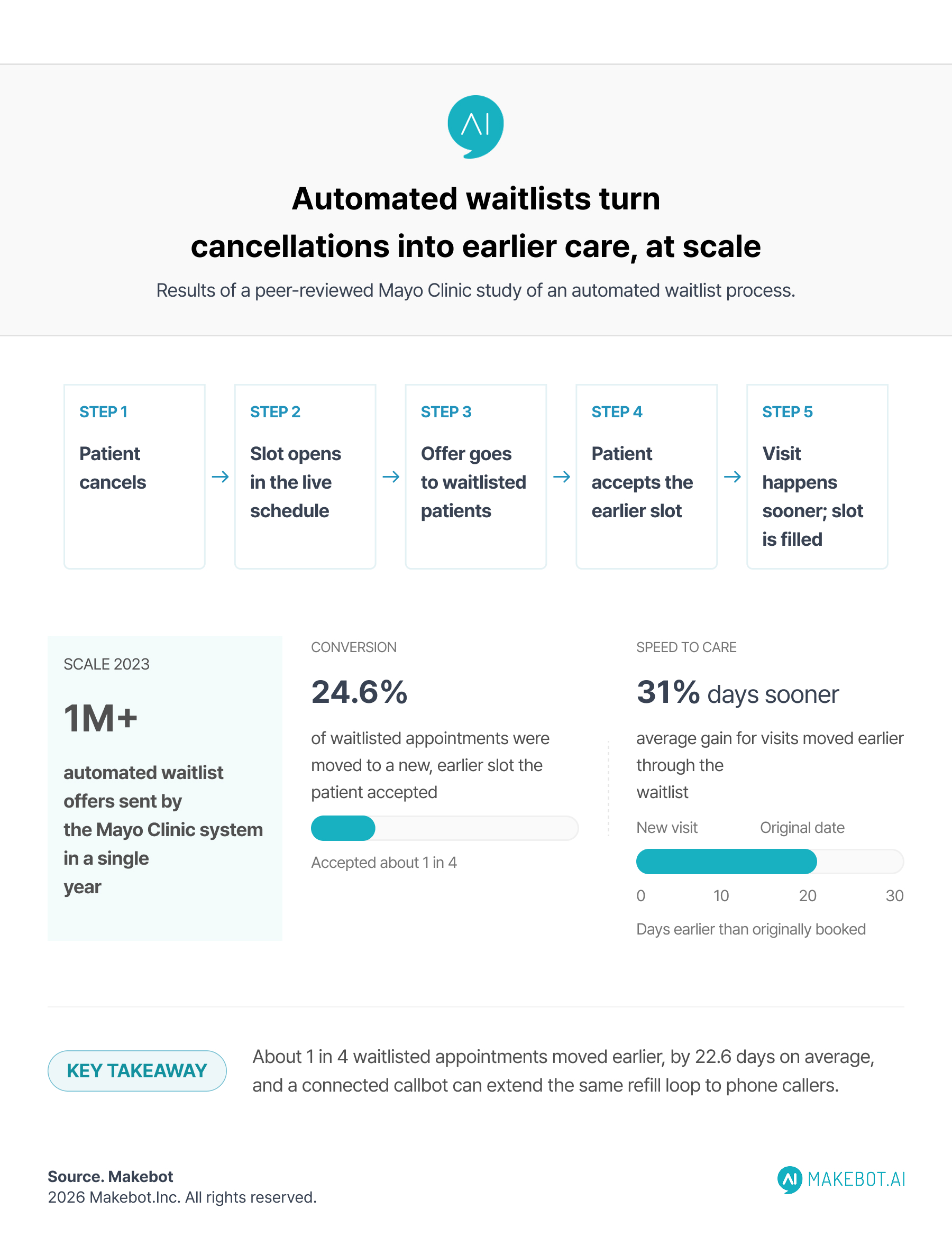
Cancellations are where hospital appointment automation quietly adds value, because the open slot can go straight to patients on a waitlist. In a peer-reviewed Mayo Clinic study of an automated waitlist, the system sent more than one million offers in 2023. Patients accepted a new appointment for 24.6% of waitlisted appointments, and visits moved earlier happened an average of 22.6 days sooner. A callbot can bring the same idea to patients who prefer phone calls.
What the Research Says About Results
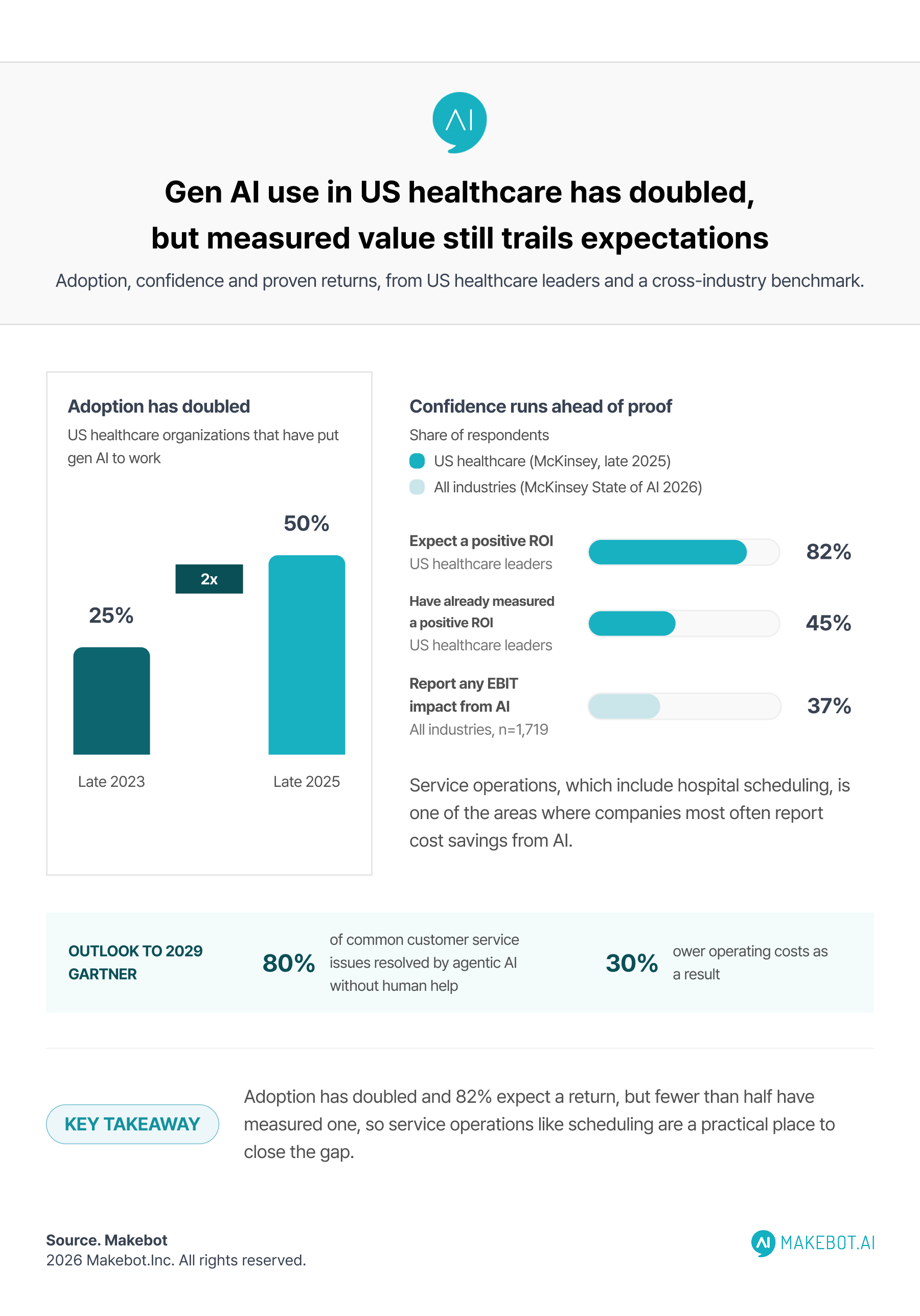
Generative AI in healthcare (AI that can create text, speech or other content) is now common. McKinsey's late-2025 survey of US healthcare leaders found that half of the organizations surveyed have put gen AI to work, up from 25% in late 2023. Leaders are also more confident about return on investment (ROI): 82% expect a positive ROI, and 45% have already measured one.
Across all industries, McKinsey's State of AI 2026 survey of 1,719 people found that:
- Only 37% say AI has added anything to their operating profit (known as EBIT).
- Service operations is one of the areas where companies most often report cost savings from AI.
Hospital scheduling is a service operation. Gartner predicts that by 2029, agentic AI will solve 80% of common customer service issues without human help, leading to a 30% drop in operating costs. Agentic AI is AI that can take actions to finish a task, not just answer questions.
For a hospital CIO, the results show up in three places: lower staff time and overtime, protected revenue from fewer hang-ups and refilled slots, and faster service for patients at any hour.
Why Some Hospitals Get Results and Others Do Not
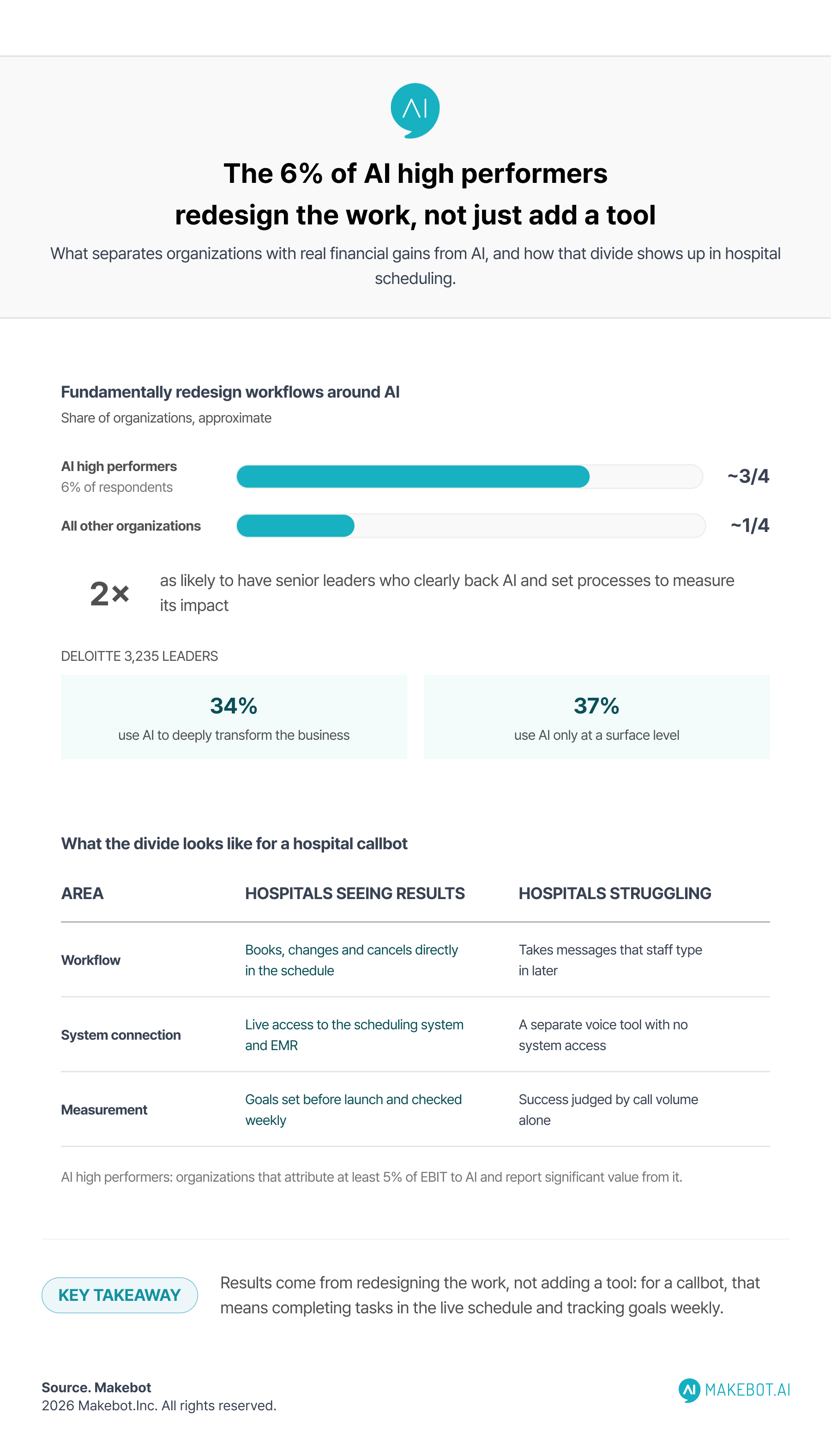
Many organizations use AI, but few see real financial gains. McKinsey calls the leaders AI high performers: organizations that say at least 5% of their EBIT comes from AI and that AI has delivered significant value. They make up only 6% of respondents, and they:
- Completely redesign how work gets done around AI. Nearly three-quarters do this, compared with one-quarter of other organizations.
- Are twice as likely to have senior leaders who clearly back AI and set processes to measure its impact.
Deloitte's State of AI in the Enterprise 2026, based on 3,235 leaders, shows the same divide. About 34% of organizations are using AI to deeply transform their business, while 37% use AI only at a surface level.
Common Challenges and How to Handle Them
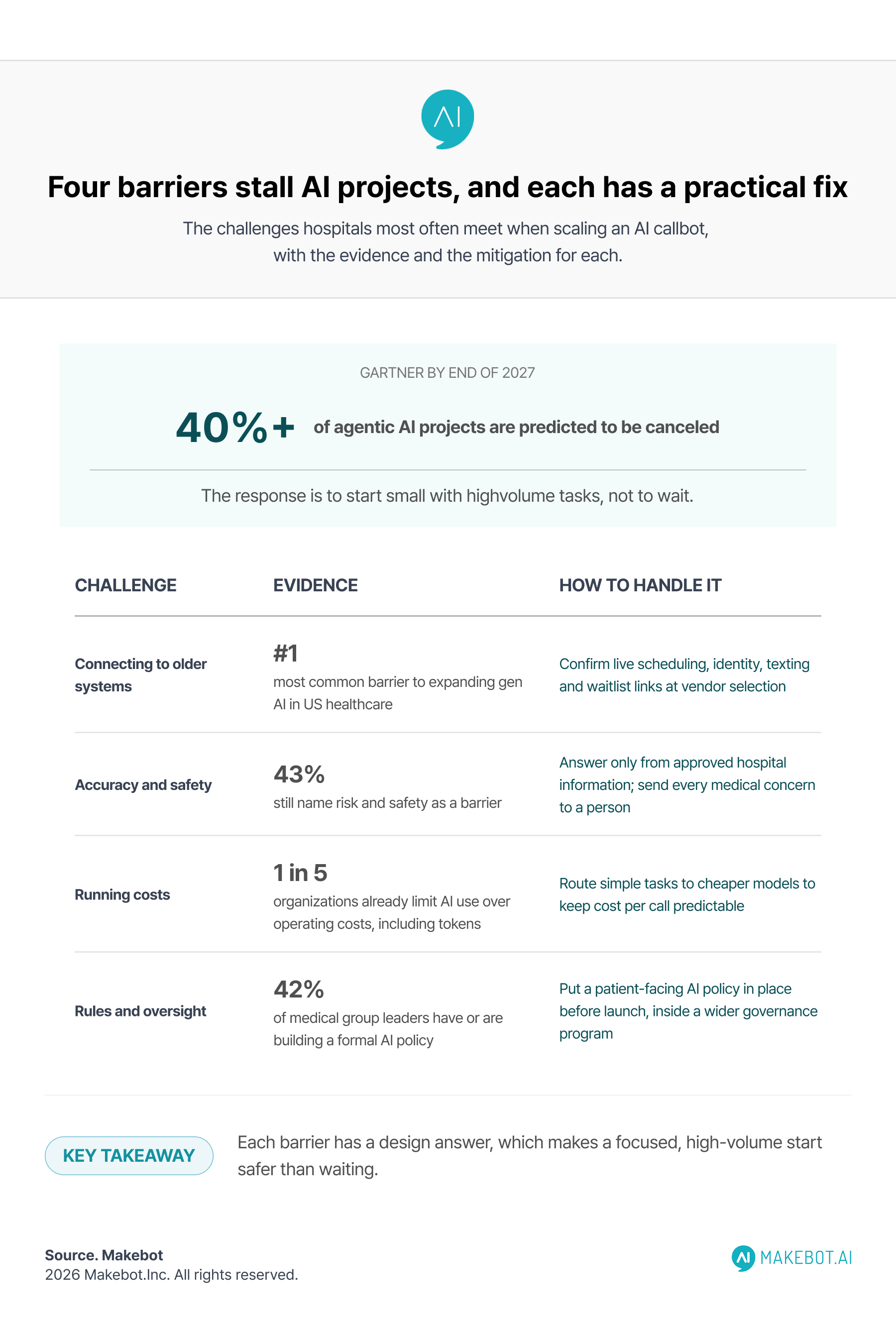
McKinsey's latest US healthcare survey found that connecting AI to existing systems was the most common barrier to expanding gen AI and risk and safety were still named by 43% of respondents. Gartner also predicts that more than 40% of agentic AI projects will be canceled by the end of 2027.
Four challenges come up most often:
- Connecting to older systems. MGMA notes that gaps in EHR connections and outdated scheduling platforms often get in the way.
- Accuracy and safety. Answers should come only from approved hospital information, and any medical concern should go to a person.
- Running costs. McKinsey found that one in five organizations already limit AI use because of operating costs, including tokens. Sending simple tasks to cheaper models keeps the cost per call predictable.
- Rules and oversight. A January 2026 MGMA Stat poll found 42% of medical group leaders have, or are building, a formal AI policy. Any AI that talks to patients needs one before launch as part of a wider healthcare AI governance program.
These are reasons to start small with high-volume tasks, not to wait, whether the tool is a voice callbot or an AI chatbot in healthcare used through a patient portal.
How to Roll It Out and Measure Success
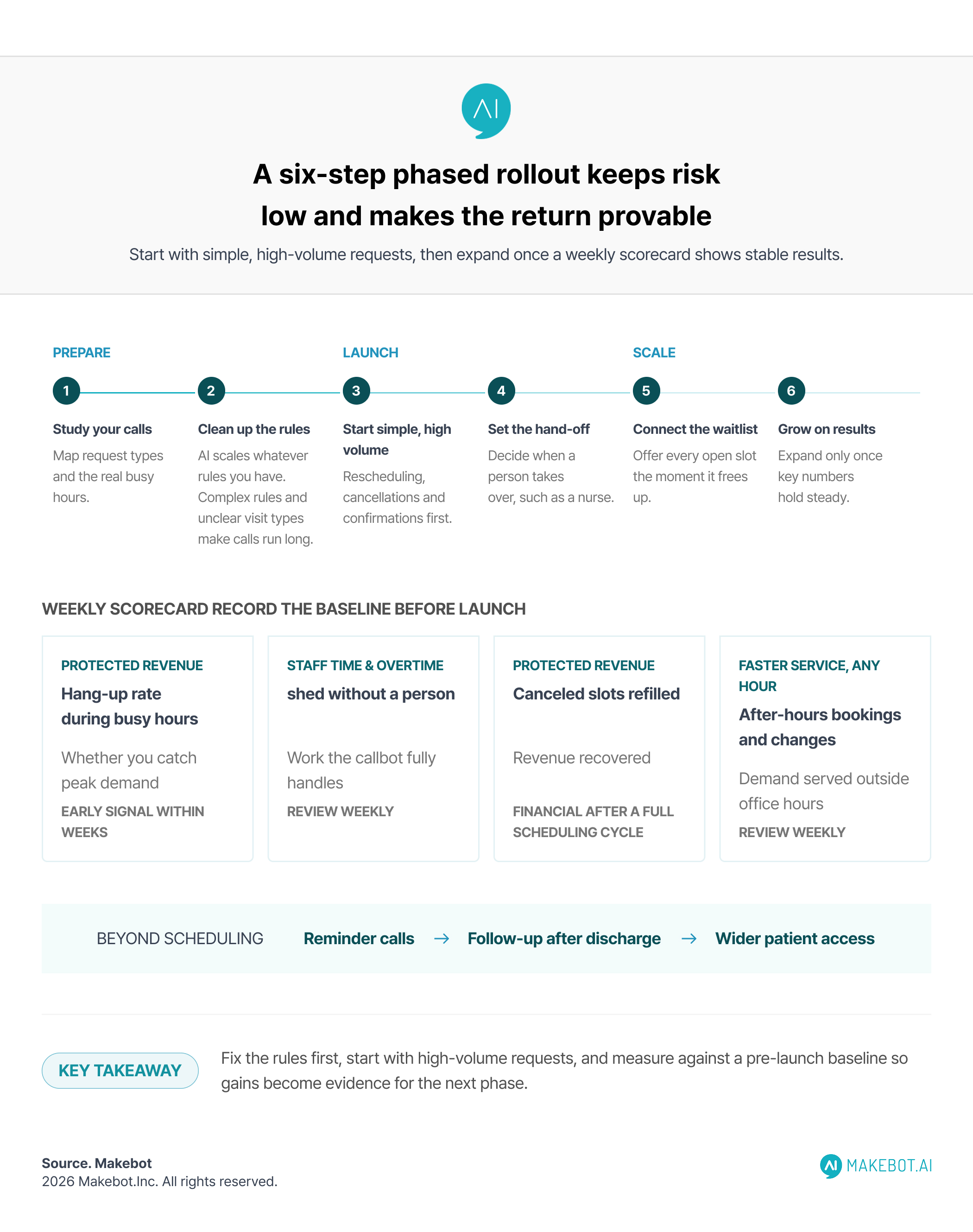
A phased rollout, which means starting small and growing in steps, keeps risk low:
- Study your calls to see request types and real busy hours.
- Clean up the rules first. As MGMA explains, AI scales up whatever rules you have, clear or messy.
- Start with simple, high-volume requests such as rescheduling, cancellations and confirmations.
- Decide when a person takes over, such as a nurse for clinical questions.
- Connect the waitlist so every open slot is offered right away.
- Grow based on results once key numbers hold steady.
Record starting numbers before launch and review them weekly:






















What Happens to Marketing When the C-Suite Starts Using AI Every Day?







Why AI Shopping Assistants Will Replace Traditional Ecommerce Search
































Why Generative AI Projects Fail and How to Achieve Scalable AI Success
































Interview Feature: Why Companies Are Betting Big on Generative AI