UCP, ACP, or AP2? The Agentic Commerce Protocol Decision Retailers Cannot Postpone Any Longer
UCP, ACP, AP2: three protocols in four months targeting $3T to $5T in agentic commerce by 2030.


Introduction
Three companies rarely release three competing commerce systems within just four months, but that is exactly what happened between September 2025 and January 2026. OpenAI and Stripe launched the Agentic Commerce Protocol (ACP). Google answered with the Agent Payments Protocol (AP2), then followed with the Universal Commerce Protocol (UCP), built with Shopify, Target, Walmart, and Etsy. Each one lets AI shopping agents search, compare, and buy on a shopper's behalf. The real question for retail teams is no longer whether AI agents in e-commerce are coming: the data from Adobe, Deloitte, and McKinsey confirms they already are. The real question is which system, or mix of systems, deserves investment first. This article covers what UCP, ACP, and AP2 do, why AI spending still fails to pay off, and how retailers can choose without betting on the wrong standard.
Why Three Different Systems Showed Up at Once
Agentic commerce did not come from one company's plan. It grew out of three companies racing to control the moment a shopper actually pays. OpenAI and Stripe released ACP on September 29, 2025, free under an Apache 2.0 license, launching with a new "Instant Checkout" button inside ChatGPT, Etsy, and a few Shopify stores.
Eighteen days earlier, Google had already released AP2, built with more than 60 partners including Mastercard, American Express, PayPal, and Coinbase, to prove payments are real and approved. Google finished its lineup on January 11, 2026, when Sundar Pichai introduced UCP at a major retail conference, with the full technical rundown published the same day. UCP was built with Shopify, Etsy, Wayfair, Target, and Walmart, and more than 20 other retailers and payment companies now support it.
ACP handles the checkout step: cart construction, payment terms, and passing a payment token (a stand-in for your card number) from agent to store, according to the official ACP specification. AP2 sits underneath both, proving with a digitally signed "mandate" that a real person approved the purchase. UCP is the biggest of the three, covering the entire shopping trip and built to work with AP2 for agentic payments, plus the Model Context Protocol and Agent2Agent Protocol, which let AI programs talk to each other. Meta has also joined ACP's leadership alongside OpenAI and Stripe, a sign this is a multi-player race, not winner-take-all.
Comparing the Three Systems
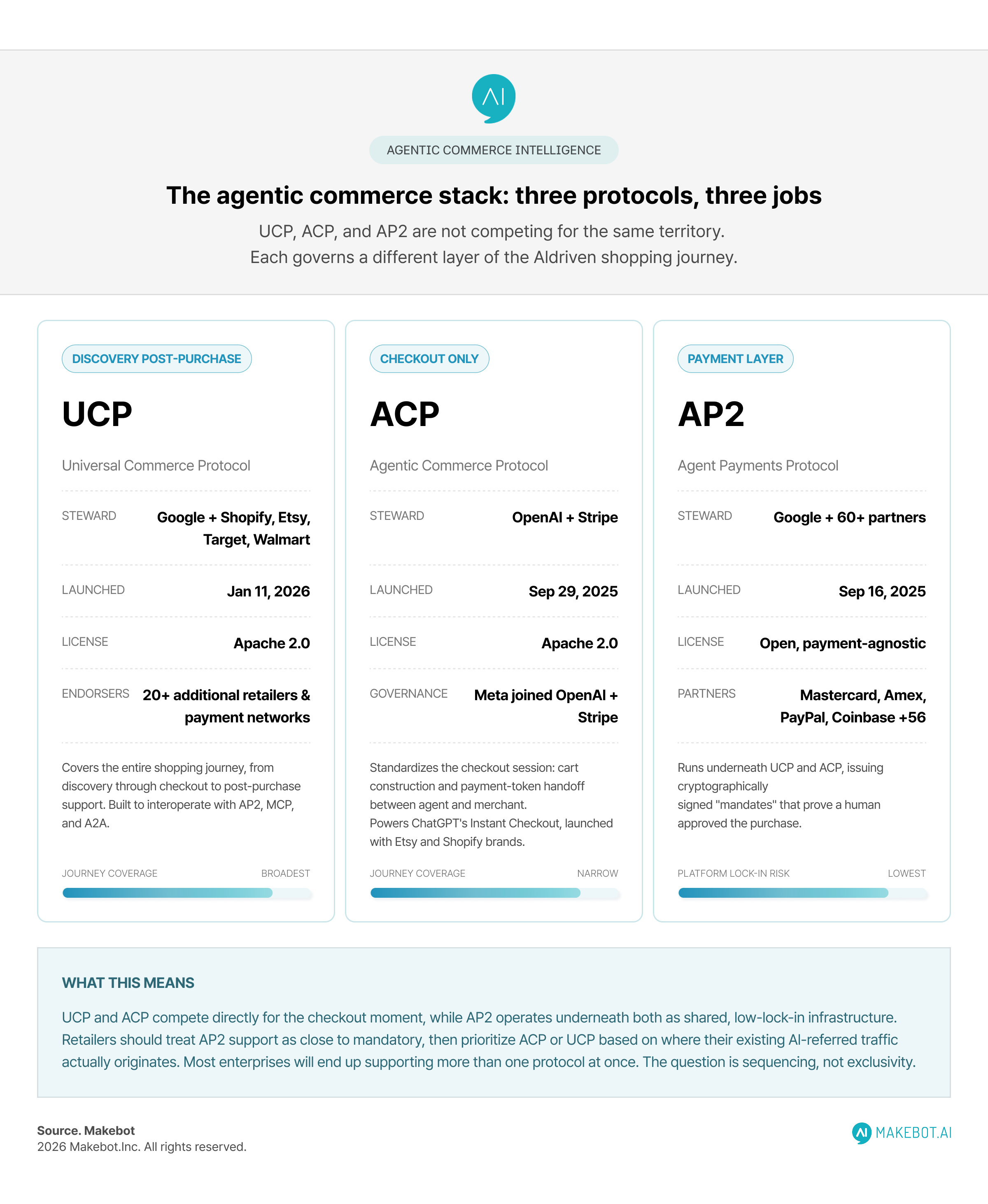
UCP and ACP fight for the same job, checkout, while AP2 stays out of it, acting like plumbing that both sides can use, the safest bet, since it does not tie you to one platform. Choosing between them is riskier: UCP pulls a retailer toward Google's search and Gemini tools, ACP toward ChatGPT's shopping tools and Stripe's payment system.
Why So Much Money Spent on AI Is Not Paying Off
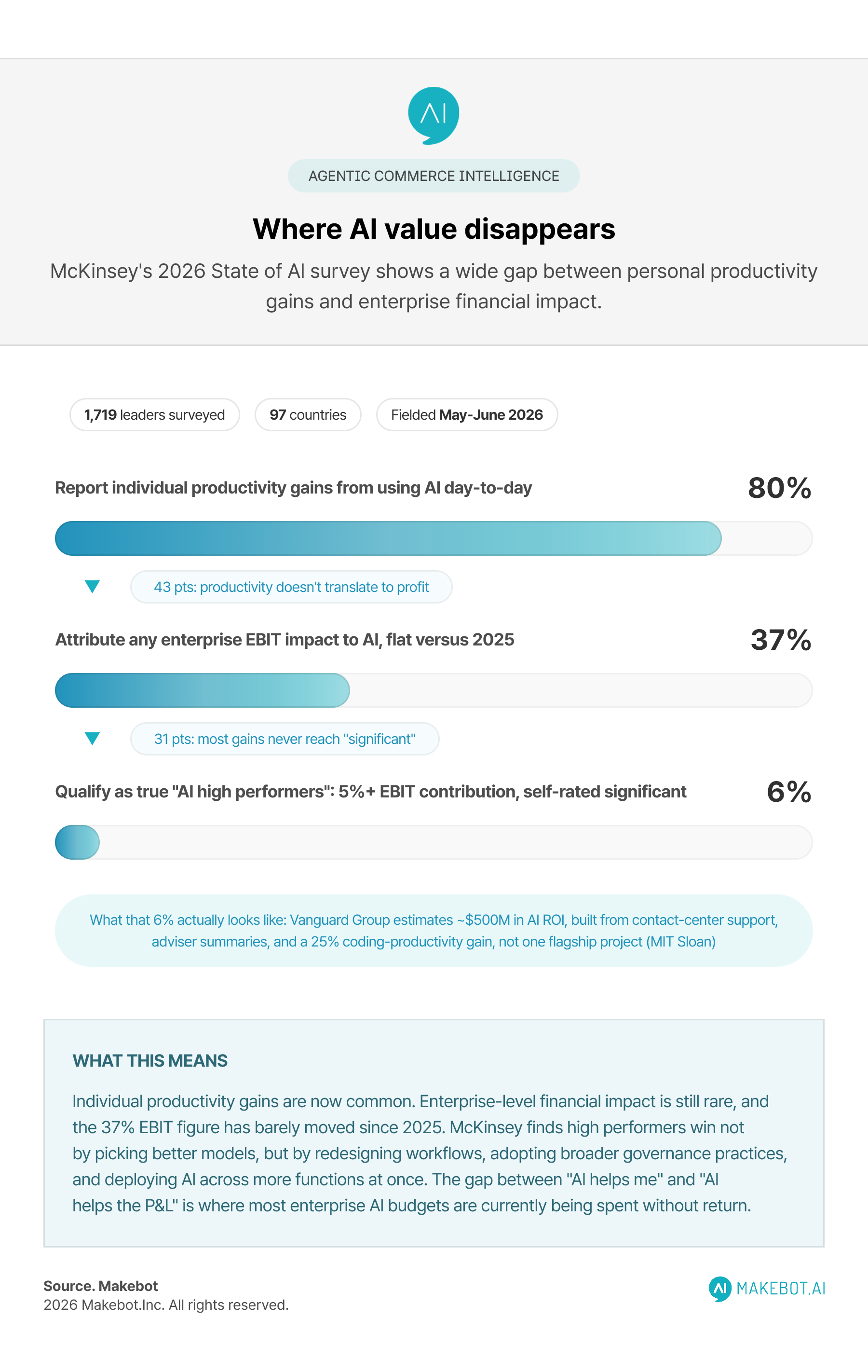
Before adding another system, consider how weak AI's payoff has been so far. McKinsey's 2026 survey of 1,719 leaders across 97 countries found 80% report individual productivity gains from AI. But only 37% say AI has added to company profits, almost unchanged from last year, and just 6% hit McKinsey's bar for "AI winners": at least 5% of profit boost from AI, rated significant.
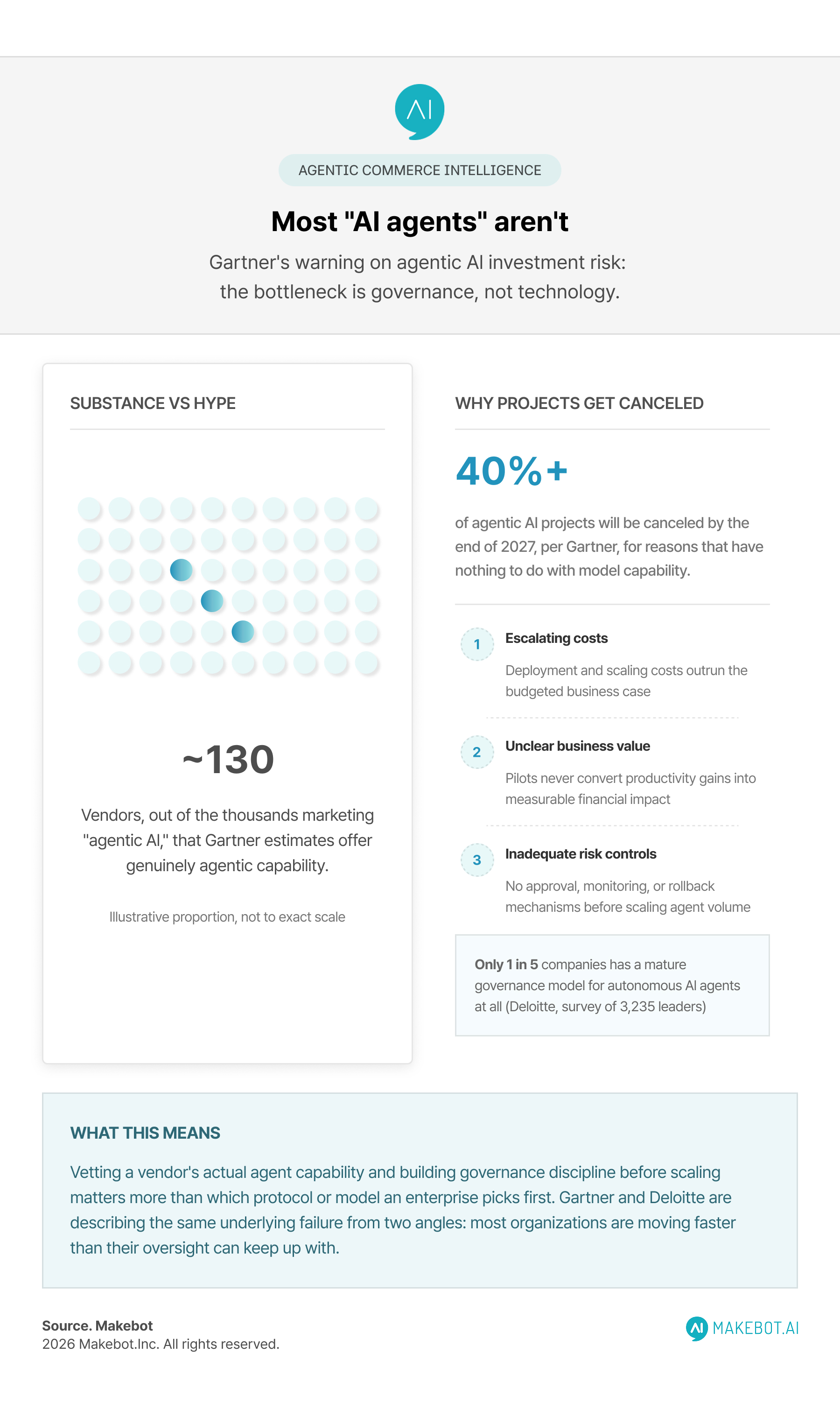
The same pattern shows up in AI agents specifically. Gartner's June 2025 report predicts more than 40% of AI agent projects will be canceled by the end of 2027, over rising costs, unclear payoff, and weak oversight, not the technology failing. Of the thousands of companies calling their products "AI agents," Gartner says only about 130 companies offer real agent capabilities: the rest is "agent washing," an AI label on an old chatbot. For retailers evaluating generative AI in e-commerce tools, telling the real thing apart from a rebranded chatbot is now essential.
What Separates the Winners From Everyone Else
The gap between AI spending and payoff is about people and process, not technology. McKinsey found top performers do not simply pick the better models: they rebuild their workflows, set up more risk rules, and use AI across many parts of the business rather than one small test. MIT Sloan's research backs this up: Vanguard Group gained close to $500 million in AI value, not from one flagship project but from smaller wins: faster call-center answers, AI-written adviser summaries, and programmers working 25% faster. Payoff builds slowly and steadily across many small changes, not from one big pilot project.
- Managing risk matters more than picking the best model. Deloitte's 2026 report on AI in business surveyed 3,235 leaders and found only one in five has solid rules for managing AI agents.
- Careful spenders do better. In Deloitte's retail survey, about half of companies spend under 0.5% of revenue on AI despite calling it a top priority, yet 82% plan to spend more next year.
- Using AI across the business beats one small test. McKinsey's winners deploy AI across more teams and tasks instead of a single department.
- Messy data is the real problem, not weak AI. Across several studies, leaders cite disorganized data as the top reason AI agents fail to scale.
These three problems (weak risk management, low spending discipline, messy data) will decide which retailers get value from commerce AI agents, whichever system they pick.
Shoppers Are Ready Faster Than Retailers Are
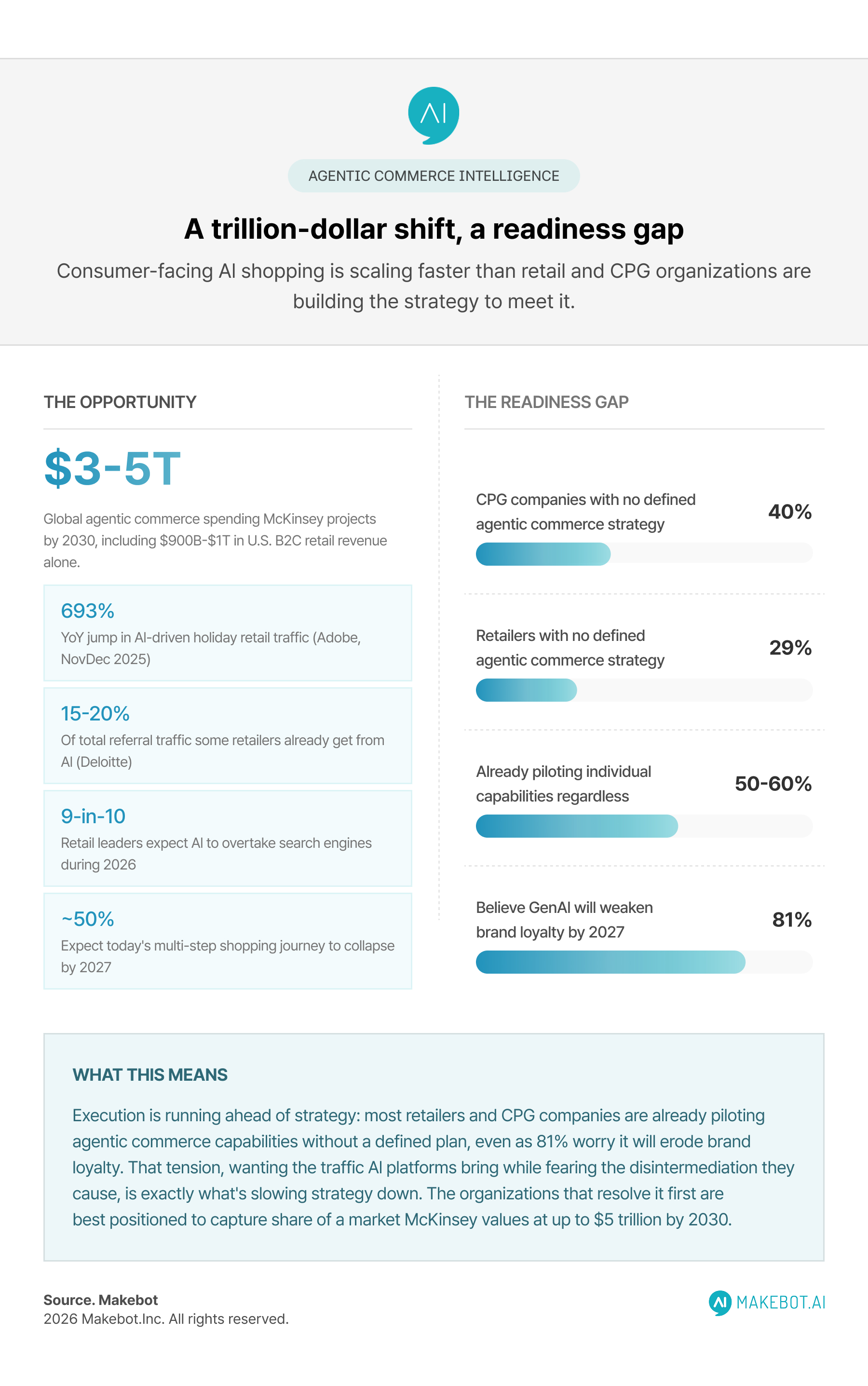
Retail leaders can see this shift coming, even if their companies are not ready. Deloitte's 2026 Retail Industry Global Outlook found nine in ten retail leaders expect AI to overtake traditional search during 2026, and about half expect today's multi-step shopping process to shrink into one AI conversation by 2027. The numbers back this up: Adobe measured a 693% jump in AI-driven traffic to U.S. retail sites during the November–December 2025 holiday season, the biggest increase Adobe tracks, November alone up 769%. Deloitte separately reports AI now sends 15% to 20% of all traffic for some retailers.
Planning has not caught up. Deloitte's survey of 200 retail and consumer goods leaders found 29% of retailers and 40% of consumer goods companies still have no real plan for agentic commerce, even though 50% to 60% are already testing pieces of it: this is execution running ahead of strategy. There is also a real worry underneath this: 81% of retail leaders surveyed believe generative AI will weaken brand loyalty by 2027, because an AI middleman now stands between retailer and customer. Wanting the traffic AI platforms bring while fearing the disintermediation is exactly the tension behind every UCP-versus-ACP-versus-AP2 decision this year.
How to Pick a Plan Without Betting Everything on One System
No single system has won, and each is backed by a different tech giant, so betting on just one is its own risk. A safer approach treats this as layered, not either-or.
- Treat AP2 as close to a must-have. It only handles payment approval rather than competing for the whole checkout, so adding it does not lock you into one company, and it already covers major card networks like Mastercard, American Express, and PayPal.
- Test ACP if ChatGPT already sends real traffic. Retailers already getting shoppers from OpenAI's ecosystem see the fastest ACP payoff, especially given Stripe's existing payment tools.
- Look at UCP if Google Search and Shopping drive your traffic. Since UCP connects to AI Mode and Gemini, it suits stores whose customers already find them through Google, and its wider scope may make it the more lasting choice long term.
- Fix your product data before picking a system. Every protocol depends on clean listings, accurate stock, and clear pricing. Messy data holds back any system.
- Set up oversight before scaling up. Since Gartner points to weak oversight, not bad technology, as the top reason projects get canceled, build approval and monitoring before scaling agent-driven checkout.
Conclusion
Against the bigger picture, the UCP-versus-ACP-versus-AP2 debate can look like a small detail. But AI-powered commerce is moving from test projects to infrastructure faster than most retailers' rules and data can keep up. These three systems will likely blend together within the next two or three years. AP2's design as an add-on layer already hints at that direction. What will not wait is how fast shoppers are changing habits, and McKinsey expects a multi-trillion-dollar shift in how people find and buy things. Retailers who treat this as a 2027 problem will start from behind. The winners will not be the ones who guessed the "right" system first: they will instead be the ones who built clean data, strong oversight, and the flexibility to support more than one system, whichever ends up on top.
The AI shopping shift is already here. Is your commerce stack ready for it?
AI-driven traffic to retail sites jumped 693% in one holiday season. MagicSuite gives your team the AI-powered commerce infrastructure to capture that demand, personalize every interaction, and stay ahead of whichever protocol wins.





.jpg)


What Happens to Marketing When the C-Suite Starts Using AI Every Day?






Why AI Shopping Assistants Will Replace Traditional Ecommerce Search






.jpg)

























Why Generative AI Projects Fail and How to Achieve Scalable AI Success











.jpg)

.png)