Jensen Huang: Why Fear of AI Could Be a Bigger Business Risk Than AI Adoption
Huang says AI hesitation is the real risk. PwC: AI-exposed firms grew productivity 34% since 2018.

Introduction
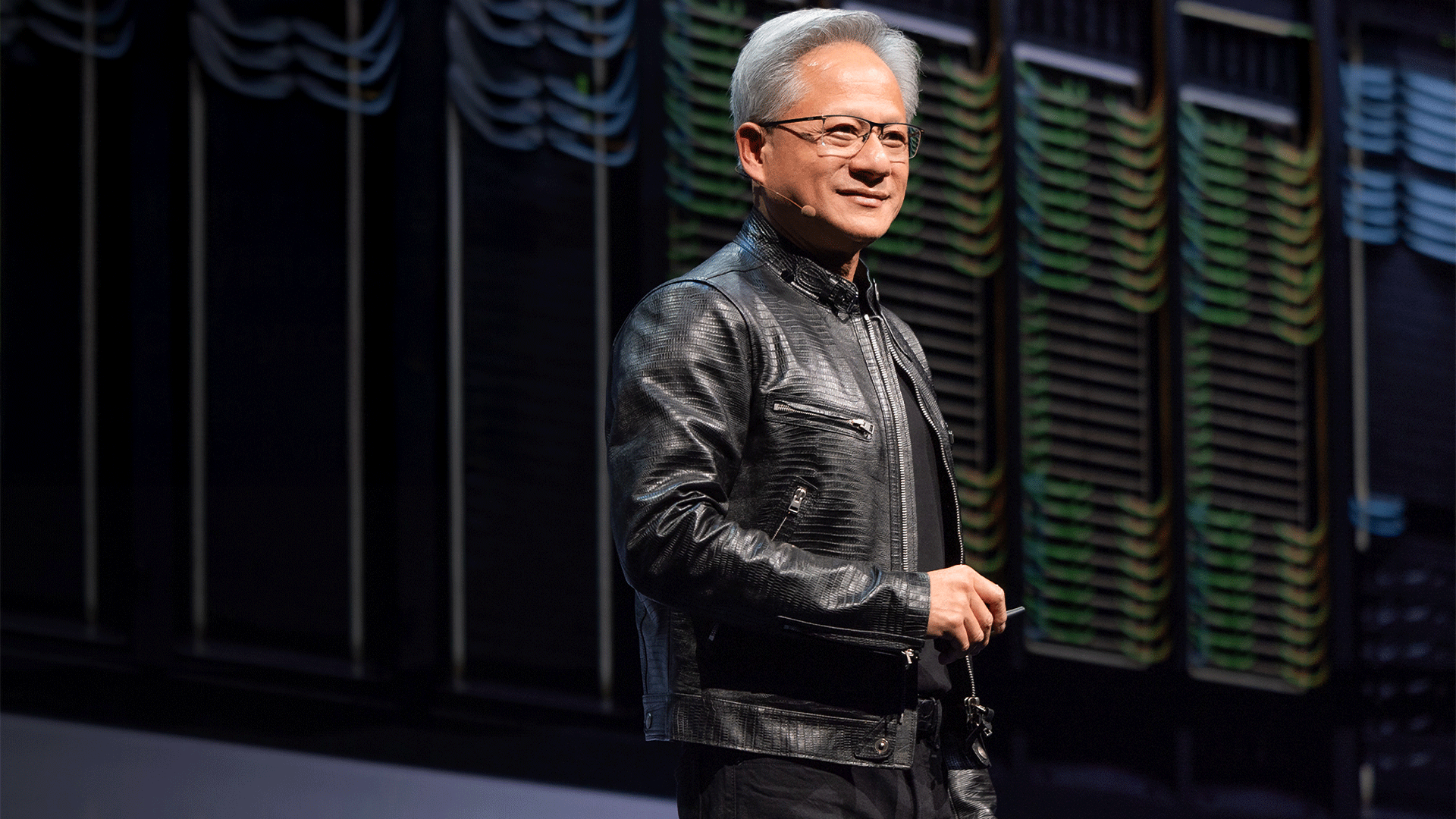
NVIDIA CEO Jensen Huang has spent much of 2026 delivering a consistent message: the danger isn't artificial intelligence itself, it's the paralysis that fear induces. While public conversation fixates on existential risk and job losses, research from McKinsey, Deloitte, MIT, Gartner, PwC, and Accenture points to a more immediate business risk: the cost of hesitation. Enterprises that delay AI adoption out of caution aren't avoiding risk; they're accumulating it, as competitors compound productivity and revenue advantages year over year. This article examines what the latest verified data reveals about the state of AI in business today, why some organizations achieve outsized returns while most stall in pilot purgatory, and what separates AI business strategy winners from the rest.
The Real Risk Isn't the Technology: It's Standing Still
Huang has made this argument repeatedly and publicly. In a July 2026 interview with Axios, he urged Washington not to let "science fiction" fears shape AI policy, calling predictions of mass job losses and human extinction "complete nonsense" and arguing that scaring workers and companies away from using AI poses the greater danger (Axios). He also urged policymakers to consult a broader range of industry voices rather than "one or two" CEOs before imposing restrictions. In the same interview cycle, he told Fast Company that his fellow tech leaders' emphasis on catastrophic risk does more harm by scaring companies and workers away from the technology than any realistic near-term risk from AI innovation itself (Fast Company).
This isn't a dismissal of AI risk altogether: Huang was named a co-laureate of the 2025 Queen Elizabeth Prize for Engineering alongside AI safety researchers Yoshua Bengio and Geoffrey Hinton for foundational contributions to modern machine learning (Queen Elizabeth Prize for Engineering). Sharing that recognition underscores that Huang's disagreement is with doomsday framing, not with safety as a legitimate concern. The distinction he draws is between managing real, near-term operational risk and being paralyzed by speculative, distant risk. For enterprises, that distinction has a direct financial translation: organizational hesitation is now measurably more costly than experimentation.
The Adoption Boom: Where Enterprise AI Actually Stands
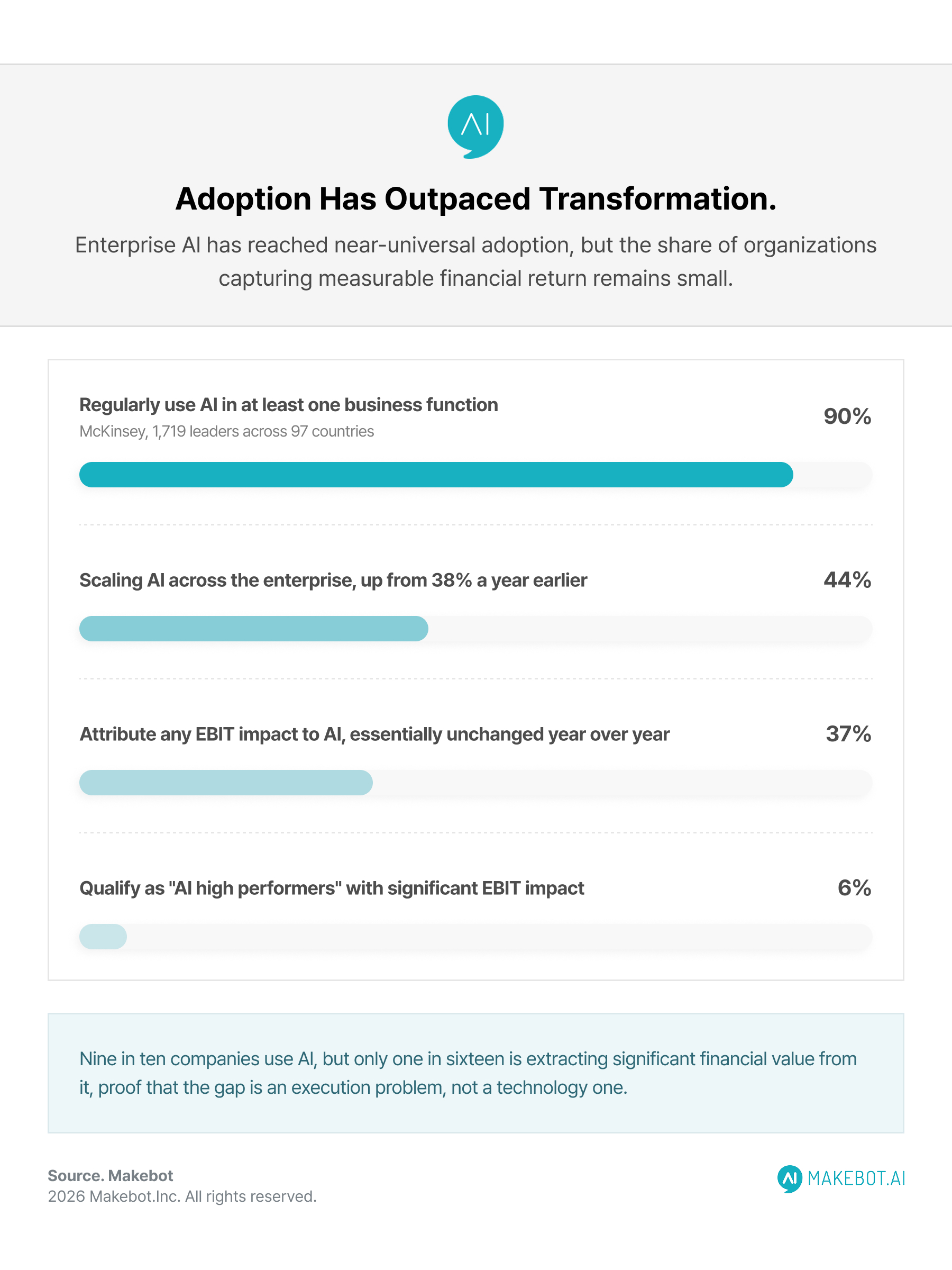
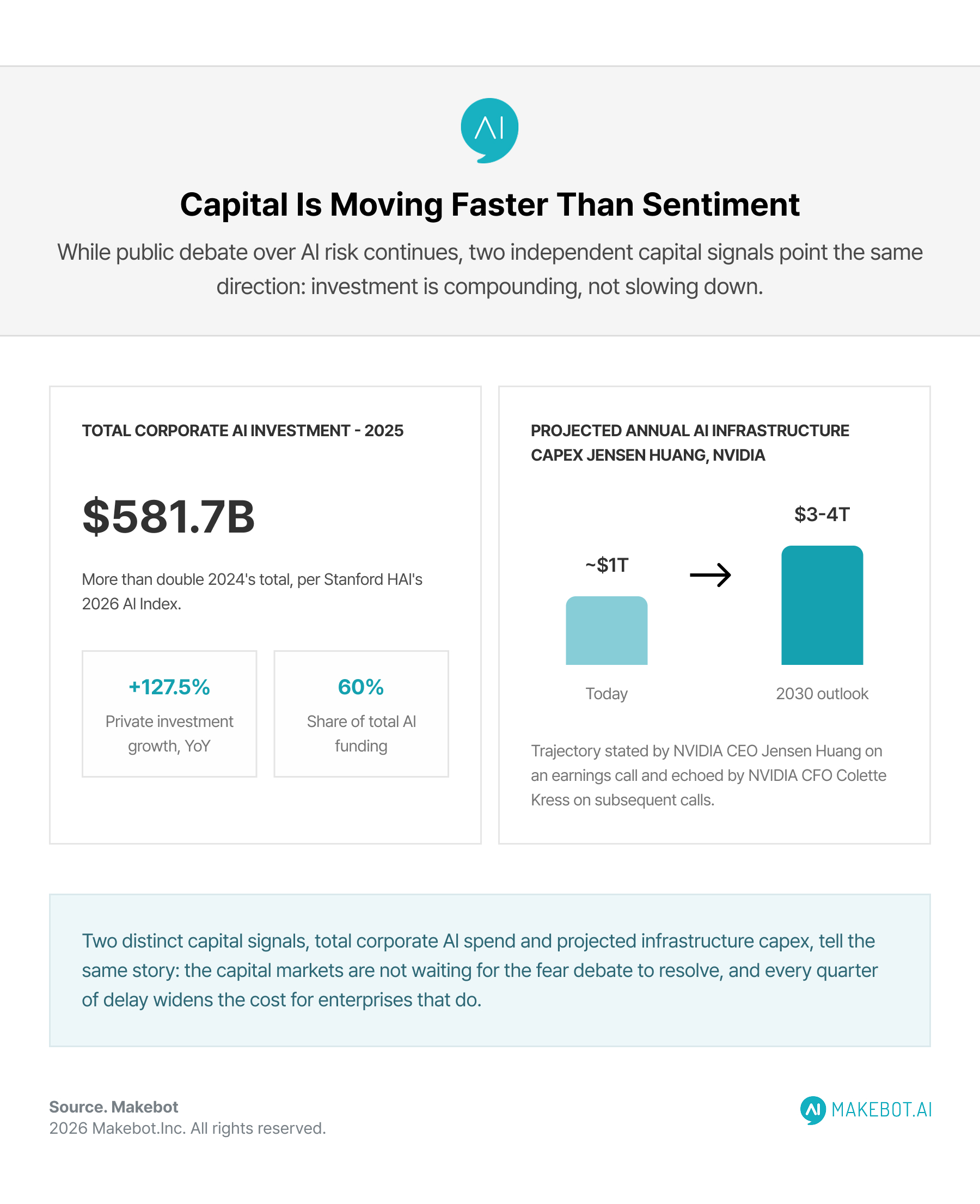
The scale of AI adoption is no longer in question. According to McKinsey's State of AI 2026 survey of 1,719 leaders across 97 countries, nearly nine in ten organizations report regular AI use, and 44% now say AI is scaling across the enterprise, up from 38% a year earlier. Stanford HAI's 2026 AI Index confirms the trajectory from a macro lens: global corporate AI investment reached $581.7 billion in 2025, more than double the prior year, with private investment up 127.5% and now accounting for 60% of total AI funding.
Eighty percent of McKinsey's respondents say AI has improved their personal productivity, and half say it has helped them make better decisions. Momentum is also broadening beyond chatbots: larger enterprises (those with over $1 billion in revenue) are scaling agentic AI far faster than smaller firms: 40% now scaling agents in at least one function, up from 27% a year ago, while adoption among smaller organizations has stayed roughly flat.
- Adoption has moved from experimentation to enterprise-wide deployment for a growing share of large firms
- Individual productivity gains are consistent and well documented across surveys
- Investment continues to climb even as ROI measurement gets harder
The Value Gap: Why Adoption Doesn't Equal ROI
Despite near-universal usage, McKinsey found that only 37% of organizations attribute any enterprise-level EBIT impact to AI (essentially unchanged from the year prior), and just 6% qualify as "AI high performers." Adoption, in other words, has outpaced transformation.
MIT's Project NANDA put a sharper point on this gap in its widely cited GenAI Divide report. Drawing on more than 300 initiative reviews, 52 executive interviews, and 153 leadership surveys, the study found that despite $30–40 billion in enterprise generative AI investment, 95% of pilots delivered no measurable profit-and-loss impact (Fortune). Crucially, the divide is not driven by model quality or regulation: it's determined by organizational approach, particularly whether tools are deeply integrated into workflows or deployed as generic, standalone assistants.
Gartner reinforces the pattern from a different angle, predicting more than 40% of agentic AI projects will be canceled by the end of 2027 due to escalating costs, unclear business value, or inadequate risk controls, and estimating that only around 130 of the thousands of vendors marketing "agentic AI" offer genuinely agentic capability (Gartner). An earlier Gartner forecast found at least 30% of generative AI projects would be abandoned after proof of concept by the end of 2025 for similar reasons (Gartner).
Deloitte's 2026 "State of AI in the Enterprise" report, surveying 3,235 leaders across 24 countries, finds just 34% are using AI to "deeply transform" their business, 30% are redesigning key processes, and 37% are applying AI only at a surface level (Deloitte). Only 25% have moved 40% or more of their AI pilots into production.
What Separates AI Winners From Laggards
Across every major research house, the same conclusion recurs: the gap between AI winners and everyone else isn't about which model they use; it's about how deeply they've rewired the organization around it.
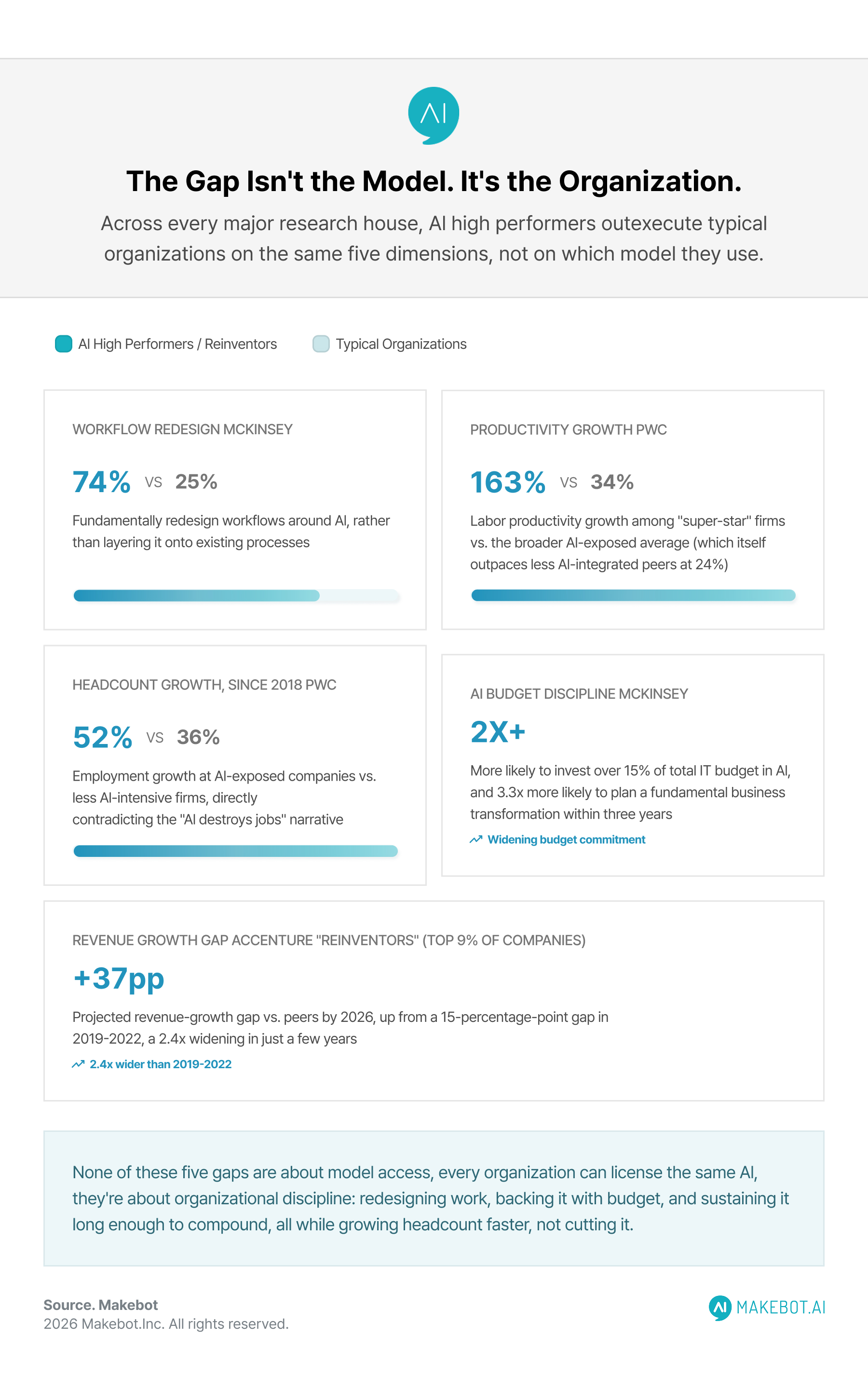
McKinsey's high performers are 3.3 times more likely to intend to fundamentally transform their business within three years and more than twice as likely to spend over 15% of their IT budget on AI. Accenture's research on "Reinventors" (the 9% of companies with mature, continuous reinvention capability) found they grew revenue 15 percentage points faster than peers between 2019 and 2022, with that gap expected to widen to 37 percentage points by 2026 (Accenture).
PwC's 2026 Global AI Jobs Barometer, drawn from more than one billion job postings across 27 countries, found the most AI-exposed companies achieved 34% labor productivity growth compared to 24% among less AI-integrated peers, and that "super-star" firms reached 163% productivity growth (PwC). These same companies grew headcount 52% since 2018, versus 36% for less AI-intensive firms, directly contradicting the narrative that adoption is primarily a story of job destruction.
The Organizational Factors That Actually Drive ROI
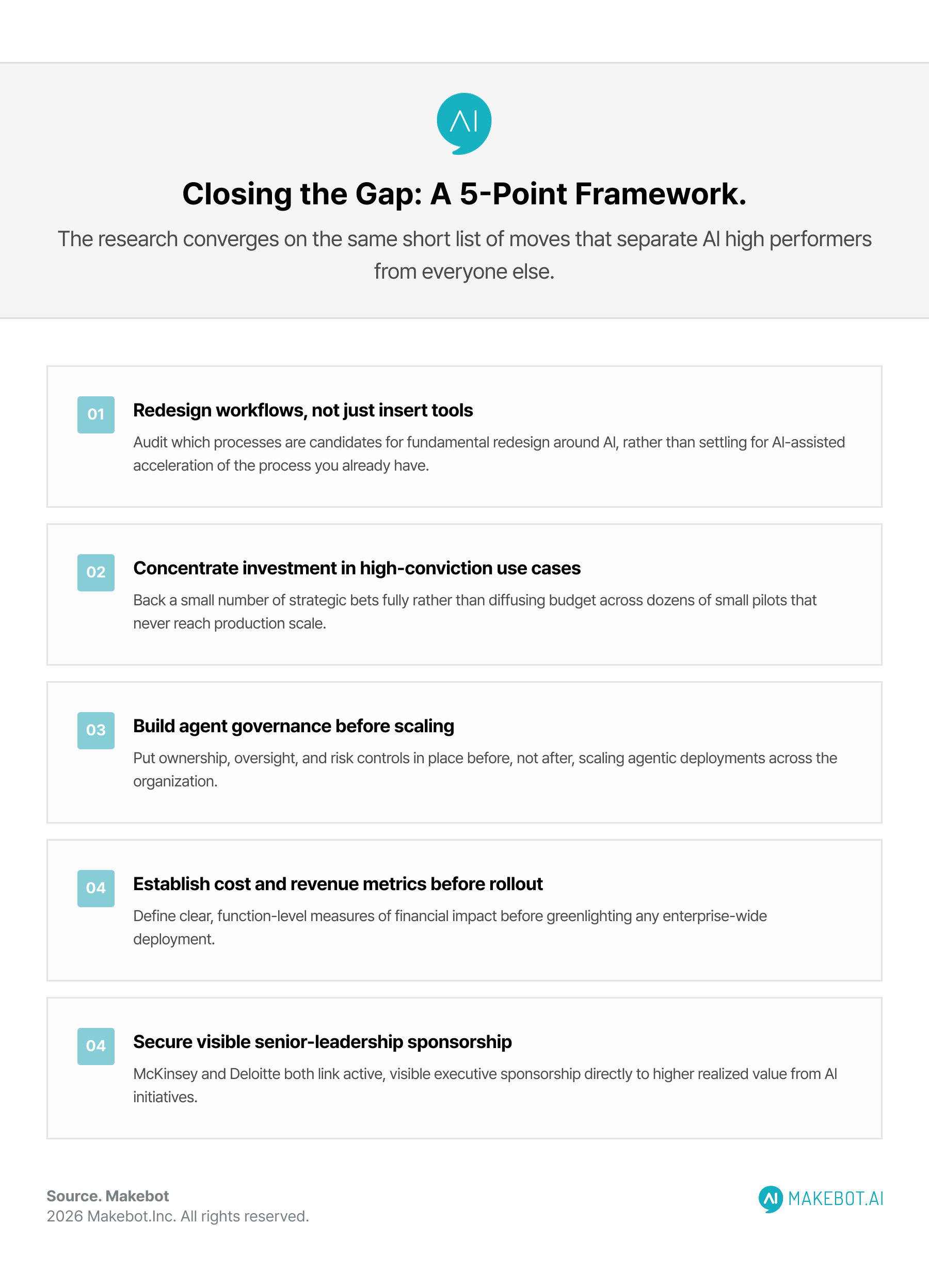
- Workflow redesign over tool insertion. McKinsey found that fundamentally redesigning workflows has the strongest measurable link to EBIT impact, yet it remains the least commonly applied lever.
- Deep integration, not generic deployment. MIT NANDA found off-the-shelf tools succeed for individual productivity but stall in enterprise settings because they don't adapt to a company's specific workflows.
- Governance maturity. Deloitte found that while nearly three-quarters of companies plan to deploy agentic AI within two years, only 21% have a mature governance model in place.
- Leadership commitment. McKinsey's high performers are twice as likely to report senior leadership actively championing AI initiatives and measuring impact.
- Selective, high-conviction bets. Accenture found companies concentrating on scaling a single strategic AI initiative are nearly three times more likely to exceed their ROI expectations.
The Cost of Fear: Why Hesitation Is the Bigger Business Risk
Huang's argument becomes a business case rather than a talking point here. Enterprises delaying AI implementation while awaiting regulatory clarity or perfect risk elimination are not opting out of risk; they are opting into a different one: falling further behind the compounding advantage that McKinsey, Accenture, and PwC all document among early adopters. Deloitte's research on AI ROI notes that despite uncertain returns, executives describe AI adoption as a business imperative driven by fear of falling behind and the promise of improved performance (Deloitte).
Huang told investors on an earnings call that he expects annual AI capital expenditure to climb from roughly $1 trillion today toward $3–4 trillion, a trajectory NVIDIA's own CFO, Colette Kress, has echoed on subsequent calls (CNBC). Whether or not that exact figure materializes, the direction is unambiguous: capital is flowing toward AI transformation at a pace that makes indefinite delay an increasingly expensive strategy.
None of this means adoption should be reckless. The same data that punishes hesitation also punishes poorly governed deployment, hence Gartner's 40% agentic AI cancellation forecast and MIT's 95% no-return finding. The strategic answer isn't "adopt faster than everyone else regardless of readiness." It's "close the readiness gap faster than competitors do."
A Practical Framework for Closing the AI Value Gap
Enterprises seeking measurable AI competitive advantage rather than another stalled pilot should prioritize:
Conclusion
The verified research is remarkably consistent: AI adoption itself is not the primary driver of enterprise risk: organizational readiness is. Companies that treat AI as a bolt-on tool remain stuck in pilot purgatory, contributing to the 95% of initiatives MIT found deliver no measurable return. Companies that treat it as a catalyst for workflow redesign, governance, and leadership commitment are pulling measurably ahead. Jensen Huang's argument, that fear-driven inaction is the bigger threat, finds real support in the data: the risk isn't in moving toward AI transformation, it's in standing still while the gap between leaders and laggards keeps widening.
The Cost of Waiting Is Already Compounding
The data is clear: hesitation is the risk, not adoption. Makebot is a leading generative AI and LLM solutions provider trusted by over 1,000 enterprise clients across healthcare, finance, retail, and the public sector. With a proprietary multi-LLM platform, hybrid RAG architecture, and deep expertise in deploying AI directly into production workflows, Makebot gives organizations the infrastructure to move past pilot purgatory and start capturing real, measurable business impact.
Start building AI that compounds returns over time.





.jpg)


What Happens to Marketing When the C-Suite Starts Using AI Every Day?







Why AI Shopping Assistants Will Replace Traditional Ecommerce Search






.jpg)

























Why Generative AI Projects Fail and How to Achieve Scalable AI Success











.jpg)

.png)