Why the Conversation Breaks at Checkout, and How Generative AI Turns Chat into a Salesperson
70% of carts are abandoned at checkout — in-thread payment cuts that by 30%, MIT and BCG show why.

.jpg)
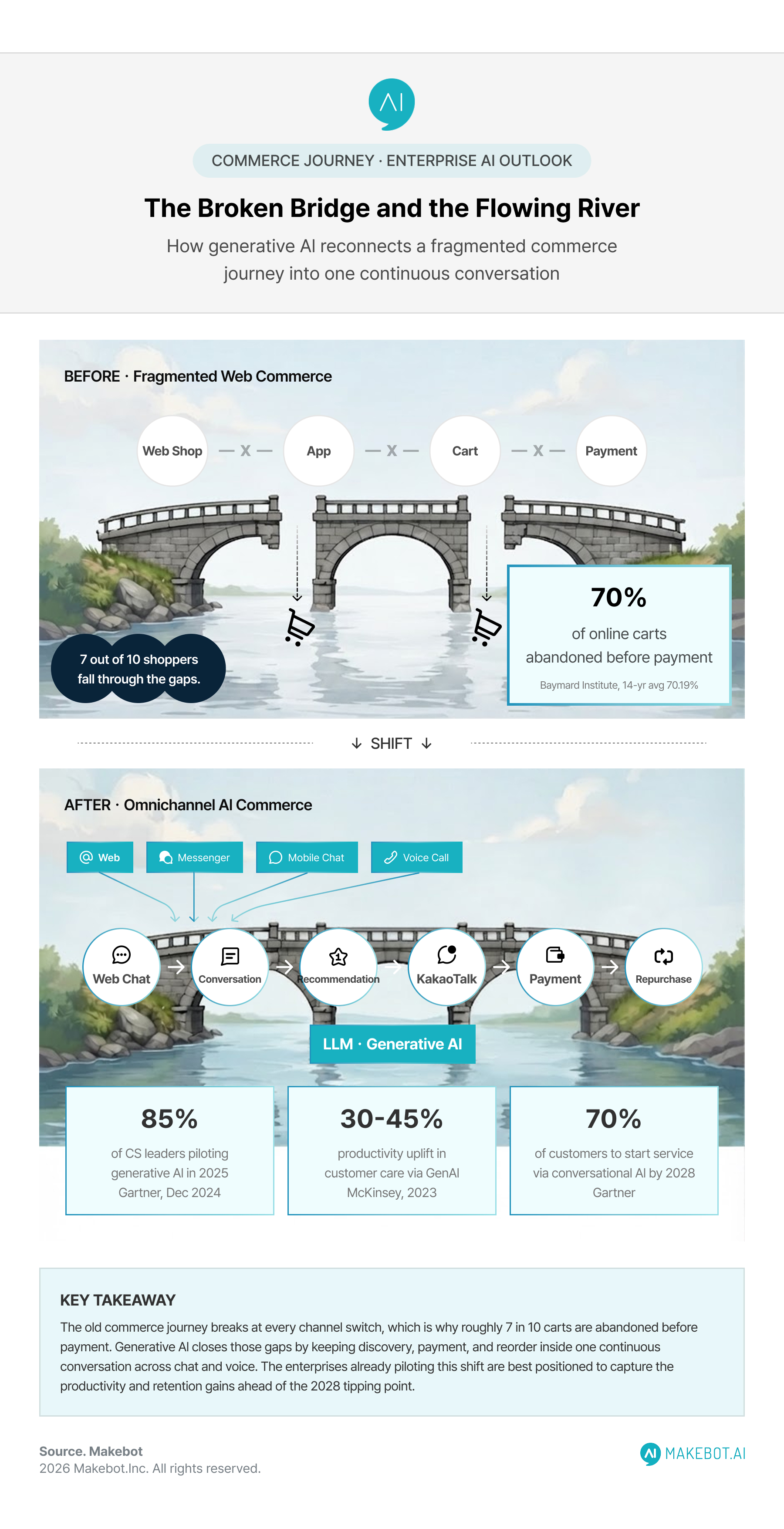
Figure 1. The Broken Bridge and the Flowing River. The old journey breaks at every channel switch. Generative-AI conversational commerce keeps chat, payment, and reorder in one unbroken flow, across both messaging and voice.
Introduction
Every enterprise now has an AI initiative. Far fewer have a return on it. That contradiction sits at the center of two conversations happening in parallel across boardrooms this year: one about why online shoppers keep disappearing at the final step of checkout, and a much larger one about why most generative AI in e-commerce investment isn't showing up on the balance sheet. These aren't separate problems. Conversational commerce - where discovery, recommendation, and payment happen inside one uninterrupted thread - is a live test case for what separates AI initiatives that pay for themselves from the majority that don't. This article looks at the mechanics of checkout abandonment, the broader enterprise data on AI ROI, and the specific factors that determine which side of that divide a conversational AI investment lands on.
Agentic AI vs Generative AI: Why the Difference Will Define Enterprise Strategy in 2026. Read more here!
The Checkout Leak Nobody Budgets For
Businesses invest heavily in traffic, product pages, and ad targeting. Far less attention goes to what happens in the final minutes before payment - which is where the largest single leak in the customer journey actually occurs. The Baymard Institute's compilation of 50 independent studies puts the average cart abandonment rate at 70.22%, a figure that has barely moved in over a decade. Setting aside pure window-shoppers, the dominant causes are structural, not emotional: surprise costs revealed late, forced account creation, and checkouts that simply ask for too much.
- The average U.S. checkout still displays around 23 form elements - nearly twice what Baymard's usability research finds necessary.
- Every redirect from chat to app to a separate checkout page is a new point of exit.
- The product isn't usually the problem. The distance between deciding and paying is.
This matters more in e-commerce AI strategy than it might first appear, because it reframes the checkout problem as an integration problem - exactly the same failure mode showing up in enterprise AI investment more broadly.
Microsoft CEO Satya Nadella On How AI Is Transforming Organizations, Teams And Leadership. Read here!
The Wider Pattern: Why Most Enterprise AI Spending Isn't Paying Off
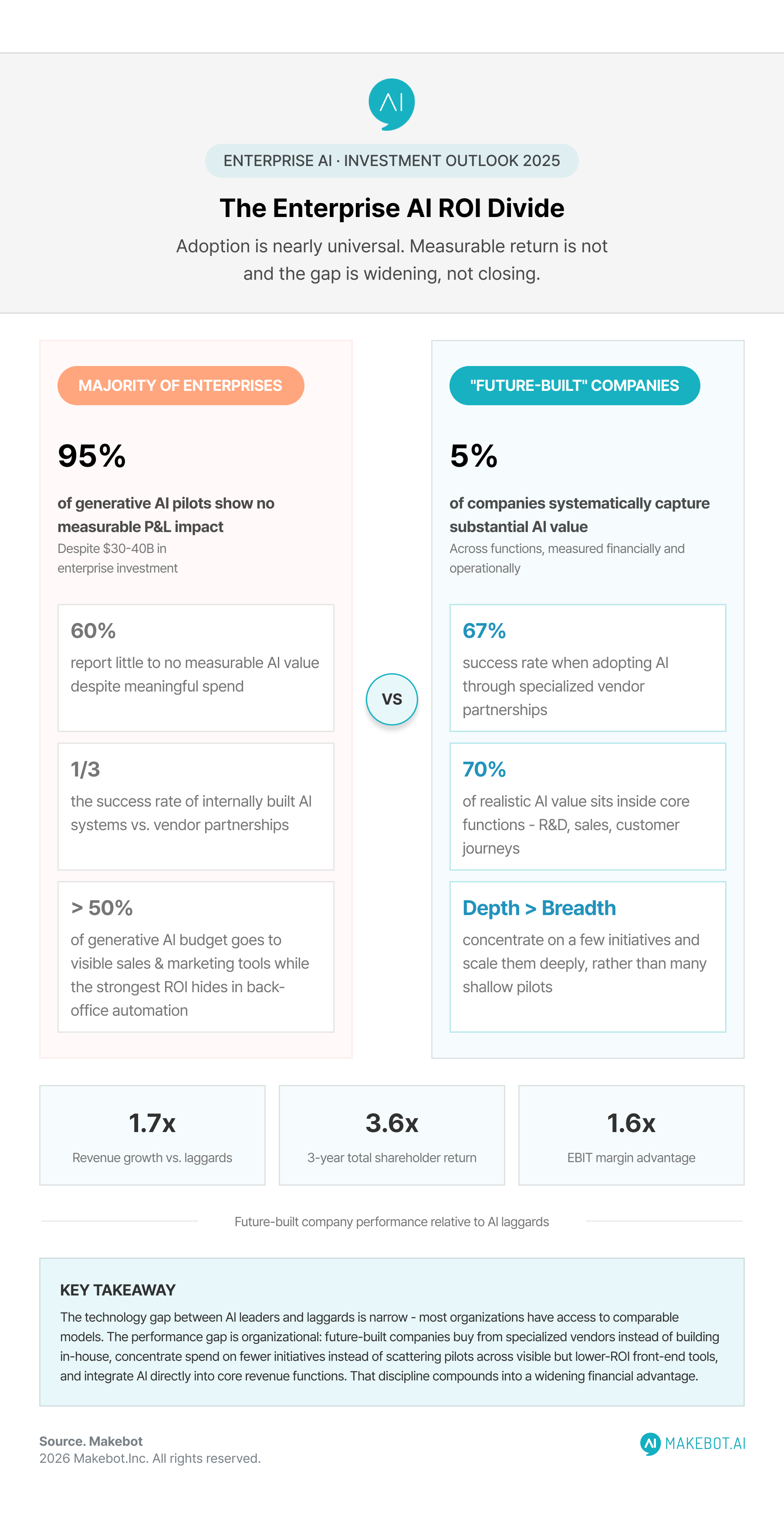
Zoom out from checkout, and the same structural gap reappears at enterprise scale. MIT's Project NANDA, in its widely cited State of AI in Business 2025 research, examined more than 300 public AI deployments alongside executive interviews and employee surveys. The finding: despite an estimated $30–40 billion in enterprise generative AI investment, roughly 95% of organizations report no measurable impact on profit and loss. Only a small fraction - about 5% - are converting pilots into real financial value.
Boston Consulting Group's 2025 AI maturity research, based on a survey of more than 1,250 C-suite executives, tells a compatible story from a different angle:
- Only about 5% of companies qualify as "future-built" - organizations systematically capturing substantial AI value across functions.
- Roughly 60% of companies report little to no measurable value despite meaningful spend.
- Future-built companies report 1.7x revenue growth, 3.6x three-year total shareholder return, and 1.6x EBIT margin relative to laggards.
Read together, these two research efforts describe the same divide from opposite ends: enthusiastic adoption, concentrated payoff. The technology itself is rarely the differentiator - most organizations, leaders and laggards alike, have access to comparable models. Nowhere is that divide easier to measure than in AI in e-commerce, where the payoff shows up directly in completed transactions rather than abstract productivity scores.
Deloitte Insights: AI Fluency Becomes the Most Valuable Workforce Skill. Continue Reading here!
What Separates AI Value Creators from Everyone Else
If the models are broadly similar, the difference has to sit somewhere else - and both MIT's and BCG's research point to the same set of factors, more organizational than technical.
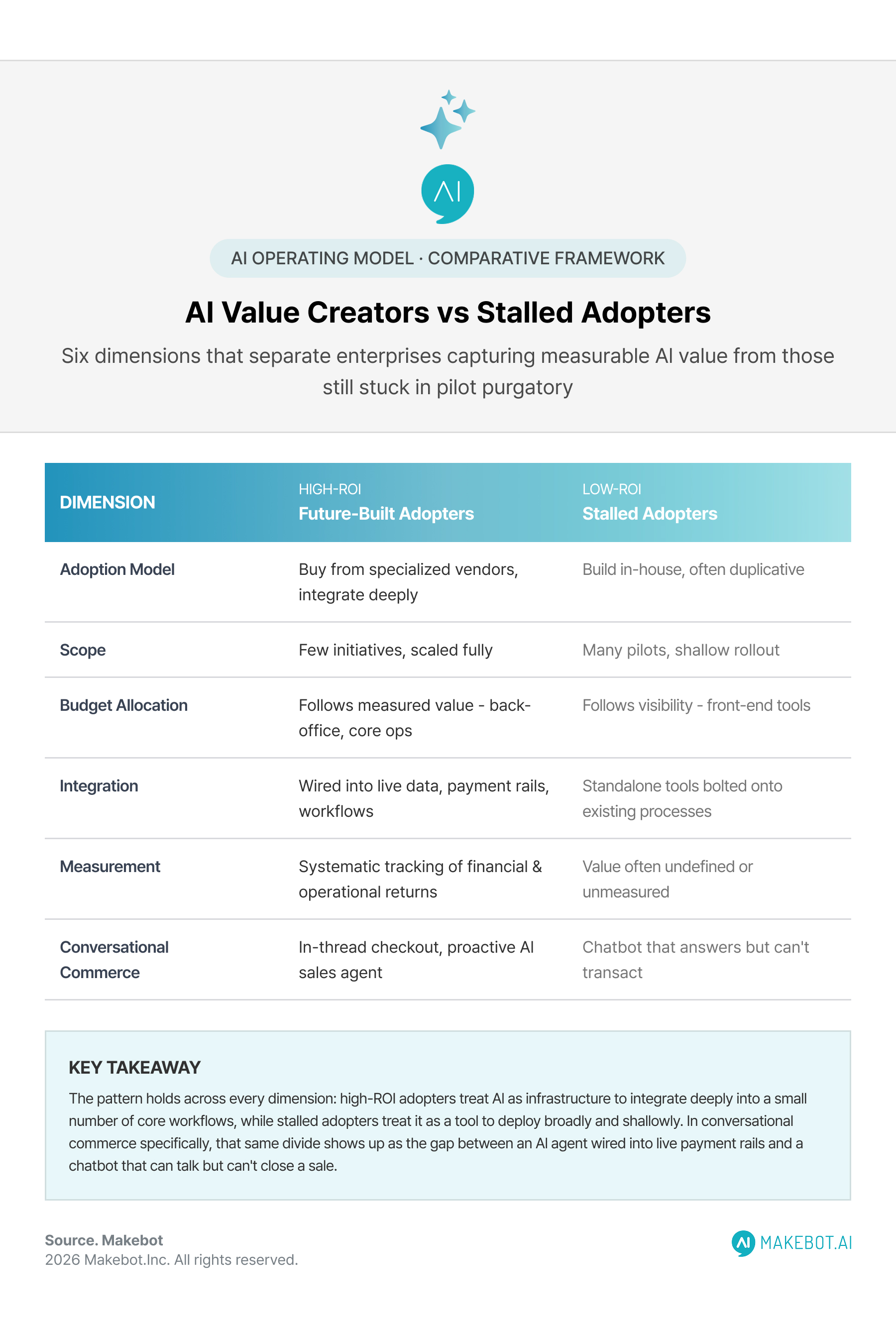
Buy versus build. MIT's research found that enterprises adopting generative AI through specialized vendor partnerships succeeded roughly 67% of the time, compared with success rates about a third as high for internally built systems. Custom-built tools frequently stall on maintenance, retraining, and integration debt that vendor platforms have already solved.
Where the budget goes versus where the value is. MIT found more than half of generative AI budgets going toward sales and marketing–facing tools, while the strongest measurable ROI showed up in less visible back-office automation. Visibility and value aren't the same thing.
Depth over breadth. BCG's research found that companies generating significant value tend to concentrate on a small number of initiatives and scale them deeply - changing core processes and measuring returns systematically - rather than spreading effort across many shallow pilots.
Where value actually concentrates. BCG estimates roughly 70% of AI's realistic value potential sits inside core business functions - R&D, marketing, sales, customer journeys - rather than in support functions like HR or legal, where much early AI spending has historically landed.
The common thread: value follows integration, not experimentation. A pilot that lives outside the actual workflow - outside the payment system, the order history, the live catalog - rarely survives contact with production.
Why Generative AI Projects Fail and How to Achieve Scalable AI Success. Read more here!
Where Conversational Commerce Fits the Pattern
Conversational commerce is a useful lens on this divide precisely because the stakes are so measurable - a completed transaction or an abandoned cart, with no ambiguity in between.
Gartner's research frames the shift as structural rather than seasonal: by 2028, at least 70% of customers are expected to start their customer service journey through a conversational AI interface - a clear signal that AI-powered customer experience is becoming the default rather than the exception. On the enterprise side, a Gartner survey of customer service leaders found 85% already exploring or piloting customer-facing conversational generative AI as of 2025, underscoring how central AI customer engagement has become to enterprise strategy.
The revenue-relevant piece is what happens at the payment step itself. Mordor Intelligence's 2026 conversational commerce analysis found that in-thread checkout - completing payment without redirecting the shopper out of the conversation - reduces cart abandonment by roughly 30% compared with mobile-web flows. That's the same mechanism as the "buy vs. build" and "integration over experimentation" findings above, just applied to a single transaction: the AI sales assistant that's wired directly into live payment rails outperforms the one that only recommends and then hands the customer off.
Deloitte: 70% of Leaders Prioritize Agility as AI Reshapes Business Strategy. More here!
From Shopping Assistant to AI Sales Agent: The Measurable Outcomes
The distinction between a basic AI chatbot for e-commerce and a genuine AI sales assistant is posture, not vocabulary. Most AI shopping assistants on the market today wait to be asked. Generative AI, properly integrated, initiates:
- Reorder nudges triggered by purchase-cycle timing, not a static drip schedule.
- Cross-sells and bundle up-sells grounded in the live catalog rather than a fixed script.
- Abandoned-cart recovery conversations that resume exactly where the shopper left off.
The results, where measured, are substantial relative to legacy channels. Rep AI's published data shows that among shoppers who respond to AI-driven abandoned-cart outreach, 35% complete the purchase, compared with the 2–5% typical of cart-recovery email. At the enterprise level, McKinsey estimates that applying generative AI to customer care functions can lift productivity by 30–45% of current function costs - turning what was historically a cost center into a measurable revenue channel.
This is where scale and channel breadth compound the effect. Rule-based order bots have already proven the underlying commerce infrastructure works at serious volume: in Korea, scenario-based KakaoTalk order bots have processed more than KRW 100 billion per year in commerce payments. Korea's TV home shopping market - recording roughly KRW 18.5 trillion in annual transaction volume per the Korea TV Home Shopping Association's most recent industry reporting, and skewing toward buyers in their 60s and 70s - is a useful reminder that the same channel-continuity problem exists in voice, not just chat: when the broadcast ends and completing the purchase requires switching to an app, the same abandonment pattern reappears in a different medium.
How AI Chatbots Are Increasing E-Commerce Conversion Rates. Read here!
Common Pitfalls When Scaling Conversational AI
Enterprises repeat a few avoidable mistakes when moving from pilot to production:
- Treating a general-purpose assistant as a commerce solution. A conversational model without catalog, inventory, and payment access can be recommended - it isn't yet one of the AI-powered sales assistants that can actually transact.
- Optimizing for ticket closure instead of completed orders. Support-suite AI add-ons are typically built to deflect tickets; their success metric isn't a sale.
- Underinvesting in the reorder and follow-up layer. The first conversation is easy to fund; the proactive nudge weeks later is where retention value actually accumulates.
- Leaving the voice out of the architecture. Gartner's 2028 prediction spans modalities - an AI strategy that only covers chat misses the customers, often older and phone-first, who are most likely to abandon a channel switch.
Showcasing Korea’s AI Innovation: Makebot’s HybridRAG Framework Presented at SIGIR 2025 in Italy. Read here!
Conclusion: The Distance Between Talking and Paying Is the Whole Story
The enterprise AI research and the conversational commerce data are describing the same phenomenon at different resolutions. At the macro level, a small share of organizations are capturing outsized value from AI while the majority see little return on meaningful spend. At the transaction level, the same divide shows up as the gap between a customer who completes checkout inside the conversation and one who abandons it at a redirect. In both cases, the differentiator isn't the sophistication of the underlying model - it's whether that model is actually wired into the systems where value gets created: the payment rail, the order record, the live catalog, the customer's history. Enterprises that already run proven commerce infrastructure - real payment rails, real order volume, years of customer data - are positioned to close this gap fastest, because the hard integration work is largely already done. The question left for most organizations isn't whether to invest in AI. It's whether that investment is connected to anything that can actually close a sale.
Turn Every Conversation into a Salesperson, in Chat and on the Phone
Makebot built its foundation with Korea's largest commerce operators, including KT Alpha, CJ, and Gong-yeong Home Shopping, processing more than KRW 100 billion per year in KakaoTalk payments. Its generative AI layer now runs across chat (MagicTalk) and voice (MagicVoice / AICC) - the same integration discipline that separates AI value creators from stalled pilots, applied to commerce.
Explore Makebot.ai → Enterprise LLM and conversational commerce solutions across messaging and voice





.png)








.jpg)


What Happens to Marketing When the C-Suite Starts Using AI Every Day?






Why AI Shopping Assistants Will Replace Traditional Ecommerce Search































Why Generative AI Projects Fail and How to Achieve Scalable AI Success











.jpg)

.png)