Vibe Coding Got You to a Demo. It Won't Get You Past POC.
95% of AI pilots never reach production - vibe coding builds the demo, not the system beneath it.


Introduction
There is a moment every enterprise AI team knows well: the demo lands, the room applauds, and someone says, "Great - when can we ship it to customers?" That is the moment the prototype reveals itself as a shell.
Vibe coding - the practice of generating software through natural language prompts, accepting AI output without deep review, and iterating conversationally rather than architecturally - has made that moment arrive faster than ever. A product manager describes an internal Q&A tool over lunch, and by end of day there is a working interface. The build that used to take a development team a quarter now takes an evening.
That velocity is real. The trap is structural.
The visible layer of software - the interface, the responses, the demo flow - was never where enterprise difficulty lived. It lives in the 90% that no demo shows: closed-network deployment, permission-aware search, audit-grade logging, HR-synced access controls, security review, and the governance architecture that allows a system to run reliably in front of regulated customers at scale. This article examines why vibe coding reaches the demo stage so efficiently, why it stalls at the threshold of production, and what crossing that ceiling actually requires - technically, organizationally, and strategically.
Why AI-Powered Customer Journey Mapping Is Becoming Essential for Enterprise Growth. Explore the latest insights here!
The Five-Minute Demo and the Standing Ovation
The numbers behind vibe coding's rise are striking in their speed. By December 2025, an estimated 41% of all code written globally was AI-generated. More than 92% of U.S. developers were already using AI coding tools. Among Y Combinator's Winter 2025 cohort, a quarter of startups reported codebases that were 95% AI-generated, according to YC managing partner Jared Friedman (TechCrunch, March 2025). Collins Dictionary named "vibe coding" its Word of the Year for 2025.
AI-assisted software development has compressed the cost of a working prototype to nearly zero. Platforms like Cursor, Replit Agent, and Lovable deliver functional screens, responses, and integrated flows from plain-language descriptions. For internal tools, throwaway experiments, and early-stage proof of concept (POC) work, this is a genuine accelerant — and the people using these tools are not naive. They are smart engineers and product leaders making a rational bet: get something in front of stakeholders fast, validate the concept, and then figure out the rest.
The problem is that "figure out the rest" is not an incremental step. It is a different kind of project entirely.
How Generative AI Is Reshaping Brand Strategy and Digital Advertising. Read the expert analysis here!
The Iceberg: What the Demo Doesn't Show
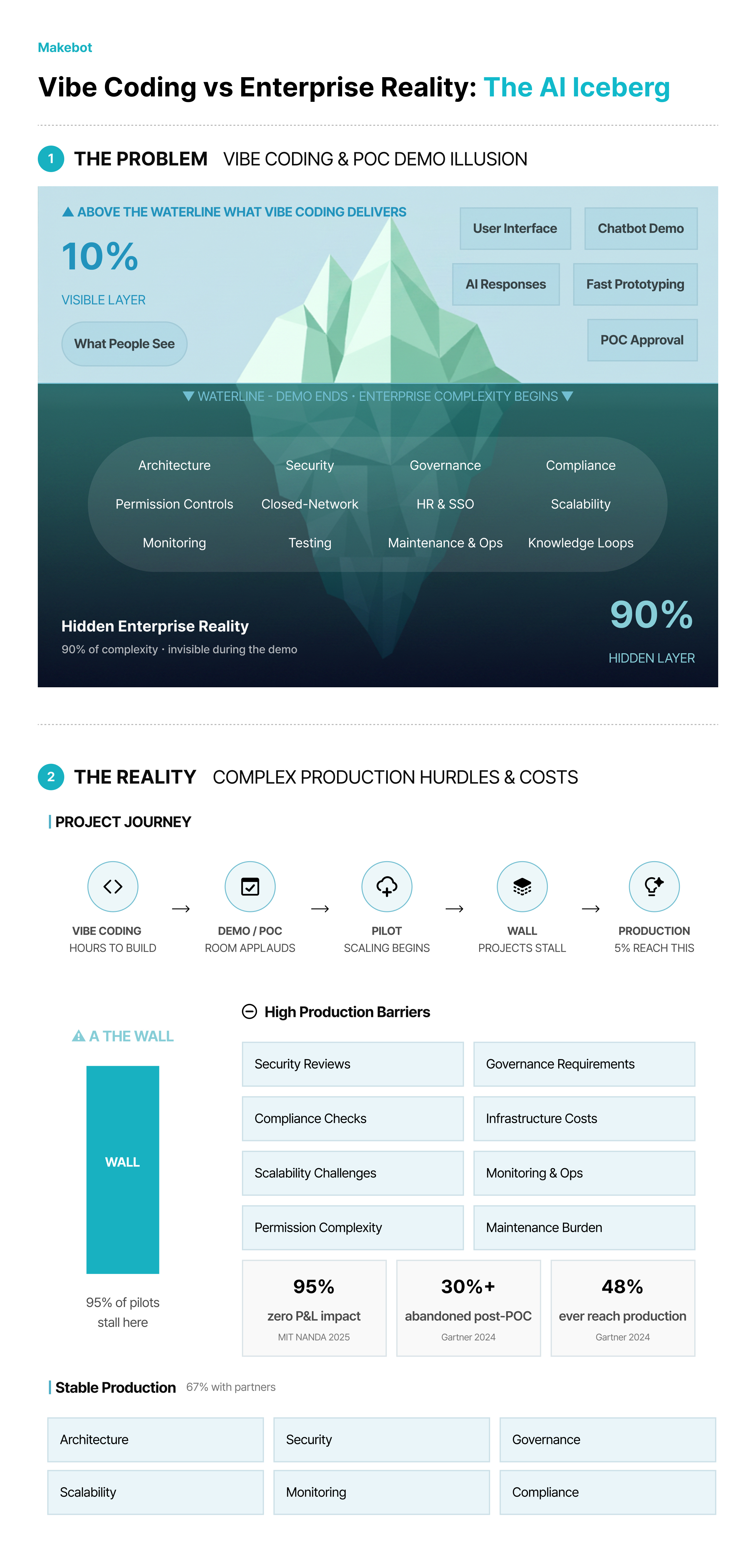
The generative AI development community often frames the journey from POC to production as "finishing the last 10%." This framing is the most expensive misconception in enterprise AI development today.
The demo represents the visible 10% of a production AI system: the interface, the response quality, the use case demonstration. What it does not show - and what vibe coding has no architectural mechanism to address - is the 90% beneath the waterline:
- Permission-aware access controls: In a real enterprise environment, the same search query must return different results depending on who is asking. A procurement manager should not surface legal documents. A contractor should not access HR records. These permission layers must run consistently across learning, approval, and retrieval pipelines - not as an afterthought, but as a foundational design decision made before a single line of interface code is written.
- Closed-network deployment: Most enterprise software development in finance, healthcare, and the public sector cannot route sensitive data through external APIs. A prototype built on a hosted commercial model and a production system operating in an air-gapped or closed-network environment are architecturally different products - not different versions of the same one.
- HR and SSO synchronization: Access rights must change automatically when an employee is reassigned, promoted, or offboarded. A system that does not integrate with identity infrastructure creates security debt that compounds silently and daily.
- Audit-grade logging: Regulated industries require complete, traceable records of every query, every response, and every access event. A demo that cannot answer "who saw what, and when?" will not survive compliance review.
- Concurrency and production reliability: A prototype used by three people in a controlled demo works. A system used by 3,000 people simultaneously - at 3 a.m., when a critical workflow depends on it, without the original developer available - is an entirely different engineering challenge.
- A self-reinforcing knowledge loop: Production-grade AI application development must improve over time. Systems that do not retain context, adapt to operational feedback, or build institutional memory do not scale. They stagnate and get abandoned.
AI-assisted software development tools are optimized for the visible layer. They are not engineered to produce the governance infrastructure, the integration architecture, or the learning loops that enterprise deployment requires. Recognizing that distinction is not a criticism of the tools - it is a prerequisite for using them responsibly.
7 Proven Factors That Drive AI ROI in 2026, According to a Survey of 1,000+ Executives. Discover what’s next here!
The Ceiling Pattern: The Simple Bot Ships. The Serious One Stalls.
Before diagnosing why projects fail, it is worth making a distinction the research supports and practitioners often miss: not every AI application development effort dies at POC. Some do ship.
A straightforward use case - an internal Q&A chatbot built on a hosted commercial model, with a basic guardrail between the internal network and the external LLM - can move from proof of concept to launch. Many enterprises have exactly this running today, and it functions. This is not a failure. It is a proof that the visible 10% can work when the stakes are proportional.
The ceiling appears at the next step.
Consider a common pattern across large enterprises: an internal knowledge assistant starts as a simple Q&A tool - staff ask questions, the bot surfaces answers from uploaded documents, and adoption is strong enough to justify expansion. The organization then attempts to deepen it: fine-grained permissions so that different departments see only their own documents; fully closed-network operation so no data touches an external model; audit-grade logging for compliance review; HR-driven access changes when employees move roles. That is where the self-built effort stops advancing. The simple version shipped. The serious version stalled.
This is what the brief for this article stream calls the Execution Divide - the structural gap not between AI adoption and non-adoption, but between an AI system that demos and one that operates. The divide is not about model quality, budget, or engineering talent. It is about whether the invisible 90% was engineered from the start or treated as a finishing task. Organizations that treat it as the latter find that the cost of finishing is greater than the cost of the original build - and frequently abandon the effort entirely rather than confront that accounting.
APAC AI Outlook 2026 Signals AI's Breakout Moment as a New Revenue Driver. Explore the future of AI here!
The "Finish the Last 10%" Fallacy
When organizations recognize the gap between demo and production, the instinct is to treat it as a sprint task. This is the most reliable path to an abandoned pilot.
AI-generated code is functionally plausible but structurally shallow. A December 2025 analysis of 470 open-source GitHub pull requests (CodeRabbit) found that code co-authored by AI coding tools contained 1.7 times more major issues than human-written code. GitClear's analysis of 211 million lines of code from organizations including Google, Microsoft, and Meta found that code churn - revisions within two weeks of initial commit - nearly doubled, rising from 3.1% in 2020 to 5.7% by 2024, while copy-paste patterns increased from 8.3% to 12.3% over the same period.
The security dimension compounds the problem structurally. Between January 2025 and February 2026, documented incidents tied to vibe-coded applications included exposed API keys, authentication bypasses, and unauthenticated data access affecting hundreds of production deployments. CVE-2025-48757 (a Row-Level Security bypass vulnerability in Lovable) was linked directly to AI-generated code in widely deployed tooling. Fortune 50 enterprises tracked a 10x increase in security findings per month between December 2024 and June 2025 — partly attributable to the volume of AI-generated code entering production pipelines without adequate review.
Inheriting this kind of codebase is not a "finishing" exercise. It is frequently cheaper to rebuild from a governed, production-grade foundation than to retrofit governance onto a shell.
Gartner Predicts That Agentic AI Will Solve 80 Percent of Customer Problems by 2029. See how enterprises are transforming here!
What the Research Actually Shows
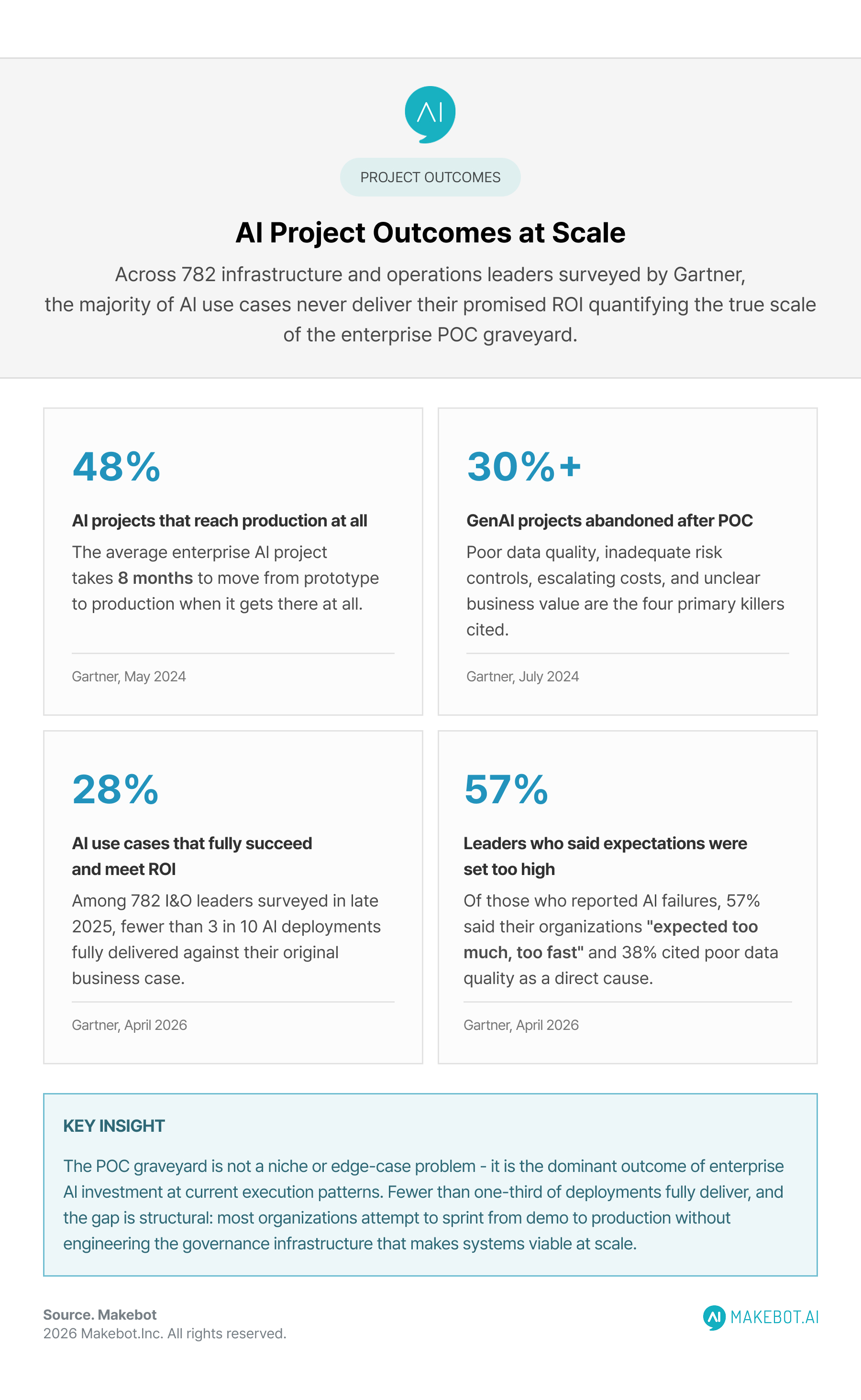
The research on enterprise AI development outcomes converges on a consistent picture - and the numbers are not marginal.
Gartner (2024) found that on average only 48% of AI projects reach production at all, with the journey from prototype to production taking approximately 8 months for those that do. Separately, Gartner predicted that at least 30% of generative AI projects would be abandoned after proof of concept by end of 2025. Gartner's April 2026 survey of 782 infrastructure and operations leaders sharpened the picture further: only 28% of AI use cases fully succeed and meet ROI expectations, while 20% fail outright.
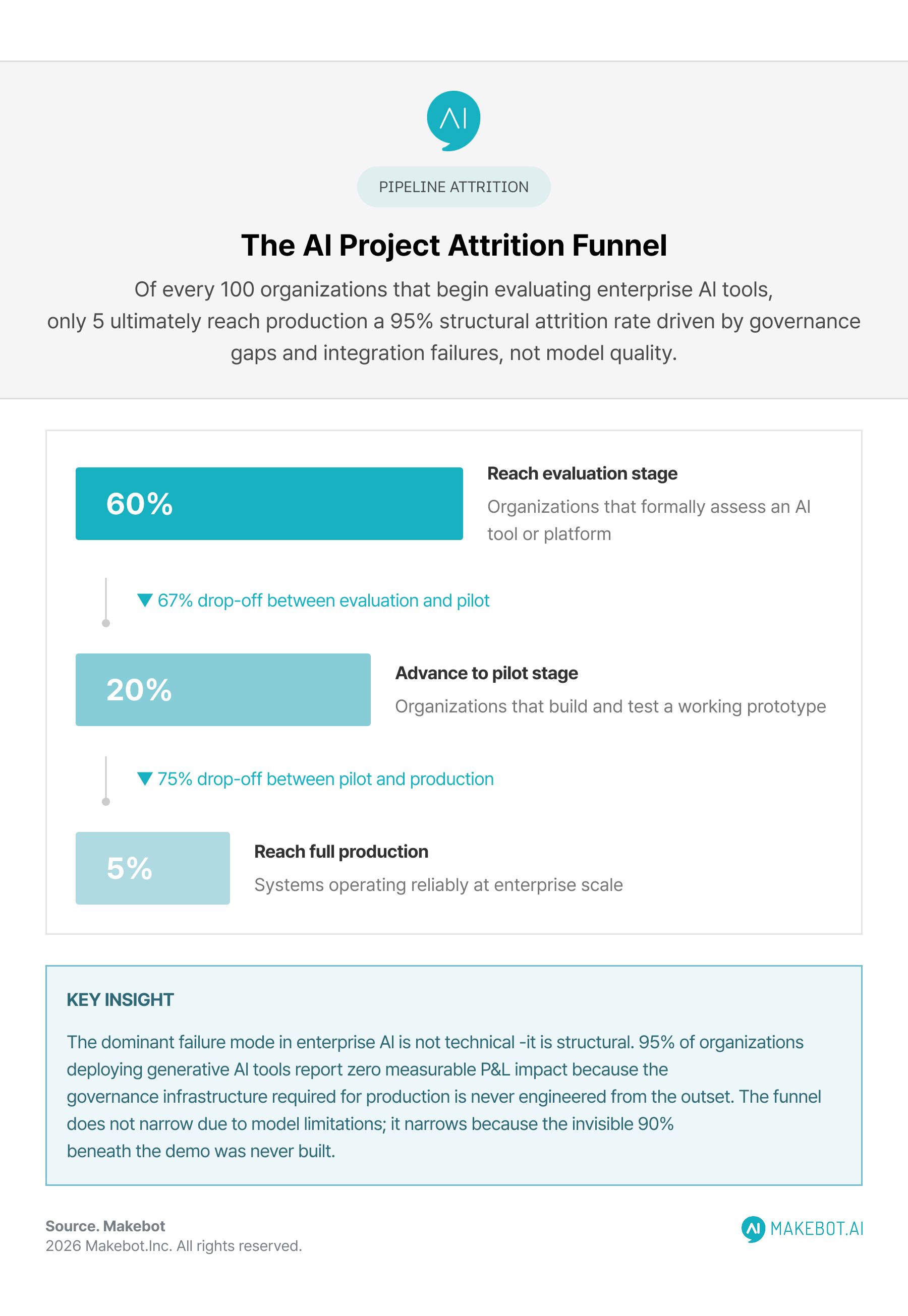
MIT NANDA's "The GenAI Divide: State of AI in Business 2025" identified a starker structural divide. Of organizations that evaluated enterprise AI development tools, 60% reached evaluation, 20% reached pilot stage, and just 5% reached production. Across the full population, 95% of organizations saw zero measurable P&L impact from their generative AI investments. MIT's central finding: the failure is almost never about model quality — it is about the learning gap. Most production AI systems do not retain feedback, adapt to context, or improve over time.
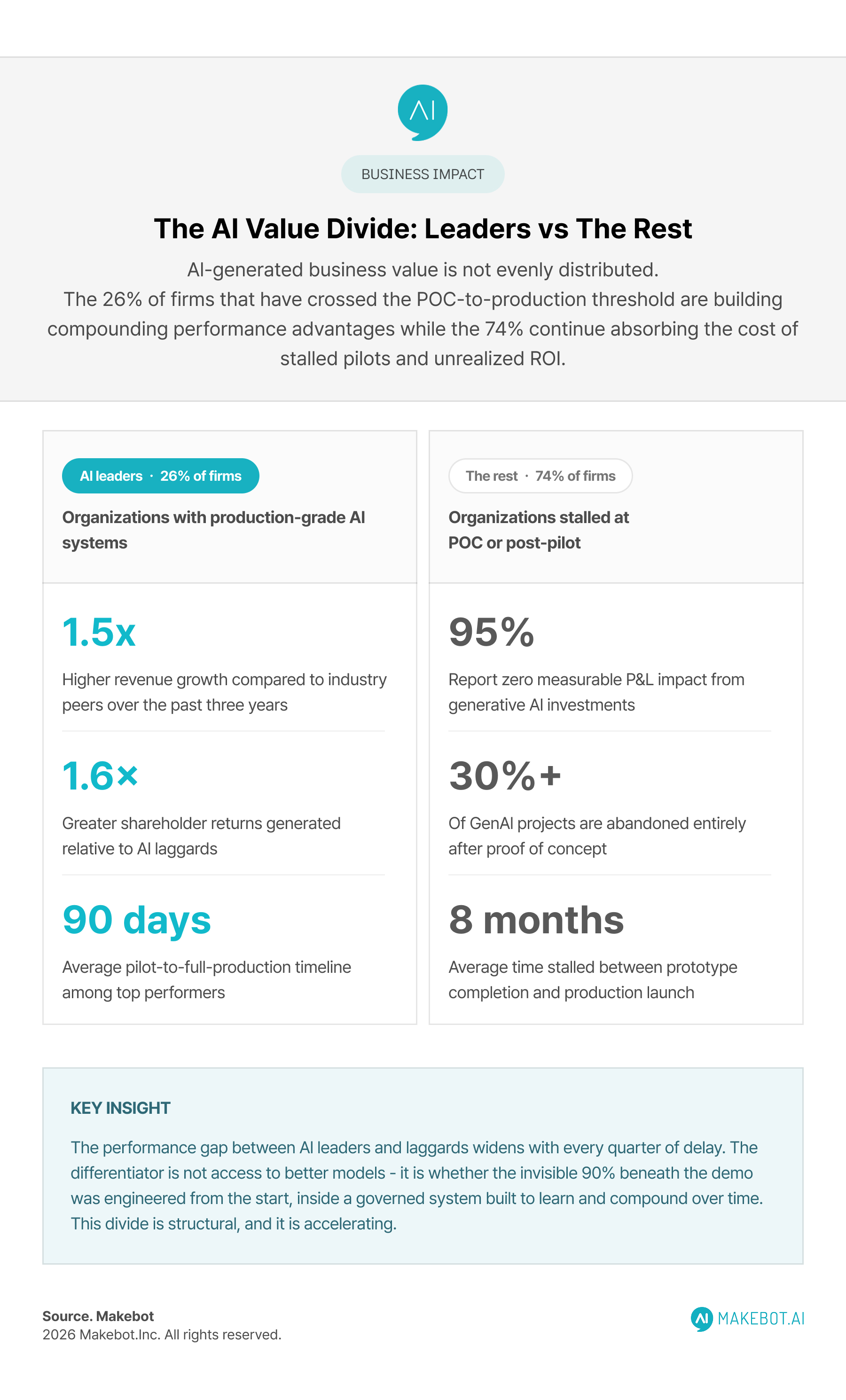
BCG (2024), surveying 1,000 senior executives across 59 countries, found that 74% of companies have been unable to extract meaningful value from their AI investments. The firms that are succeeding are achieving 1.5 times higher revenue growth and 1.6 times greater shareholder returns than their peers. The differentiator is not access to better models. It is the integration of AI into governed, workflow-embedded production AI systems with clear operational ownership.
These are not peripheral findings. They represent the most authoritative voices in enterprise software development strategy, and they agree: the dominant outcome of enterprise AI investment, at current execution patterns, is a stalled pilot.
Agentic AI vs Generative AI: Why the Difference Will Define Enterprise Strategy in 2026. Learn how industry leaders are adapting here!
The Maintenance Question No Demo Answers
There is a question the applause in the demo room never surfaces: who owns this system at 3 a.m. when it breaks in front of a regulated customer?
Vibe-coded applications have no structural answer to this question. The code is generated conversationally, often without documentation, without test coverage for edge cases, and without any record of why specific architectural decisions were made. When the operations manager who understood a vendor-specific contract exception or a data-routing rule leaves the organization, that knowledge leaves with them - because the system has no mechanism for capturing and compounding institutional knowledge over time.
This is one of the structural failure modes MIT NANDA identified as definitional to the learning gap. Production AI systems must not only run reliably - they must learn. A system that resets context with every session, that does not integrate with the workflows where actual decisions are made, and that cannot be queried for its own operational reasoning history is not an enterprise asset. It is a liability that happens to function under demo conditions.
The maintenance void is not a future risk. It is the reason 70–90% of AI pilots - across multiple independent research bodies - never scale beyond the initial proof of concept (POC) stage.
Microsoft CEO Satya Nadella On How AI Is Transforming Organizations, Teams And Leadership. Explore the data and findings here!
What Separates the 5% That Make It
The organizations crossing the POC-to-production threshold share structural characteristics that have nothing to do with the sophistication of their models and everything to do with how they approached the 90%.
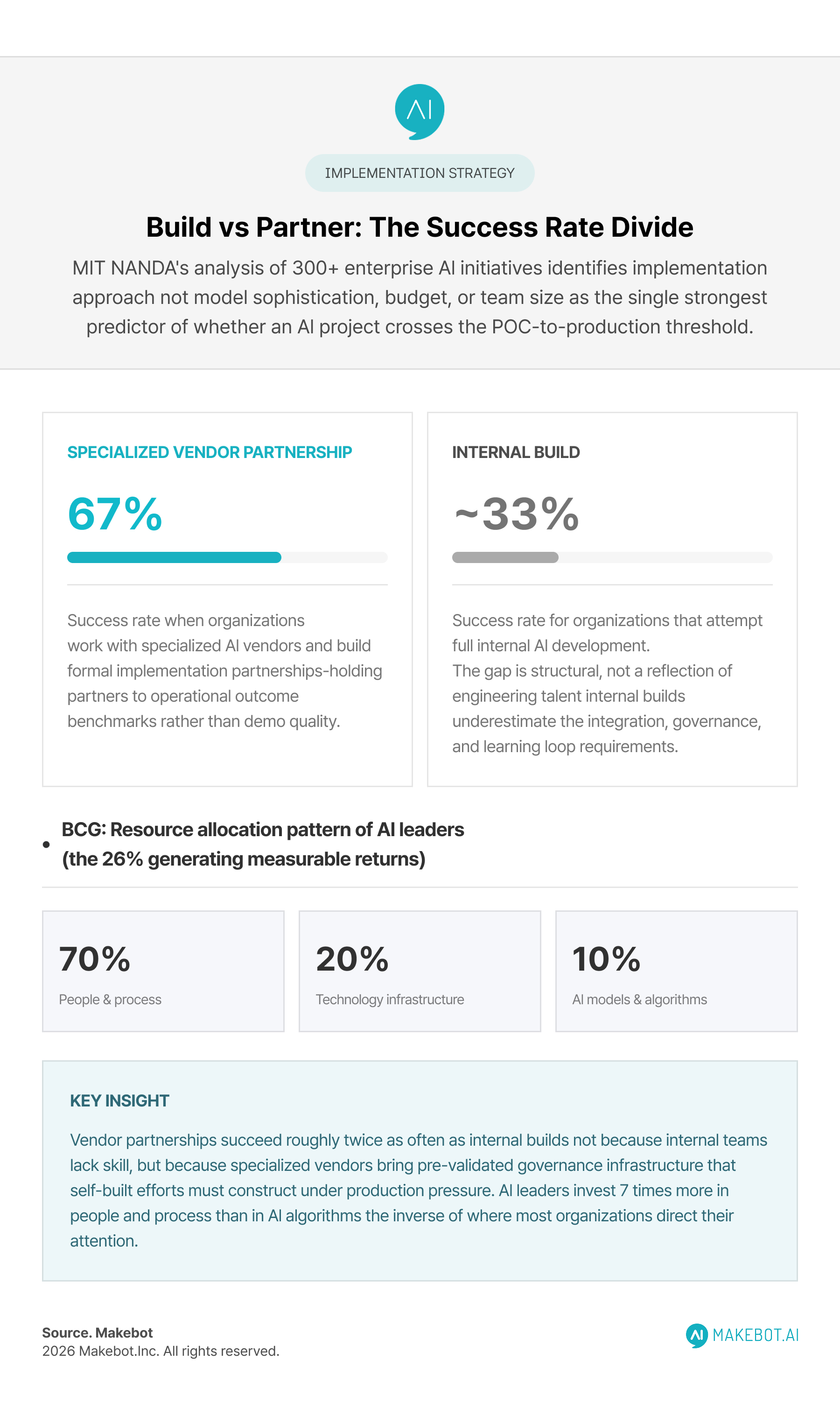
MIT NANDA (2025) identified implementation approach as the single strongest predictor of success across the initiatives reviewed:
- Strategic vendor partnerships succeed approximately 67% of the time, compared to roughly one-third for internal builds - a gap MIT describes as structural, not incidental.
- Top performers reported average pilot-to-full-implementation timelines of 90 days - achieved not through speed, but through narrow scope, embedded integration, and clear accountability from day one.
- Successful organizations treated specialized AI vendors less like software suppliers and more like operational partners, holding them to business outcome benchmarks rather than software demo criteria.
BCG's analysis reinforces the people-and-process dimension consistently. AI leaders - the 26% generating measurable returns - allocate 70% of their transformation resources to people and processes, 20% to technology, and only 10% to AI algorithms. These organizations are not running better models. They are running better-governed systems, embedded in core workflows, with defined ownership of outcomes and a clear answer to the 3 a.m. question.
The pattern is consistent: enterprise AI development succeeds when it starts from the 90% - governance, integration, permissions, and a knowledge architecture that compounds over time - not from the demo.
Deloitte Insights: AI Fluency Becomes the Most Valuable Workforce Skill. Read the full breakdown here!
So What Do We Do?
The gap between a demo and a production AI system is structural. That means it cannot be closed by adding resources to an existing effort, iterating faster, or selecting a better model. It requires a different starting point.
Organizations that have crossed the ceiling share one observable pattern: they did not mistake speed-to-demo for progress. They treated the invisible 90% as the primary engineering challenge and found partners who had already solved it - not building from scratch in their environment, but deploying proven infrastructure that was already running at scale.
The four practices that separate successful deployments from the 95% are consistent across the research:
- Define the problem before selecting the tool. The biggest driver of POC abandonment is not technical failure - it is unclear business value. Organizations that can articulate, in measurable terms, what a system must do differently from today before they build it dramatically outperform those that prototype first and define success later.
- Engineer the 90% from the start, not after. Permissions, closed-network governance, audit logging, and a self-reinforcing knowledge loop are architectural decisions. Organizations that treat them as features to be added post-demo consistently find the retrofit cost exceeds the original build.
- Evaluate partners on operational outcomes, not demo quality. MIT NANDA's finding that partnerships succeed twice as often as internal builds is not a statement about talent - it is a statement about infrastructure. Vendors who have already deployed at scale in regulated environments bring validated systems, not starting points.
- Narrow the scope until the accountability is unambiguous. The fastest-moving successful deployments in the MIT NANDA research identified one high-value operational problem, embedded AI into the existing workflow for that problem, and measured the outcome against a defined baseline. Breadth is the enemy of production-grade deployment.
This is hard to get right alone - and the organizations that attempt it alone are the ones populating the 95% that MIT NANDA documents. Defining the problem precisely, engineering the infrastructure correctly, and operating reliably in regulated environments at scale is specialized work. The data is clear on what happens when it is treated as a general-purpose sprint.
Showcasing Korea’s AI Innovation: Makebot’s HybridRAG Framework Presented at SIGIR 2025 in Italy. Read here!
Conclusion
Vibe coding is a genuine accelerant for the visible layer of software. A working prototype in hours, concept validation at near-zero cost, the ability to put something in front of stakeholders before committing an engineering team - for bounded, low-stakes use cases, that promise holds. The ceiling appears the moment the organization tries to push that prototype toward real depth: fine-grained permissions, closed-network governance, audit-grade logging, and the learning architecture that allows a system to compound institutional knowledge rather than reset it with every session.
Anyone can build the 10% that a demo shows. The 90% beneath it - the infrastructure that makes AI software engineering outcomes durable, secure, and operationally reliable in regulated environments - cannot be generated from a prompt. It must be architected, governed, and proven across real enterprise deployments at scale.
That is precisely what separates organizations generating 1.5 times the revenue growth of their peers from those writing off abandoned pilots. It is not a better model. It is a better-engineered system, embedded in a workflow that learns.
Makebot has solved this shape of problem across 1,000+ enterprise clients - in finance, healthcare, and the public sector - not by starting from scratch in each environment, but by deploying a proven, container-based production AI system that is already on the production side of the divide. Makebot's domain expertise spans the precise challenges that cause self-built efforts to stall: permission-aware retrieval, closed-network deployment, audit infrastructure, and a HybridRAG-powered knowledge loop that compounds organizational intelligence over time rather than discarding it. That framework was not built for demos - it was built for deployment, and validated at SIGIR 2025 among the world's leading information retrieval researchers.
See how Makebot can help your organization build AI that works inside your workflows.






.jpg)

What Happens to Marketing When the C-Suite Starts Using AI Every Day?







Why AI Shopping Assistants Will Replace Traditional Ecommerce Search






.jpg)
























Why Generative AI Projects Fail and How to Achieve Scalable AI Success











.jpg)

.png)