Deloitte: 70% of Leaders Prioritize Agility as AI Reshapes Business Strategy
Agility, not AI tools, now defines competitive strategy as 70% of leaders prioritize speed.

Keywords : Generative AI , Deloitte Report , AI in business strategy , enterprise AI adoption , AI leadership strategy , Digital transformation
The latest Deloitte Report signals a structural shift in how organizations compete: 70% of business leaders now define their competitive strategy around speed and agility as artificial intelligence accelerates transformation across industries .
This is not a marginal trend—it reflects a fundamental redesign of AI in business strategy, where static planning models are rapidly giving way to dynamic, continuously adaptive systems.
As Generative AI and enterprise-scale automation reshape workflows, decision-making, and customer engagement, the ability to sense, respond, and reconfigure operations in real time is emerging as the new strategic baseline—not a differentiator.
LLM Optimization for B2B Marketing: Architecture, RAG Pipelines, and AI Strategies for Enterprise Growth. Read more here!
1. The Compression of Strategy Cycles in the AI Era
One of the most critical insights from the Deloitte Report is the compression of the traditional S-curve of business growth. Historically, organizations moved through gradual growth, acceleration, and plateau phases. Today, AI is collapsing these cycles.
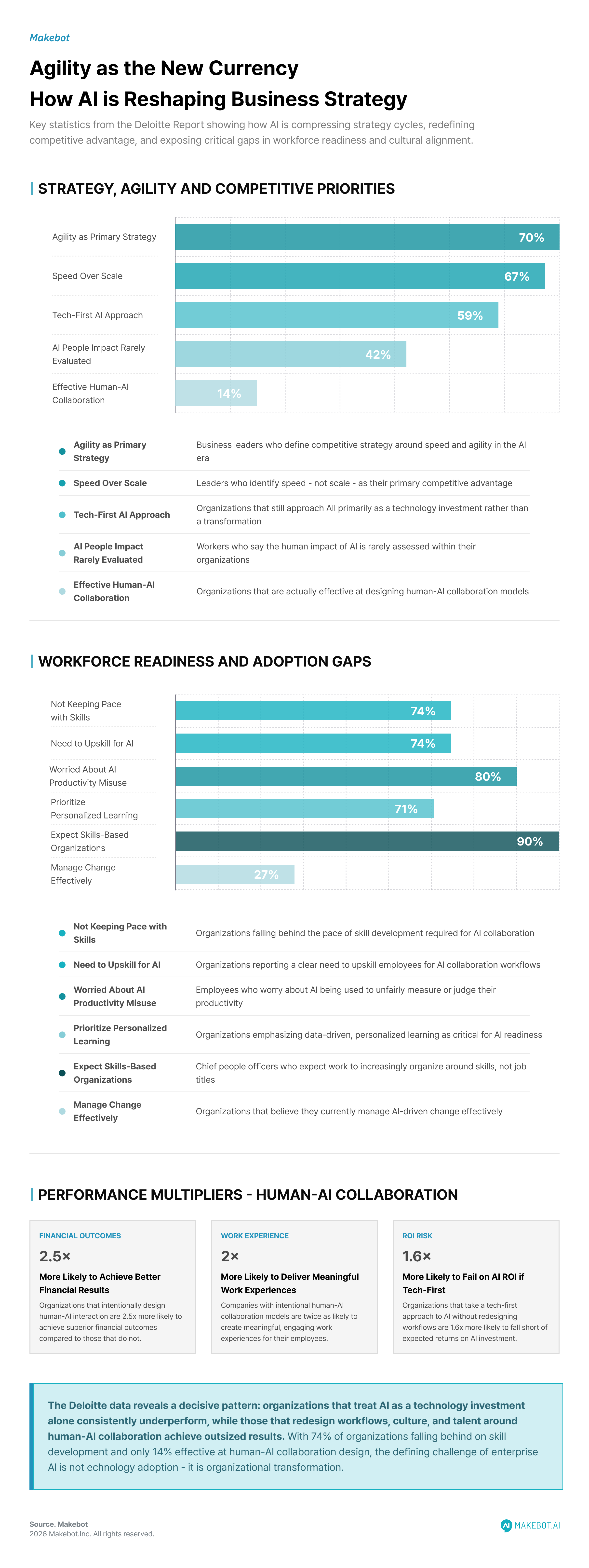
- 70% of leaders prioritize agility and speed as their primary strategy
- 67% identify speed—not scale—as their main competitive advantage
- Only 28% still view scale as a primary differentiator
This shift has profound implications for enterprise AI adoption:
- Long-term strategic planning cycles are becoming obsolete
- Execution and strategy are converging into a single continuous loop
- Competitive advantage now depends on real-time adaptability
In practice, this means organizations must move from “plan → execute → evaluate” to “sense → experiment → adapt → repeat.”
2. AI Is Not the Advantage—Human Adaptability Is
A counterintuitive but crucial finding: AI itself is no longer the primary source of differentiation.
- 59% of organizations still take a tech-first approach to AI
- These firms are 1.6× more likely to fail to achieve expected ROI
- Only 14% of organizations are effective at designing human–AI collaboration
This highlights a core limitation in current AI leadership strategy—over-indexing on tools rather than transformation.
Key Insight:
Competitive advantage is shifting from technology ownership → capability orchestration
Organizations that succeed are those that:
- Redesign workflows for human–AI collaboration
- Integrate Generative AI into decision processes—not just automation layers
- Prioritize judgment, creativity, and adaptability as strategic assets
In short, AI amplifies capability—but humans define value.
Redefining talent in the AI era: From Tool Proficiency to Enterprise Advantage. More here!
3. The Hidden Risk: “Tech-First” AI Strategy Failure
Despite rapid enterprise AI adoption, many organizations are structurally misaligned.
Key Data Points:
- 59% of companies approach AI primarily as a technology investment
- Tech-first firms are 1.6× more likely to underperform on AI ROI
- Only 27% believe their organizations manage change effectively
- Just 8% are highly effective at continuous learning
Why This Happens:
- Workflow inertia – legacy processes remain unchanged
- Skill misalignment – workforce capabilities lag behind AI deployment
- Cultural resistance – lack of trust in AI outputs
- Fragmented ownership – AI initiatives isolated within IT
Strategic Trade-Off:
- Fast deployment vs sustainable value creation
- Automation efficiency vs organizational reinvention
The data suggests that speed without redesign leads to diminishing returns.
4. Human–AI Collaboration as the New Operating Model
The Deloitte Report emphasizes a transition from “human + machine” → “human × machine” collaboration.
This is not incremental—it’s architectural.
Emerging Operating Principles:
- AI becomes a co-decision-maker, not just a tool
- Workflows are redesigned around capability integration
- Decision rights must be explicitly redefined
Supporting Data:
- Organizations that intentionally design human–AI interaction are:
- 2.5× more likely to achieve better financial outcomes
- 2× more likely to deliver meaningful work experiences
This represents a critical evolution in AI in business strategy—from deployment to orchestration.
5. The Rise of “Cultural Debt” in AI Transformation
One of the most overlooked risks in Digital transformation is what Deloitte terms “cultural debt.”
Key Statistics:
- 42% of workers say AI’s impact on people is rarely evaluated
- 80% of employees worry about misuse of AI for perceived productivity
What Is Cultural Debt?
The accumulation of:
- Trust gaps
- Unclear accountability
- Misaligned incentives
- Perceived unfairness in AI-assisted work
Strategic Implication:
Unchecked cultural debt can:
- Erode employee trust
- Reduce adoption rates
- Undermine long-term ROI
This is a critical blind spot in many AI leadership strategy frameworks.
6. Workforce Agility: The Real Bottleneck to AI Value
While AI capabilities are advancing rapidly, workforce readiness is not.
Key Data:
- 74% of organizations are not keeping pace with required skill development
- 74% also report a need to upskill employees for AI collaboration
- 71% emphasize data-driven, personalized learning as critical
The Core Challenge:
Traditional learning models cannot keep up with:
- Rapid evolution of Generative AI tools
- Continuous changes in workflows
- Increasing complexity of decision environments
Required Shift:
From: Static training programs
To: Continuous, embedded learning ecosystems
This reinforces that enterprise AI adoption is fundamentally a talent problem—not just a technology problem.
7. Reinvention as the New Baseline for Strategy
Perhaps the most important insight: Transformation is no longer episodic—it is continuous.
Key Observations:
- Innovation, scaling, and efficiency must now occur simultaneously
- Organizations must operate in a state of permanent reinvention
- Strategy and execution are becoming inseparable
Implications for AI leadership strategy:
- Leaders must shift from planners → orchestrators
- Organizations must build “always-on adaptability”
- Decision-making must become real-time and distributed
This marks the transition from Digital transformation → perpetual transformation.
8. Strategic Recommendations for AI-Driven Agility
Based on the Deloitte Report, high-performing organizations consistently demonstrate five strategic behaviors:
1. Redesign Work, Not Just Technology
AI value emerges from workflow transformation—not tool deployment.
2. Build Human Advantage
Invest in uniquely human capabilities:
- Judgment
- Creativity
- Adaptability
3. Operationalize Speed
Embed:
- Rapid experimentation
- Real-time analytics
- Dynamic resource allocation
4. Address Cultural Risk Early
Actively manage:
- Trust
- Transparency
- Accountability
5. Shift to Skills-Based Organizations
- 90% of chief people officers expect organizations to increasingly organize work around skills rather than job titles.
- Only 20-30% of organizations globally currently use skills-based workforce planning.
Conclusion: Agility Is the New Currency of AI Strategy
The Deloitte Report makes one thing clear: Agility is no longer optional—it is the foundation of modern strategy.
As Generative AI continues to scale across industries, the winners will not be those with the most advanced models, but those with the most adaptive systems.
The future of AI in business strategy will be defined by organizations that can:
- Continuously reinvent themselves
- Integrate human and machine intelligence seamlessly
- Balance speed with sustainability
- Align culture, talent, and technology
In an era where change is constant, the ability to adapt is the ultimate competitive advantage.
Showcasing Korea’s AI Innovation: Makebot’s HybridRAG Framework Presented at SIGIR 2025 in Italy. Read here!





.png)








.jpg)


What Happens to Marketing When the C-Suite Starts Using AI Every Day?







Why AI Shopping Assistants Will Replace Traditional Ecommerce Search






.jpg)

























Why Generative AI Projects Fail and How to Achieve Scalable AI Success










.jpg)

.png)