McKinsey: AI Could Save the Healthcare Industry $360 Billion Annually
How AI integration drives cost savings, efficiency, and clinical outcomes in healthcare


Healthcare is entering a period of structural transformation driven by AI in Healthcare. While the sector has historically lagged behind industries such as finance, retail, and logistics in technology adoption, recent analyses from Mckinsey and Harvard researchers suggest that artificial intelligence may become one of the most powerful productivity drivers the industry has ever seen.
Their research estimates that broader deployment of artificial intelligence applications could reduce healthcare spending by 5–10%, equivalent to $200–$360 billion annually in the United States alone. These estimates are based on currently available technologies and realistic adoption within the next five years—meaning the potential impact does not depend on speculative breakthroughs.
More importantly, the economic value extends beyond cost reduction. Properly implemented AI integration can improve clinical quality, reduce administrative friction, expand access to care, and alleviate clinician burnout.
This article explores how those savings emerge, what architectures enable them, and what real-world barriers still stand in the way.
Glossary of Technical Key Terms
- Generative AI – A class of artificial intelligence models capable of creating new content such as medical documentation, clinical summaries, or patient communication by learning patterns from large datasets.
- Predictive Healthcare Analytics – The use of machine learning models to analyze historical clinical and operational data in order to forecast health risks, patient outcomes, or hospital resource needs.
- Electronic Health Records (EHR) – Digital systems that store and manage patient medical information, including diagnoses, treatment history, lab results, and clinical notes across healthcare providers.
- Clinical Decision Support Systems (CDSS) – AI-powered tools that assist healthcare professionals by analyzing patient data and providing evidence-based recommendations for diagnosis or treatment.
- Reinforcement Learning – A machine learning approach in which algorithms learn optimal actions through trial-and-error interactions with an environment, often used for optimizing complex processes like hospital scheduling or resource allocation.
Stanford Develops Real-World Benchmarks for Healthcare AI Agents. Read more here!
The $360 Billion Opportunity: Where AI Creates Value
Healthcare is a $4.9 trillion industry in the United States, with operational complexity that far exceeds most sectors. A major portion of that spending is not directly tied to patient treatment.
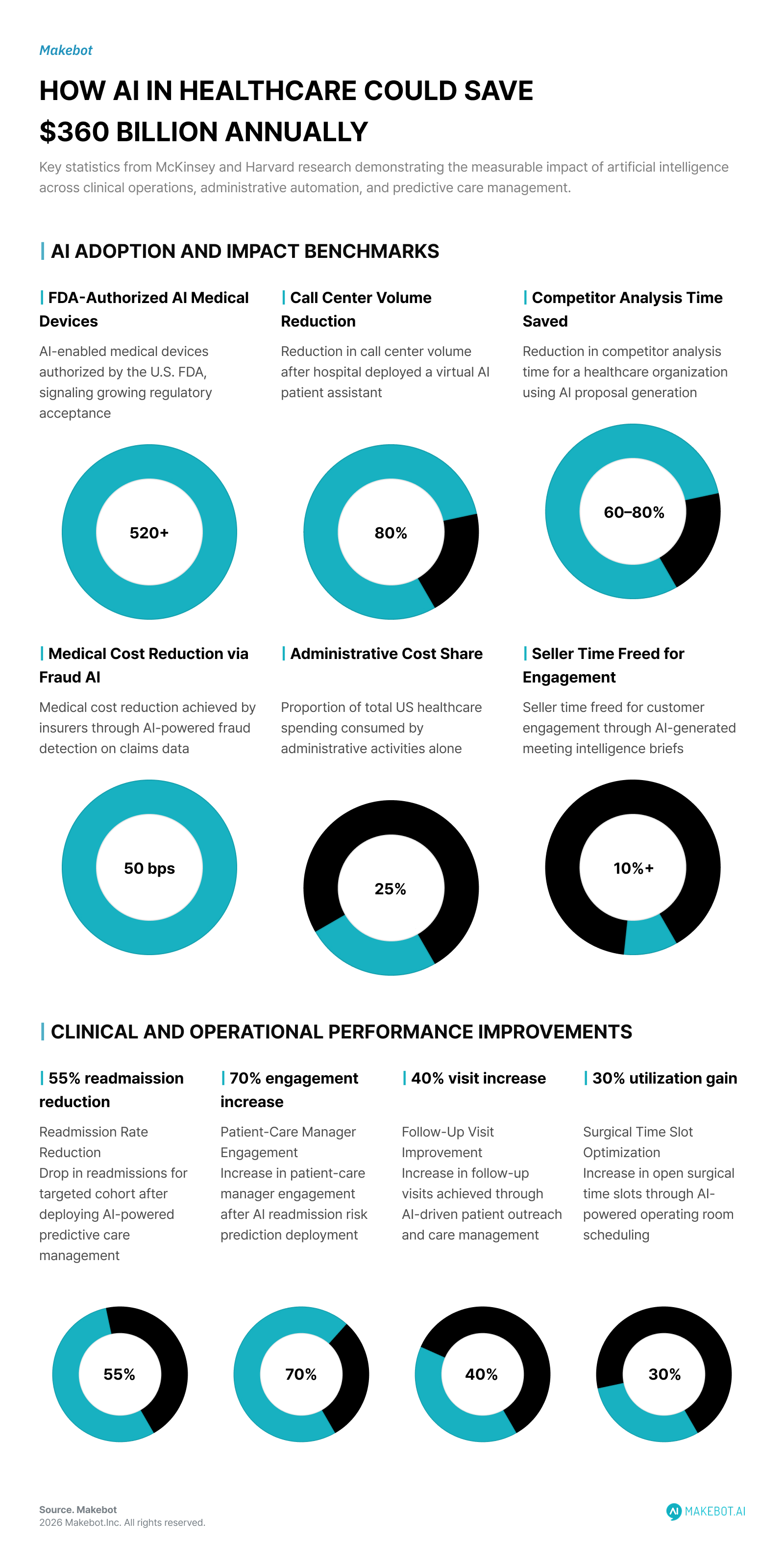
Administrative activities alone account for roughly 25% of total healthcare spending, making them one of the largest sources of inefficiency.
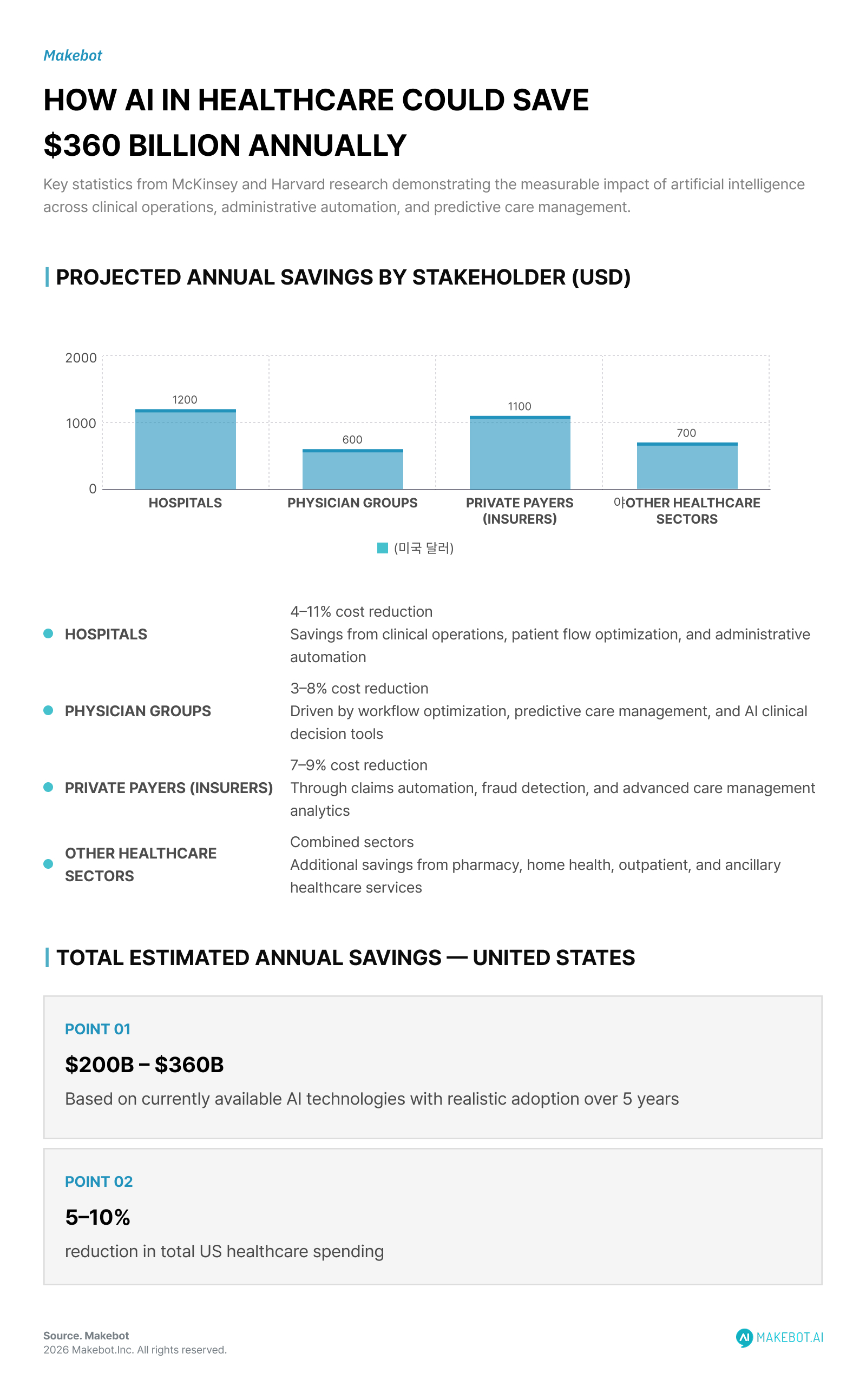
The Mckinsey analysis identifies three primary stakeholders where artificial intelligence applications could generate major cost reductions:
- Hospitals: Potential annual savings of $60 billion to $120 billion, representing 4–11% reductions in hospital costs, primarily through improvements in clinical operations, patient flow optimization, and administrative automation.
- Physician Groups: Estimated savings of $20 billion to $60 billion per year, or roughly 3–8% cost reductions, driven by workflow optimization, predictive care management, and AI-supported clinical decision tools.
- Private Payers: The largest opportunity lies with insurers, which could save $80 billion to $110 billion annually, equivalent to 7–9% cost reductions, largely through claims automation, fraud detection, and advanced care management analytics.
Combined with other healthcare sectors, these improvements could reach the $200–$360 billion total annual savings estimate.
The scale of this opportunity emerges from three primary transformation layers:
- Clinical operations optimization
- Administrative automation
- Advanced clinical decision support
Each layer represents a different class of healthcare solutions enabled by modern AI systems.
AI in Healthcare: High-Impact Use Cases
1. Clinical Operations Optimization
One of the most immediate opportunities for AI in Healthcare lies in operational efficiency.
Hospitals rely on complex scheduling systems, patient flows, and resource allocation processes. Many of these workflows remain largely manual or rule-based.
For example, a hospital deploying AI to optimize operating room scheduling increased open surgical time slots by 30%, improving patient access and utilization of expensive surgical infrastructure.
Typical AI-driven clinical operations improvements include:
- Operating room utilization optimization
- Patient flow prediction
- Bed capacity management
- Clinical workforce allocation
- Medical supply chain forecasting
These capabilities rely on machine learning models trained on historical hospital operations data.
Example Architecture
A typical operational AI system includes:
Data Sources
- Electronic Health Records (EHR)
- Hospital logistics systems
- Scheduling databases
- Real-time telemetry
AI Layer
- Demand forecasting models
- Reinforcement learning schedulers
- Resource allocation optimizers
Decision Layer
- Workflow recommendations
- Automated scheduling adjustments
- Real-time alerts
The result is a predictive healthcare operations platform capable of balancing patient demand with staff capacity.
2. Administrative Automation
Administrative inefficiency is one of the largest cost drivers in healthcare.
Processes such as:
- Prior authorization
- Insurance claims adjudication
- medical coding
- appointment scheduling
- billing
are often handled through manual workflows.
AI integration can automate many of these processes using natural language processing (NLP) and intelligent automation.
For example, one hospital deployed a virtual AI assistant to handle patient inquiries. The system reduced call center volume by nearly 30%, allowing staff to focus on more complex cases.
Private insurers are also using machine learning for fraud detection. In one deployment, an AI classification system analyzing historical claims data reduced medical costs by 50 basis points through improved fraud detection.
These improvements illustrate how artificial intelligence applications can significantly reduce operational overhead while improving service quality.
3. Predictive Care Management
Another major area of impact is predictive healthcare analytics. AI models can identify patients at risk of complications, readmission, or disease progression long before symptoms become severe.
For instance, one payer deployed an AI system predicting readmission risk using claims data and patient demographics. The results included:
- 70% increase in patient-care manager engagement
- 40% increase in follow-up visits
- 55% reduction in readmission rates for the targeted cohort
These outcomes demonstrate how predictive healthcare solutions can simultaneously improve outcomes and reduce costs. Key predictive AI use cases include:
- hospital readmission prediction
- early sepsis detection
- chronic disease progression modeling
- personalized treatment recommendations
Dr. Hamad Husainy on AI in Emergency Medicine: Restoring Clinical Clarity in a Data-Saturated ED. Read here!
The Role of Generative AI in Healthcare
While early AI in Healthcare deployments focused on predictive models, the next phase is being shaped by Generative AI.
Generative models enable new capabilities that were previously impossible at scale.
Examples include:
Clinical Documentation Automation
Clinicians spend significant time writing notes in electronic health records. Generative models can transcribe conversations and automatically structure them into medical documentation.
Automated Medical Coding
Large language models can analyze physician notes and generate billing codes in real time.
Patient Communication
AI chat agents can:
- answer patient questions
- schedule appointments
- provide medication reminders
- triage symptoms
These conversational healthcare solutions reduce clinician workload while improving patient access to information. However, the deployment of Generative AI also introduces risks including hallucinated outputs, privacy concerns, and regulatory compliance challenges.
System Architecture for AI Integration in Healthcare
Achieving meaningful cost savings requires enterprise-scale AI integration across healthcare systems.
Most successful deployments rely on layered architecture.
1. Data Infrastructure
Healthcare data is notoriously fragmented. A modern AI stack must unify data from:
- Electronic Health Records (EHR)
- Insurance claims
- medical imaging
- wearable sensors
- lab results
Interoperability APIs and data lakes are often required before models can be deployed.
2. Machine Learning Layer
This layer includes:
- predictive models
- natural language processing
- computer vision for imaging
- optimization algorithms
3. Decision Support Layer
Outputs are integrated into clinical workflows:
- EHR alerts
- clinical dashboards
- automated administrative workflows
Without seamless workflow integration, even accurate AI systems often fail to deliver measurable value.
Why Healthcare Has Been Slow to Adopt AI
Despite its enormous potential, adoption of AI in Healthcare has been slower than in many other industries.
Several structural challenges explain this gap.
1. Data Fragmentation
Healthcare systems use incompatible IT systems and data formats. This limits the ability to train high-quality models.
2. Limited Evidence
Academic studies evaluating clinical AI outcomes remain scarce. Some research has found a “paucity of robust evidence” demonstrating improved clinical outcomes.
3. Regulatory Uncertainty
Regulatory agencies are still developing frameworks for AI-based medical software. However, progress is accelerating. The U.S. FDA has already authorized more than 520 AI-enabled medical devices, signaling growing regulatory acceptance.
4. Trust and Ethical Concerns
Patients and clinicians remain cautious about algorithmic decision-making, particularly when transparency is limited. Issues include:
- algorithmic bias
- patient privacy
- explainability of AI decisions
OpenAI Report Reveals Accelerating Enterprise AI Adoption in Healthcare. Read here!
Lessons from Other Industries
Healthcare is not the first industry facing AI-driven transformation. Retail, logistics, aviation, and finance have already demonstrated the value of operational AI systems.
For example:
- UPS route optimization systems save $300–$400 million annually in fuel costs.
- Retail companies have reduced inventory holdings by up to 90% using AI forecasting models.
These industries illustrate a key lesson: AI generates the most value when organizations redesign workflows around it rather than simply inserting algorithms into legacy processes.
Healthcare organizations must follow a similar approach.
The Road Ahead: From Pilots to Enterprise Transformation
Many healthcare organizations are still experimenting with pilot AI deployments. However, pilots alone rarely produce measurable economic value.
According to Mckinsey, successful AI adoption requires several structural changes:
- Executive-level commitment to AI strategy
- Enterprise-scale deployment beyond small pilots
- Interdisciplinary teams combining clinical and technical expertise
- Long-term investment in data infrastructure
Organizations that treat AI as a core capability—rather than an experimental tool—are more likely to capture the full benefits of AI integration.
Conclusion: AI as the Next Productivity Engine for Healthcare
Healthcare faces a fundamental productivity crisis. Costs continue rising while workforce shortages intensify and patient demand grows.
The research from Mckinsey suggests that AI in Healthcare could become the industry's next major productivity engine.
By combining predictive analytics, operational automation, and Generative AI, healthcare organizations could unlock $200–$360 billion in annual savings while simultaneously improving care quality and patient experience.
Yet achieving this transformation requires more than technology.
It demands a systemic redesign of healthcare workflows, infrastructure, and governance around artificial intelligence applications.
The organizations that succeed in building these AI-enabled healthcare solutions will likely define the next generation of global healthcare systems.
For healthcare organizations aiming to capture the full value of AI integration, scalable infrastructure is essential. Platforms such as Makebot are advancing enterprise AI deployment through innovations like the HybridRAG framework, which combines large language models with pre-generated domain knowledge bases to deliver fast, accurate responses from complex medical and administrative documents.
Showcasing Korea’s AI Innovation: Makebot’s HybridRAG Framework Presented at SIGIR 2025 in Italy. Read here!
This architecture enables healthcare providers, insurers, and clinical teams to transform fragmented data into actionable intelligence—supporting automated documentation, knowledge retrieval, and decision support while maintaining the reliability required for high-stakes healthcare environments.
👉 Start your AI transformation: www.makebot.ai
📩 Inquiries: b2b@makebot.ai
.jpg)


What Happens to Marketing When the C-Suite Starts Using AI Every Day?








Why AI Shopping Assistants Will Replace Traditional Ecommerce Search






.jpg)


























Why Generative AI Projects Fail and How to Achieve Scalable AI Success










.jpg)

.png)