The Growing Role of AI Chatbots in Modern Healthcare Communication
How conversational AI restructures healthcare communication and administrative workflows.

Healthcare communication has long been one of the most complex and resource-intensive aspects of healthcare delivery. From appointment scheduling and insurance inquiries to symptom triage and follow-up care instructions, healthcare providers must manage a constant flow of patient interactions across multiple channels. As patient demand continues to grow, these communication workloads have become increasingly difficult for hospitals and clinics to manage efficiently.
This is where AI in healthcare is beginning to reshape operational infrastructure. Conversational technologies—particularly the AI Chatbot—are emerging as scalable digital interfaces capable of automating routine communication while improving responsiveness and patient engagement.
Rather than functioning merely as automated FAQ tools, modern healthcare chatbots are evolving into integrated communication platforms that connect patient conversations with clinical systems, scheduling platforms, and administrative workflows. As healthcare organizations continue investing in AI Development, conversational AI is becoming a foundational component of communication strategies across modern healthcare systems.
Glossary of Technical Key Terms
- AI Chatbot – An AI-powered conversational system that interacts with patients through text or voice to automate healthcare communication tasks.
- Natural Language Processing (NLP) – A core AI technology that enables chatbots to understand, interpret, and respond to human language in healthcare conversations.
- Natural Language Understanding (NLU) – A subfield of NLP that allows conversational systems to identify user intent and extract key information from patient messages.
- Electronic Health Records (EHRs) – Digital systems that store and manage patient medical information, which healthcare chatbots can access through system integration.
- Dialogue Management System – The conversational engine that controls how a chatbot responds, asks follow-up questions, and manages the flow of interactions.
Can AI Help Doctors Identify Patients at Risk of Suicide? Read more here!
The Communication Bottleneck in Modern Healthcare
Healthcare organizations worldwide face a growing mismatch between patient communication demand and available administrative capacity. Traditional communication channels—phone calls, front-desk interactions, and manual coordination—were not designed to handle the scale and complexity of modern healthcare operations.
According to research from the American Medical Association, physicians spend nearly two hours on administrative tasks for every hour of direct patient care, highlighting the extent to which non-clinical communication tasks consume valuable medical resources.
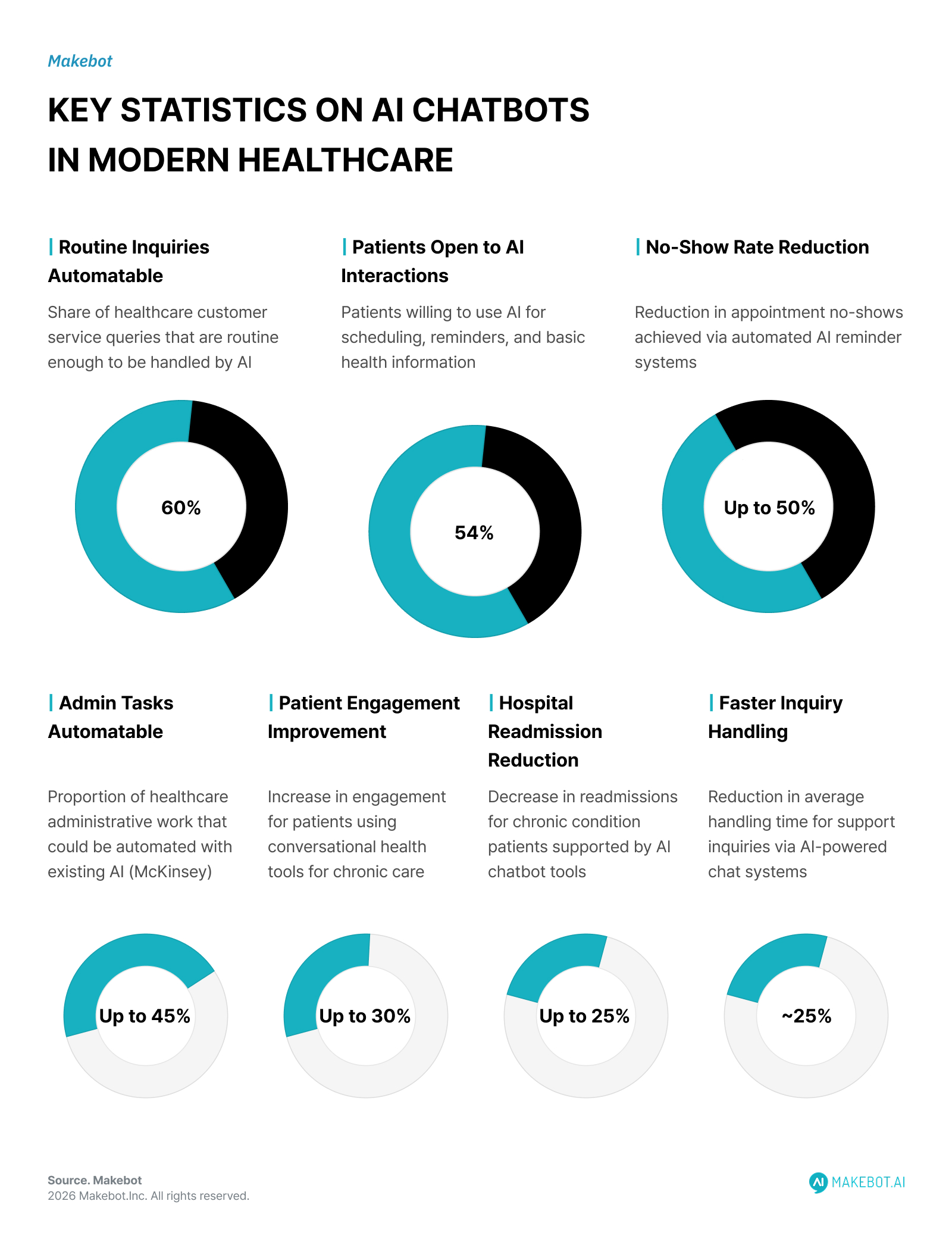
This imbalance has significant implications for healthcare efficiency. Administrative interactions such as appointment scheduling, billing questions, prescription refills, and insurance verification represent a large share of healthcare communication volume. Deloitte estimates that nearly 60% of healthcare customer service inquiries involve routine requests that could potentially be automated, making them ideal candidates for conversational AI solutions.
As healthcare systems face increasing patient demand, workforce shortages, and rising operational costs, automation technologies such as AI Chatbot platforms are increasingly viewed as essential tools for scaling healthcare communication infrastructure.
What Defines a Healthcare AI Chatbot
A healthcare AI Chatbot is an AI-powered conversational interface designed to interact with patients through text or voice channels. These systems rely on natural language processing (NLP) and machine learning algorithms to interpret patient queries, retrieve relevant information, and generate responses in real time.
Unlike traditional rule-based chat systems that rely on static decision trees, modern conversational systems use natural language understanding (NLU) models capable of interpreting patient intent even when phrased in ambiguous or conversational language.
Healthcare chatbots typically support multiple communication tasks, including:
- Answering patient questions 24/7
- Scheduling or rescheduling medical appointments
- Providing insurance and billing information
- Sending medication reminders and follow-up instructions
- Escalating complex inquiries to human staff when needed
These capabilities enable healthcare organizations to maintain continuous patient communication without expanding administrative staffing.
10 Key LLM Market Trends for 2026. More here!
Architecture of Conversational Systems in AI in Healthcare
The effectiveness of a healthcare chatbot depends largely on its underlying architecture. Unlike simple customer service bots, healthcare chatbots must operate within a highly regulated and technically complex environment.
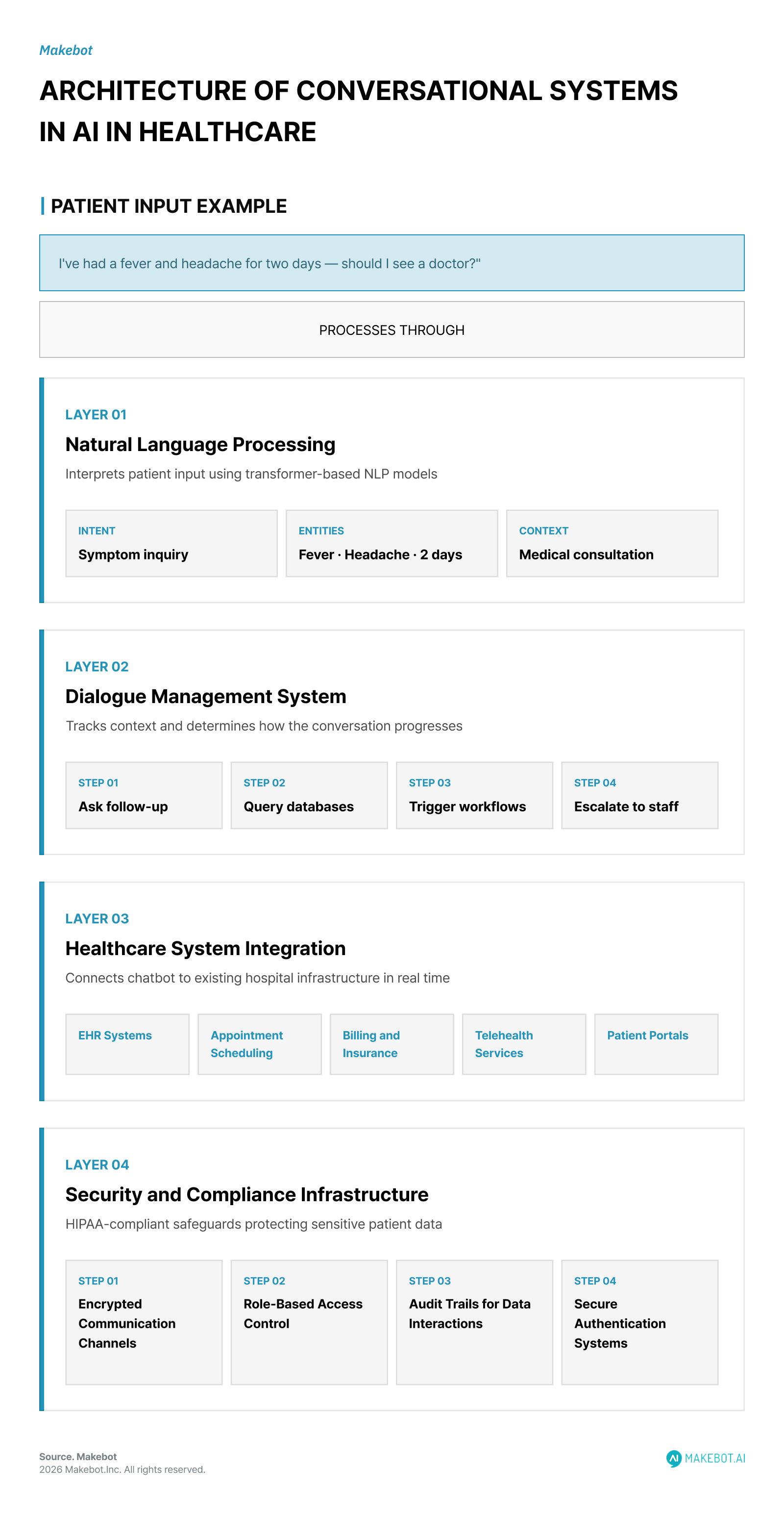
Most enterprise-grade chatbot systems deployed in modern healthcare environments consist of four major architectural layers.
Natural Language Processing Layer
This layer interprets patient input using NLP models trained to recognize medical terminology, conversational phrasing, and patient intent. Modern NLP systems use transformer-based architectures that can process complex natural language interactions.
For example, when a patient types:
"I’ve had a fever and headache for two days—should I see a doctor?"
The NLP system identifies:
- Intent: symptom inquiry
- Entities: fever, headache, duration
- Context: potential medical consultation
These insights allow the chatbot to generate appropriate follow-up questions or recommendations.
Dialogue Management System
The dialogue management engine determines how the conversation progresses. It tracks conversation context and decides whether the system should:
- ask additional questions
- retrieve information from medical databases
- trigger operational workflows
- escalate to human staff
Advanced conversational platforms continuously improve through machine learning feedback loops, analyzing interaction outcomes and patient satisfaction metrics to refine dialogue strategies.
Healthcare System Integration Layer
For an AI Chatbot to function effectively within healthcare environments, it must integrate with existing hospital infrastructure.
These integrations commonly include:
- Electronic health records (EHRs)
- Appointment scheduling systems
- Billing and insurance platforms
- telehealth services
- patient portals
This integration allows chatbots not only to answer questions but also to execute real tasks—such as booking appointments or retrieving patient records—within healthcare systems.
Security and Compliance Infrastructure
Healthcare data security requirements are significantly stricter than in most other industries. Chatbots handling patient communication must comply with strict regulatory frameworks such as HIPAA to ensure the protection of sensitive medical information.
Healthcare chatbot systems therefore incorporate:
- encrypted communication channels
- role-based access control
- audit trails for patient data interactions
- secure authentication systems
Without these safeguards, chatbot deployments risk compromising patient privacy and regulatory compliance.
Operational Efficiency Gains from Healthcare Chatbots
The adoption of conversational AI in healthcare communication is largely driven by measurable operational benefits.
Automation of Administrative Work
Administrative processes represent one of the largest operational burdens in healthcare systems. Appointment management, insurance verification, and patient inquiries generate enormous volumes of routine communication.
A McKinsey study found that up to 45% of healthcare administrative tasks could be automated using existing technologies, including conversational AI platforms and workflow automation systems.
By automating these tasks, healthcare providers can redirect human staff toward higher-value clinical responsibilities.
Reduction in Healthcare Communication Costs
Healthcare call centers require substantial staffing, training, and infrastructure investments. Scaling these operations to meet growing patient demand can significantly increase operational costs.
Conversational AI offers a cost-efficient alternative. According to IBM research, organizations deploying AI-powered chatbots can reduce customer service costs by up to 30% through automation and improved response efficiency.
Additionally, industry analyses indicate that digital chatbot interactions can cost up to 50% less than traditional live-agent phone calls, creating a strong economic incentive for healthcare providers to adopt conversational automation.
Improving Patient Engagement Through Conversational AI
Beyond operational efficiency, chatbots play an increasingly important role in improving patient engagement.
One of the major advantages of chatbot systems is their ability to provide continuous communication. Unlike traditional healthcare communication channels that operate during office hours, chatbots can provide patient support 24 hours a day.
This constant availability significantly improves patient access to information and services.
Research from Accenture indicates that 54% of patients are willing to use AI technologies for basic healthcare interactions, particularly for scheduling appointments, receiving reminders, and accessing health information.
Additionally, global healthcare reports estimate that more than 40 million people now use AI tools for health-related queries, including symptom checks and treatment guidance.
These trends suggest that conversational AI is rapidly becoming a mainstream interface for patient communication.
Key Healthcare AI Trends Shaping Innovation in 2026. Read here!
Real-World Applications of AI Chatbots in Healthcare
Healthcare organizations are deploying chatbots across multiple stages of the patient journey.
Symptom Assessment and Triage
Conversational AI systems can conduct preliminary health assessments by collecting symptom information and guiding patients toward appropriate care options.
Typical chatbot triage workflow:
- Patient describes symptoms through chat interface
- Chatbot asks follow-up questions to clarify context
- System evaluates severity using clinical decision rules
- Patient receives recommended care options
This process helps reduce unnecessary emergency visits while ensuring urgent cases receive timely attention.
Appointment Scheduling and Reminders
Appointment management is one of the most widely deployed chatbot use cases.
Chatbots can automatically:
- schedule appointments based on provider availability
- send automated reminders
- manage cancellations and rescheduling
Research indicates that automated reminder systems can reduce appointment no-show rates by 20–50%, improving clinic efficiency and patient care continuity.
Chronic Disease Management
For patients managing long-term conditions such as diabetes, hypertension, or heart disease, continuous communication is critical.
Healthcare chatbots can support chronic care management by:
- sending daily symptom check-ins
- providing medication reminders
- tracking patient-reported health metrics
- delivering educational resources
Studies suggest that conversational health tools can improve patient engagement by up to 30% and reduce hospital readmissions for chronic conditions by up to 25%, demonstrating their potential impact on long-term health outcomes.
Performance Metrics from Real-World Deployments
Real-world implementations of conversational AI in healthcare have demonstrated measurable performance improvements.
Industry benchmarks show that healthcare chatbot systems can achieve:
- 30–50% call containment rates, reducing the number of interactions requiring human staff
- 25% reductions in average handling time for support inquiries
- improved patient satisfaction metrics through faster response times
These metrics illustrate why conversational AI is increasingly viewed as a strategic communication infrastructure within healthcare systems.
Adoption Trends in AI in Healthcare
Despite growing interest, conversational AI adoption across healthcare remains relatively early in its lifecycle.
Industry research indicates that approximately 19% of medical group practices currently use chatbots or virtual assistants for patient communication, suggesting significant room for growth.
However, adoption is expected to accelerate rapidly in the coming years. Analysts forecast that up to 30% of healthcare communication interactions could be handled by AI systems by 2026, as conversational technologies become more advanced and healthcare providers expand digital transformation initiatives.
The Future of Conversational AI in Modern Healthcare
As AI Development continues to advance, conversational systems will likely become a core component of healthcare digital infrastructure.
Future developments in AI in healthcare may include:
- Large language model–powered clinical assistants
- voice-based conversational agents integrated with telehealth platforms
- predictive patient engagement systems that initiate proactive outreach
- personalized communication based on patient health data and medical history
These innovations could significantly transform how healthcare providers manage patient communication and operational workflows.
Conclusion
The rapid growth of conversational AI reflects a broader shift in healthcare toward digital communication infrastructure. As healthcare systems struggle to manage rising patient demand and administrative complexity, the AI Chatbot is emerging as a powerful solution for improving communication efficiency and patient engagement.
By automating routine interactions, integrating with healthcare systems, and providing continuous patient support, conversational AI is becoming an essential component of AI in healthcare strategies.
While challenges related to data accuracy, system integration, and privacy remain, ongoing AI Development is steadily improving the reliability and capabilities of conversational systems.
As adoption continues to expand, AI Chatbots will likely play a central role in shaping the future of communication within modern healthcare, enabling healthcare providers to deliver faster, more efficient, and more patient-centered care.
Healthcare providers adopting AI Chatbot platforms can significantly reduce administrative workload by automating routine patient inquiries such as appointment scheduling, billing questions, and care instructions. Conversational AI systems integrated with hospital scheduling and knowledge systems enable organizations to handle high volumes of patient requests instantly, helping reduce inbound call traffic while improving response speed and patient engagement.
Showcasing Korea’s AI Innovation: Makebot’s HybridRAG Framework Presented at SIGIR 2025 in Italy. Read here!
Makebot’s AI Development platform delivers enterprise-grade conversational Medical Solutions designed for high-volume environments in Modern Healthcare. By combining advanced retrieval architecture with real-time system integration, Makebot enables healthcare organizations to deploy scalable automation that improves operational efficiency and patient communication.
👉 Start your AI transformation: www.makebot.ai
📩 Inquiries: b2b@makebot.ai
.jpg)

What Happens to Marketing When the C-Suite Starts Using AI Every Day?









Why AI Shopping Assistants Will Replace Traditional Ecommerce Search






.jpg)


























Why Generative AI Projects Fail and How to Achieve Scalable AI Success









.jpg)

.png)