Can Generative AI Improve Early Disease Detection Through Predictive Healthcare Analytics?
AI mammography detects 25% more cancers than human readers alone — predictive healthcare analytics.

Introduction
Modern healthcare faces a persistent paradox. Global healthcare data is growing at a compound annual rate of 36%, projected to reach 10,800 exabytes by 2025 — yet approximately 80% of that data remains unstructured and clinically underutilized. Buried in imaging archives, clinical notes, and genomic records, this data contains early signals of diseases that are regularly diagnosed too late.
Generative AI in healthcare is designed to resolve that paradox. Unlike rule-based systems, generative AI models synthesize heterogeneous clinical data — imaging, genomics, EHR narratives, lab trends — into actionable risk signals far earlier than human clinicians can achieve working alone. When combined with predictive healthcare analytics, these models shift medicine from reactive treatment toward proactive, data-driven prevention.
This article examines where AI disease detection is demonstrably outperforming legacy approaches, what distinguishes high-performing adopters from laggards, and what structural barriers the industry must address to move from validated pilots to sustained clinical impact.
Why AI Fails to Scale in Healthcare—and How to Fix It. Explore the latest insights here!
The Market Reality Behind Predictive Healthcare AI
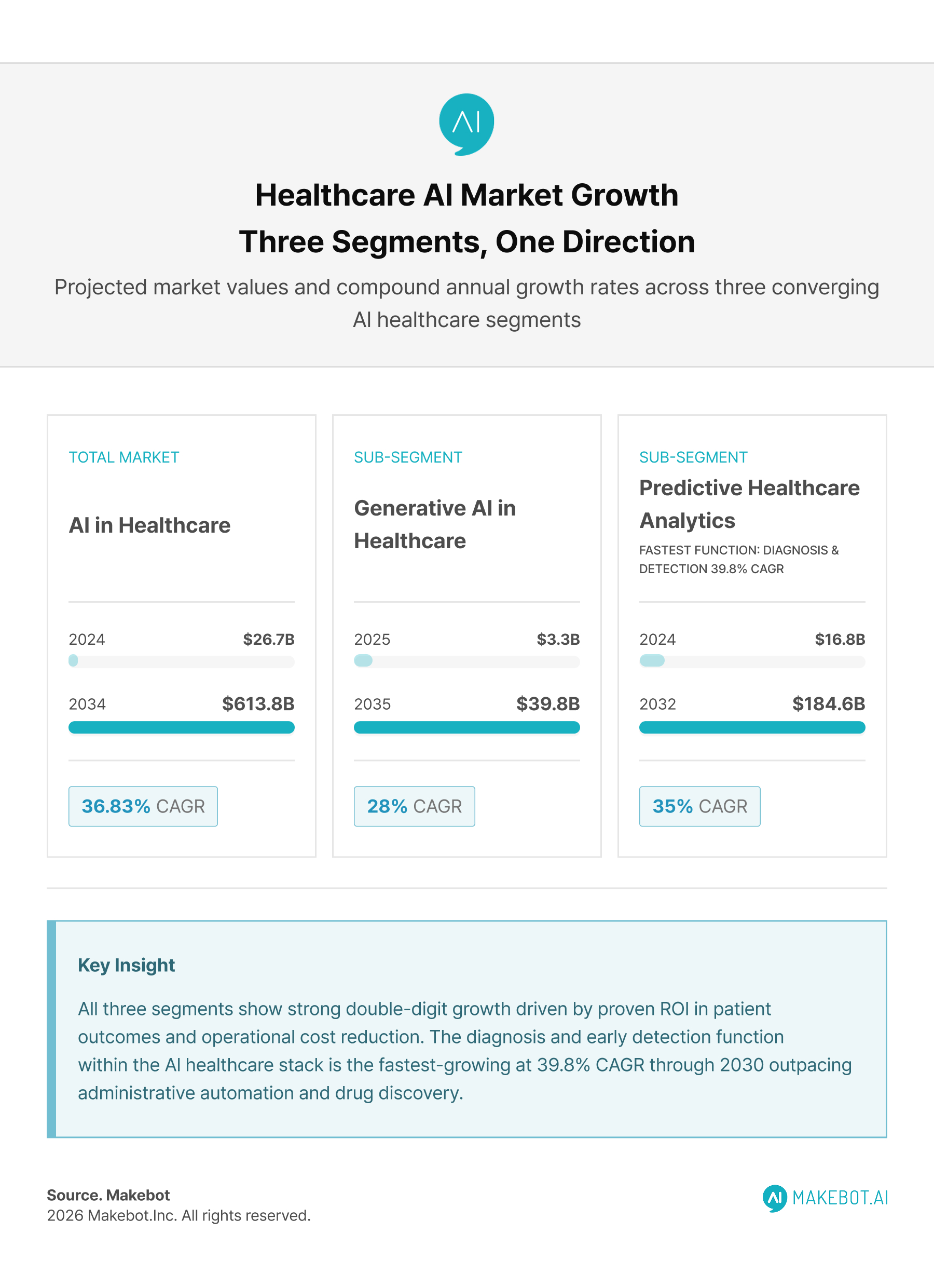
The scale of investment flowing into AI healthcare analytics reflects both clinical urgency and financial opportunity. According to Precedence Research, the global AI in healthcare market reached approximately $26.69 billion in 2024 and is projected to reach $613.81 billion by 2034 at a CAGR of 36.83%. Within that, the generative AI in healthcare segment is forecast to grow from $3.3 billion in 2025 to $39.8 billion by 2035 at a 28% CAGR (Roots Analysis).
The predictive healthcare analytics market specifically was valued at $16.75 billion in 2024 and is projected to reach $184.58 billion by 2032 at a CAGR of 35.0%, according to Fortune Business Insights. It is important to note that market size estimates vary considerably across research firms — figures from other providers for the same segment range from $11.84 billion to $18.13 billion in 2024, reflecting different scope definitions and methodologies. The directional consensus, however, is clear: strong double-digit growth driven by proven ROI in patient outcomes and operational cost reduction.
According to MarketsandMarkets, the diagnosis and early detection function is the fastest-growing segment in the AI healthcare stack, projected at 39.8% CAGR through 2030 — outpacing administrative automation and drug discovery.
Why Healthcare CIOs Need Enterprise Architecture to Scale AI. Read the expert analysis here!
How Generative AI Powers Early Disease Detection
The architectural advantage of generative AI in healthcare over traditional diagnostic tools is its ability to process unstructured, multimodal clinical data. Most clinically meaningful information — physician notes, discharge summaries, radiology narratives, patient-reported outcomes — is unstructured text that legacy ML systems cannot effectively operationalize. Large language models and multimodal AI architectures extract, structure, and integrate this data into risk models that consistently outperform structured-data-only approaches.
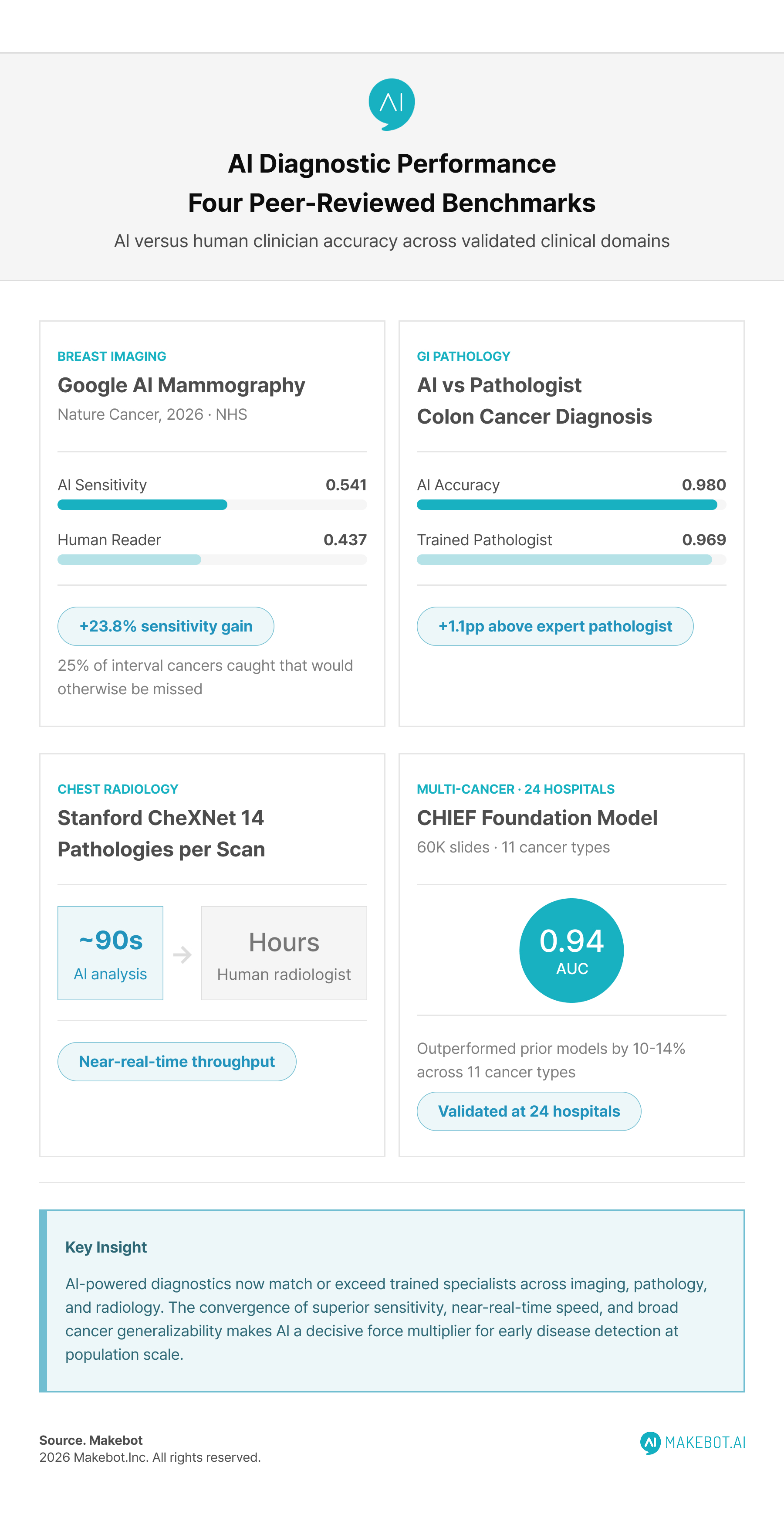
AI-powered diagnostics in medical imaging represent the most mature and evidence-rich application. Key benchmarks from peer-reviewed sources include:
- Google's mammography AI achieved 0.541 sensitivity vs. 0.437 for a first human reader, increasing cancer detection from 7.54 to 9.33 per 1,000 women screened, with 25% of interval cancers detected (Kelly et al., Nature Cancer, 2026).
- The CHIEF framework — trained on 60,000 whole-slide images from 14 cohorts — achieved an AUC of 0.9397 across 11 cancer types at 24 hospitals, outperforming prior models by 10–14%.
- Stanford's CheXNet analyzes chest X-rays for 14 pathologies in approximately 90 seconds — a process that typically requires several hours for a human radiologist.
- In colon cancer pathology, AI systems have demonstrated accuracy of 0.98 compared to 0.969 for trained pathologists.
Beyond imaging, predictive healthcare analytics is enabling early detection in cardiovascular disease, acute kidney injury, sepsis (6–12 hours before clinical deterioration), diabetic complications, and neurological conditions including Alzheimer's and psychosis onset. A multicenter international study published in Molecular Psychiatry (2024) found that a structural MRI classifier for adolescent psychosis-onset prediction achieved 73% accuracy on independent validation data — a significant milestone for neurological early detection.
McKinsey has noted that generative AI's ability to synthesize large volumes of patient history data frees physicians to focus on complex clinical decision-making while simultaneously enriching the pipelines that power detection algorithms — a dual-value proposition driving rapid enterprise adoption.
Gemini in Healthcare: Multimodal Intelligence Reshaping Clinical and Biomedical Systems. Discover what’s next here!
Enterprise Adoption: What Separates Leaders from Laggards
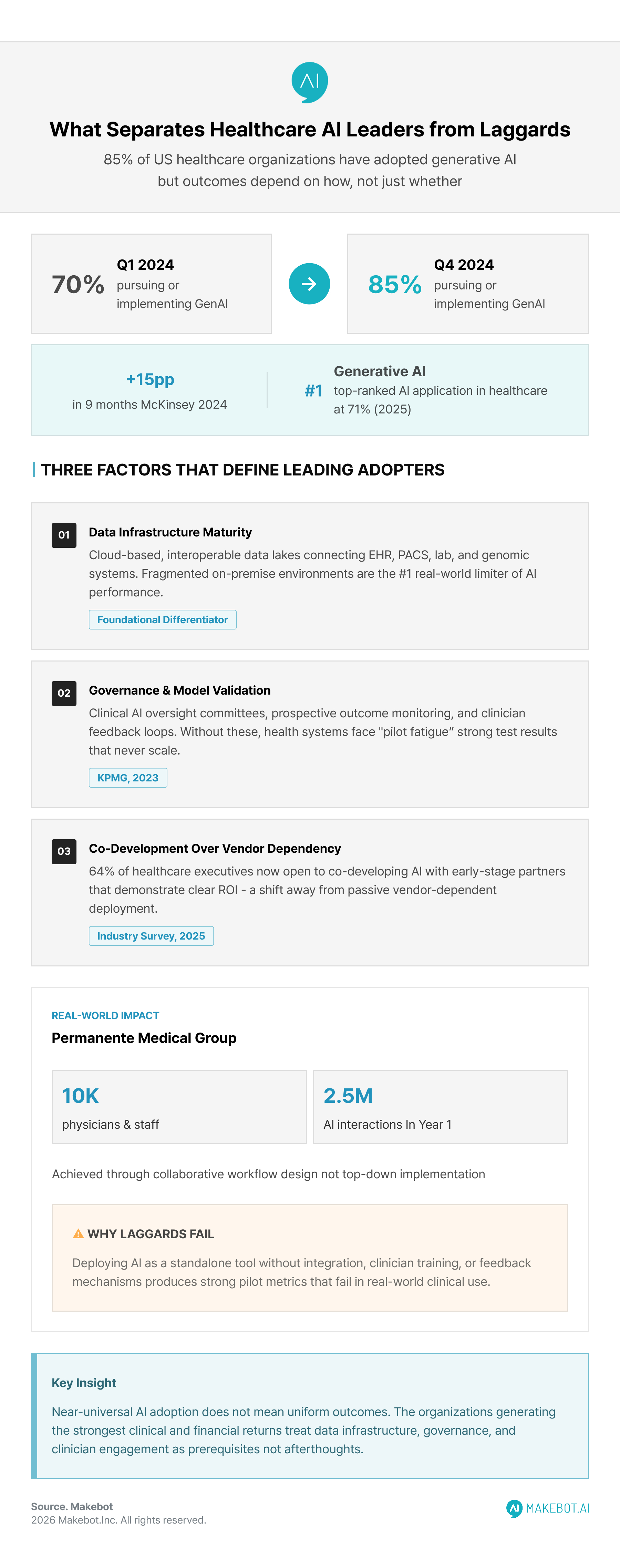
McKinsey's Q1 2024 survey of 100 US healthcare leaders found that more than 70% were pursuing or had already implemented generative AI capabilities. This adoption figure rose to 85% by Q4 2024 in McKinsey's follow-up survey of 150 US healthcare leaders. By 2025, generative AI ranked as the top AI application in healthcare AI at 71%, ahead of speech recognition (70%), agentic AI (68%), machine learning (66%), and robotics (65%), according to Vention Teams' 2025 healthcare AI statistics report.
Yet adoption quality varies significantly. Organizations achieving the strongest outcomes in AI in preventive healthcare consistently share several structural characteristics that struggling adopters lack:
- Data infrastructure maturity: Cloud-based, interoperable data lakes integrating EHR, PACS, laboratory, and genomic systems provide the multimodal foundation AI models require. Fragmented on-premise environments remain the single largest real-world limiter of AI healthcare analytics performance.
- Governance and model validation: Organizations that establish clinical AI oversight committees, mandate prospective outcome monitoring, and build clinician feedback loops into model refinement sustain performance over time. KPMG's 2025 healthcare analysts noted that many health systems face "pilot fatigue" due to insufficient clinical AI governance structures.
- Co-development models: A 2025 industry survey found 64% of healthcare executives open to co-developing AI with early-stage startup partners demonstrating clear ROI — shifting from the vendor-dependent patterns that dominated 2024.
The Permanente Medical Group's AI deployment enabled 10,000 physicians and staff to generate 2.5 million AI-assisted interactions within the first year — a scale achieved because clinical workflow integration was designed collaboratively, not imposed on existing processes.
How Generative AI and Automation Are Transforming Nursing Burnout Across Modern Healthcare Systems. Explore the future of AI here!
AI vs. Traditional Diagnostics: A Comparative Overview
The following table illustrates how early disease detection AI compares to conventional diagnostic approaches across key clinical dimensions.
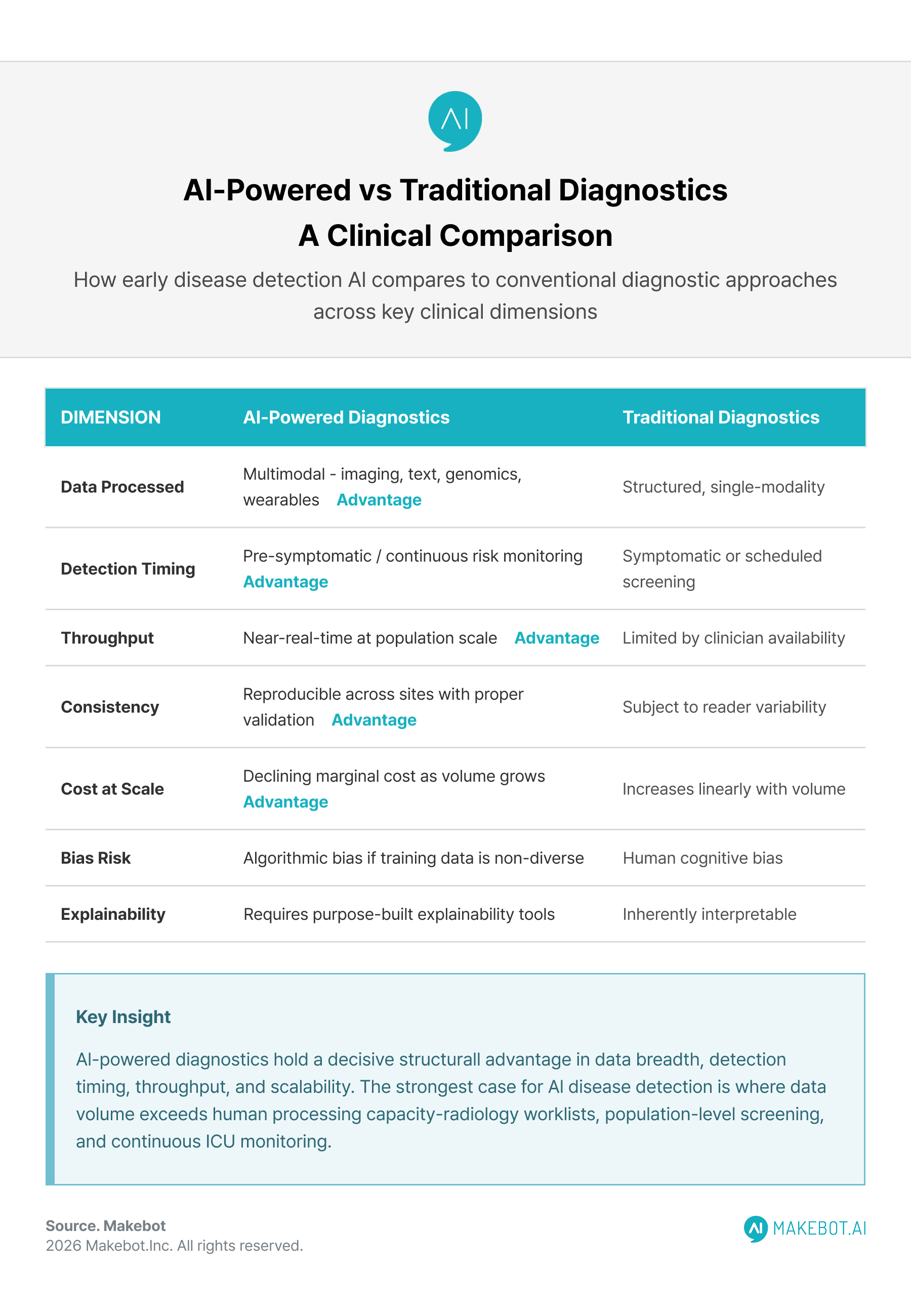
The case for AI disease detection is strongest where data volume exceeds human processing capacity — radiology worklists, population-level screening programs, continuous ICU monitoring — and weakest where training data diversity is insufficient to ensure equitable generalization.
McKinsey: AI Could Save the Healthcare Industry $360 Billion Annually. See how enterprises are transforming here!
Key Challenges Limiting Clinical Scale
Performance in controlled validation studies does not automatically translate to sustained real-world clinical impact. The transition to full deployment surfaces structural challenges the industry is still actively working through.
Algorithmic bias and equity represent the most serious clinical concern. Stanford HAI's 2025 AI Index confirmed that publications on ethics in medical AI quadrupled from 288 in 2020 to 1,031 in 2024 — driven largely by documented performance disparities across racial, socioeconomic, and demographic subgroups. Federated learning — training models across distributed institutional datasets without centralizing patient data — has emerged as the most technically viable response. Stanford HAI's 2025 Index also confirmed that AI-generated synthetic data is now being used to supplement underrepresented populations in training sets and enable privacy-preserving clinical risk modeling.
Data fragmentation remains the foundational infrastructure barrier. Despite decades of EHR investment, most health systems operate siloed data environments with proprietary vendor formats and inconsistent coding standards — creating systematic gaps in the predictive pipelines that predictive analytics in healthcare depends upon. The shift to cloud-based health data platforms is accelerating, but integration debt accumulated over years of siloed deployment remains substantial.
Regulatory complexity creates real deployment friction. The FDA's SaMD framework, the EU AI Act's high-risk clinical AI classification, and HIPAA's data governance requirements create a multi-jurisdictional compliance environment that extends deployment timelines. A 2025 Deloitte survey found that more than 80% of healthcare executives expect generative AI to have significant organizational impact, but regulatory oversight is simultaneously cited as the most common deployment barrier.
Clinical explainability and trust remain persistent adoption challenges. Clinicians retain legal and ethical accountability for diagnostic decisions, meaning black-box AI outputs without interpretable reasoning face ongoing resistance. Progress on attention-based interpretable architectures is meaningful, but the trust infrastructure required for durable clinical integration continues to lag capability development.
Stanford Develops Real-World Benchmarks for Healthcare AI Agents. Learn how industry leaders are adapting here!
The Long-Term Preventive Medicine Case
The most significant implication of AI in preventive healthcare is structural: a reorientation of healthcare economics from treatment-centric spending toward prevention-centric value creation. Early detection is not merely a clinical priority; it is a health economics imperative.
The economic case is well-documented. A Microsoft-commissioned IDC study found that healthcare organizations investing in AI generate $3.20 for every $1 invested, typically within 14 months. AI-powered diagnostics and early disease detection AI operating at population scale — analyzing routine screening data, primary care records, pharmacy trends, and wearable sensor outputs — can identify highest-risk individuals for targeted early intervention at a cost-efficiency profile unachievable through human clinical review alone.
Stanford HAI's 2025 AI Index confirmed that a wave of large-scale medical AI foundation models — including Med-Gemini, EchoCLIP for echocardiography, and ChexAgent for radiology — was released in 2024, establishing the infrastructure layer for the next generation of AI healthcare analytics. The FDA's authorization of 223 AI-enabled medical devices by 2023 further confirms that regulatory normalization of AI in healthcare is already well underway.
Organizations building the data infrastructure, governance frameworks, and clinical partnerships to support these systems today are positioning for a decisive and durable competitive advantage as the field matures.
Showcasing Korea’s AI Innovation: Makebot’s HybridRAG Framework Presented at SIGIR 2025 in Italy. Read here!
Conclusion
The evidence is no longer ambiguous. Generative AI in healthcare, when paired with robust predictive healthcare analytics, has the technical foundation to fundamentally change how diseases are detected, managed, and ultimately prevented. The performance benchmarks are validated. The ROI is measurable. The market momentum is accelerating at nearly every level — from FDA device authorizations and venture capital investment to enterprise adoption rates and the release of specialized clinical foundation models.
What separates organizations that will lead this transformation from those that fall behind is not access to the technology — it is the organizational discipline to deploy it well. Data infrastructure, clinical governance, and clinician trust are the determinants of durable impact. Health systems that treat these as implementation prerequisites rather than afterthoughts will extract the full clinical and economic value that AI disease detection and preventive analytics make possible.
The shift from reactive treatment to proactive, data-driven care is not a future scenario. It is happening now — and the organizations investing in the right foundations today are the ones that will define what modern healthcare looks like for the next decade.





.png)







.jpg)


What Happens to Marketing When the C-Suite Starts Using AI Every Day?







Why AI Shopping Assistants Will Replace Traditional Ecommerce Search





.jpg)
























Why Generative AI Projects Fail and How to Achieve Scalable AI Success










.jpg)

.png)