AI Adoption Isn't the Competitive Advantage. Problem Definition Is.
88% of firms use AI , only 6% see real returns - MIT & McKinsey trace the gap to problem definition.


Introduction
Every week brings a new demo: a tool that writes an app in five minutes, a workflow that used to take a quarter now finished by lunchtime. The room applauds. Then the tab closes, and the same question lands on every team's desk: "so what do we actually do with this, for our business?" That gap - between the festival of capability and the blank screen that follows it - is not a talent problem or a hype problem. It is the defining fact of enterprise AI in 2025 and 2026. Enterprise AI adoption crossed 88% globally this year, according to McKinsey - and across nearly every major research house tracking the same question, from McKinsey to MIT to Gartner to BCG, the same uncomfortable pattern shows up: adoption is nearly universal, and measurable business impact is rare. This is not a story about AI underperforming. It is a story about what happens when a powerful, general-purpose tool meets an organization that has not yet defined the specific problem it needs to solve. This article uses the latest verified data to show why "adopting AI" was never the right goal, what that mistake costs operationally, and what the 5-6% of organizations capturing real value are doing differently.
Why AI Pilots Stall After POC (And How to Fix It). Explore the latest insights here!
The Adoption Number Everyone Cites - and the One Nobody Does
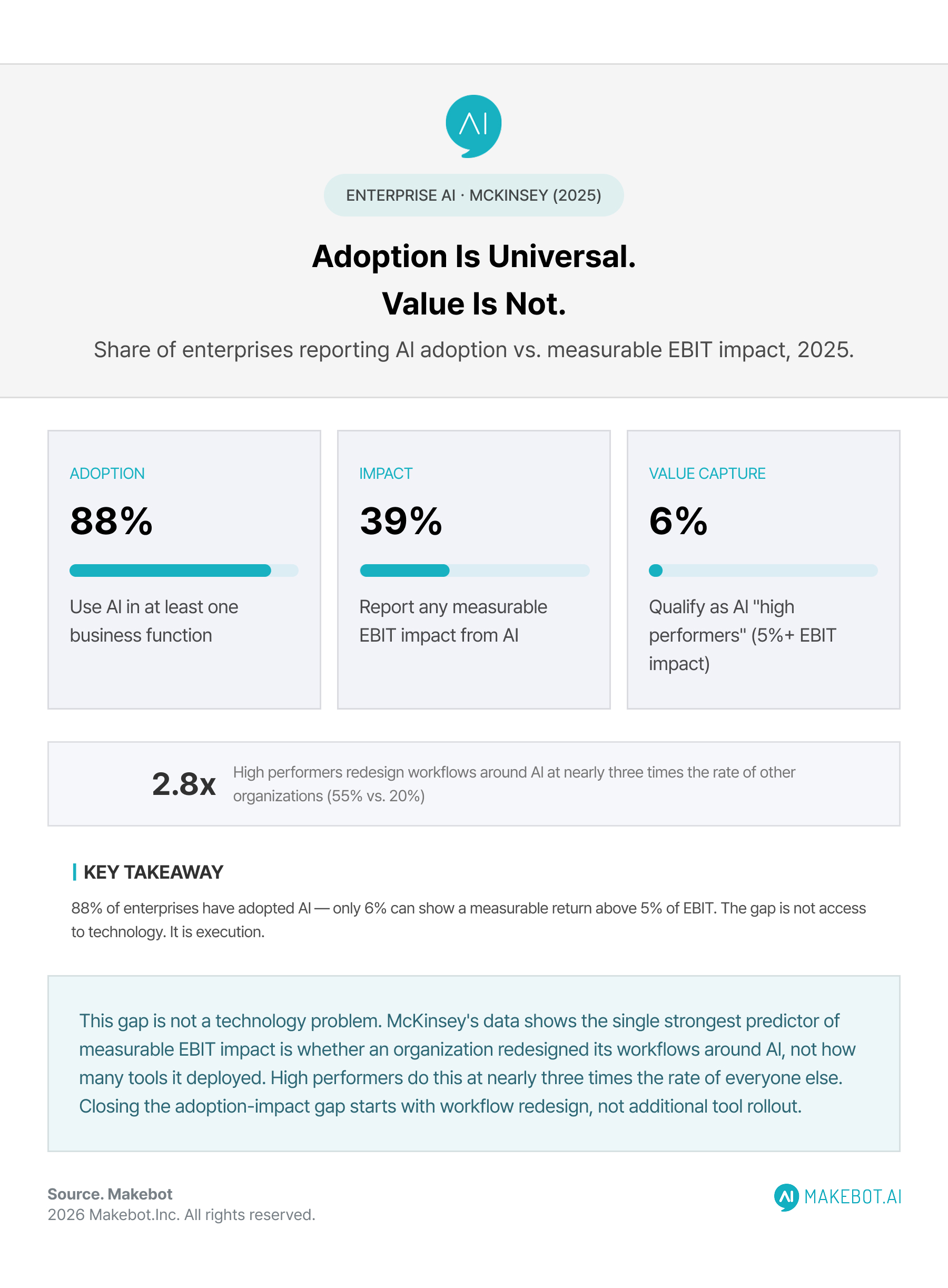
The headline is familiar by now: 88% of organizations use AI in at least one business function, up from 78% a year earlier (McKinsey, 2025). Two-thirds use it across multiple functions. On paper, this looks like a technology that has fully arrived.
The second number is less comfortable. Of those adopters, only 39% attribute any EBIT impact to their AI use - and among that group, most report less than 5%. Just 6% of organizations qualify as what McKinsey calls "AI high performers," attributing 5% or more of EBIT to AI. The other 94% are, in McKinsey's own framing, using AI without transforming with it.
This is not a small discrepancy. It is the central fact of enterprise AI in 2025 and 2026: near-universal tool access, concentrated value capture. And it repeats, almost number-for-number, across every other major research house that has looked at the same question.
Vibe Coding Got You to a Demo. It Won't Get You Past POC. Read the expert analysis here!

Adoption Became the Goal. That Was the Mistake.
Somewhere in the last two years, "adopt AI" quietly replaced "solve a specific, costed business problem" as the objective boards and leadership teams actually tracked. Procurement counted licenses. IT counted pilots. Nobody was consistently asking what problem, at what cost, would be solved by the tenth or the hundredth deployment.
MIT's NANDA initiative - in its 2025 study of 300 public AI deployments, 52 executive interviews, and 153 leadership surveys - put a hard number on the consequence: 95% of generative AI pilots delivered no measurable profit-and-loss impact. Only 5% of integrated systems created significant value. Critically, the researchers were explicit that this was not a model-quality problem. They called it the "learning gap" - the failure of most deployed tools, and the organizations around them, to retain feedback, adapt to context, or improve over time within a specific, defined workflow.
That is the means-versus-ends inversion in one data point. A tool without a defined problem to solve doesn't fail because it's a bad tool. It fails because "using AI" was never a business outcome to begin with.
Why AI-Powered Customer Journey Mapping Is Becoming Essential for Enterprise Growth. Discover what’s next here!

The Misuse Cost: Reaching for AI Where a Formula Already Worked
A less-discussed cost of adoption-without-definition is AI implementation aimed at the wrong problems entirely. Gartner's 2024 research on GenAI project abandonment identified poor data quality, inadequate risk controls, escalating costs, and unclear business value as the four consistent killers of GenAI initiatives after proof of concept - the same recurring AI implementation challenges Gartner has tracked at a rate initially projected at 30% by the end of 2025, and which subsequent Gartner commentary has since revised upward, above 50%.
Buried inside "unclear business value" is a specific, recurring failure mode: deploying a large, expensive, probabilistic model on a problem that a rules engine, a lookup table, or a basic statistical model already solved reliably and cheaply. BCG's 2025 research on AI value distribution offers a useful proxy for this: roughly 70% of AI's realized value concentrates in a handful of core business functions - R&D, innovation, and digital marketing - where the problems are genuinely open-ended and benefit from generative reasoning. That concentration is a strong signal, not direct proof, of the same underlying issue: AI applied outside a well-matched problem tends to produce cost without a corresponding return, because the underlying task never needed generative reasoning in the first place.
- The tell: the business case for the AI deployment reads like a technology capability statement, not a quantified problem statement.
- The cost: budget and engineering time spent on the 90% of use cases that don't need a generative model, instead of the 10% that do.
- The fix: define the problem, its cost, and its constraints before selecting the tool - not after.
How Generative AI Is Reshaping Brand Strategy and Digital Advertising. Explore the future of AI here!
Why the Blank Page Paralyzes Teams That Have Every Tool They Need
Earlier generations of enterprise software solved this by constraint. Photoshop and Excel handed employees a fixed set of operations mapped to a fixed set of problems - the software itself defined the boundaries of the task. Generative AI strategy inverts that relationship entirely: the tool hands the user a blank page and asks them to supply the problem, the constraints, and the definition of success, all at once.
This is precisely where McKinsey's data on high performers becomes instructive. The single factor most correlated with EBIT impact from AI, across 25 attributes tested, was whether an organization had fundamentally redesigned its workflows around AI use - not whether it had deployed more tools. McKinsey's Nov 2025 survey exhibit shows high performers redesigning workflows at roughly 2.8 times the rate of other organizations (55% versus 20%). Redesigning a workflow is, functionally, an act of problem definition: it forces a team to specify exactly which step, in which process, AI is meant to change - and by how much.
Organizations that skip that step are not failing at AI. They are failing at the harder, older discipline of business architecture, and asking a language model to compensate for the gap.
7 Proven Factors That Drive AI ROI in 2026, According to a Survey of 1,000+ Executives. See how enterprises are transforming here!
The Real Lever Is Problem Definition, Not Tool Selection
Every data source cited above converges on the same conclusion from a different angle:
The pattern is not that AI underdelivers. It is that AI business strategy built around tool adoption, rather than problem definition, produces a predictable failure curve - regardless of model quality, vendor, or budget size. The organizations bridging that gap share one behavior: they define the specific, costed, bounded problem first, and only then decide whether - and how - AI solves it.
- High performers set ambitious, workflow-level objectives, not "deploy AI everywhere" mandates.
- They select a narrow set of use cases and scale those, rather than distributing effort across dozens of shallow pilots.
- They measure a specific business KPI tied to the original problem statement, not general tool usage.
- They choose partners and platforms that are already fitted to the shape of a similar, previously solved problem.
APAC AI Outlook 2026 Signals AI's Breakout Moment as a New Revenue Driver. Learn how industry leaders are adapting here!
The Research Firms Named the Problem. Naming It Isn't the Same as Solving It.
It's worth being direct about what McKinsey, MIT, Gartner, BCG, and Deloitte have actually delivered here. Their research is rigorous, and it has done the enterprise world a real service: it named the gap, sized it, and diagnosed its causes with more precision than most companies could produce internally. That diagnostic work is genuinely valuable - and it is also, by design, where a strategy engagement or a research report stops. A slide deck can tell a CIO that 95% of pilots stall and that workflow redesign is the strongest predictor of value. It cannot redesign the workflow, integrate the permissions, or ship the system that survives contact with a production environment.
That's the second half of the gap this data exposes, and it's the half the research firms don't operationalize. The evidence base above is the same evidence base most enterprise leaders already have on their desks. The open question isn't whether the diagnosis is correct - it consistently is. It's who does the harder, less glamorous work of translating "define the problem before the tool" into a system that actually runs inside a specific business, with its specific constraints. That is a different discipline than research, and it's the one AI adoption strategy conversations tend to skip past.
Gartner Predicts That Agentic AI Will Solve 80 Percent of Customer Problems by 2029. Explore the data and findings here!

AI Adopters vs. AI Value-Capturers: What Actually Separates Them
The gap between organizations that "have AI" and organizations that see a return from it is not a technology gap. It's a discipline gap, and the research is consistent about where it shows up.
Struggling organizations typically:
- Measure success by number of pilots launched or licenses purchased.
- Apply the same general-purpose tool across unrelated problems without adapting the workflow around it.
- Lack a defined cost baseline, so ROI can't be measured against anything concrete.
- Build internally from scratch, re-solving problems a specialized partner has already solved elsewhere.
High-performing organizations typically:
- Start from a single, quantified business problem - a cost, a cycle time, a conversion rate - and work backward to the AI use case.
- Redesign the workflow around the tool rather than bolting the tool onto an unchanged process.
- Track a business KPI, not a usage metric, as the measure of success.
- Bring in a partner with prior, provable experience solving that exact shape of problem, rather than building the capability from zero.
This is not a talent gap between the two groups. Deloitte's 2025 enterprise survey (3,235 leaders) found that a third of organizations are already using AI to deeply transform - reinventing products or core processes - while another third remain at a surface level, applying AI with little change to the underlying process at all. The difference between those two groups is not who has better engineers. It's who defined the problem before reaching for the tool, and whether that definition was ambitious enough to count as real AI transformation rather than a surface-level automation layer.
Agentic AI vs Generative AI: Why the Difference Will Define Enterprise Strategy in 2026. Read the full breakdown here!
What "Business Problems AI Can Solve" Actually Looks Like
The strongest use cases share a specific shape: a defined, recurring, cost problem, embedded inside a workflow that can be redesigned around the solution - not a generic capability applied hopefully across the business. Business problems AI can solve well tend to have three characteristics in common:
- A quantifiable baseline. The cost, error rate, or cycle time before AI is a known number - not an estimate.
- A bounded, repeatable task. The problem recurs often enough, and consistently enough, that a system can learn and improve inside it.
- An owner accountable for the outcome, not just the deployment. Someone is measured on the business result, not on whether the tool was rolled out.
Absent all three, an AI deployment is, structurally, a demo looking for a use case - which is precisely the pattern behind the abandonment and stagnation rates cited throughout this article.
Showcasing Korea’s AI Innovation: Makebot’s HybridRAG Framework Presented at SIGIR 2025 in Italy. Read here!
The Data Suggests a Structural Trap, Not a Shortage of Ambition
None of the organizations behind these numbers lack ambition, budget, or technical talent. McKinsey's own tracking shows AI use climbing from 78% of organizations in 2024 to 88% in 2025, and BCG finds three-quarters of executives naming AI a top-three strategic priority for their business. The trap is structural: a genuinely capable, general-purpose tool handed to an organization that has not yet done the older, harder work of defining exactly which problem it is meant to solve. That gap - not the technology - is what separates the 6% capturing real value from the 94% still waiting to see it.
Defining that problem precisely, and building the infrastructure to solve it, is a different discipline than deploying a model. It's the discipline that determines whether an AI-driven business transformation actually reaches production - or joins the majority of pilots that never do.
The Problem Is Defined. The Question Is Who Builds the System That Solves It.
The research is clear: the organizations capturing real AI value start from a specific, bounded, costed problem — not a tool. Makebot has engineered that discipline into practice across 1,000+ enterprises in healthcare, finance, and the public sector, deploying HybridRAG-powered systems with permission-aware search, closed-network operation, and audit-grade logging — built to solve a defined problem reliably, not to demo well and stall.
Start with the problem your organization actually needs solved




.png)








.jpg)


What Happens to Marketing When the C-Suite Starts Using AI Every Day?







Why AI Shopping Assistants Will Replace Traditional Ecommerce Search






.jpg)
























Why Generative AI Projects Fail and How to Achieve Scalable AI Success











.jpg)

.png)