Bill Gates Promised Business at the Speed of Thought. AI Delivered It, and the Bottleneck Moved
88% of firms use AI. Only 6% profit from it. Makebot CEO on why verification is the real bottleneck.


David Kim, CEO of Makebot AI · September 2026
Executive Summary
01. Making things now happens at the speed of thought. The bottleneck did not disappear. It moved to the speed of verification and the quality of judgment.
02. 88% of companies use AI. Only 6% profit from it at scale. In McKinsey's surveys, AI use jumped from 55% to 88% in three years, yet only 6% of companies attribute 5% or more of their EBIT to AI.
03. People now run a "second loop." Instruct → generate → verify → decide. How fast and how accurately an organization runs this loop now sets its real speed.
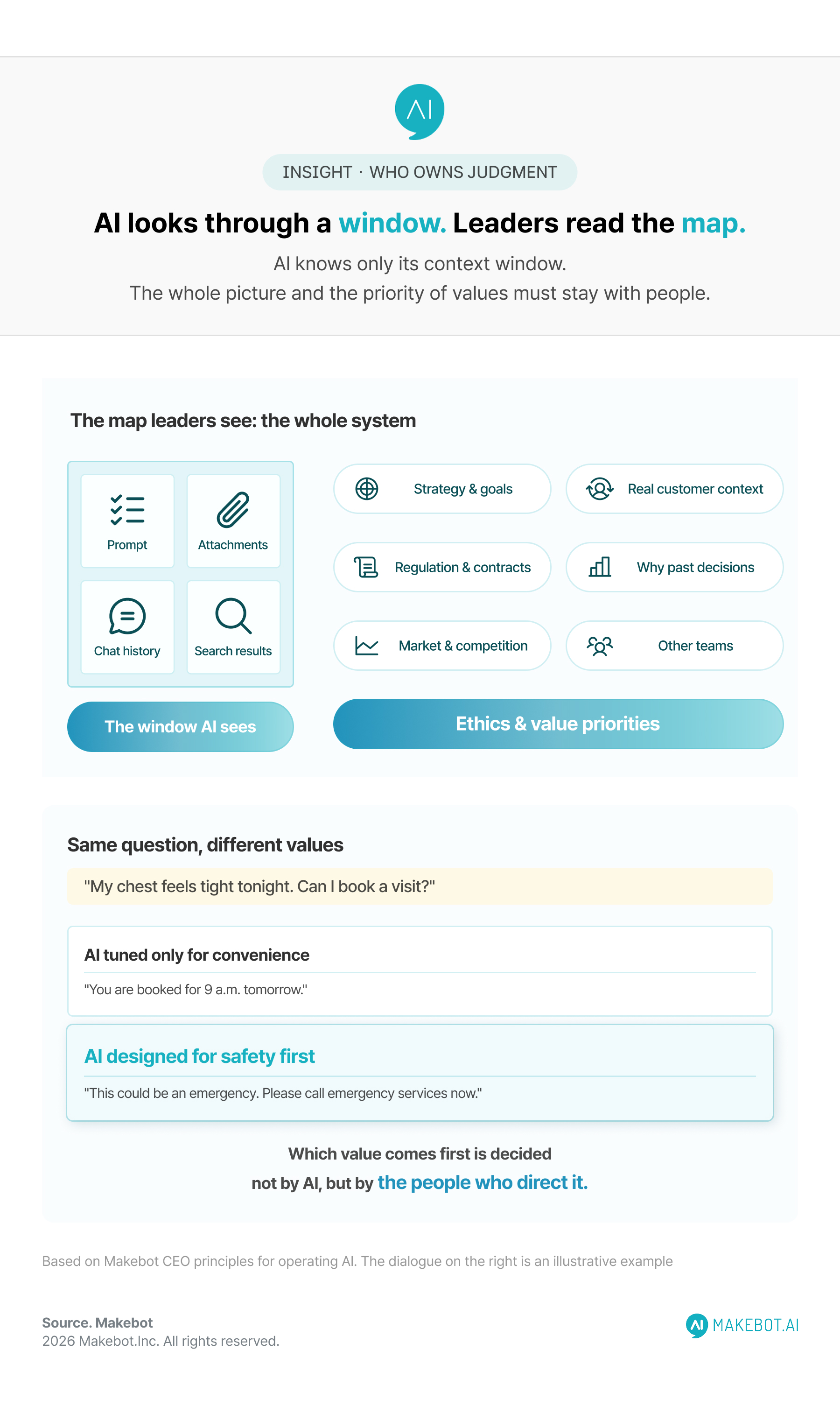
04. AI looks through a window. Leaders read the map. AI only knows what is in its context window. The full picture of the system and the priority of values remain human responsibilities.
05. AI is a vector. Speed is now available to everyone; what differentiates organizations is direction.
Introduction
I remember reading Bill Gates's Business @ the Speed of Thought years ago. Published in 1999, it declared the 2000s the "decade of velocity." Companies, Gates argued, could respond to market change in time only when information flowed through a digital nervous system as fast as thought. The speed that book promised was the speed at which information travels.
Lately I find myself recalling that title in a completely different sense. Today it is not just information that moves at the speed of thought. Reports and proposals, contract reviews, answers to citizens and customers, data analyses and presentations, code and patent specifications are all produced that fast.
I have led Makebot for eight years. I am also a developer who still writes product code, and an inventor who designs the company's patents myself. I now do all three jobs with AI, and from each of those seats I see the same scene.
Patent specifications. With a multi-stage AI workflow, first drafts of claims and embodiments appear faster than I could have imagined. Yet the faster the drafts arrive, the more of my time goes to one place: deciding how broad each claim should be, and whether a single word might later narrow the scope of protection.
Voice AI. One of Makebot's AI callbots handles live customer inquiries for a Korean financial institution. It runs an sLLM within the institution's own infrastructure, keeping sensitive data on-premise. The first principle we set when designing it was not "how freely can the AI speak?" but "how reliably can it say only what has been verified?" On the phone, a spoken answer cannot be taken back, and callers cannot see the source for themselves.
Product development. Features that used to take days now take half a day with AI. But hidden defects surface only when I use the feature as a real user would, and decisions such as who the feature is for remain mine to the end.
The scene was the same from all three seats. Making things now happens at the speed of thought, but the bottleneck has not disappeared. It has moved to verification and judgment. This year, researchers and industry gave the phenomenon a name: the verification bottleneck. This column unpacks it from three angles and suggests what leaders in the public sector, finance and healthcare should do now.
1. The Bottleneck Did Not Disappear. It Moved.
What generative AI changed is the cost of making things. The cost of confirming that the output is correct, and right for your organization, has barely fallen. A paper published in September 2026 defines this as a distinct mechanism: AI raises the rate of production, but it does not proportionally raise people's capacity to verify claims, sources and calculations.
Economics puts it even more simply. A paper released in February compares it to Amdahl's Law. AI can produce unlimited memos, but every memo worth acting on still needs human judgment, one at a time. How much an organization can actually ship is capped by how much its senior people can review.
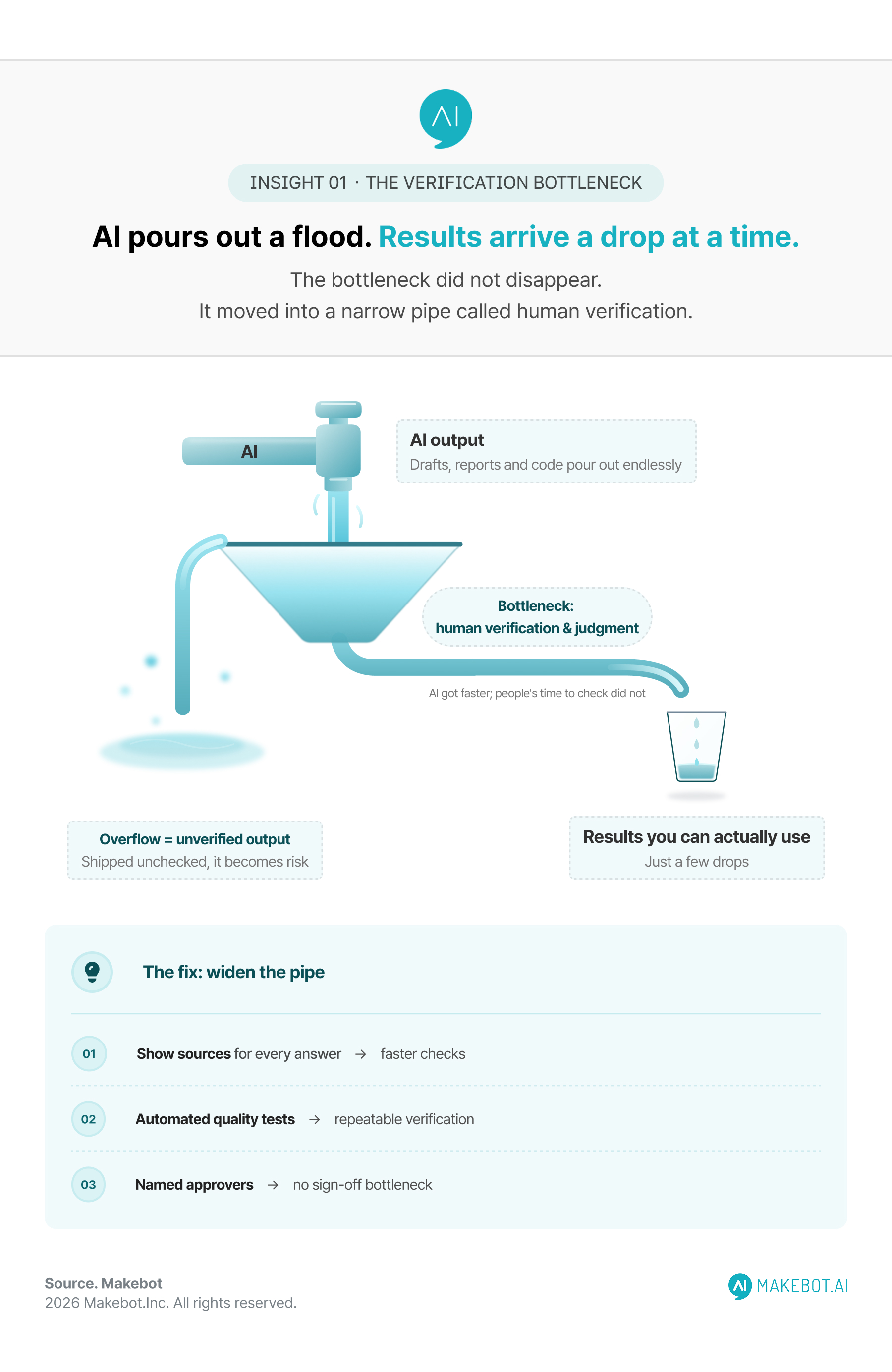
The numbers tell the same story. According to McKinsey, the share of companies using AI rose from 55% in 2023 to 88% in 2025, yet only 6% generate 5% or more of their EBIT from AI. Using AI and profiting from it are two very different things.
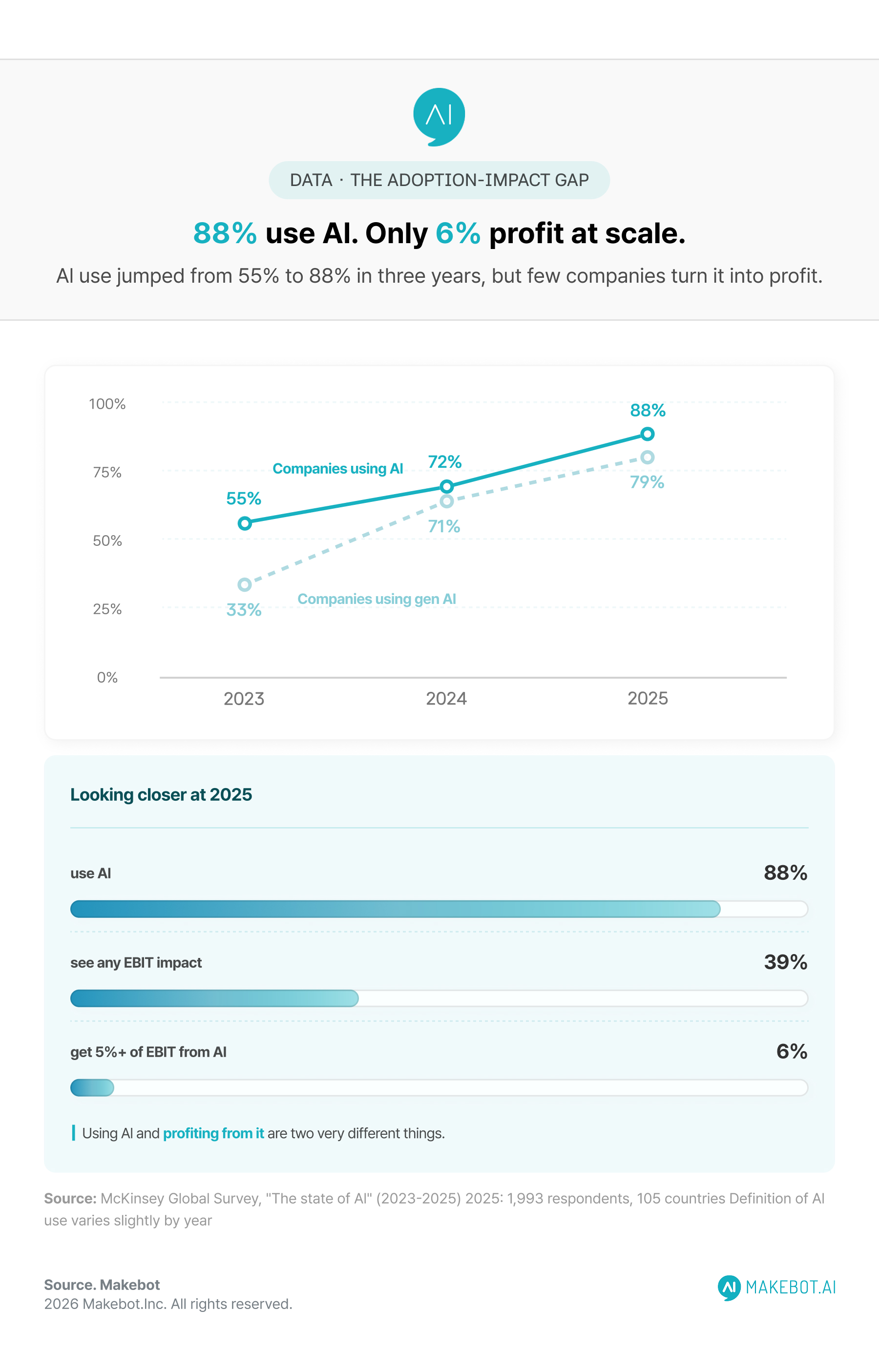
The front line points the same way. An August 2026 survey of 500 U.S. developers and 300 engineering leaders, polled separately, found that both groups ranked reviewing and validating AI output as the number-one bottleneck. 48% of leaders named it their biggest governance gap.
The most striking evidence comes from a randomized controlled trial by the nonprofit research group METR. Experienced developers working on code they knew well took 19% longer when using AI. Yet they believed they had been 20% faster. The AI's suggestions were often directionally right but not exactly what was needed, and reviewing and fixing them cost more time than they saved.
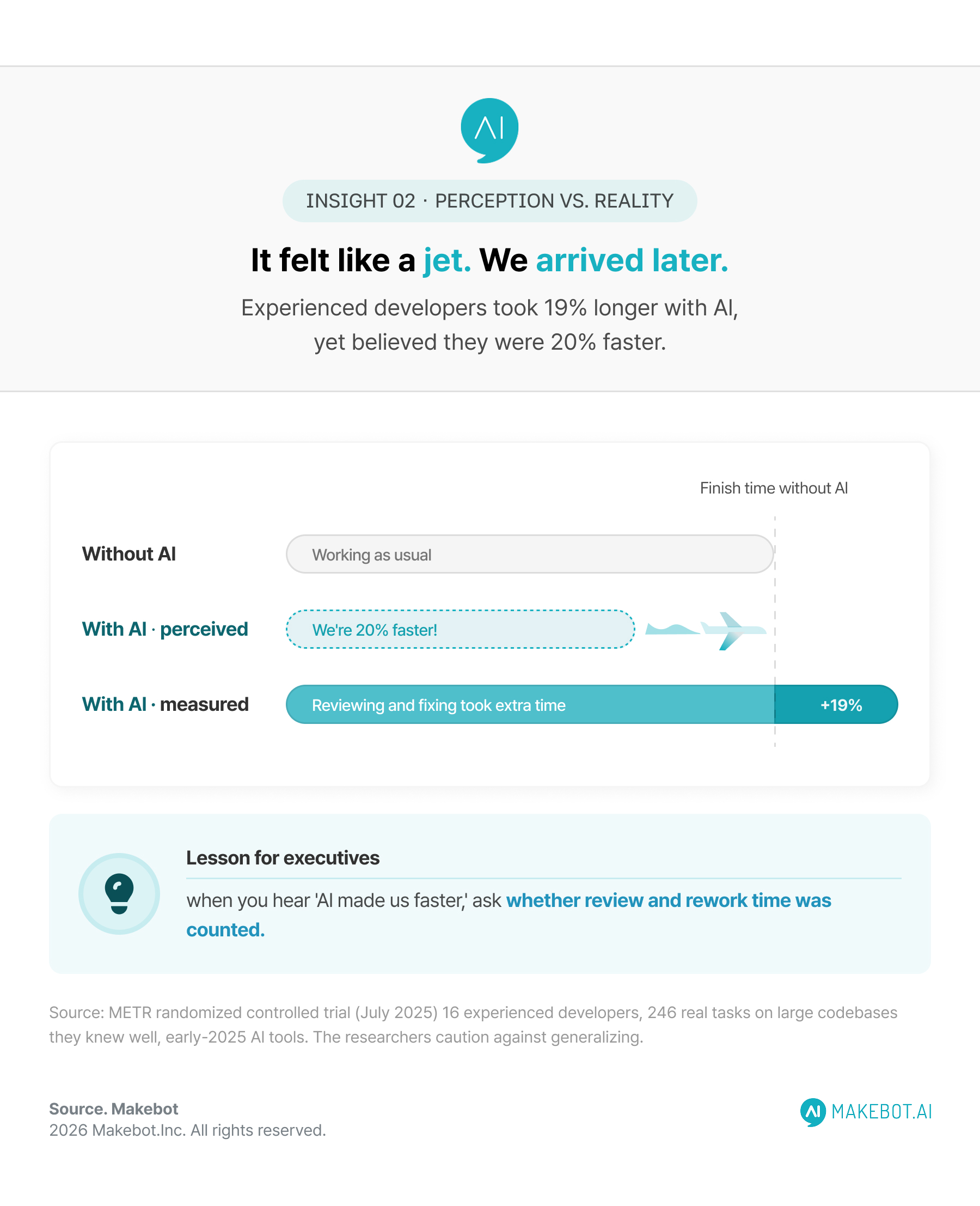
The researchers caution against generalizing the result. What executives should notice is less the number than the gap between perception and measurement. When someone reports that "AI made us faster," ask whether they counted the time spent reviewing and correcting.
2. As AI Sped Up, People Gained a Second Loop
My own experience differs a little from METR's findings. With AI, both my development work and my writing became faster. But the faster things got, the heavier verification became, and verifying well meant first telling the AI clearly what to make and by what standard.
A new loop emerged: instruct clearly, let AI generate, verify as a human, then decide and instruct again. In the past, slow implementation gave us plenty of time to think. Now implementation is instant, so we need a second speed of thought that can keep pace with what AI produces.
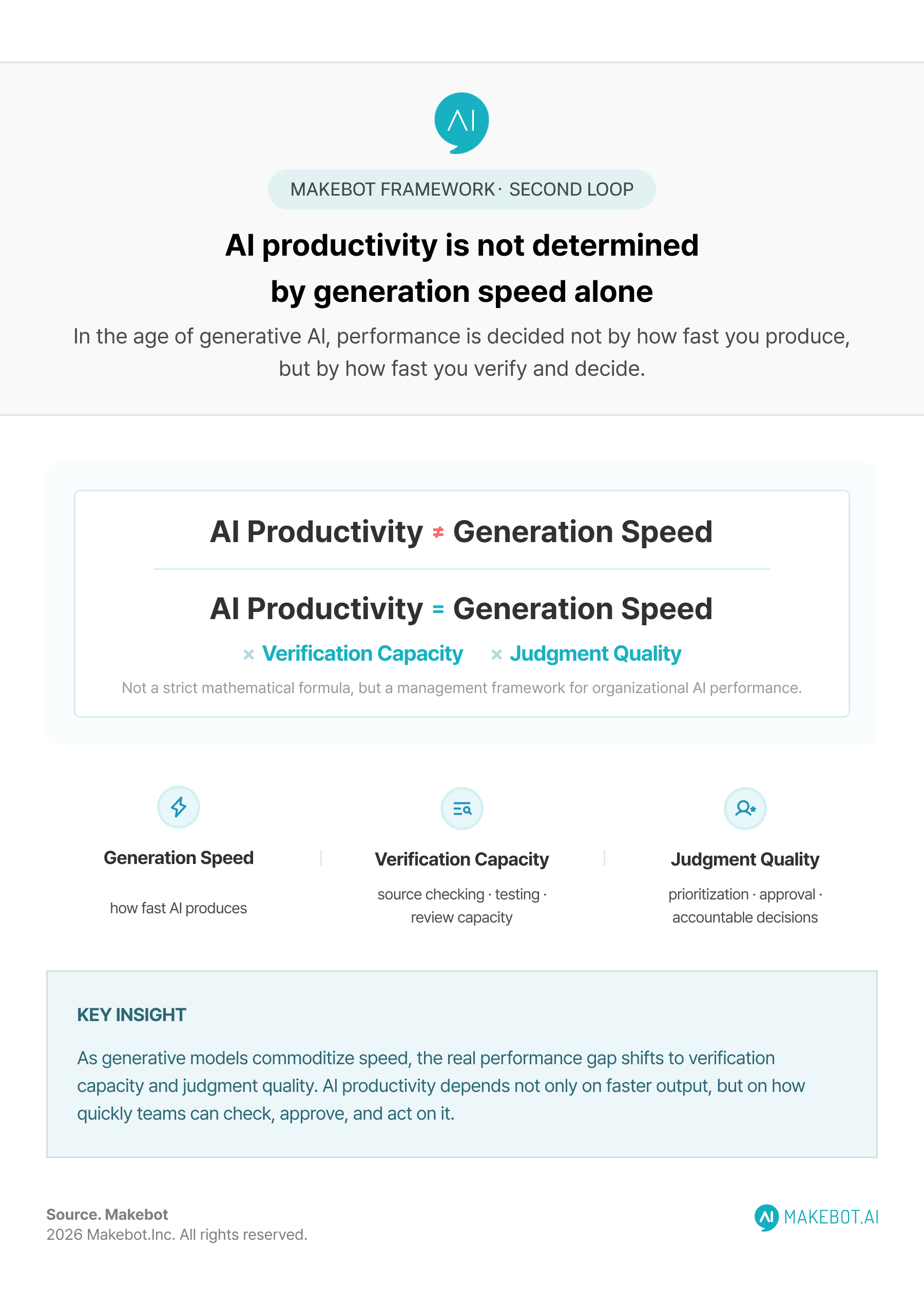
This is not just my personal impression. Researchers have begun describing AI collaboration as a generation-verification loop, and the industry report cited above sums up the remedy as "give agents context and standards before they write, then verify their work after." What sets the speed of this loop is verifiability: how cheaply and quickly you can confirm that a result is right.
Paradoxically, software development is the lucky field. Code can be run and tests can be automated. Errors in reports, legal opinions and customer answers, by contrast, hide in plausible-looking form. So the more an organization runs on documents and consultations, as in the public sector, finance and healthcare, the more its loop bottlenecks at verification, and the more its success depends on tools that make verification fast.
3. AI Looks Through a Window. Leaders Read the Map.
No matter how much I use AI, the one thing I never hand over is decision-making. AI sees only the context given in its window. It does not know the organization's strategy, the customer's real situation, other departments' constraints, or why past decisions were made. However convincing its output, a person has to keep judging whether it fits the whole picture.
Even more important is the question of values. The same question gets very different answers depending on whether you put customer convenience first or safety and accuracy first. Ethical and moral judgment depends not on the AI, but on the people who direct it.
We already have data on what happens when judgment is handed to AI. Research published in Harvard Business Review calls polished-looking but hollow AI output "workslop." 41% of U.S. workers had received it, and each instance took nearly two hours to clean up. The burden fell hardest on team leads and managers, and the researchers frame it not as individual laziness but as a leadership problem.
Nor does accountability move. In 2023 a U.S. federal court in New York fined lawyers $5,000 for submitting case law fabricated by ChatGPT, noting that attorneys retain a gatekeeping role to ensure the accuracy of their filings. In the public sector, finance and healthcare, this is not a productivity issue but a matter of accountability and audit. If an AI-written reply to a citizen or AI-provided medical guidance is wrong, the institution bears the responsibility.
4. AI Is a Vector: Speed Is for Everyone, Direction Decides
So who will win in the era of generative AI? I see AI as a vector. A vector has magnitude and direction. Magnitude, meaning speed, comes from technology. But with 88% of companies already using AI, nearly everyone holds similar models. Speed is no longer a differentiator. What separates results is direction.
The data points the same way. When McKinsey tested 25 organizational attributes, the one with the biggest effect on EBIT impact from gen AI was not the model but the redesign of workflows, yet only 21% of companies had done it. CEO oversight of AI governance was also among the attributes most correlated with bottom-line impact, and only 28% of companies had it. The companies capturing the most value set growth and innovation as objectives alongside efficiency. These are correlations based on self-reported surveys, but the direction is clear.
So here is my prediction. The winners of generative AI will not be the organizations with the fastest AI. They will be the ones that set the right direction, and that confirm and correct that direction faster than anyone else.
For leaders in the public sector, finance and healthcare, I recommend starting three things now.
- Set the direction first. Before deciding how much to produce with AI, leadership should decide which values come first: safety, accuracy or customer convenience.
- Start with work you can verify. Begin with information and consultation tasks backed by clear source documents, and rule out any AI that cannot show the basis for each answer.
- Design the loop. Decide, task by task, who instructs, who verifies and who approves. That is where the workflow redesign McKinsey describes begins.
Conclusion: The New Speed of Thought Is the Speed of Judgment
The speed of thought that Bill Gates imagined is now reality. But the scarce resource has changed. Generating an answer is no longer difficult. Knowing whether the answer is right, whether it fits the situation, and whether an organization should act on it is.
That changes what AI transformation means. The goal is no longer simply to make AI produce more. It is to build organizations that can instruct clearly, verify quickly, and make sound decisions at the same speed AI generates.
Twenty-seven years ago, Bill Gates wrote that in a good organization, bad news travels fast. In the age of AI, I would update that idea:
The organization where AI's errors surface fastest will move fastest.
That may be the new meaning of business at the speed of thought.
How we think about this at Makebot
In healthcare, finance and the public sector, we have learned that a useful answer is not enough. Organizations need to know where it came from, how it was verified, and when a human should take over.
That is why we have increasingly designed our systems around verifiability: traceable sources, repeatable quality testing, controlled generation, human escalation and auditability.
These are not features added around AI. They are infrastructure for making AI accountable enough to use.



.png)








.jpg)


What Happens to Marketing When the C-Suite Starts Using AI Every Day?







Why AI Shopping Assistants Will Replace Traditional Ecommerce Search






.jpg)

























Why Generative AI Projects Fail and How to Achieve Scalable AI Success











.jpg)

.png)