How RAG Can Turn Hospital SOPs and Policies into an Intelligent Staff Knowledge System
95% of AI pilots fail to deliver ROI - RAG turns hospital SOPs into instant, auditable answers.


Introduction
Every hospital runs on thousands of pages of protocols, policies, and standard operating procedures - and almost none of that knowledge is instantly accessible at the point of care. A nurse unsure of the current sepsis escalation protocol, or a new hire trying to locate the correct consent form, still often falls back on hallway questions, outdated binders, or a frustrating intranet search. This isn't a minor inconvenience; it's an operational and safety risk hiding in plain sight.
Retrieval-augmented generation (RAG) offers a practical fix. Rather than relying on a general-purpose chatbot's memorized training data, RAG grounds every answer in a hospital's actual, current SOPs and policy documents, retrieved and cited in real time. This article examines the data behind enterprise AI adoption in healthcare, why so many AI investments underdeliver, and how RAG-based knowledge systems are becoming one of the clearest paths to measurable ROI.
The Hidden Cost of Fragmented Hospital Knowledge
Hospitals are, in many respects, knowledge organizations disguised as clinical ones. Every shift depends on staff correctly recalling or locating the right protocol - infection control steps, medication administration rules, escalation pathways, credentialing requirements - often under time pressure.
Hospital SOPs typically live across disconnected systems: shared drives, PDF repositories, intranet portals, and printed binders that are rarely synchronized when policies change. The consequences show up directly in workforce data:
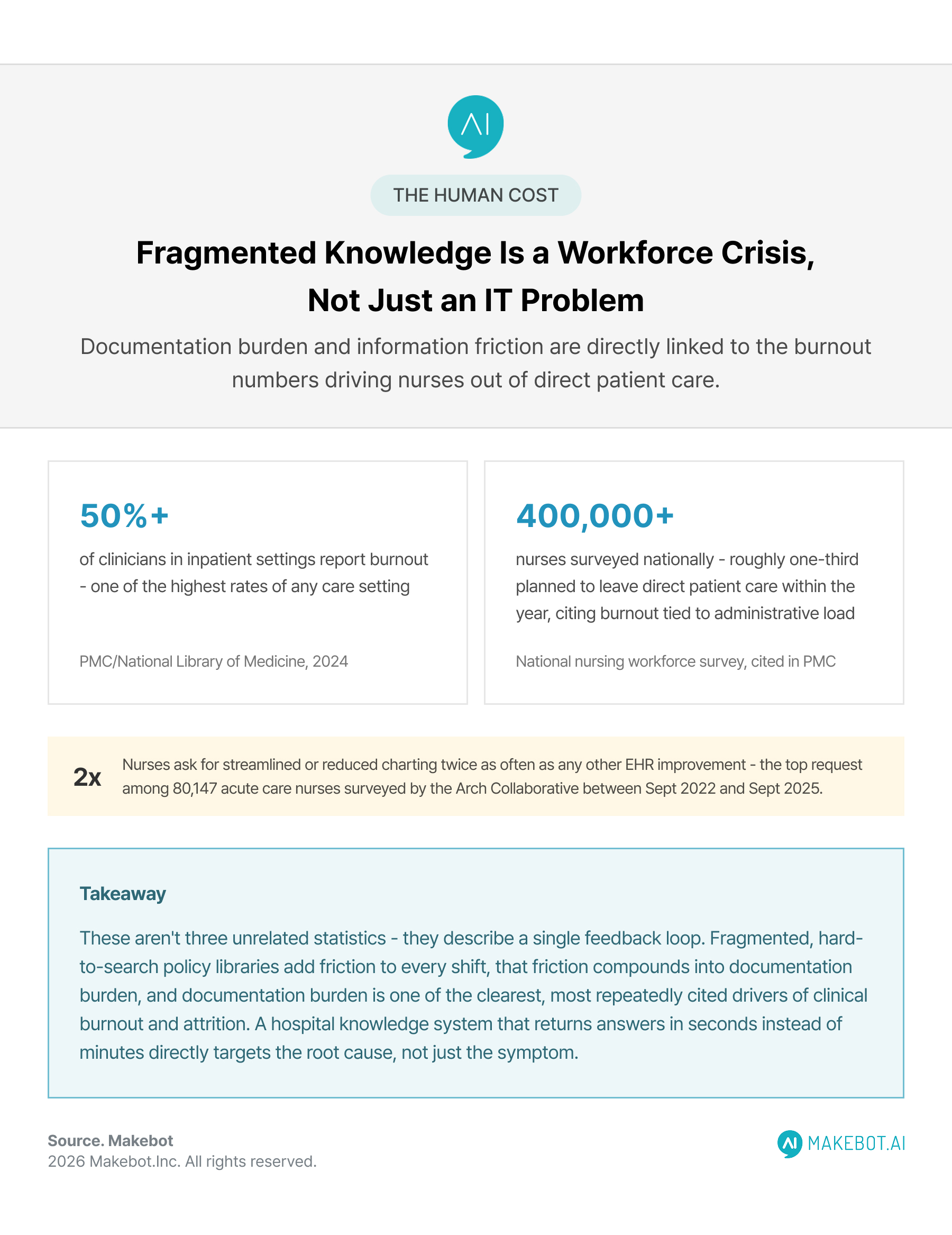
- Clinicians in inpatient settings report burnout rates exceeding 50%, and documentation burden is consistently cited as a contributing factor.
- In a national survey of more than 400,000 nurses, roughly one-third said they planned to leave direct patient care within the year, with burnout - closely tied to administrative and documentation load - cited as a central driver.
- Nursing informatics research from the Arch Collaborative, drawing on data from over 80,000 acute care nurses, has repeatedly found that reducing documentation and information-lookup friction is one of the most requested EHR improvements among frontline staff.
None of this is a knowledge content problem - the SOPs exist. It's a knowledge access problem. Static repositories were never designed to answer a specific question in seconds; they were designed to be filed and, too often, forgotten. It's part of why nursing burnout tied to administrative load has become such a pressing operational priority for health system leaders.
Why Traditional Search and Static Repositories Fall Short
Conventional hospital knowledge management tools - keyword-based intranet search, PDF libraries, static FAQs - struggle for three structural reasons:
- No semantic understanding. Keyword search can't interpret a question like "what do I do if a patient refuses a blood transfusion" against a policy titled "Informed Refusal Protocol."
- Version drift. SOPs are updated regularly, but old PDFs often remain indexed, cached, or printed, creating conflicting guidance across departments.
- No conversational interface. Staff must know which document to open before they can search within it - an unreasonable expectation for time-pressured clinical and administrative teams.
This is precisely the gap that a general-purpose healthcare AI chatbot cannot close on its own. A standard large language model, without grounding, either declines to answer specific institutional questions or - more dangerously - generates a plausible-sounding but incorrect response based on generic training data rather than the hospital's actual policy. In a regulated clinical environment, that failure mode is unacceptable.
What RAG Is - and Why It Matters for Healthcare
Retrieval-augmented generation is an AI architecture that pairs a large language model with a real-time retrieval step: before generating an answer, the system searches an approved knowledge base, retrieves the most relevant passages, and feeds them to the model as grounding context. As Gartner's Market Guide for Enterprise AI Search frames it, this kind of platform enables retrieval and synthesis of information across enterprise repositories, grounding outputs in current, authorized organizational knowledge rather than the model's training data alone - a distinction that is essential for accuracy, auditability, and trust in enterprise contexts.
For a healthcare LLM deployment, this distinction is the difference between a liability and an asset:
- Traceability: Every answer can cite the exact SOP, section, and version it was drawn from.
- Currency: When a policy updates, the retrieval index updates - no retraining of the underlying model required.
- Access control: Retrieval can be scoped so staff only see content authorized for their role, department, or facility.
- Reduced hallucination risk: Because the model answers from retrieved text rather than memorized patterns, ungrounded or fabricated responses drop sharply compared to a standalone LLM.
This combination is why healthcare RAG has become one of the fastest-growing enterprise AI categories. Market analysis projects the global retrieval-augmented generation market to grow from roughly $1.94 billion in 2025 to $9.86 billion by 2030 - a 38.4% compound annual growth rate - with healthcare and life sciences expected to post the highest growth rate of any sector, driven by demand for accurate, auditable, patient-centric AI systems.
From SOPs to Answers: How a Hospital RAG System Works in Practice
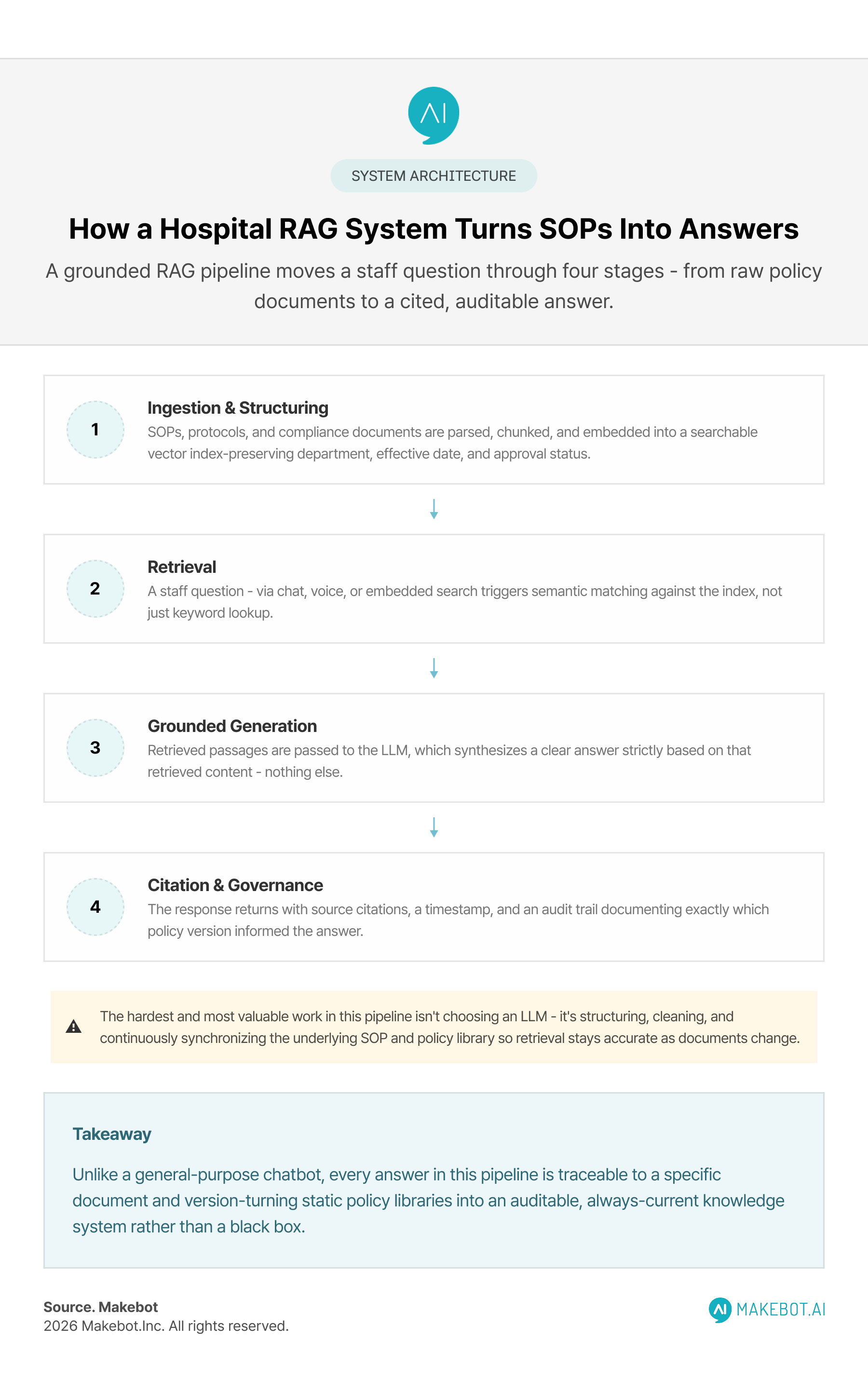
An AI-powered hospital knowledge search system built on RAG generally follows four stages:
- Ingestion and structuring. SOPs, policies, clinical protocols, and compliance documents are parsed, chunked, and embedded into a searchable vector index, preserving metadata like department, effective date, and approval status.
- Retrieval. When a staff member asks a question - via chat, voice, or an embedded search bar - the system retrieves the most relevant document sections using semantic (not just keyword) matching.
- Grounded generation. The retrieved passages are passed to the LLM, which synthesizes a clear, plain-language answer strictly based on that retrieved content.
- Citation and governance. The response is returned with source citations, a timestamp, and - critically - an audit trail documenting exactly which policy version informed the answer.
Gartner's 2025 Market Guide for Enterprise AI Search makes a point hospitals should take seriously: RAG-based assistants and agents tend to underperform once they're scaled across a large, varied body of enterprise content, and the root cause is typically the quality of the source data and the relevance of what gets retrieved - not the underlying language model. In practice, this means the hardest and most valuable work in a hospital RAG deployment isn't choosing an LLM; it's structuring, cleaning, and continuously synchronizing the underlying hospital SOPs and policy library so retrieval stays accurate as documents change - the same grounding discipline behind RAG in clinical decision support reducing diagnostic errors elsewhere in the hospital.
The Enterprise AI Adoption Gap: Why Some Health Systems Win and Others Stall
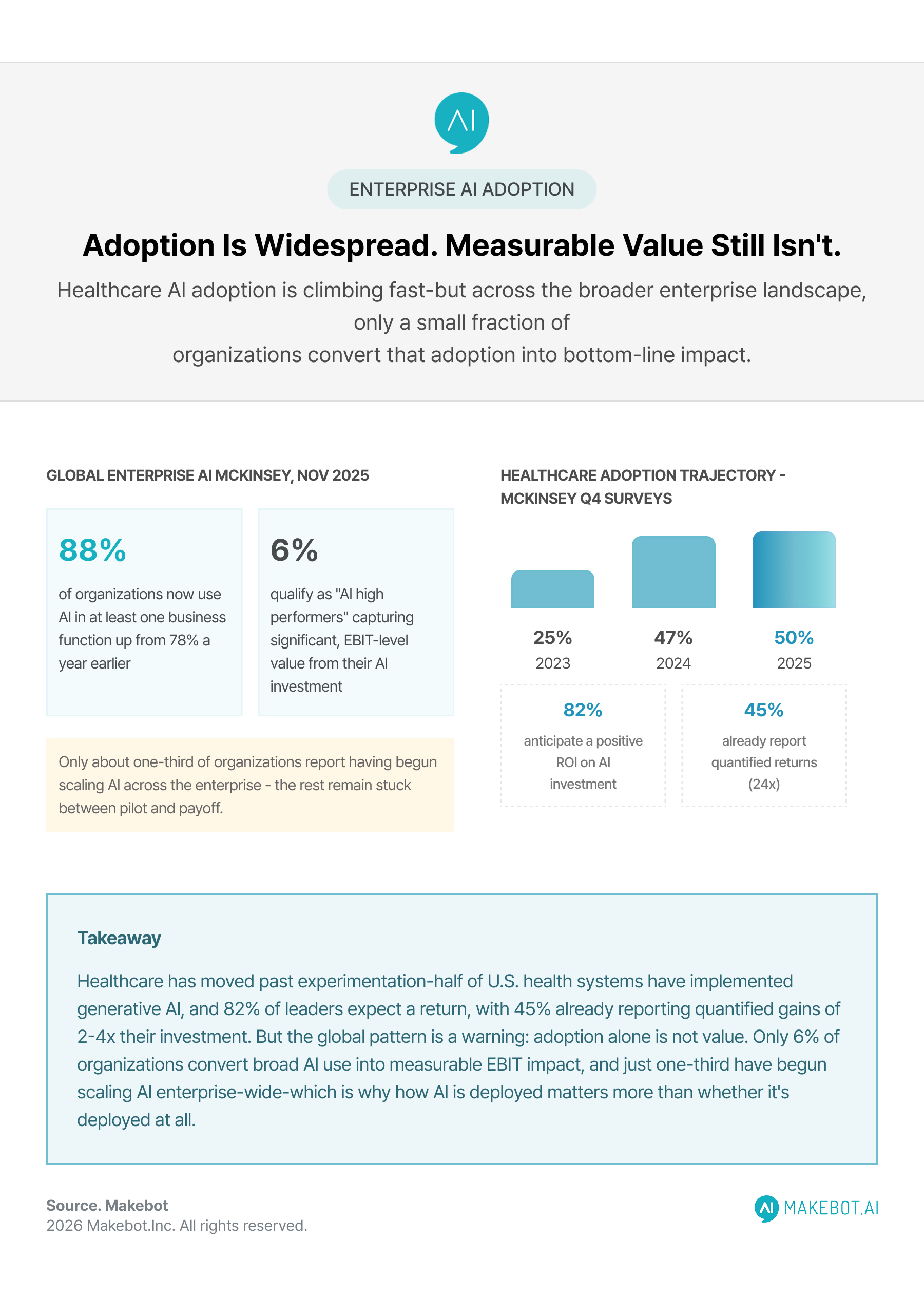
The broader enterprise AI data paints a sobering picture that hospital leaders should factor directly into their planning. McKinsey's November 2025 global AI survey found that 88% of organizations now use AI in at least one business function, up from 78% the year before - yet only about 6% qualify as "AI high performers," meaning they report both significant enterprise-wide value and at least 5% EBIT impact attributable to AI. Just one-third of all organizations report having begun scaling AI across the enterprise.
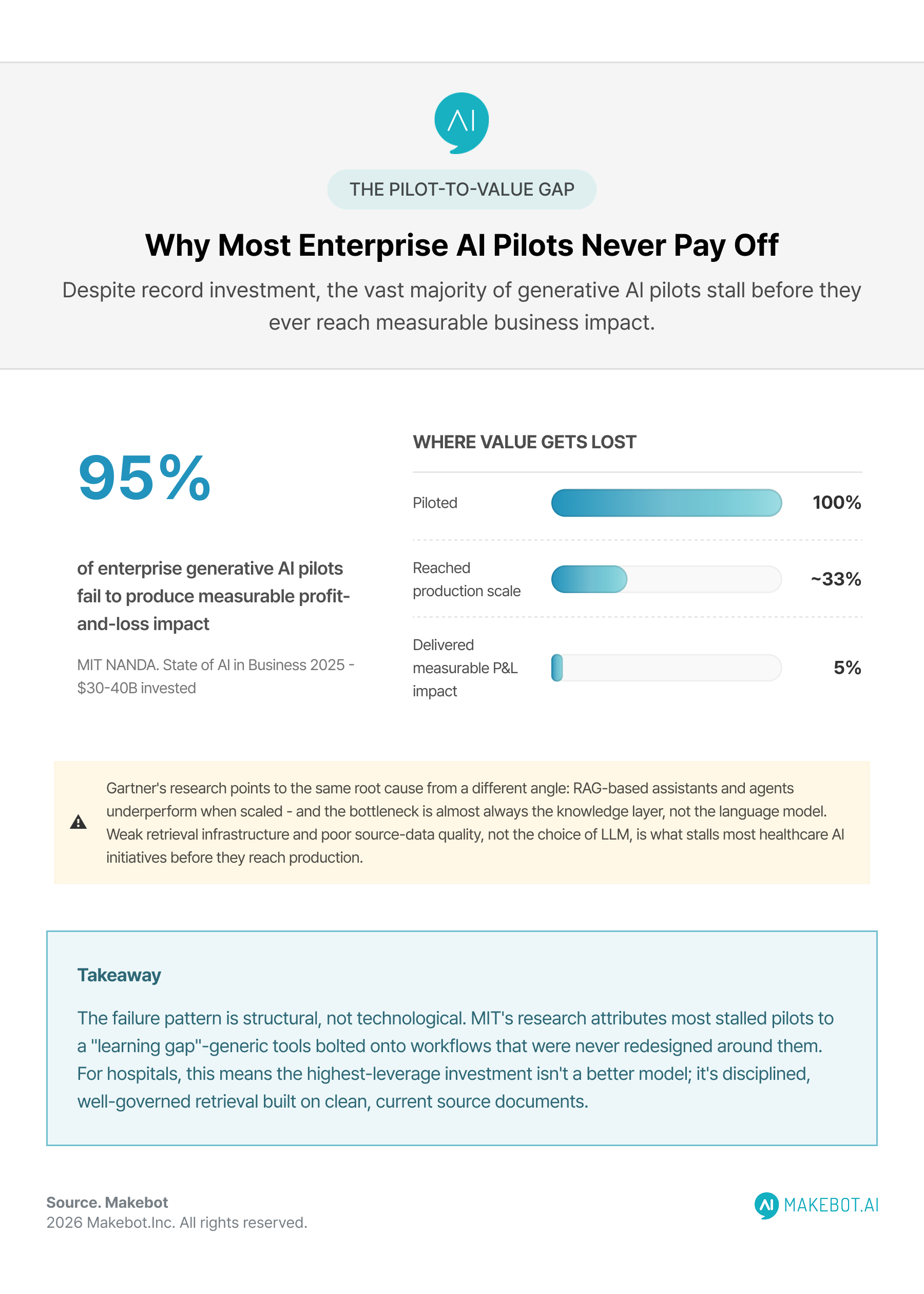
The picture is starker at the pilot level. MIT's Project NANDA, in its widely cited State of AI in Business 2025 report, found that despite $30–40 billion in enterprise generative AI spending, 95% of pilots failed to deliver measurable profit-and-loss impact. The report's central finding is not that the technology is flawed, but that most failures trace back to a "learning gap" - generic tools that don't adapt to institutional workflows, and organizations that never redesign processes around what AI actually enables.
Two categories of factors consistently separate high performers from stalled initiatives:
Technical factors
- Weak or fragmented source data (outdated SOPs, inconsistent formatting, siloed repositories)
- Retrieval systems that aren't tuned for domain-specific terminology and clinical language
- Lack of integration between the AI layer and existing EHR, intranet, or credentialing systems
Organizational factors
- No clear ownership of the knowledge base's ongoing accuracy and version control
- Frontline staff excluded from design, leading to low trust and low adoption
- Success measured by pilot activity rather than defined, trackable business outcomes
Healthcare specifically shows encouraging momentum on the adoption side. McKinsey's Q4 2025 survey of U.S. healthcare leaders found that implementation has climbed steadily - from 25% of organizations in late 2023, to 47% in 2024, to 50% by the end of 2025 - and more than 80% of leaders say their organizations have deployed at least one generative AI use case to end users. On returns, 82% of these leaders now anticipate a positive ROI, with 45% already reporting quantified returns, typically in the range of less than two times to four times their initial investment. The opportunity - and the risk - is that adoption is outpacing the operational discipline needed to convert it into consistent value, which is exactly why AI fails to scale in healthcare even after a promising pilot.
Measurable Business Outcomes: What the Data Shows
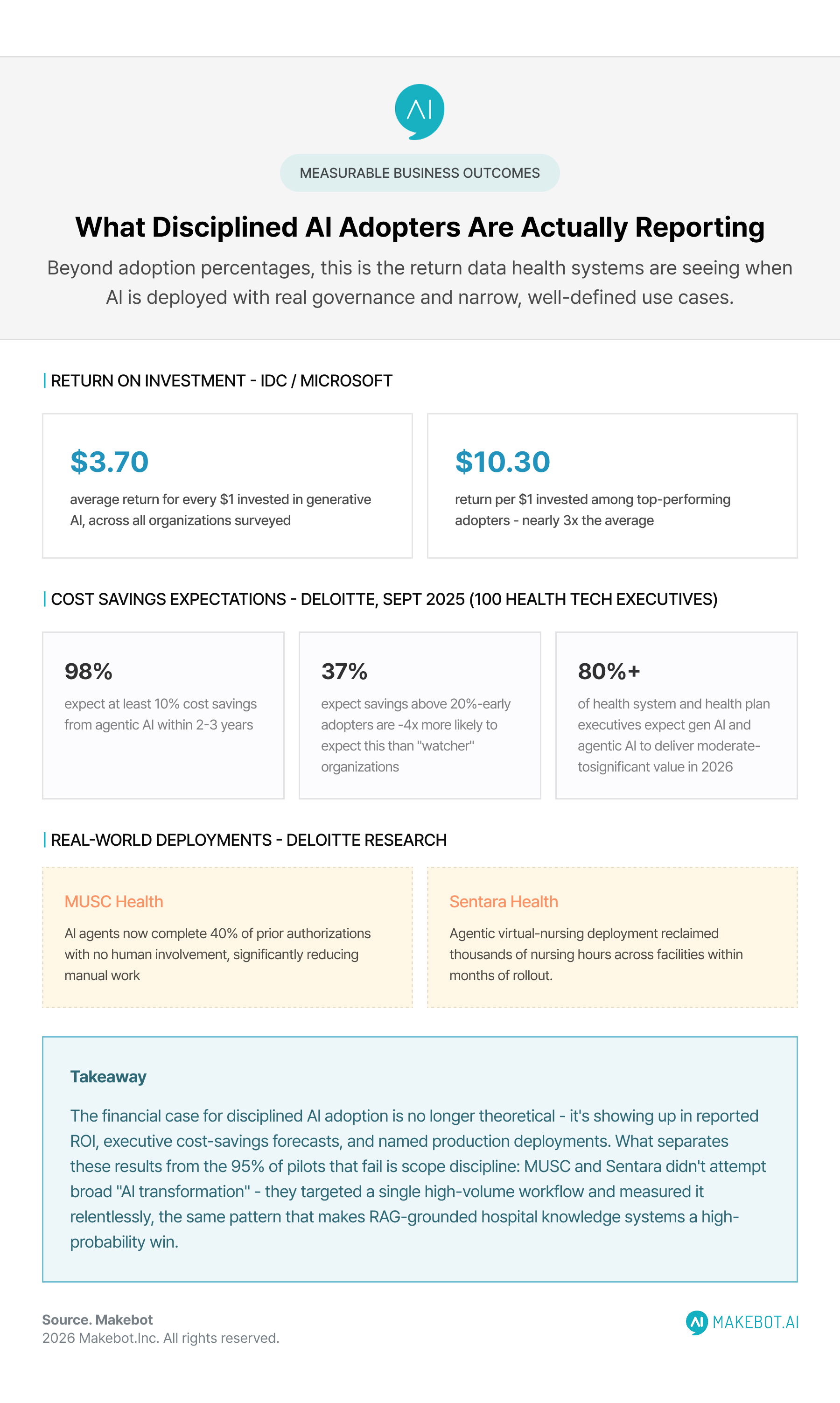
For a technology conversation this fast-moving, decision-makers need outcome data, not hype. Several figures stand out:
- Cost savings expectations are rising sharply. In Deloitte's September 2025 survey of 100 U.S. health system and health plan technology executives, 98% expect at least 10% cost savings from agentic AI within two to three years, and 37% expect savings above 20% - with early adopters roughly four times more likely than "watcher" organizations to expect savings that high.
- Retrieval-grounded automation is already showing measurable results. MUSC Health, for example, now completes 40% of prior authorizations using AI agents without human involvement, while Sentara Health's agentic virtual-nursing deployment has reclaimed thousands of nursing hours within months of rollout.
- Enterprise AI ROI, broadly, is real for disciplined adopters. An IDC study commissioned by Microsoft found organizations reporting an average return of $3.70 for every $1 invested in generative AI, with top-performing adopters seeing returns as high as $10.30.
- Confidence is converting into budget. More than 80% of health system and health plan executives now expect generative and agentic AI to deliver moderate-to-significant value across clinical, operational, and back-office functions in 2026, per Deloitte's 2026 US Health Care Executive Outlook.
The consistent pattern across McKinsey, Deloitte, and IDC data is this: value concentrates in narrow, well-defined, high-volume workflows - exactly the profile of SOP and policy lookup, prior authorization, and documentation support - rather than broad, undirected AI rollouts. This lines up with McKinsey's own analysis of healthcare cost reduction opportunities industry-wide.
High Performers vs. Struggling Adopters
Common Challenges When Scaling Enterprise RAG in Hospitals
Even well-designed pilots hit predictable friction points when scaling enterprise RAG hospital-wide:
- Document sprawl across departments, each with its own formatting conventions and update cadence
- Sensitive data handling, requiring careful separation of retrievable content from protected health information
- Change management, since staff must trust and adopt a new lookup habit instead of defaulting to colleagues or memory
- Ongoing content governance, as SOPs are revised more often than most IT teams initially plan for
None of these are reasons to avoid RAG - they're reasons to treat the underlying knowledge base with the same rigor as a clinical system, not a one-time IT project, which is why enterprise architecture matters as much as the AI model itself when scaling past a single department.
Strategic Recommendations for Health System Leaders
- Start with one high-friction, high-volume workflow (SOP lookup, onboarding, or prior authorization) rather than an enterprise-wide rollout.
- Invest in retrieval quality before model selection - clean, well-tagged, continuously updated source documents matter more than which LLM sits on top.
- Build citation and audit trails in from day one so every answer is traceable to a specific policy version.
- Involve frontline nurses and clinicians in design and testing, not just IT and compliance teams - closing the clinician AI training gap that undermines adoption elsewhere.
- Define a measurable outcome before launch - minutes saved per shift, reduction in policy-related incident reports, or onboarding time reduction - and track it from week one.
Conclusion: The Long-Term Case for RAG-Powered Hospital Knowledge
The enterprise AI data is unambiguous on one point: adoption alone does not create value. The organizations separating themselves from the 95% that MIT identifies as stuck are the ones treating AI as infrastructure rather than experimentation - starting narrow, grounding every answer in verified source material, and measuring outcomes relentlessly.
For hospitals, RAG in healthcare is a particularly strong fit for this discipline because the underlying asset - SOPs, protocols, and policies - already exists, is already authoritative, and simply needs to become instantly retrievable, auditable, and current. Done well, an AI-powered knowledge management system doesn't just save time; it reduces variation in care, shortens onboarding, lightens the administrative load tied to burnout, and gives every staff member - from a first-week nurse to a twenty-year physician - the same accurate answer, sourced and timestamped, in seconds. As adoption pressure and cost expectations both rise through 2026, that combination of speed, accuracy, and accountability lines up closely with the factors that drive measurable AI ROI across enterprise deployments - and is what will separate hospitals capturing real returns from those still searching their own file systems.









.jpg)


What Happens to Marketing When the C-Suite Starts Using AI Every Day?






Why AI Shopping Assistants Will Replace Traditional Ecommerce Search






.jpg)

























Why Generative AI Projects Fail and How to Achieve Scalable AI Success











.jpg)

.png)