From IVR to AICC: How AI Is Modernizing the Hospital Contact Center
Hospital call abandonment hits 5–7%; AICC replaces IVR with ROI-backed conversational AI.


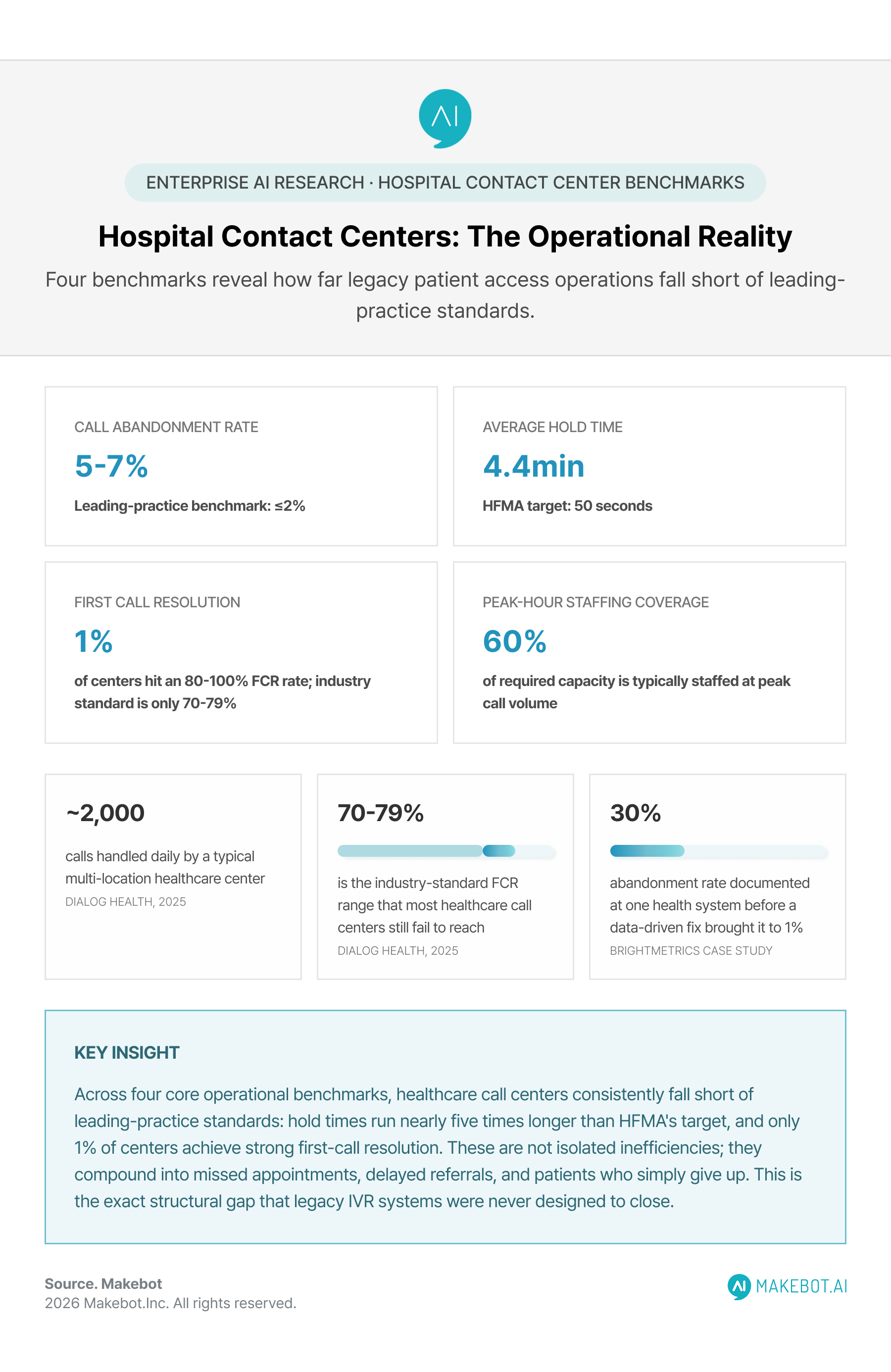
A patient calling a hospital in 2026 still has a meaningful chance of hanging up before anyone answers. Healthcare patient access centers commonly report call abandonment rates in the 5% to 7% range, well above the roughly 2% leading-practice benchmark that healthcare finance industry standards set for hospital scheduling lines. The gap between average and worst-case can be severe: one documented case involved a Southern California nonprofit healthcare provider whose abandonment rate held steady at 30%, nearly one in three callers giving up, before a data-driven intervention brought it down to 1%. Every one of those hang-ups is a missed appointment, a delayed referral, or a patient who simply gives up and calls a competing provider instead.
For three decades, the hospital's answer to this problem was the interactive voice response (IVR) system: a rigid menu tree of "press 1 for billing, press 2 for scheduling" that shifted call volume around without actually resolving it. That era is ending. A new category, the AI contact center (AICC), is replacing static phone trees with conversational systems that can verify identity, check eligibility, schedule appointments, and escalate clinical questions to a live nurse, all without a hold queue. This shift is not a minor IT upgrade. It is a structural change in how hospitals manage patient access, and the data now shows measurable gaps between organizations that get it right and those still stuck in "pilot purgatory."
Why the Hospital Contact Center Became a Breaking Point
Healthcare access operations were never designed for today's call volume, and nowhere is that pressure more visible than inside the modern hospital contact center. A typical multi-practice healthcare center handles around 2,000 calls a day, and patients often call multiple times just to resolve one scheduling need. Industry operational benchmarking compiled across healthcare call center analyses paints an unforgiving picture:
- Average hold time across healthcare call centers runs about 4.4 minutes, well above the HFMA's 50-second target.
- First call resolution tells a similar story: only 1% of healthcare call centers achieve an FCR rate of 80–100%, against an industry standard of 70–79%, meaning most calls fall short of that benchmark.
- Typical staffing meets only about 60% of needed peak-hour coverage, leaving centers structurally understaffed before the phone even rings.
Patients notice the wait. Industry access-management research consistently finds that a majority of callers abandon a call within roughly the first minute of hold time, and a meaningful share won't attempt a second call if the first goes unanswered. In healthcare, where the call might be about test results or a specialist referral, that abandonment isn't a minor inconvenience. It's a patient access failure with clinical and financial consequences. This is the exact pressure point that legacy IVR systems were never built to relieve, because a static menu tree can route a call but cannot actually resolve one.
What "AICC" Actually Means for Hospitals
An AI contact center is a patient-access platform where conversational AI, not a fixed phone tree, handles the interaction from start to finish, using natural language to understand intent, pull data from scheduling and EHR systems, and either resolve the request or route it to the right person with full context attached. Where IVR asked patients to adapt to the system, AICC asks the system to understand the patient.
In a hospital setting, this typically shows up as:
- A conversational voice or chat agent that verifies identity and answers routine scheduling, billing, and refill questions.
- An AI chatbot in healthcare settings handling portal messages and pre-visit intake without a live agent.
- Real-time triage logic that recognizes clinical urgency language and escalates immediately to a nurse line.
- Multimodal access (call, text, web chat) so patients aren't locked into a single channel.
This is where generative AI in healthcare access operations differs meaningfully from older rules-based bots: large language models can handle open-ended phrasing ("my knee's been swelling since Tuesday, can someone look at it soon") instead of requiring patients to navigate rigid keyword menus.
This shift isn't happening in isolation. Stanford HAI's 2026 AI Index reports that AI-generated clinical documentation tools are already saving physicians up to 83% of the time they used to spend on notes, clear evidence that hospitals are comfortable embedding AI deep into clinical workflows. Extending that same logic to the access and scheduling side of the patient experience is a natural next step rather than a leap of faith.
The ROI Case: What the Data Actually Shows
The Contact Center Economics
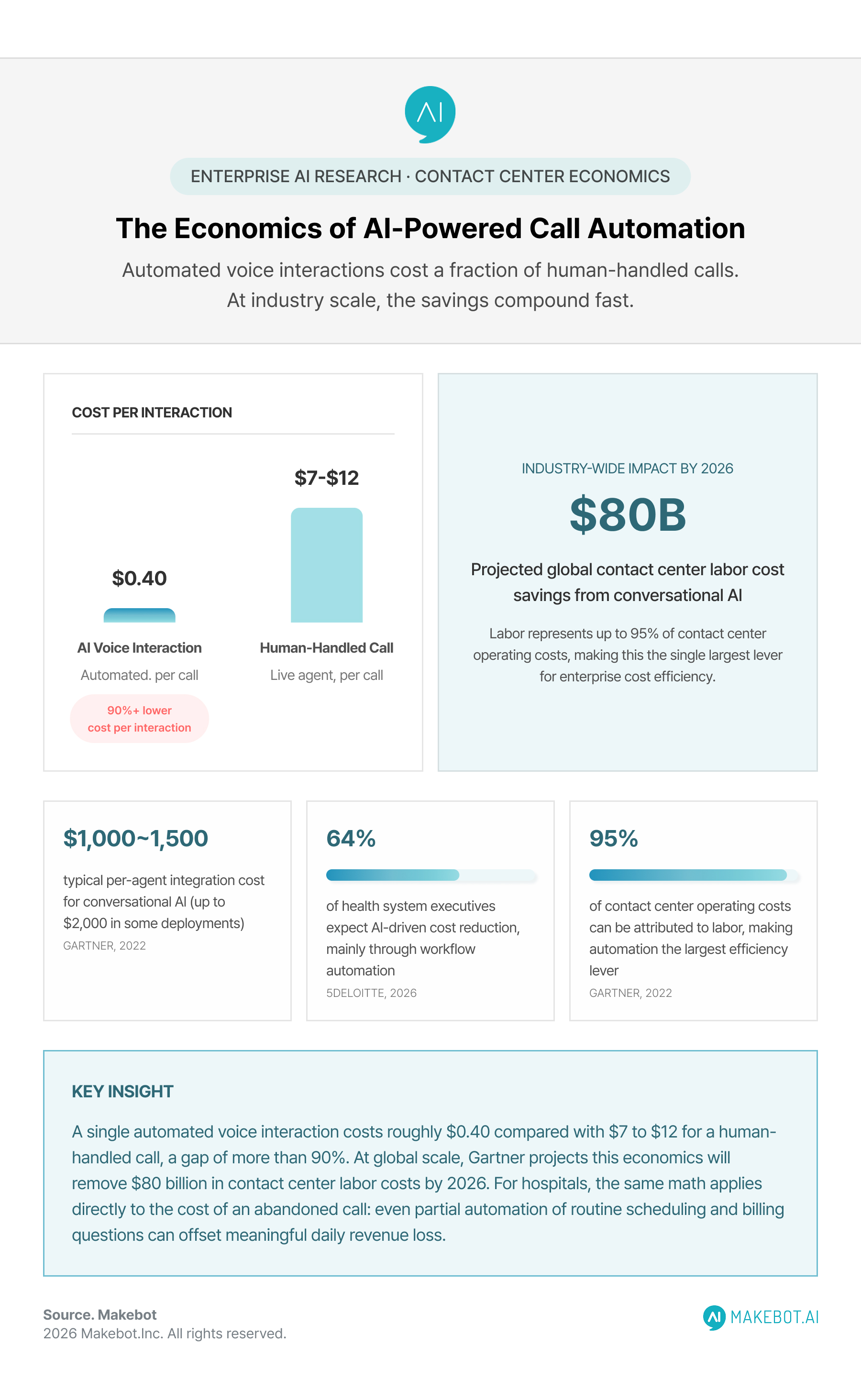
Gartner's analysis remains the industry's reference point for conversational AI economics, even though the original forecast dates back to 2022: contact center labor can represent up to 95% of operating costs, and Gartner projected that conversational AI deployments would cut global contact center labor costs by $80 billion in 2026. The same $1,000 to $1,500 per-agent integration cost Gartner cited then (with some organizations reporting costs up to $2,000) still holds as a working estimate for deployment budgeting today.
Separately, industry cost benchmarking (not from Gartner, and worth distinguishing clearly) puts the typical cost of an automated voice interaction at roughly $0.40, compared with $7 to $12 for a human-handled call. That gap is directionally consistent with Gartner's broader economic logic, even though the specific per-call figure comes from vendor-side industry analysis rather than Gartner's own published research.
For hospitals, that math intersects directly with abandonment economics. One industry analysis estimates that healthcare call centers automating roughly a third of call volume can unlock tens of thousands of dollars in daily savings, on top of the revenue recovered simply by answering calls that would otherwise be abandoned.
The Adoption-vs-Value Gap
Here's the part hospital leadership teams need to internalize before signing a vendor contract: adoption numbers and value numbers are two entirely different stories.
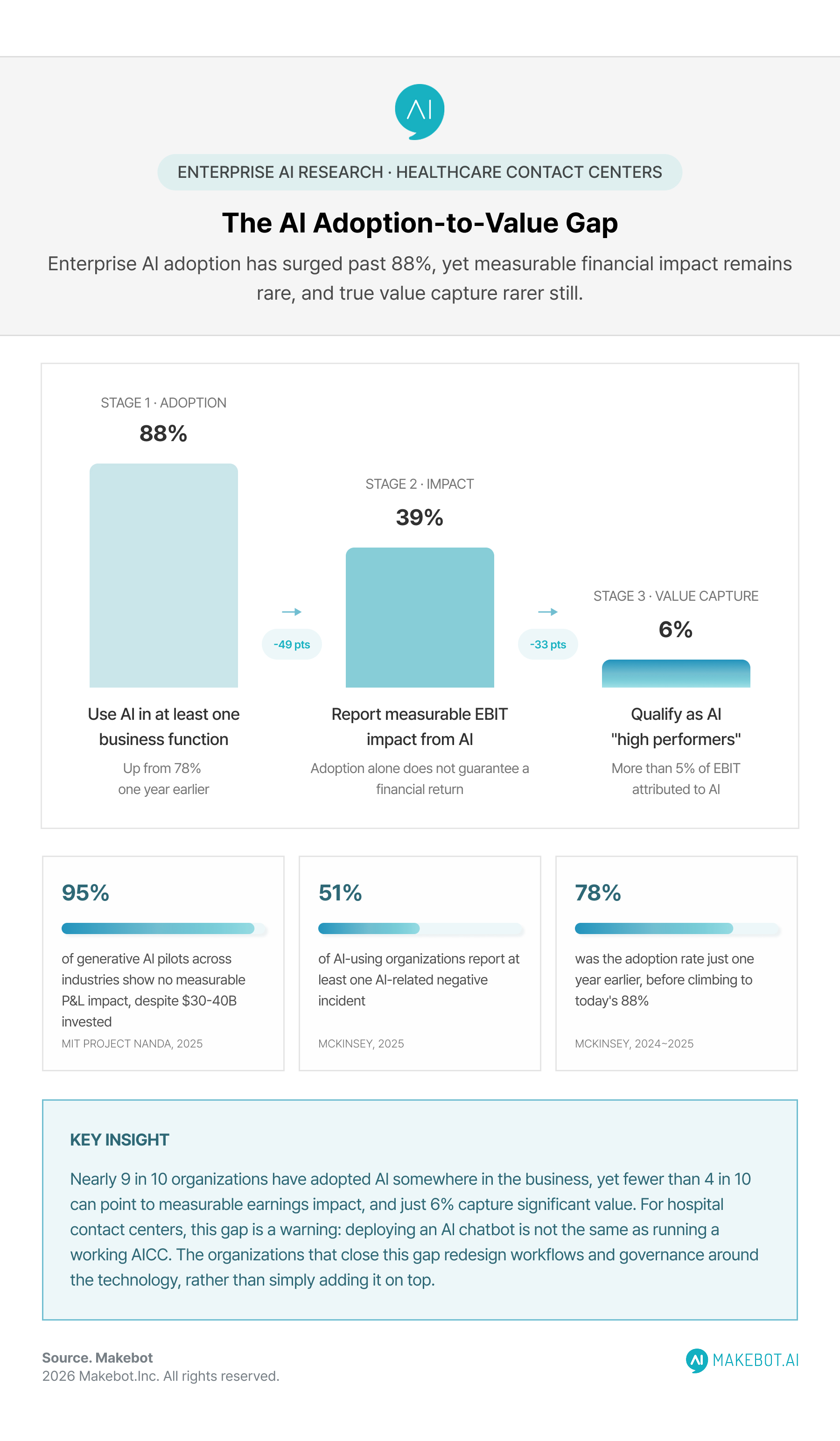
- McKinsey's 2025 State of AI survey found 88% of organizations now use AI in at least one business function, up from 78% the year before.
- Yet only about 39% attribute any measurable EBIT impact to AI, and just 6% qualify as "AI high performers" capturing more than 5% of EBIT from AI.
- MIT's Project NANDA GenAI Divide report went further, finding that 95% of generative AI pilots across industries deliver no measurable P&L impact at all, despite $30–40 billion in enterprise investment.
The takeaway for healthcare contact center automation specifically: buying an AI chatbot license is not the same as running a working AICC. The organizations extracting value redesign the workflow around the tool; the ones that don't simply bolt AI onto an unchanged process and wonder why nothing improved.
Why Some Health Systems Get More ROI Than Others
The gap between AI leaders and laggards isn't primarily a technology gap. It's an organizational one. Several consistent factors separate high performers:
- Workflow integration over tool addition. MIT's research found that generative AI pilots stall when tools can't retain context or adapt to real workflows; success came from embedding AI into the process, not layering it on top.
- Governance and human-in-the-loop design. McKinsey's 2025 data shows 51% of firms report AI-related incidents, but high performers manage that risk through centralized oversight and clear escalation rules rather than avoiding automation altogether.
- Vendor partnerships over pure internal builds. MIT's report found externally partnered AI deployments were roughly twice as likely to succeed as internal-only builds, a meaningful data point for hospital IT teams deciding whether to build or buy an AICC platform.
- Executive-level commitment and measurement. A June 2025 Gartner survey of 432 leaders found that 45% of high-AI-maturity organizations kept AI projects in production for three years or more, compared with just 20% of low-maturity organizations, largely because they define success metrics and governance structures upfront instead of measuring after the fact.
- Deloitte's healthcare-specific finding reinforces this: in a Deloitte Center for Health Solutions survey of 100 health system and health plan technology executives (September 2025), 85% of health care leaders said they plan to increase agentic AI investment over the next two to three years, and 82% of early adopters said they were prioritizing multi-agent solutions coordinated across consumer engagement, care delivery, and back-office operations, not isolated point solutions.
Common Challenges When Scaling AICC in Healthcare
Hospitals scaling beyond a single pilot consistently run into the same set of obstacles:
- Data fragmentation. Patient scheduling, billing, and EHR systems often sit in silos, and an AICC platform is only as good as the data it can actually query in real time.
- Compliance and trust. A healthcare LLM deployment has to satisfy HIPAA requirements while still sounding natural enough that patients don't disengage, a stricter bar than general-purpose customer service AI.
- Clinical escalation risk. Unlike retail or banking chatbots, deploying conversational AI in healthcare settings means a hospital AICC misclassifying an urgent symptom as routine scheduling carries real patient-safety consequences, which is why triage logic needs conservative, well-tested escalation thresholds.
- Staff buy-in. Front-line schedulers and patient access reps who feel replaced rather than supported will route around the system, undermining adoption data even when the technology itself performs well.
- Measurement gaps. Without a pre-deployment baseline for abandonment rate, first call resolution, and average hold time, hospitals can't credibly prove the AICC's ROI to leadership, a documented failure pattern behind many stalled pilots industry-wide.
Successful Adopters vs. Stalled Pilots: What the Comparison Shows
This pattern holds whether the underlying research comes from McKinsey's enterprise-wide EBIT analysis or Deloitte's healthcare-specific agentic AI findings. The differentiator is consistently organizational discipline, not model sophistication.
What This Means for Patient Experience and Business Outcomes
The measurable outcomes hospitals should expect from a properly implemented AI customer service in healthcare deployment fall into a few concrete categories:
- Reduced abandonment and hold time: directly recovering the appointment revenue and referral volume lost to hang-ups.
- Higher first call resolution: closing the gap behind an industry standard of just 70–79%, where only 1% of healthcare call centers currently hit the 80–100% range.
- Lower cost per interaction: following the same economics Gartner documents across contact centers broadly, with voice AI running a fraction of live-agent cost.
- Freed staff capacity: routine scheduling and billing questions absorbed by AI so human agents handle complex, high-stakes calls.
- Better data for operations: every interaction generates structured data on call drivers, peak timing, and recurring patient friction points, feeding continuous improvement instead of guesswork.
None of these outcomes are automatic. They depend on the organizational factors outlined above, which is exactly why adoption statistics and ROI statistics diverge so sharply across the industry.
Conclusion
The shift from IVR to AICC isn't a cosmetic upgrade to the hospital phone tree. It's a redefinition of what patient access can be. The economics are compelling: lower per-call cost, recovered appointment revenue, and freed staff capacity for complex cases. But the enterprise-wide data from McKinsey, MIT, and Gartner delivers a consistent warning alongside the opportunity. Most organizations that adopt AI never translate that adoption into measurable value, because value depends on workflow redesign, governance, and staff alignment, not just the presence of a chatbot.
For hospital leaders, the long-term implication is clear. The health systems that will differentiate over the next several years are not the ones that deploy an AI patient support tool fastest, but the ones that treat it as an operating-model transformation, with clear baselines, coordinated multi-agent workflows, and a governance structure built for clinical stakes. The technology is ready. Whether an organization captures its value is, as the data consistently shows, a leadership decision, not a technology one.





.png)








.jpg)

What Happens to Marketing When the C-Suite Starts Using AI Every Day?






Why AI Shopping Assistants Will Replace Traditional Ecommerce Search






.jpg)

























Why Generative AI Projects Fail and How to Achieve Scalable AI Success











.jpg)

.png)