The 79% Governance Gap Behind Enterprise AI Agent Deployment
79% of firms lack mature AI agent governance. Gartner says 40% of agentic projects get canceled.


Key Takeaways
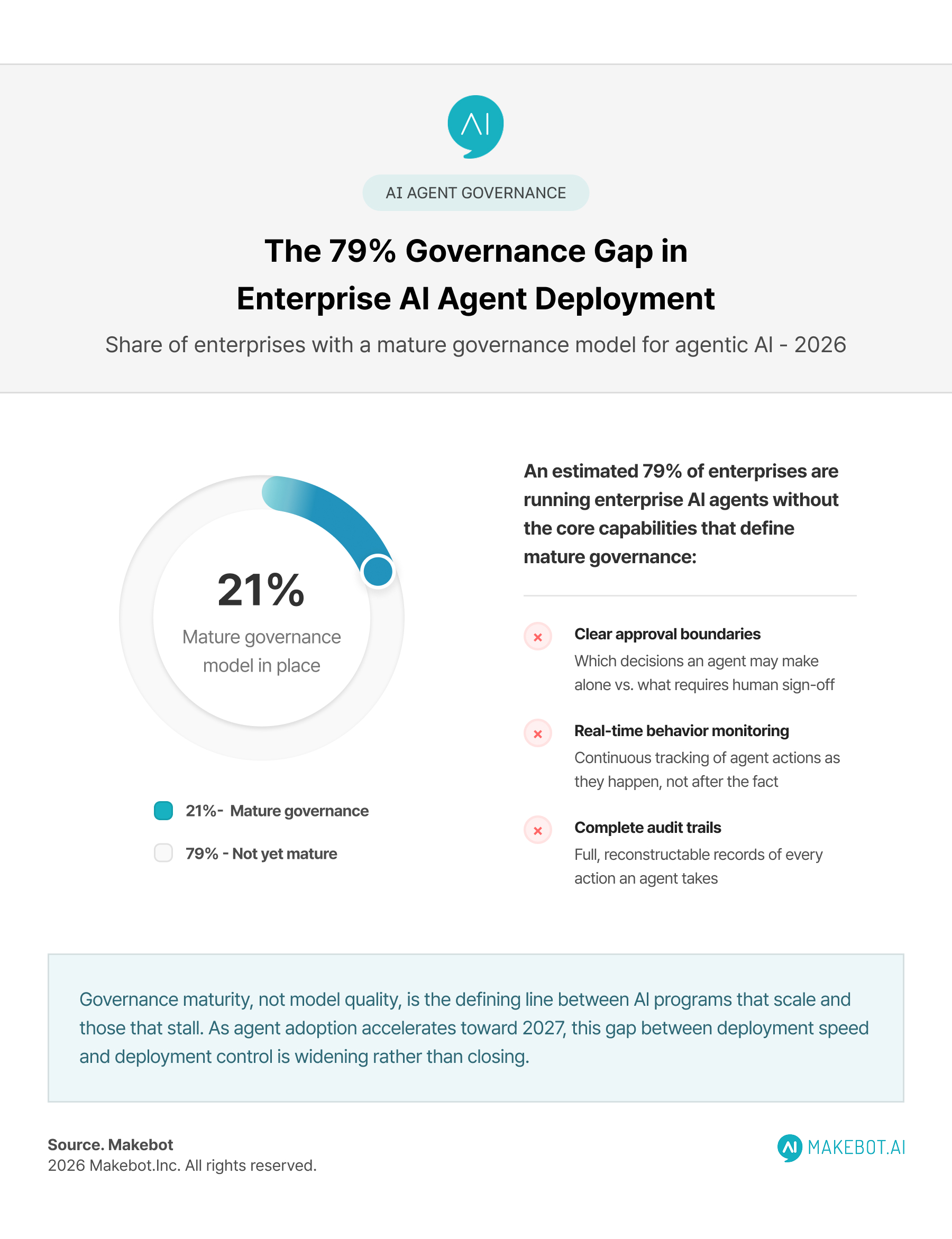
- Only 21% of companies say they have a mature governance system for agentic AI, leaving roughly four out of five running AI agents without real oversight, based on Deloitte's 2026 survey of 3,235 business leaders.
- Gartner predicts that more than 40% of agentic AI projects will be canceled by the end of 2027, due to rising costs, unclear business value, and weak risk controls, not poor model quality.
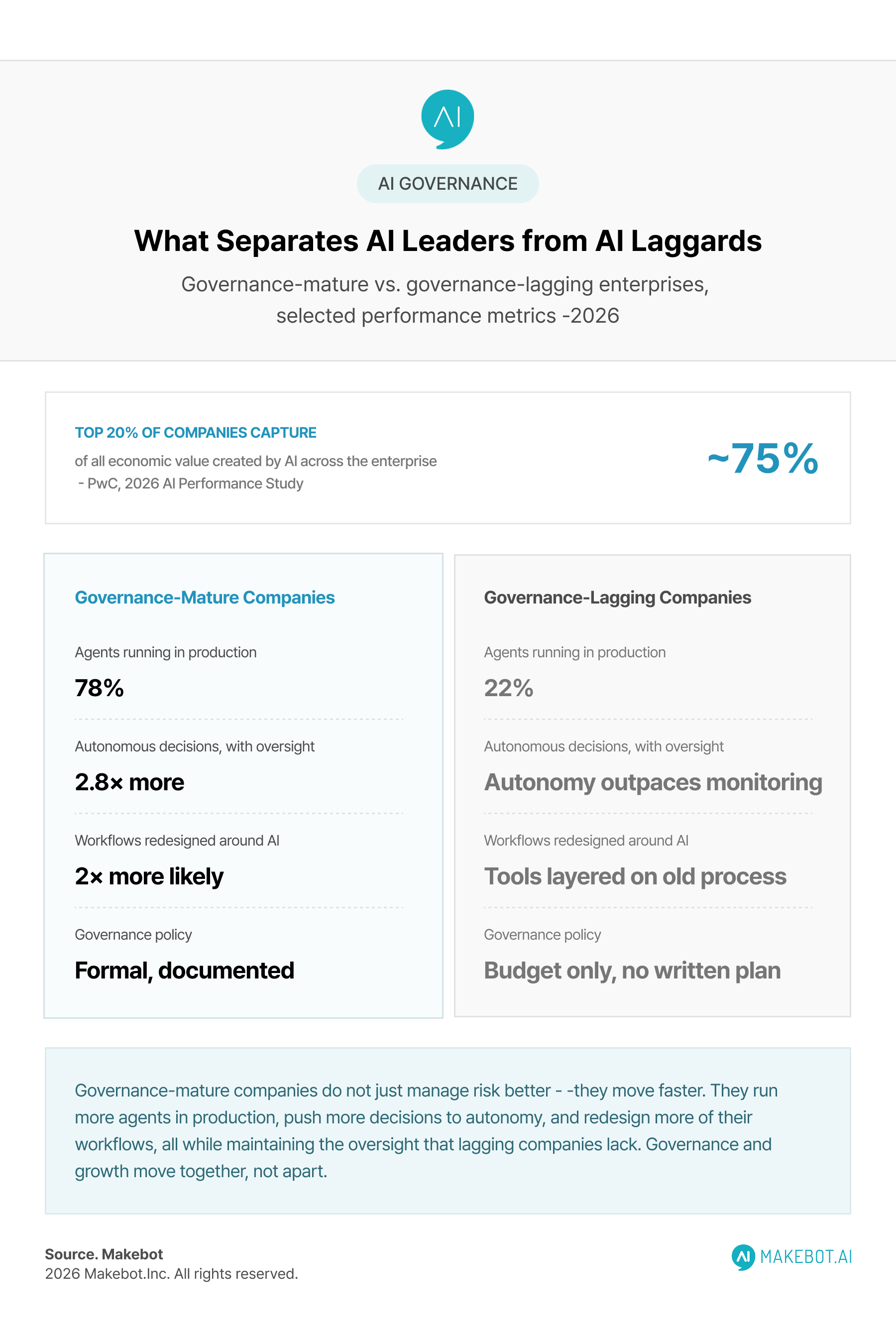
- PwC's 2026 AI Performance Study found that the top 20% of companies capture almost three quarters of all economic value created by AI, and these leaders also push further on AI governance, not less.
- Schellman's 2026 State of AI Governance Report found that companies with mature governance run AI agents in production at more than three times the rate of companies still building their programs (78% versus 22%).
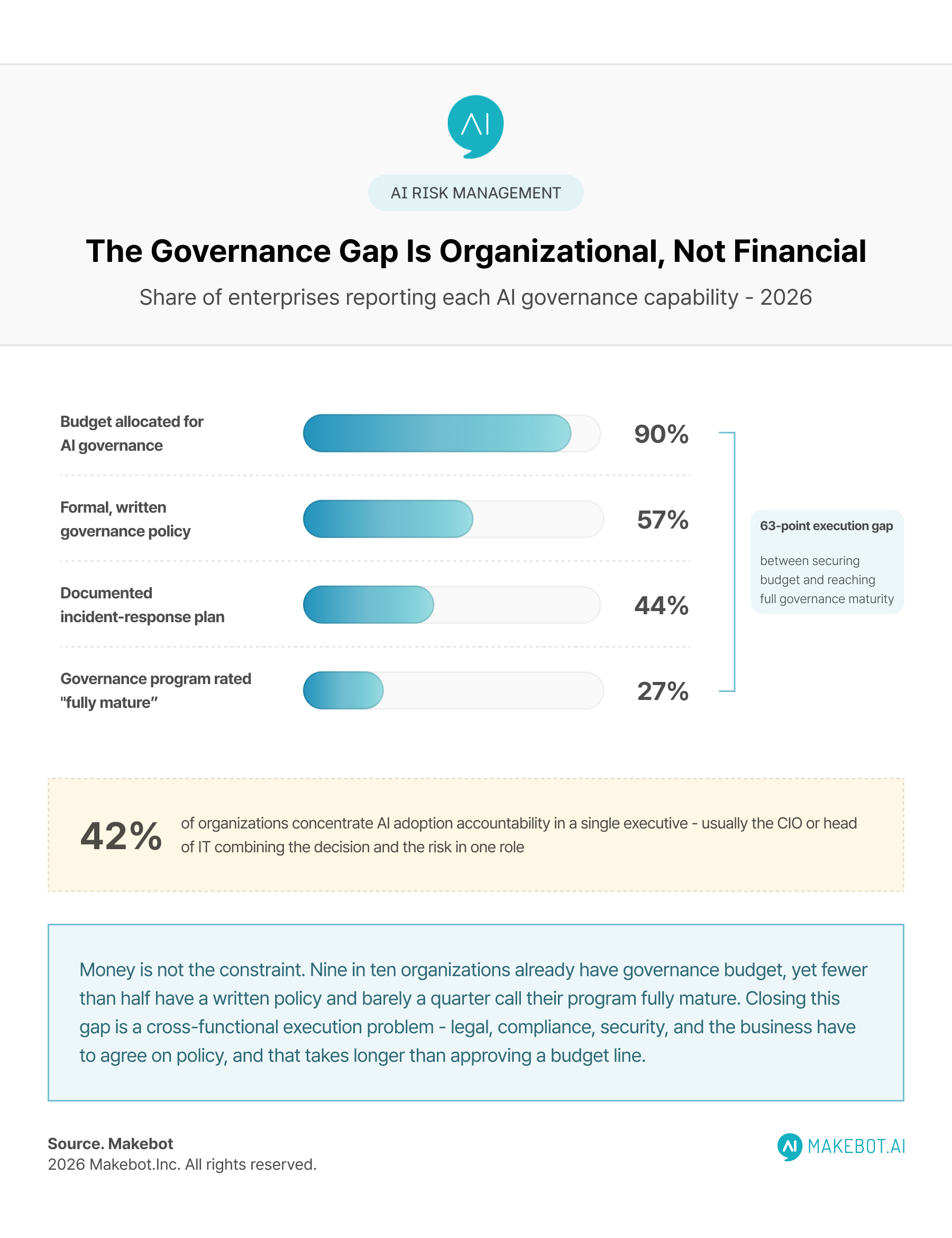
- The gap is organizational, not financial: 90% of organizations have already set aside budget for AI governance, yet only 57% have a written policy and just 44% have a documented incident-response plan.
Enterprise AI agents are no longer small test projects. Right now, they approve customer refunds, sort support tickets, pull data from live systems, and start workflows across finance, HR, and customer service, often with little human review. Yet according to Deloitte's global survey of 3,235 business and IT leaders, only 21% say they have a governance system mature enough to manage this. That leaves an estimated 79% running enterprise AI agents without clear answers to basic questions: which decisions can an agent make alone, is every action logged, and who is responsible when something goes wrong? This article looks at what the data shows about that gap, why it exists, and what separates companies turning agentic AI into real value from those quietly building up risk.
The Governance Gap, By the Numbers
Deloitte's State of AI in the Enterprise 2026 report, based on interviews with 3,235 leaders in 24 countries, found that only 21% of respondents have a mature governance system for agentic AI. That means about 80% still lack the basics: clear rules for which decisions need a human, real-time monitoring, and complete records of agent actions.
This gap is widening as adoption speeds up. The same survey found 74% of organizations expect to use AI agents at least "moderately" by 2027, with 23% expecting extensive use. Gartner's research shows the same pattern: it predicts more than 40% of agentic AI projects will be canceled by the end of 2027, pointing to rising costs, unclear value, and weak risk controls. Gartner also estimates only about 130 vendors out of thousands selling "agentic AI" offer real autonomous capability, a pattern it calls "agent washing."
Why Agentic AI Breaks Traditional Governance Models
Most AI governance rules were built for a Large Language Model that drafts or suggests something while a person checks the output first. Agentic AI changes that. An agent does not just suggest an action, it can carry one out: issuing a refund, changing a record, or triggering another system, often chaining decisions together with no natural checkpoint.
This is why enterprise AI governance built around content review keeps failing to contain agent risk. AI agent security has to handle problems an LLM alone never created: agents gaining too much access, multiple agents coordinating unpredictably, and small errors multiplying. Deloitte defines mature agentic AI governance in specific terms: clear approval boundaries, real-time monitoring, and full audit trails. Treating agentic AI governance as an add-on to existing AI policy, instead of its own discipline, is a leading driver of this gap.
What Separates AI Leaders from AI Laggards
PwC's 2026 AI Performance Study, surveying more than 1,200 executives across 25 industries, found that a small group of companies is pulling ahead on financial returns from AI, with governance as a defining trait rather than a tradeoff.
- The top 20% capture almost three quarters of AI's economic value.
- They are two to three times more likely to use AI for new growth opportunities rather than isolated tasks.
- They are twice as likely to redesign workflows around AI instead of layering tools on top.
- They are 2.8 times more likely to increase autonomous decisions while investing further in governance.
MIT's NANDA research reinforces this: 95% of companies studied saw generative AI fall short of measurable financial impact, while purchased, vendor-partnered systems succeeded about 67% of the time versus roughly a third that rate for internal builds.
The Organizational Roots of the Governance Gap
The answer is rarely money. Schellman's 2026 State of AI Governance Report found 90% of organizations have a budget for AI governance, yet only 57% have a formal policy and 44% have a documented incident-response plan. It also found 74% believe they could pass an AI compliance audit today, while only 27% call their program fully mature.
This is a people-and-process problem:
- Budgets get approved faster than policies get written, since policy needs agreement across legal, compliance, security, and the business.
- AI risk management frameworks are often borrowed from cybersecurity playbooks never built for autonomous, multi-step agents.
- A single executive, usually the CIO, holds AI adoption accountability at 42% of organizations, concentrating both the decision and the risk.
Governance-mature companies report clearly better results: 57% cite improved efficiency, 49% stronger regulatory readiness, and 43% easier scaling. They also run agents in production at more than three times the rate of less-mature peers (78% versus 22%).
AI Leaders vs. AI Laggards: A Quick Comparison
The difference between these two groups shows up across nearly every dimension. Deloitte's research found that governance-mature companies start small and scale deliberately, while governance-lagging companies rush to scale without clear boundaries.
According to Schellman, 78% of governance-mature companies run agents in production, compared with just 22% of governance-lagging companies. PwC's data shows governance-mature companies are 2.8 times more likely to increase autonomous decisions while maintaining oversight, and twice as likely to redesign workflows around AI, whereas governance-lagging companies let autonomy outpace monitoring and simply layer tools onto old processes.
On policy, Schellman found that governance-mature companies have a formal policy and documented incident response, while lagging companies often have budgets set aside but no written plan. The result: governance-mature companies report better efficiency, regulatory readiness, and easier scaling, while Gartner's research shows governance-lagging companies face stalled pilots and a higher risk of project cancellation.
Common Challenges When Scaling AI Agents
- Unclear decision boundaries: few companies formally document which actions an agent can take alone.
- Incomplete records: without full logs, investigating problems becomes guesswork.
- Regulatory readiness gaps: 94% already operate under active AI regulation, yet only 29% are ready for the EU AI Act and 12% for APAC rules.
- Board-level blind spots: only 36% of boards regularly discuss third-party AI risk.
- Speed outpacing oversight: the same mix Gartner ties to project cancellations, rising costs, unclear value, and weak controls.
Building a Governance Framework
Deloitte's research shows leading companies build governance alongside deployment, not after it:
- Define approval thresholds before an agent goes live.
- Set up real-time monitoring and full audit trails.
- Assign shared ownership across IT, legal, compliance, and the business, rather than concentrating accountability in one executive.
- Pilot low-risk use cases first, expanding only as governance keeps pace.
Conclusion: Governance Is Becoming the Growth Strategy
The data points to one conclusion: the biggest obstacle to enterprise AI is oversight, not model capability. A 79% governance gap does not mean companies lack ambition or budget; investment keeps climbing. It means most companies still treat AI agent governance as an afterthought instead of the foundation that decides whether an agentic AI program survives contact with real work. The leaders capturing three quarters of AI's economic value, according to PwC, and running agents in production at more than three times the rate of everyone else, prove governance and growth are the same strategy, not competing ones. Governance built in from the start is what decides whether a program gets the chance to prove itself at all.
Governance Built In From Day One, Not Retrofitted After an Incident
The data is clear: companies with mature AI governance run agents in production at more than three times the rate of those still building their programs. Makebot is a leading generative AI and LLM solutions provider trusted by over 1,000 enterprise clients across healthcare, finance, public institutions, and beyond. With a proprietary multi-LLM platform, HybridRAG architecture with audit-grade logging, permission-aware search, and human-in-the-loop design built in from deployment, Makebot gives enterprises the governed AI infrastructure needed to run agents in production with real oversight, not just real speed.
See how Makebot builds enterprise AI that is governed from the start








.jpg)


What Happens to Marketing When the C-Suite Starts Using AI Every Day?







Why AI Shopping Assistants Will Replace Traditional Ecommerce Search






.jpg)
























Why Generative AI Projects Fail and How to Achieve Scalable AI Success











.jpg)

.png)