What Happens to Marketing When the C-Suite Starts Using AI Every Day?
Only 6% of firms hit real AI ROI - when C-suite uses AI daily, marketing faces sharper scrutiny.


Introduction
Something has quietly shifted in the executive suite. AI is no longer a side project CEOs delegate to an innovation team; it's showing up in how they read forecasts, question campaign plans, and set quarterly targets. That shift changes what marketing has to deliver. When the people approving budgets use generative AI in marketing tools themselves, they bring sharper questions about attribution, speed, and measurable return. This article examines what the latest data from McKinsey, Deloitte, Gartner, PwC, MIT, and Accenture reveals about this transition: how fast C-suite AI use is accelerating, why marketing has become a focal point for scrutiny, which organizations are actually capturing value from enterprise AI, and what separates them from everyone else still waiting for returns to show up.
The New Normal: AI Has Become a C-Suite Habit, Not a Pilot
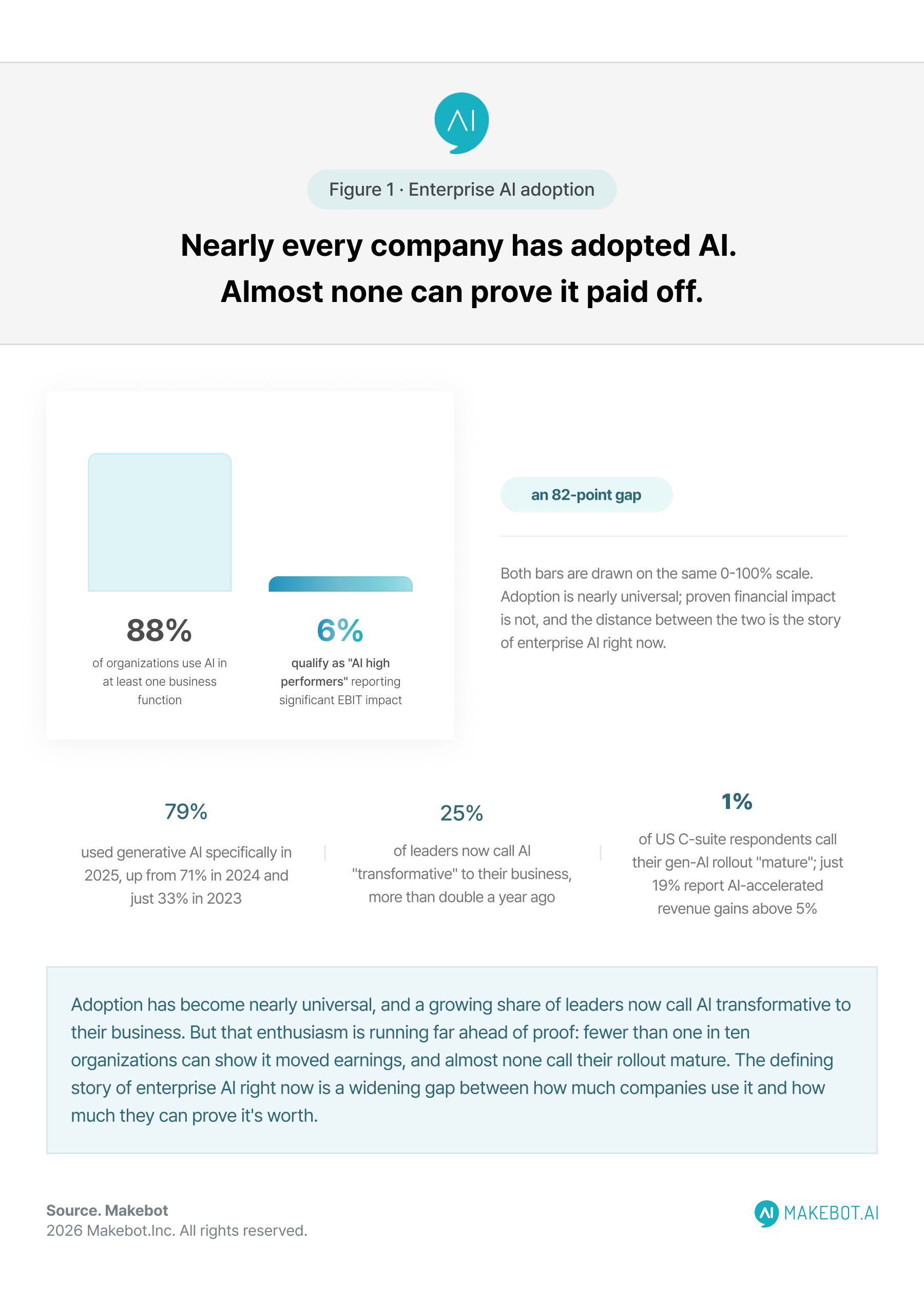
Enterprise AI adoption has crossed a threshold. Deloitte's 2026 "State of AI in the Enterprise" survey of 3,235 director-to-C-suite leaders found that 25% now describe AI as having a transformative effect on their business, more than double the share reported a year earlier. A third (34%) say they are using AI to "deeply transform" operations rather than simply automate existing tasks.
That momentum is echoed in McKinsey's State of AI research, which found that 88% of organizations now use AI in at least one business function (up from 78% the year before), and that generative AI use specifically reached 79% in 2025, up from 71% in 2024 and just 33% in 2023. AI-driven decision making is no longer confined to IT or analytics teams; it has become part of how leadership teams operate day to day, and AI in marketing is one of the functions where that shift is most visible.
The Executive Perception Gap
One of the more revealing findings concerns how leaders perceive adoption inside their own companies. McKinsey's "Superagency in the Workplace" research, based on a late-2024 survey of US C-suite executives and employees, found that C-suite respondents estimated only 4% of employees were already using generative AI for at least 30% of their daily tasks, while employees themselves put that figure at 13%, more than three times higher. That gap matters for marketing leaders: it means many executives are still calibrating their expectations of "how much AI is really being used" against outdated internal data, even as their own AI habits accelerate. Separate PwC research puts daily generative AI use among the broader workforce at just 14%, a reminder that "daily AI habit" is still far more common in the C-suite than on the front line.
Why Marketing Is Ground Zero for AI-Driven C-Suite Scrutiny
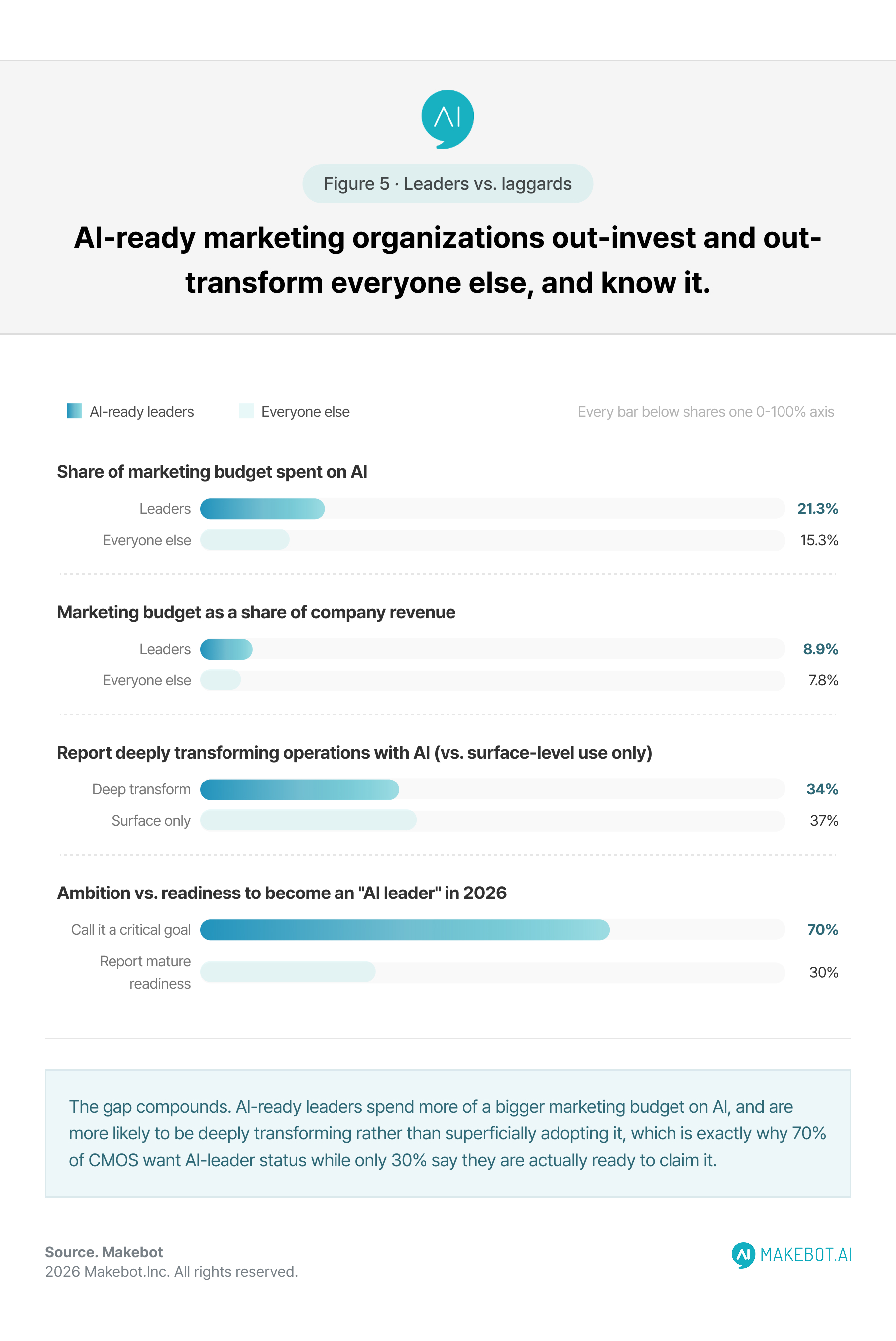
Marketing sits closer to this shift than almost any other function, largely because CMOs have made AI marketing automation a budget priority. Gartner's 2026 CMO Spend Survey, based on 401 marketing leaders across North America, the UK, and Europe, found that CMOs now allocate an average of 15.3% of marketing budgets to AI initiatives. Seventy percent say becoming an "AI leader" is a critical 2026 goal, but only 30% report mature, scalable AI readiness.
That readiness gap has direct financial consequences. Gartner found that AI-ready marketing organizations allocate 21.3% of budget to AI (well above the 15.3% average) and run marketing budgets equal to 8.9% of company revenue, versus a 7.8% average for everyone else. In other words, the CMOs furthest along with AI marketing strategy are also the ones with more resources to invest, a compounding advantage.
Rising Pressure to Prove ROI
As AI-literate executives get closer to the numbers, the bar for what counts as marketing performance is rising. Fifty-six percent of CMOs in the Gartner survey say their organization lacks the budget required to deliver its 2026 strategy, forcing sharper trade-offs about where AI spend actually pays off versus where it simply automates existing work. AI marketing analytics that can tie campaigns to revenue, not just engagement metrics, is quickly becoming table stakes for keeping budget at all.
The Investment-Return Mismatch: Where AI Marketing Dollars Go vs. Where Value Is Created
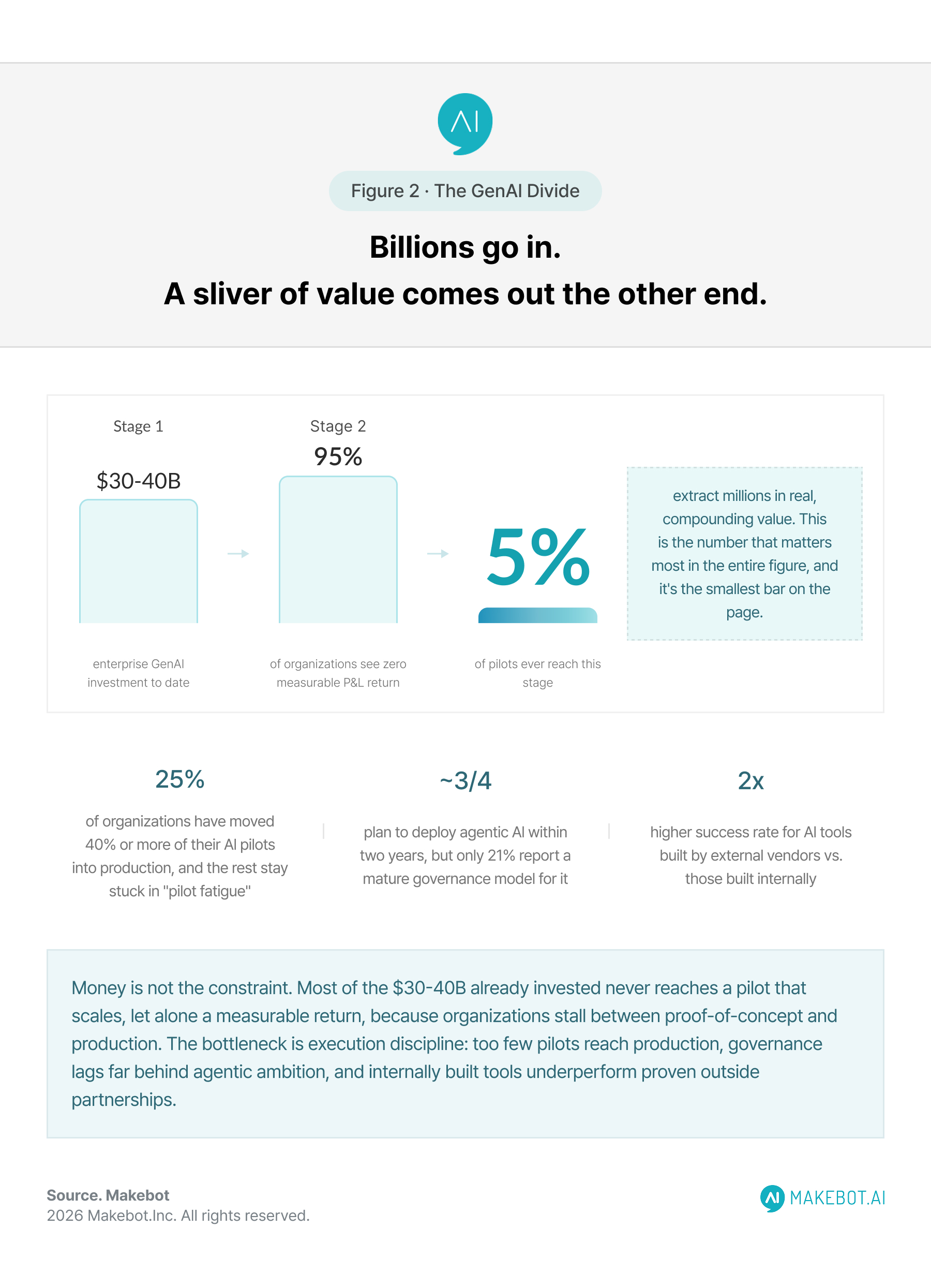
This is where the data gets uncomfortable for marketing leaders. MIT's Project NANDA, in its widely cited "GenAI Divide: State of AI in Business 2025" report, found that despite $30–40 billion in enterprise GenAI investment, 95% of organizations saw no measurable P&L return; just 5% of pilots were extracting significant value.
Crucially, the report found that sales and marketing functions absorb roughly half of enterprise GenAI budgets, yet back-office functions such as finance and operations often deliver stronger, faster-to-measure returns. The report attributes this to measurability, not merit: sales and marketing outcomes are easy to tie to board-level KPIs, while back-office efficiencies are real but harder to surface in strategic conversations.
McKinsey's 2026 State of AI survey of 1,719 executives across 97 countries reinforces the same pattern at the enterprise level: 80% of respondents say AI has improved their individual productivity, yet only 37% report any positive EBIT impact from AI at the organizational level, and just 6% qualify as "AI high performers," attributing 5% or more of EBIT to AI and describing its impact as significant. A separate McKinsey survey of more than 10,000 senior executives found the gap even sharper in the United States: only 1% of US C-suite respondents describe their generative AI rollout as mature, and just 19% report AI-accelerated revenue increases above 5%. The takeaway for AI-powered marketing teams is direct: activity and adoption are not the same as proven business outcomes, and the C-suite is increasingly aware of the difference.
What Separates High-Performing AI Marketing Organizations From the Rest
Not every organization is stuck on the wrong side of this divide. A smaller group is converting AI investment into measurable growth, and the data shows fairly consistent patterns behind their success.
- Foundations before scale: PwC's 29th Global CEO Survey (more than 4,000 CEOs across 95 countries and territories) found that companies with strong AI foundations (responsible-AI frameworks and enterprise-wide technical integration) are three times more likely to report meaningful financial returns from AI.
- Reinvented workflows, not bolt-on tools: Accenture's research on 2,000 executives across 12 countries found that companies with fully modernized, AI-led processes achieve 2.5x higher revenue growth, 2.4x greater productivity, and 3.3x more success scaling generative AI use cases compared with peers.
- Deep transformation over surface automation: Deloitte found that while 34% of organizations use AI to deeply transform how they operate, 37% report only surface-level use with little change to underlying processes, a split that tracks closely with which companies see revenue and margin benefits.
- Profit impact from broad application: Separate PwC analysis found that companies applying AI widely across products, services, and customer experience achieved close to four percentage points higher profit margins than those that did not.
AI Marketing Leaders vs. AI Marketing Laggards
Organizational and Technical Factors Behind AI ROI Divergence
The divide between leaders and laggards is rarely about which AI model or tool a company licenses. It is about organizational discipline. Deloitte's 2026 survey found that only 25% of organizations have moved 40% or more of their AI pilots into production; the rest remain stuck in what the industry calls "pilot fatigue." Nearly three-quarters of companies plan to deploy agentic AI within two years, but only 21% report having a mature governance model for it, leaving a wide gap between ambition and operational readiness.
MIT NANDA's research adds a technical dimension: tools built and customized by external vendors succeeded roughly twice as often as internally built systems, largely because internal builds tend to lack the iterative learning and integration depth needed to fit real workflows. For marketing organizations, this suggests that AI for business leaders evaluating build-versus-buy decisions should weigh integration maturity as heavily as feature lists or cost.
Underlying both findings is a consistent theme: successful AI marketing transformation requires redesigning the workflow itself: how campaigns are briefed, measured, and iterated, rather than layering AI onto an unchanged process and expecting different results.
The Long-Term Transformation of the Marketing Function
Taken together, this data points to a marketing function under structural pressure to change. As AI-driven decision making becomes routine at the top of the organization, marketing leaders are being asked to justify spend with the same rigor applied to any other capital allocation decision, grounded in EBIT contribution, not campaign volume.
This doesn't mean marketing loses influence. Gartner's own research shows that AI-ready CMOs are already commanding larger marketing budgets relative to revenue, not smaller ones, evidence that credible, measurable AI use expands a CMO's mandate rather than shrinking it. The organizations pulling ahead are treating marketing transformation as an operating-model change: pairing AI tools with governance, skills investment, and workflow redesign rather than treating AI as a faster way to do the same work.
For the marketing leaders who get this right, the payoff compounds. For those who don't, the C-suite's own growing AI fluency means the gap between activity and impact will be increasingly difficult to hide.





.png)








.jpg)

What Happens to Marketing When the C-Suite Starts Using AI Every Day?






Why AI Shopping Assistants Will Replace Traditional Ecommerce Search






.jpg)
























Why Generative AI Projects Fail and How to Achieve Scalable AI Success











.jpg)

.png)