Agentic Search Takes the Wheel: How Retailers Must Rebuild Holiday Readiness for 2026
24% of shoppers start holiday buying on AI platforms. AI referral traffic to retail rose 693%.


Key Takeaways
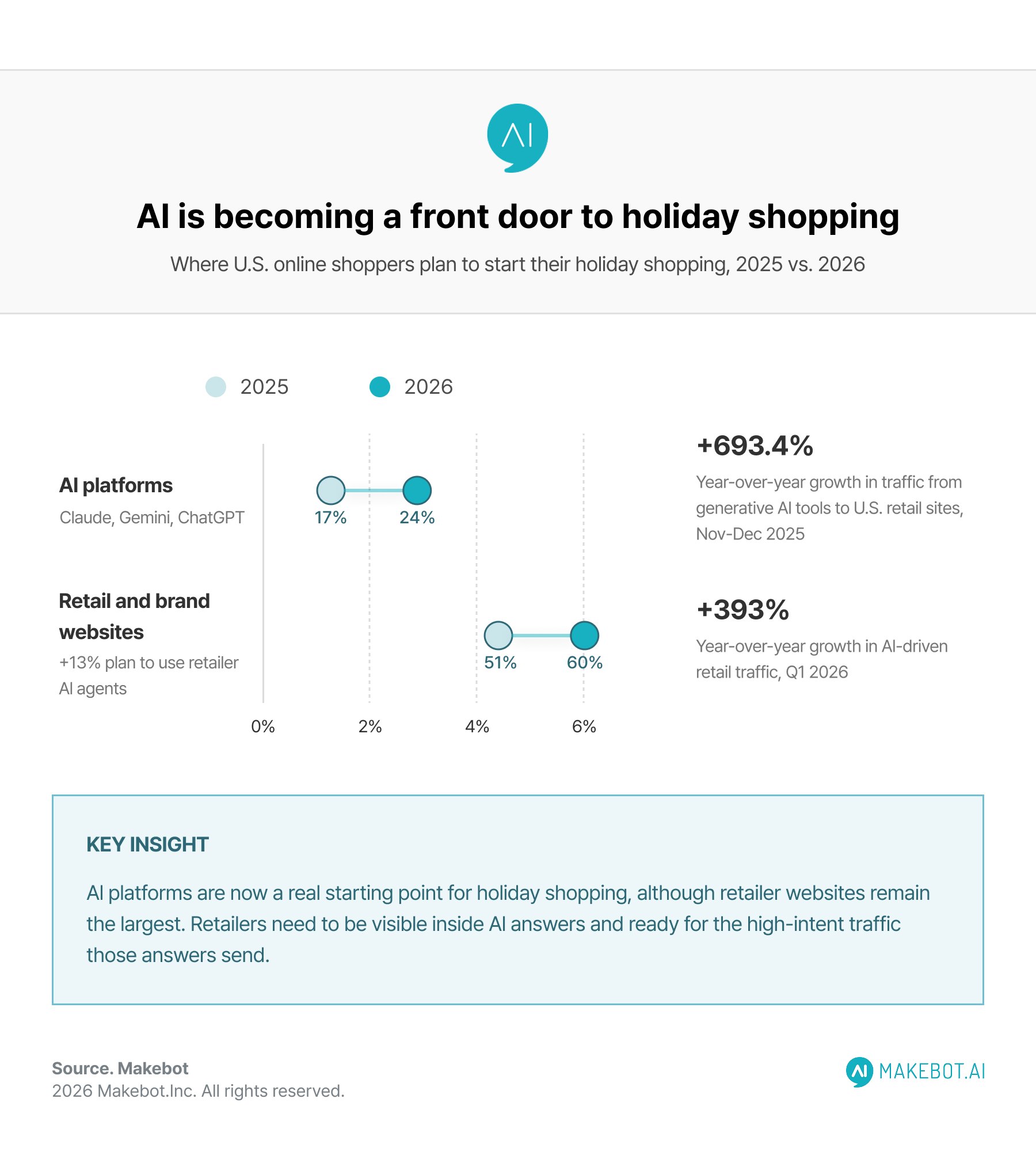
- About 1 in 4 online shoppers (24%) plan to start their holiday shopping on AI platforms this year, up from 17% in 2025.
- Shoppers who reach U.S. retail sites from AI tools converted 42% better than other visitors in March 2026. But product detail pages scored lowest of the page types Adobe reported averages for, so AI tools struggle to read them.
- Most people who use AI for gift ideas still go to a website on their own to buy. Earning trust matters more than simply getting traffic.
- Only about 6% of organizations get strong financial results from AI, the same share as in 2025. Redesigning how work gets done is one of the clearest things that sets them apart.
- In June 2025, Gartner predicted that more than 40% of agentic AI projects will be canceled by the end of 2027. Retailers should not rush unfinished AI agents into the busiest season of the year.
For years, holiday preparation meant load-testing websites, planning sales, buying search ads, and hiring extra warehouse staff. It all assumed shoppers would type a search and click through to a product page.
That is changing. More and more holiday shopping now starts inside AI assistants such as ChatGPT or Gemini. These tools run on a Large Language Model (LLM), so shoppers can describe what they want and get suggestions, comparisons, and sometimes help with checkout. This is agentic search, and it means retailers must convince the AI before they can reach the person.
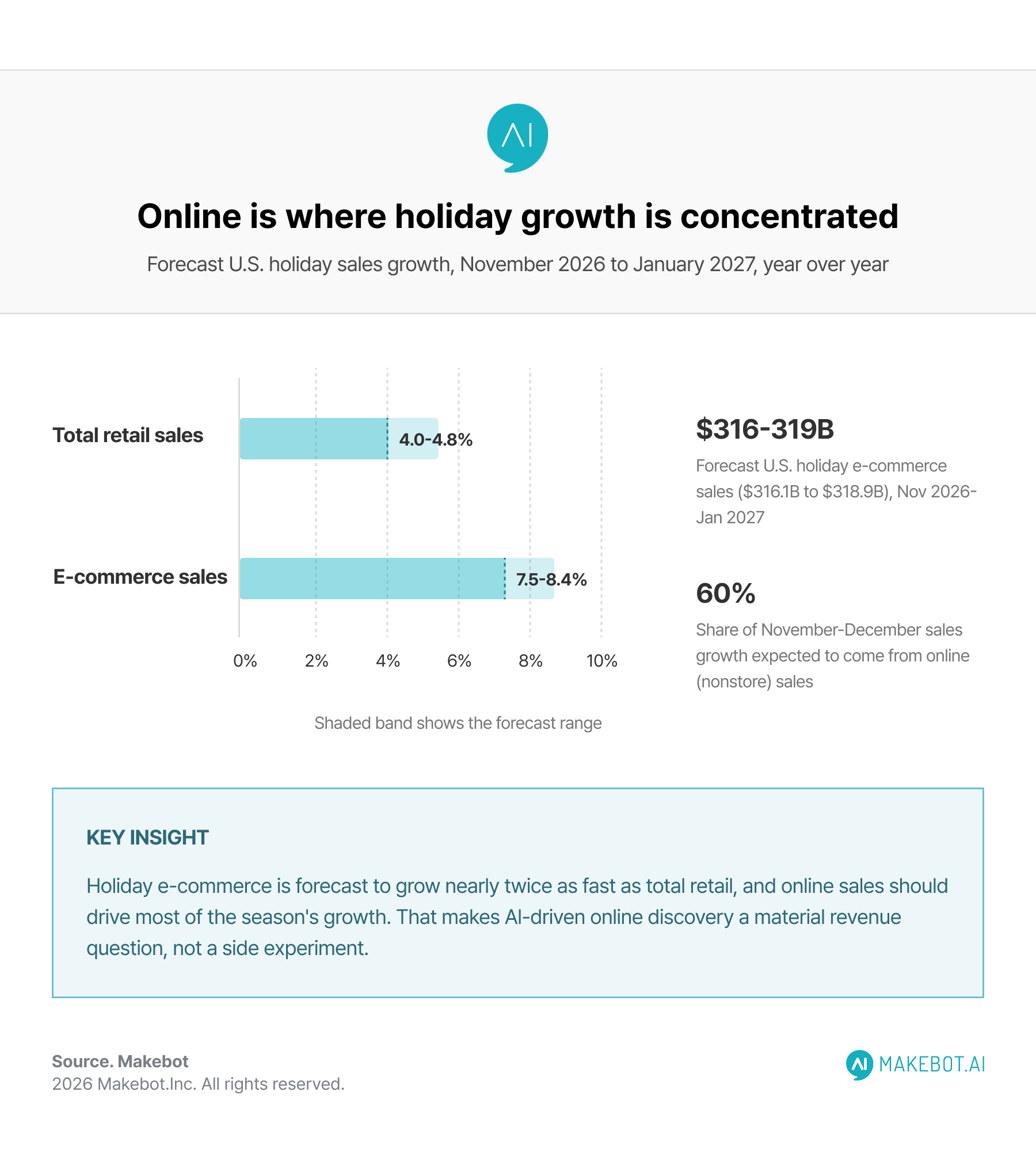
The stakes are high. Deloitte expects U.S. holiday online sales of $316.1 billion to $318.9 billion from November 2026 to January 2027. Here are the holiday e-commerce readiness steps that still fit before Black Friday.
Holiday Shopping Now Starts With AI
Bain & Company's 2026 U.S. holiday forecast finds that 24% of online shoppers plan to begin on AI platforms like Claude, Google Gemini, and ChatGPT, up from 17% last year. Traffic from generative AI tools to retail sites rose 693.4% year over year in November and December 2025, and grew another 393% in the first quarter of 2026.
AI product discovery changes shopping in three ways:
- Shoppers ask full questions, such as "a robotics gift for a 12-year-old, under $60, delivered before the 20th." The AI must match every detail against product data.
- The shortlist forms before anyone clicks. PwC advises retailers to make sure their products, brands, and prices show up clearly in AI answers.
- Price gaps are easy to spot, because AI makes it easier for shoppers to compare prices.
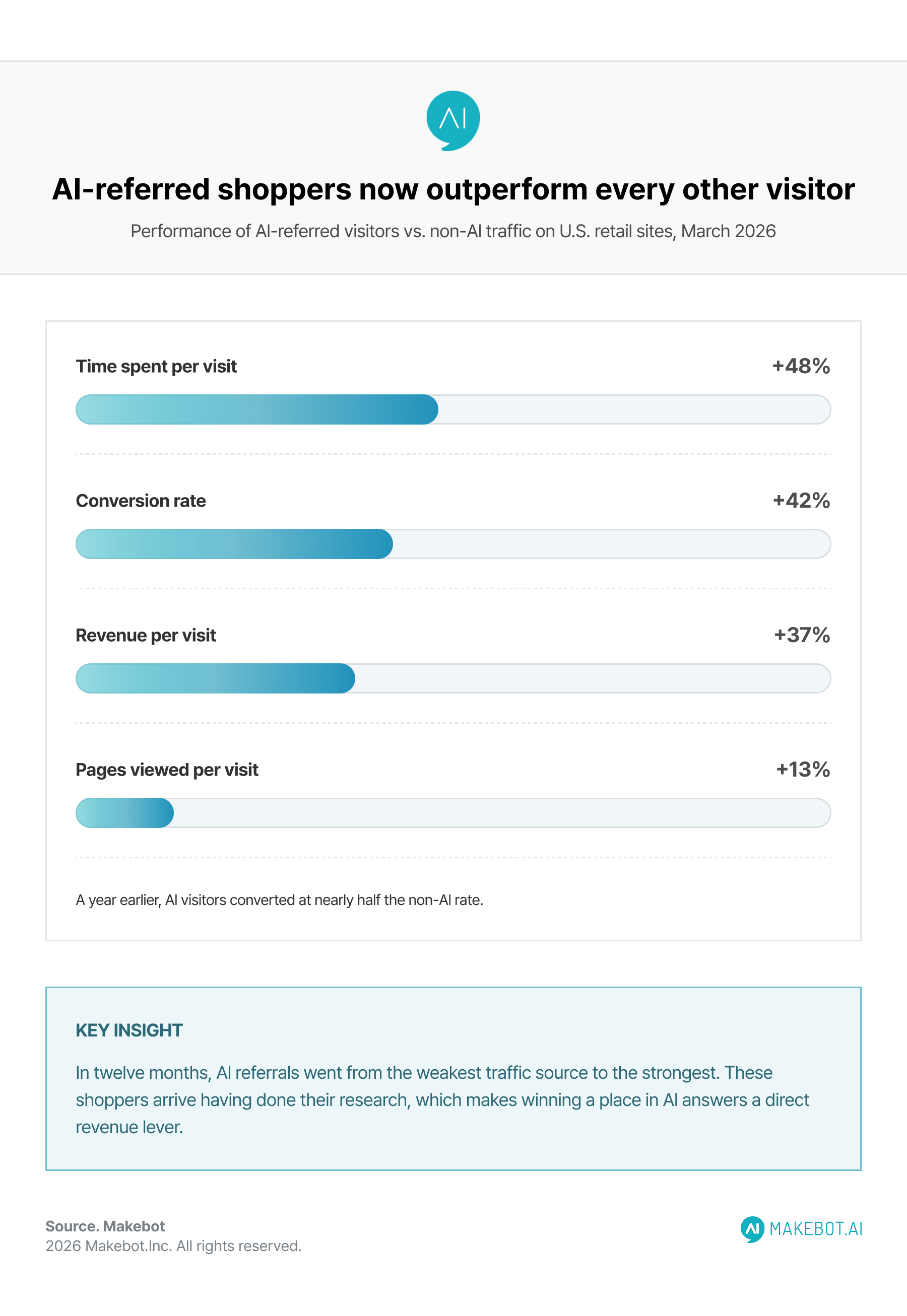
AI Shoppers Buy More, but AI Struggles to Read Many Sites
A year ago, AI visitors were less likely to buy than others. By March 2026, they converted 42% more often and brought in 37% more revenue per visit. They usually arrive knowing what they want, which is where generative AI in e-commerce creates real value.
The problem is machine readability: how much of a page an AI system can understand. In Adobe's review of U.S. retail sites, homepages averaged 75%, but product detail pages averaged only 66%. By Adobe's scoring, about a third of a typical product page cannot be read by machines.
From Agentic Search to Agentic Commerce
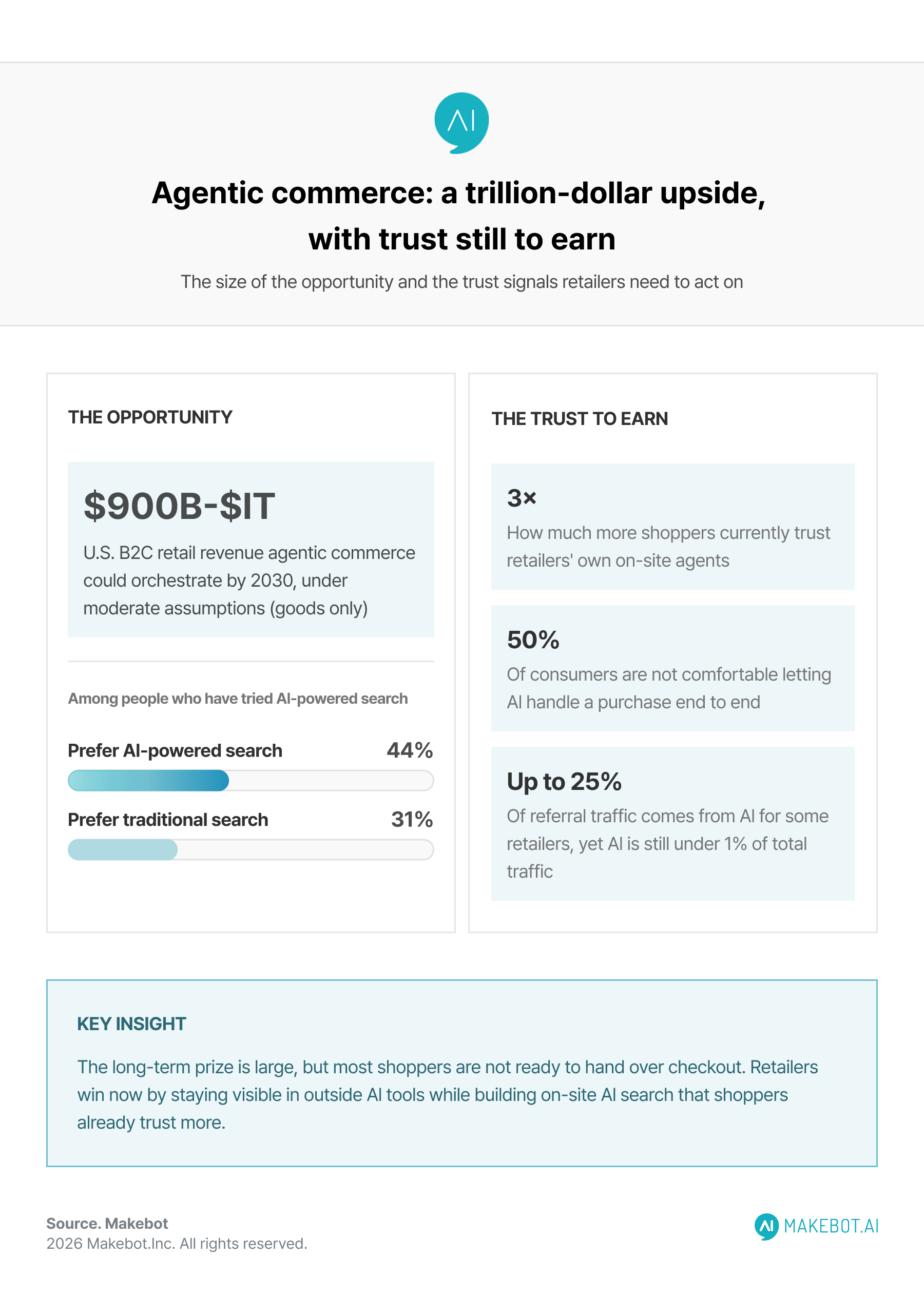
Agentic commerce means AI agents shopping and paying on a person's behalf. McKinsey estimated in October 2025 that agentic commerce could handle $900 billion to $1 trillion in U.S. B2C retail sales by 2030 under moderate assumptions. Behavior is already shifting: 44% of people who have tried AI-powered search call it their "primary and preferred" way to search.
AI Search Optimization
AI search optimization makes sure AI tools can find, understand, and recommend your products. It serves two audiences: the LLM that writes the answer and the AI shopping agents that may place the order. McKinsey recommends adding detailed metadata to product catalogs and sharing loyalty and eligibility information through APIs.
New Standards and Your Strategy
McKinsey points to new standards that help AI agents shop and pay, including Model Context Protocol (MCP), Agent Payments Protocol (AP2), and Agentic Commerce Protocol (ACP). Every retailer needs a plan. Shoppers currently trust retailers' own on-site agents three times more, and Bain sees third-party agents as the biggest threat to retailers' customer relationships. So invest in AI-powered product search on your own website while staying visible in outside AI tools.
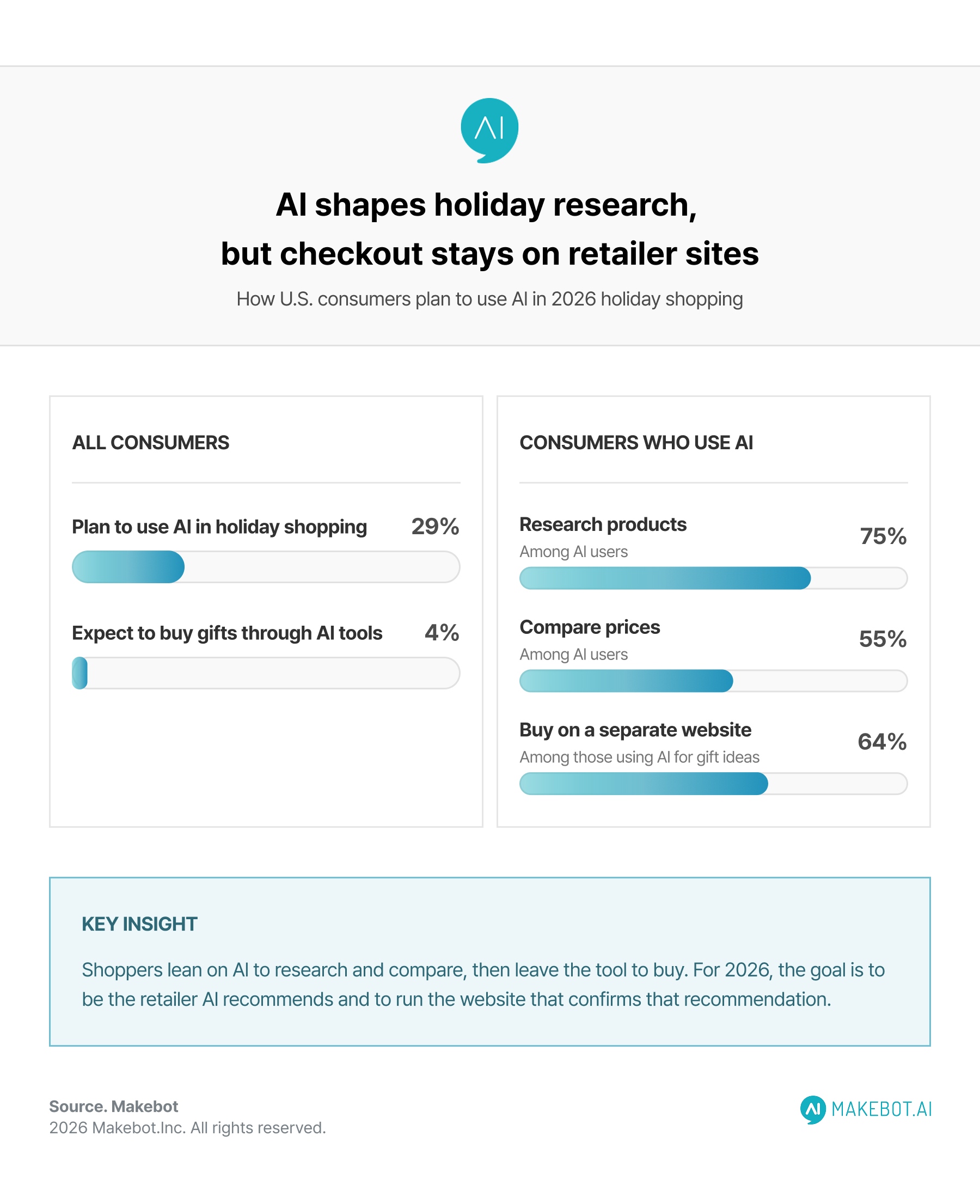
The Trust Gap: People Research With AI but Buy Elsewhere
PwC's June 2026 survey of 4,093 U.S. consumers found that 29% plan to use AI for holiday shopping, up from 22%, mostly to research products and compare prices. Yet 64% of people using AI for gift ideas still buy on a separate website, and only 4% of all consumers expect to buy gifts through AI tools. In November 2025, half of consumers said they were not comfortable letting AI handle a whole purchase.
So the goal of generative AI in e-commerce this season is not automatic checkout. It is to be the store the AI recommends, backed by a website with clear deals, matching prices, and accurate stock.
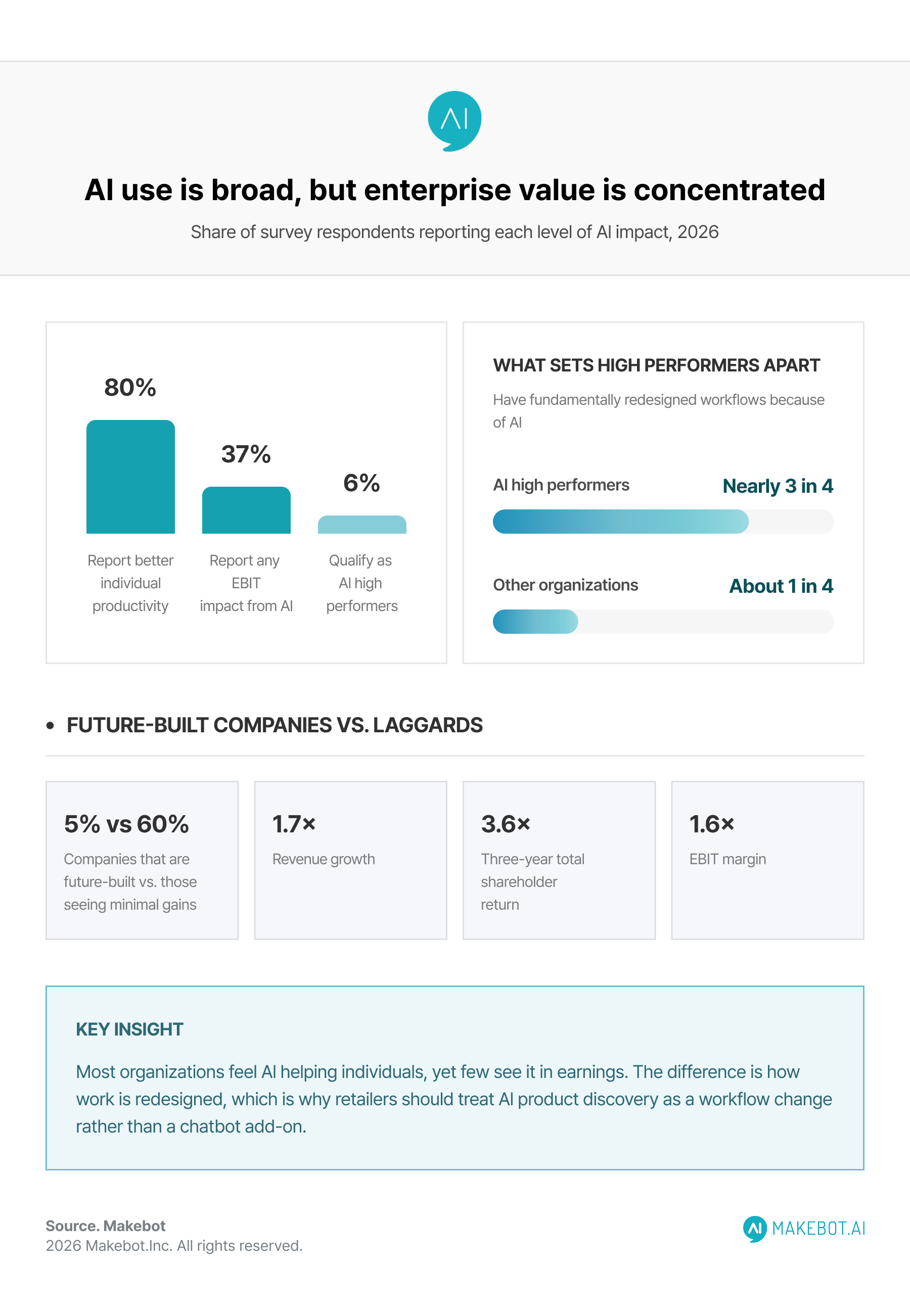
Why Few Companies See AI Returns, and Why Projects Stall
Many companies use AI, but few make much money from it. McKinsey's 2026 survey of 1,719 people found that 80% say AI makes them more productive, but only 37% report any impact on company EBIT, about the same as in 2025. BCG classifies just 5% of companies as "future-built," while 60% see little gain.
What sets the leaders apart is as much how they organize work as their technology. Nearly three-quarters of McKinsey's AI high performers have redesigned workflows because of AI, versus one-quarter of other companies. For retailers, that means treating AI product discovery as a reason for workflow redesign, not adding a chatbot to an unchanged website.
In June 2025, Gartner predicted that more than 40% of agentic AI projects will be canceled by the end of 2027 because of rising costs, unclear value, and weak risk controls. E-commerce AI projects usually run into the same problems:
- Old systems. Connecting agents to legacy systems is often complex and expensive.
- Running costs. One in five respondents say AI operating costs limit their organization's AI use.
- Missing safeguards. High performers are much more likely to work on preventing unauthorized or unintended AI actions. These safeguards are hard to add during peak season.
A Seven-Week Holiday E-Commerce Readiness Plan
Black Friday falls on November 27, about seven weeks away. Put e-commerce AI effort into work that pays off this season and after. That is holiday e-commerce readiness in practice.
Weeks 1 and 2: Check What AI Can Read
Make sure key details, prices, and stock levels for your top holiday items appear as text and structured data, not just images. Then match prices and deals across every channel.
Weeks 3 to 5: Make Your Value Clear
Publish gift guides and clear FAQ pages. Adobe found that the top 20% of retailers by AI traffic scored 23% to 30% higher on readability for content pages than retailers with the least AI traffic. Then test popular AI assistants with realistic holiday questions.
Weeks 6 and 7: Measure and Protect
Avoid risky catalog changes, make sure a person can step in on any on-site AI assistant, and track AI visitors' conversion rate and revenue per visit separately from other channels.
Conclusion
Holiday 2026 will not be the year AI agents take over checkout. Most AI users still finish their purchases outside the AI tool. But as agentic search spreads, AI will play a bigger role in deciding which stores make the shortlist, and Adobe's data shows those visitors are worth winning. Retailers that redesign their work, fix their data, and treat agent readiness as core infrastructure will start 2027 ahead. Those that wait may find their products missing where shoppers now begin.
Agentic search is already deciding which retailers make the shortlist before shoppers click anything.
AI-referred visitors to retail sites now convert 42% better than other traffic, and some retailers are already seeing up to 25% of their referral traffic come from AI tools. But only 6% of companies using AI are seeing real financial results, and the gap comes down to one thing: how well their data, workflows, and systems are actually built for it.
MagicSuite gives your team the AI-powered commerce infrastructure to make sure your products show up in AI answers, your pages are fully readable by machines, and every interaction from discovery to checkout is optimized for the way shoppers are searching now. Not a bolt-on. Not a chatbot with a new label. A platform built for the season ahead and every season after it.



.png)








.jpg)


What Happens to Marketing When the C-Suite Starts Using AI Every Day?






Why AI Shopping Assistants Will Replace Traditional Ecommerce Search






.jpg)

























Why Generative AI Projects Fail and How to Achieve Scalable AI Success










.jpg)

.png)