Why AI Shopping Assistants Will Replace Traditional Ecommerce Search
58% of shoppers now use AI over keyword search - half of retailers expect it to fully replace search


Introduction
Search bars built ecommerce as we know it. Type a keyword, scan a grid of results, filter by price - a model unchanged for two decades. That model is now breaking down. Shoppers are increasingly describing what they want in plain language and letting an assistant do the comparing, filtering, and recommending. This is not a fringe behavior anymore; it is measurable in traffic data, retailer budgets, and enterprise AI investment. Yet the transition is uneven. Some organizations are converting this shift into revenue, while most are stuck running pilots that never reach production. This article examines the verified data behind that divide - what is driving the move away from keyword search, why some companies are winning decisively, and what the underlying business case for generative AI in e-commerce actually looks like when the hype is stripped away.
7 Proven Factors That Drive AI ROI in 2026, According to a Survey of 1,000+ Executives. Explore the latest insights here!
The Silent Collapse of Keyword-Based Product Search
Traditional ecommerce search was built for an era when customers already knew what to type. That assumption no longer holds. Shoppers now arrive with vague, comparative, or conversational intent - "a waterproof jacket for hiking in humid climates under $150" - which keyword indexes handle poorly but large language models handle natively.
The data reflects this shift clearly:
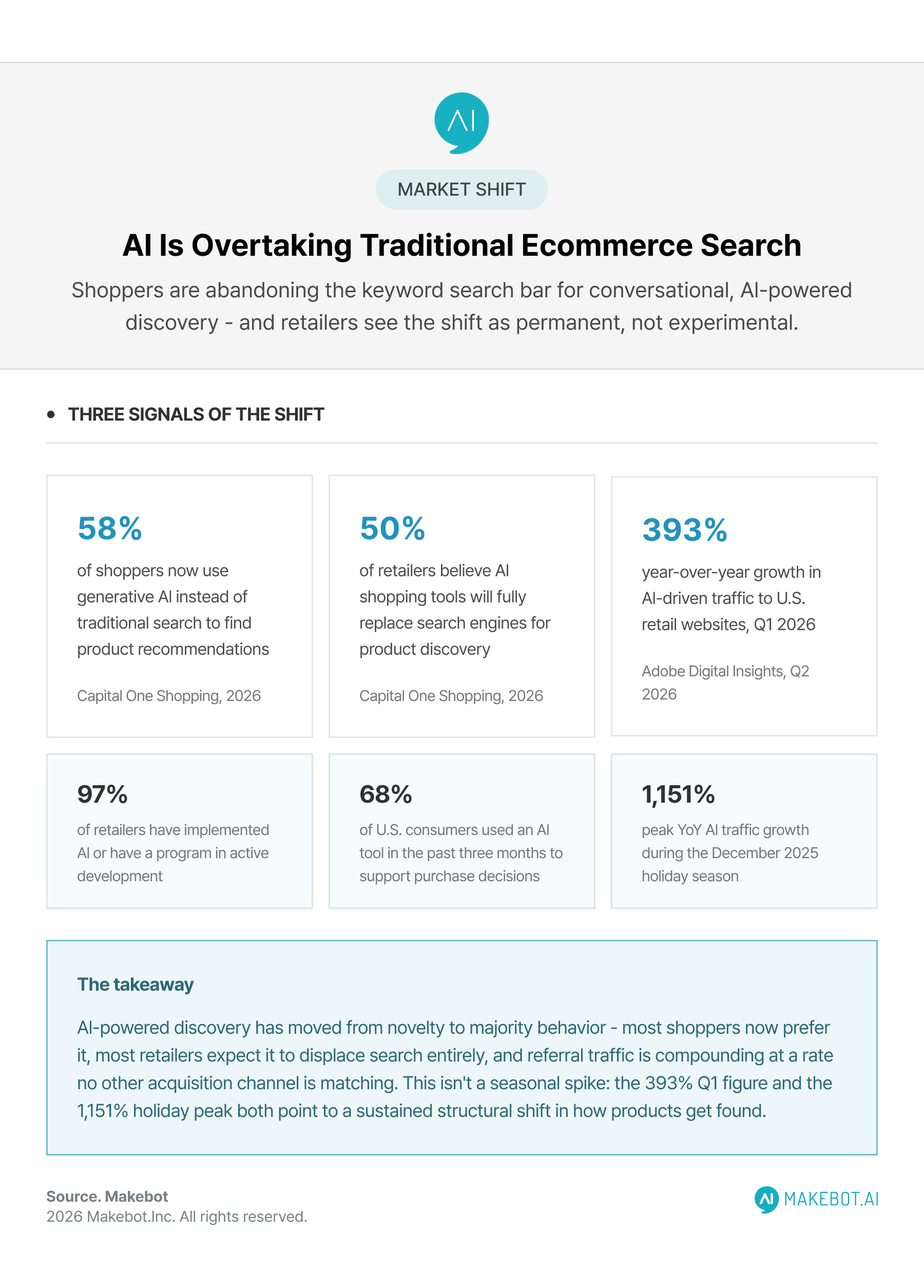
- 58% of shoppers now use generative AI instead of traditional search to find product recommendations, according to Capital One Shopping's 2026 consumer research.
- Roughly half of retailers (50%) believe AI shopping tools will fully replace search engines for product discovery within their category.
- McKinsey's own research on AI-powered search found that roughly half of consumers now intentionally seek out AI-powered search engines as their top digital source for buying decisions, and a separate McKinsey survey of roughly 4,000 U.S. consumers found 68% had used AI tools in the prior three months, primarily to support purchase decisions.
This is not simply a UX preference. It reflects a structural limitation of keyword search: it retrieves matches, not understanding. AI product discovery tools interpret intent, context, and constraints simultaneously - a capability keyword indexing was never designed to deliver.
APAC AI Outlook 2026 Signals AI's Breakout Momen8t as a New Revenue Driver. Read the expert analysis here!
From Search Bars to Conversations: How AI Shopping Assistants Work
Modern AI shopping assistants are not simple chatbots layered on top of a search index. Most production-grade systems combine two components:
- Large language models (LLMs) that interpret natural-language queries, hold context across a conversation, and generate comparative reasoning ("this one has better reviews for durability, but this one ships faster").
- Retrieval-augmented generation (RAG), which grounds the LLM's output in a retailer's live product catalog, inventory, and pricing data - preventing the model from recommending items that are out of stock, discontinued, or fabricated.
This architecture is what distinguishes a genuine AI shopping agent from a scripted chatbot. Without RAG, an LLM has no reliable way to know what a retailer actually sells today; with it, the assistant becomes a real-time interface to the catalog rather than a static conversational layer. This is also why so many early conversational commerce pilots underperformed - they deployed the language model without the retrieval infrastructure needed to keep responses accurate at scale.
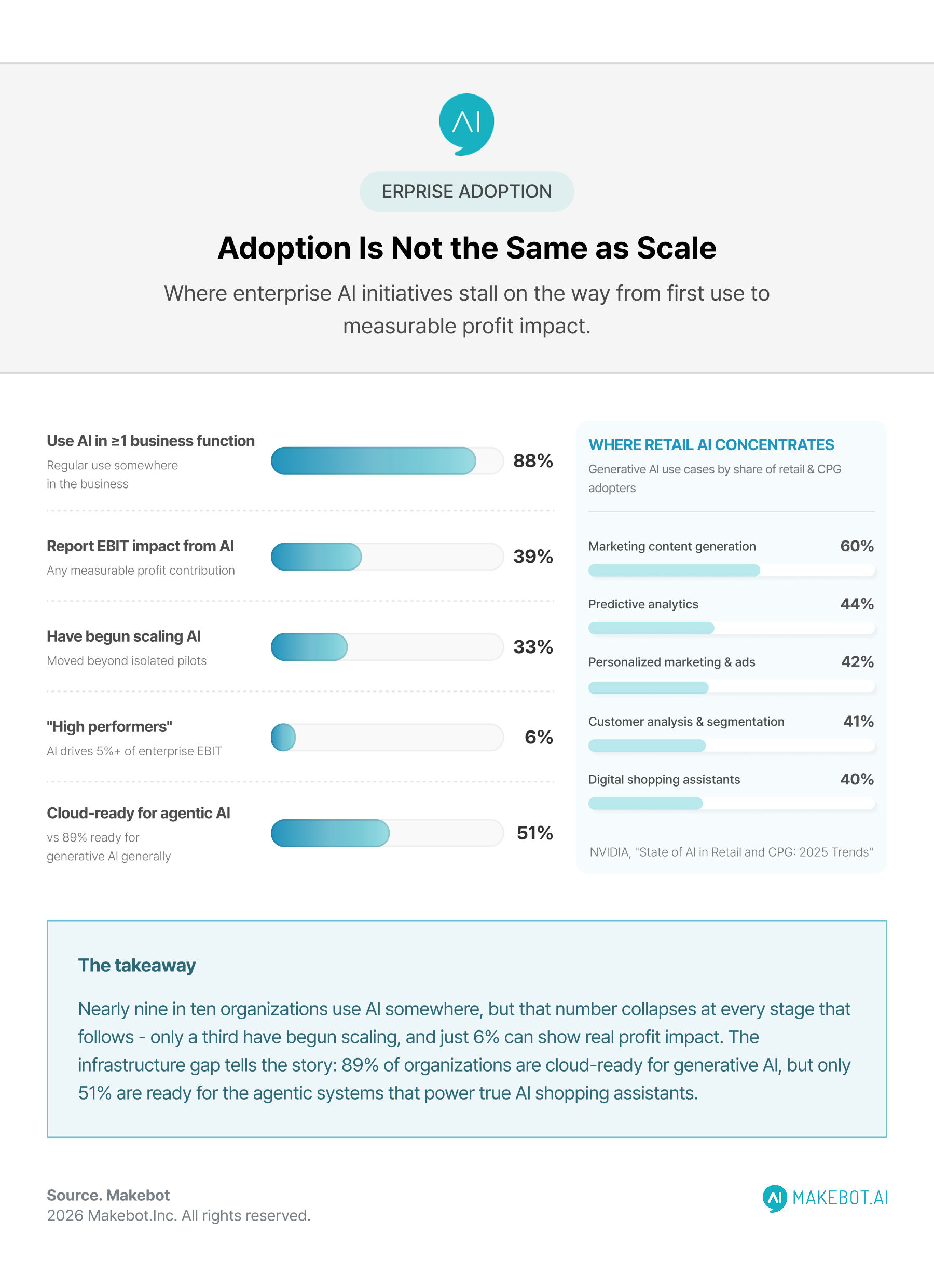
Retailer deployment data shows where these systems are concentrated today: NVIDIA's 2025 State of AI in Retail and CPG survey found content generation for marketing as the leading generative AI use case in retail (60%), followed by predictive analytics (44%), personalized marketing and advertising (42%), customer analysis and segmentation (41%), and digital shopping assistants or copilots (40%).
OpenAI Releases GPT-5.5 Instant: A New Default Model for ChatGPT. Discover what’s next here!
The Adoption Curve: How Fast Enterprises and Consumers Are Moving
Both sides of the market - enterprise supply and consumer demand - are moving in the same direction simultaneously, which is unusual for an emerging technology cycle.
On the enterprise side:
- 88% of organizations report regular AI use in at least one business function, up from 78% a year earlier - per McKinsey's The State of AI: Global Survey 2025 (published November 5, 2025; 1,993 respondents across 105 countries).
- 97% of retailers report having implemented AI or having a program actively in development.
- Despite that adoption level, McKinsey found nearly two-thirds of organizations have not yet begun scaling AI across the enterprise, with only about one-third reporting they've begun to scale their AI programs - underscoring that "adoption" and "production-grade deployment" are very different milestones.
On the consumer side:
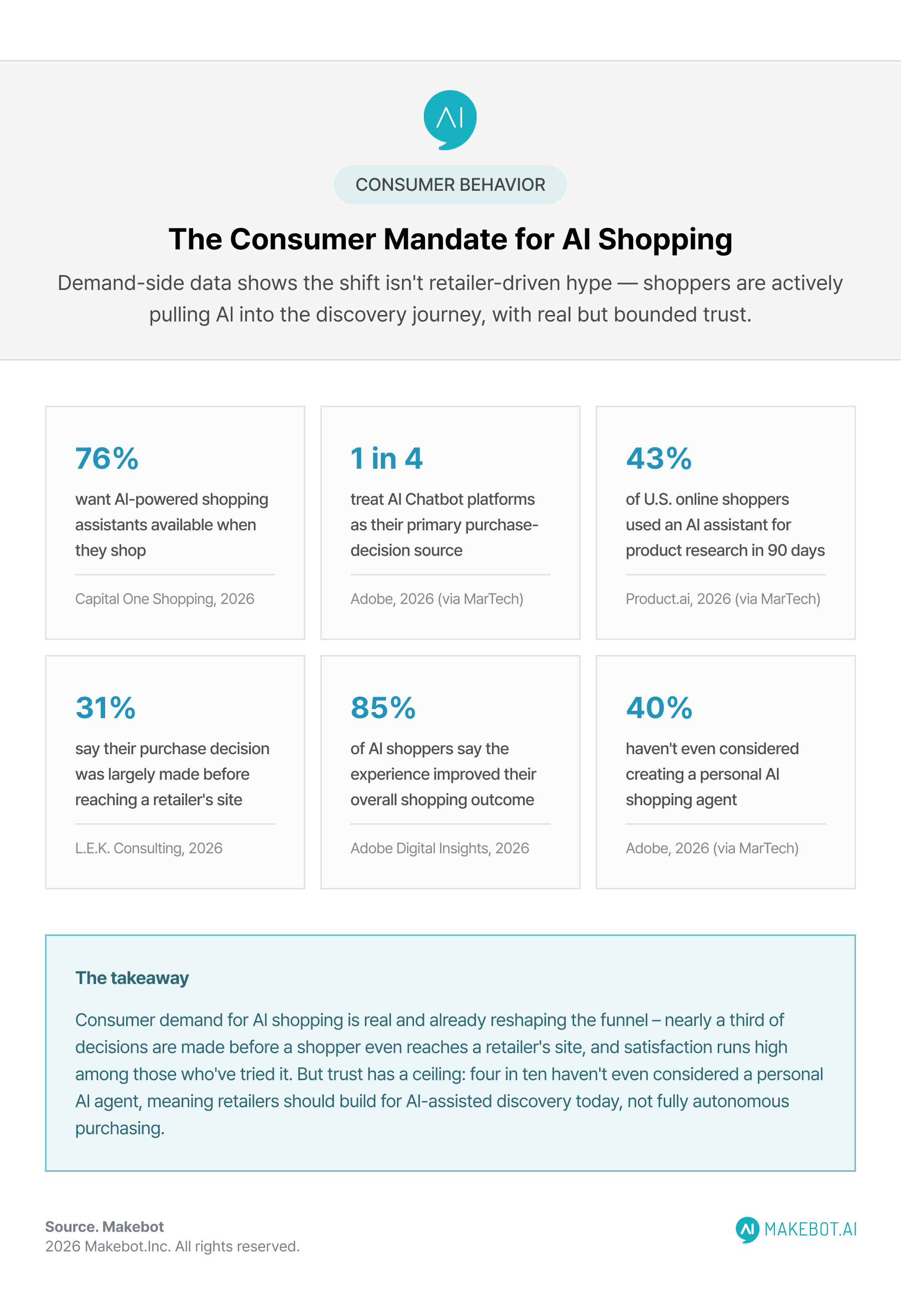
- 76% of consumers say they want AI-powered shopping assistants available when they shop.
- 43% of U.S. online shoppers used an AI assistant for product research in the past 90 days, and among that group, one in five used AI on a purchase over $50 (Product.ai, via MarTech, 2026).
- Adobe research (via MarTech) found roughly one in four customers now treat AI Chatbot platforms as their primary source for purchase decisions - ahead of brand websites and online reviews.
The pattern is consistent across sources: adoption is no longer experimental. What varies significantly is depth - how far AI has moved from pilot to embedded, revenue-generating infrastructure, which is where the real business story begins.
Agentic AI vs Generative AI: Why the Difference Will Define Enterprise Strategy in 2026. Explore the future of AI here!
Measuring the Payoff: Business Outcomes from AI-Powered Search
Adoption headlines only tell part of the story. The more important question for decision-makers is what AI-driven discovery actually returns.
Evidence of measurable outcomes includes:
- AI-driven traffic to U.S. retail websites grew 393% year-over-year in the first quarter of 2026, according to Adobe Digital Insights' own Q2 2026 Quarterly AI Traffic Report. That same report shows AI-driven retail traffic peaked even higher - at 1,151% year-over-year - during the December 2025 holiday season, confirming that the Q1 393% figure is not a seasonal anomaly but a sustained structural shift, not a one-time spike.
- Among consumers who use AI for online shopping, 85% say AI assistants have improved their shopping experience, and 66% say they trust GenAI tools to provide accurate results, per Adobe's March 2026 consumer survey of more than 5,000 U.S. respondents.
- e-commerce AI tools are increasingly influencing the purchase decision before a shopper reaches a retailer's site: L.E.K. Consulting found 31% of AI users say their decision was largely made pre-arrival, up from 26% two years earlier, while the share of AI users starting research on a standalone AI platform rather than a search engine rose from 25% to 46% over the same period.
At the same time, enterprise-wide financial attribution remains harder to prove than adoption. McKinsey's State of AI 2025 survey found only 39% of organizations report any EBIT impact attributable to AI at the enterprise level, and roughly 6% qualify as "high performers" attributing more than 5% of EBIT to AI. This is the central tension every ecommerce leader needs to reconcile: consumer-facing traffic and engagement gains are real and well documented, but converting that engagement into audited profit impact is where most organizations currently stall.
Microsoft CEO Satya Nadella On How AI Is Transforming Organizations, Teams And Leadership. See how enterprises are transforming here!
Why Some Retailers Win and Others Don't: The ROI Divide
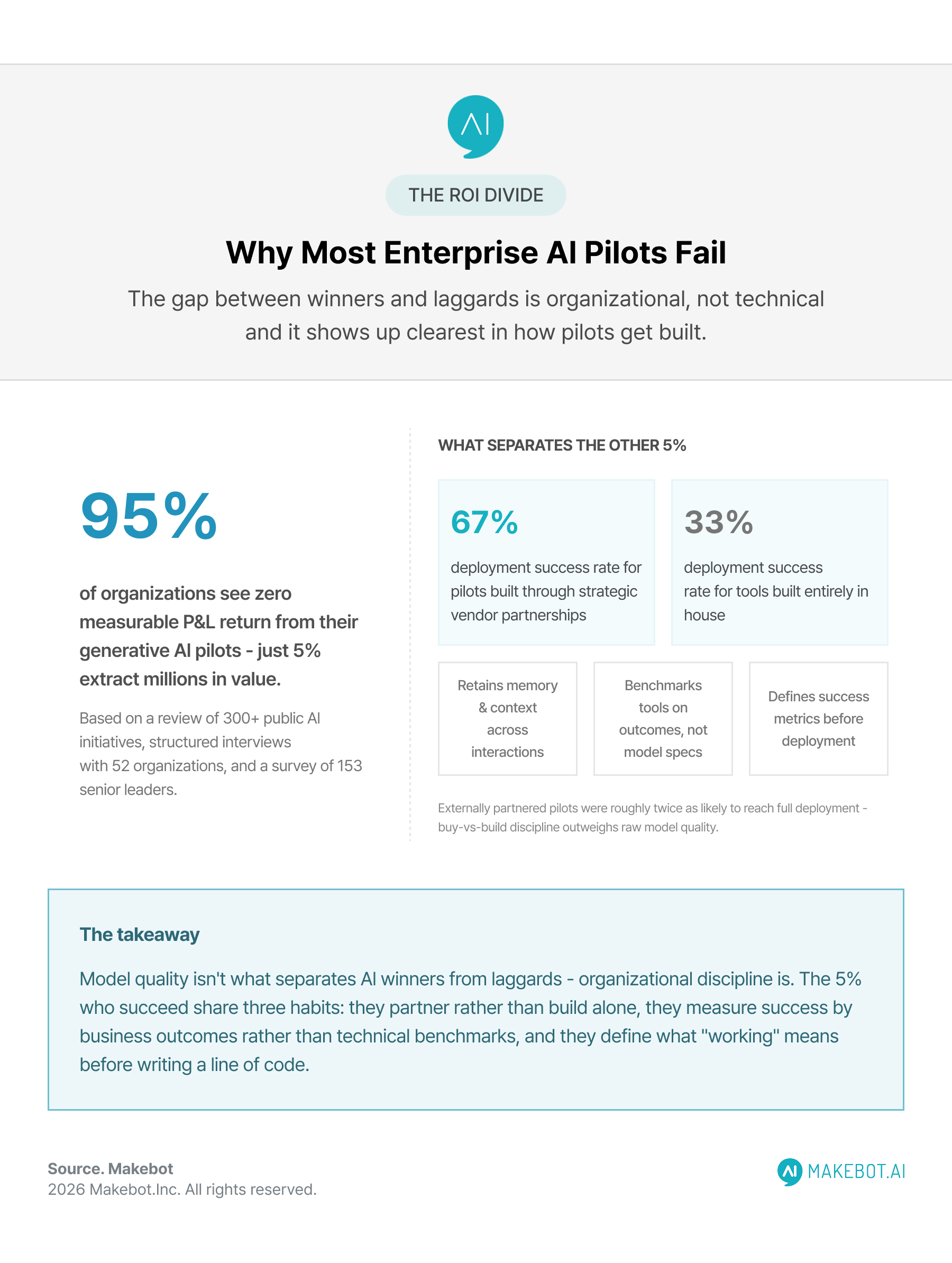
This is the most consequential finding in the current research landscape. MIT's Project NANDA, in its July 2025 report The GenAI Divide: State of AI in Business 2025, combined a systematic review of 300+ publicly disclosed AI initiatives, structured interviews with representatives from 52 organizations, and survey responses from 153 senior leaders. It concluded that roughly 95% of organizations are seeing zero measurable return from generative AI pilots, while just 5% of integrated pilots are extracting millions of dollars in value.
The report is explicit that the divide is not primarily a technology problem. The determining factors are organizational:
Technical factors separating winners from laggards:
- Systems that retain memory and context across interactions outperform static, single-turn tools by a wide margin.
- RAG-grounded assistants that stay synchronized with live inventory avoid the "brittle in production" failure mode that generic chatbots hit almost immediately.
- Workflow-integrated deployments - embedded directly into checkout, customer service, or merchandising systems - outperform standalone pilot tools that sit outside daily operations.
Organizational factors separating winners from laggards:
- Buy-vs-build discipline matters more than most leaders expect: MIT NANDA found that pilots built through strategic vendor partnerships reached full deployment roughly 67% of the time, compared with about 33% for tools built entirely in-house - meaning externally partnered pilots were roughly twice as likely to succeed.
- Leadership sponsorship and clear internal ownership consistently predict successful scaling; McKinsey's State of Organizations research identifies ease of use, leadership sponsorship, and dedicated teams as the key enablers of enterprise AI adoption.
- Successful adopters define a measurable business outcome before building - not after the pilot concludes - reversing the sequence that leads most projects to stall.
In practice, this means two retailers can license nearly identical underlying AI models and produce entirely different results. The differentiator is whether the deployment is architected as production infrastructure with clear ownership, or as an isolated experiment layered on top of an unchanged operating model.
Why Generative AI Projects Fail and How to Achieve Scalable AI Success. Learn how industry leaders are adapting here!
Common Challenges Enterprises Face When Scaling AI Shopping Assistants
Even well-resourced organizations run into a consistent set of obstacles when moving from pilot to production:
- Data readiness gaps - product catalogs, inventory feeds, and pricing systems are often too fragmented or inconsistent for a RAG pipeline to trust without significant cleanup work.
- Trust and infrastructure readiness gaps - Adobe's research (via MarTech, 2026) found only 51% of organizations have the cloud infrastructure to support agentic AI, compared with 89% for generative AI generally, and 40% of consumers haven't even considered creating a personal AI shopping agent - meaning both the technical and consumer-trust foundations for autonomous purchasing are still being built.
- Conversion infrastructure lag - agent-driven traffic is growing fast, but merchant-side infrastructure (checkout, product feeds, attribution systems) was largely built for human browsers, not AI agents, creating friction between rising AI referral traffic and actual conversion.
- Governance and measurement immaturity - McKinsey's own research shows nearly two-thirds of organizations have not scaled AI across the enterprise despite high pilot activity, and MIT NANDA found that organizations crossing the divide benchmark AI tools on operational outcomes rather than model benchmarks before deployment - a discipline most organizations still lack.
None of these challenges are permanent. They describe an infrastructure and governance lag rather than a ceiling on the technology's potential - which is precisely why the organizations solving them first are pulling ahead so quickly.
Showcasing Korea’s AI Innovation: Makebot’s HybridRAG Framework Presented at SIGIR 2025 in Italy. Read here!
What This Means for the Future of Ecommerce Search
Traditional keyword search will not disappear overnight, and it will likely remain useful for high-intent, specific queries where a shopper already knows exactly what they want. But its role as the default entry point into product discovery is eroding steadily, replaced by conversational, context-aware interfaces that reason across a catalog rather than merely indexing it.
The strategic implication for enterprise leaders is straightforward: AI-powered search and AI shopping agents are no longer differentiators - they are becoming baseline infrastructure, in the same way mobile-responsive design became non-negotiable a decade ago. The companies capturing disproportionate value are not necessarily the ones with access to the most advanced models; they are the ones treating conversational commerce as core operating infrastructure, with dedicated ownership, clean data foundations, and outcomes defined before deployment begins. For everyone else, the 95% failure rate MIT documented is not a warning to avoid AI - it is a description of what happens when investment outpaces integration.







.jpg)


What Happens to Marketing When the C-Suite Starts Using AI Every Day?





Why AI Shopping Assistants Will Replace Traditional Ecommerce Search






.jpg)

























Why Generative AI Projects Fail and How to Achieve Scalable AI Success











.jpg)

.png)