The Next Generation of D2C: How Enterprise AI Is Personalizing Every Customer Journey
Multimodal AI cuts document processing time 80% - Gartner: 40% of enterprise data is unstructured.


Introduction
Direct-to-consumer brands built their reputation on knowing customers better than retail intermediaries ever could. That advantage is being rewritten. Enterprise AI - spanning large language models (LLMs), retrieval-augmented generation (RAG), and AI chatbots - now lets brands personalize pricing, content, and support at a scale and speed manual segmentation could never reach. But adoption and value are two different stories. Most enterprises have deployed generative AI somewhere in their operations; far fewer have turned it into a measurable driver of revenue or retention. This article examines what the latest research from McKinsey, MIT, Gartner, BCG, and PwC actually shows about AI-powered personalization and AI in e-commerce - and what separates the D2C AI brands capturing real returns from those still stuck in pilot mode.
7 Proven Factors That Drive AI ROI in 2026, According to a Survey of 1,000+ Executives. Explore the latest insights here!
Why D2C Personalization Has Become an AI Problem
D2C growth was never just about cutting out the middleman - it was about owning the customer relationship well enough to personalize it. That premise now runs into a data and complexity ceiling that manual tooling can't clear: individual browsing behavior, purchase history, support interactions, and lifetime value signals arrive faster than teams can act on them.
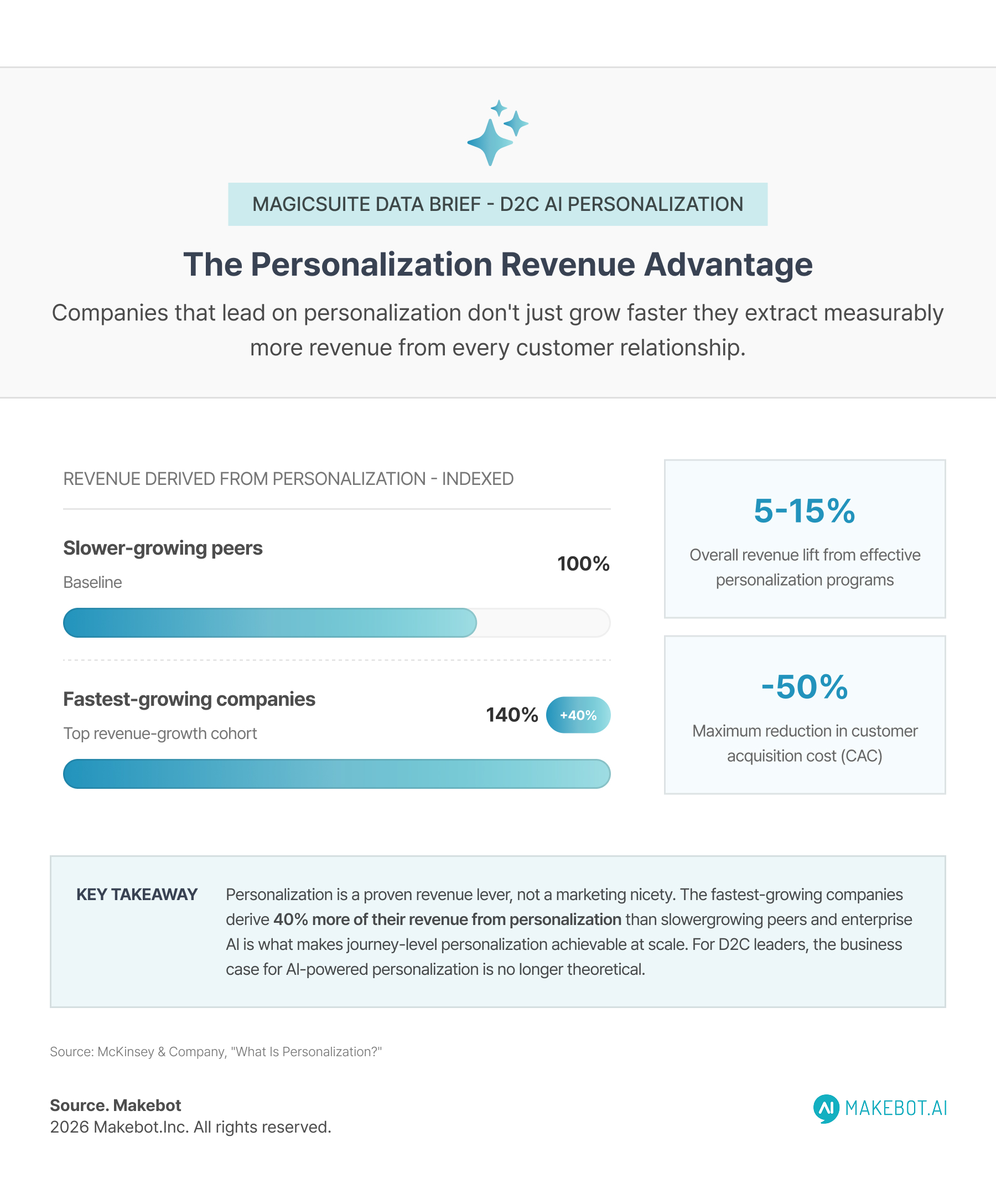
Generative AI and modern AI-powered personalization engines close that gap by processing behavioral and transactional data in real time and translating it into individualized journeys - a recommendation, a support answer, a price nudge - automatically. McKinsey's long-running personalization research puts a number on the payoff: companies with the fastest growth rates generate roughly 40% more of their revenue from personalization than their slower-growing counterparts, and effective personalization can lift overall revenue by 5–15% while cutting customer acquisition costs by as much as 50%.
That is the pull. The push comes from customer expectations that have simply moved on from generic experiences - shoppers increasingly treat relevant, contextual interactions as the baseline, not the differentiator.
APAC AI Outlook 2026 Signals AI's Breakout Moment as a New Revenue Driver. Read the expert analysis here!
From Rule-Based Personalization to LLM-Driven Customer Journeys
Traditional D2C personalization ran on rules: segment customers into buckets, trigger a static set of emails or on-site banners. It worked, but it didn't scale to genuinely individual experiences and it broke down the moment a customer's intent didn't match the segment they'd been assigned to.
Enterprise AI changes the underlying mechanism in three ways:
- LLMs interpret unstructured intent - a support message, a search query, a review - instead of relying on pre-tagged categories.
- RAG grounds responses in live product and account data, so an AI chatbot can answer with current inventory, order status, or policy details instead of a static script.
- Agentic workflows chain steps together, letting a system move from "recommend" to "resolve" to "upsell" without a human handing off between tools.
The practical result for D2C AI teams is a shift from segment-level personalization to journey-level personalization - where the next best action is computed per customer, per moment, rather than per cohort. This is also where most of the real engineering difficulty sits: connecting an LLM to clean, current customer data is a harder problem than writing the prompt that sits on top of it.
Gartner Predicts That Agentic AI Will Solve 80 Percent of Customer Problems by 2029. Discover what’s next here!
.jpg)
Agentic AI vs Generative AI: Why the Difference Will Define Enterprise Strategy in 2026. Explore the future of AI here!
What the Data Actually Shows About AI Investment Performance
Enthusiasm for enterprise AI has outpaced evidence of consistent returns, and the research from 2025–2026 is unusually candid about that gap.
Adoption is real and broad:
- 88% of organizations report regularly using AI in at least one business function, and 72% report using generative AI specifically - up from 33% in 2024, according to McKinsey's State of AI research.
- Despite that reach, McKinsey also finds that nearly two-thirds of organizations have not yet begun scaling AI across the enterprise, and only 23% have scaled AI agents in any single function.
Value is concentrated in a minority of organizations:
- Only 39% of organizations report any EBIT impact attributable to AI at the enterprise level, and roughly 6% qualify as "AI high performers" attributing more than 5% of EBIT to AI, per McKinsey.
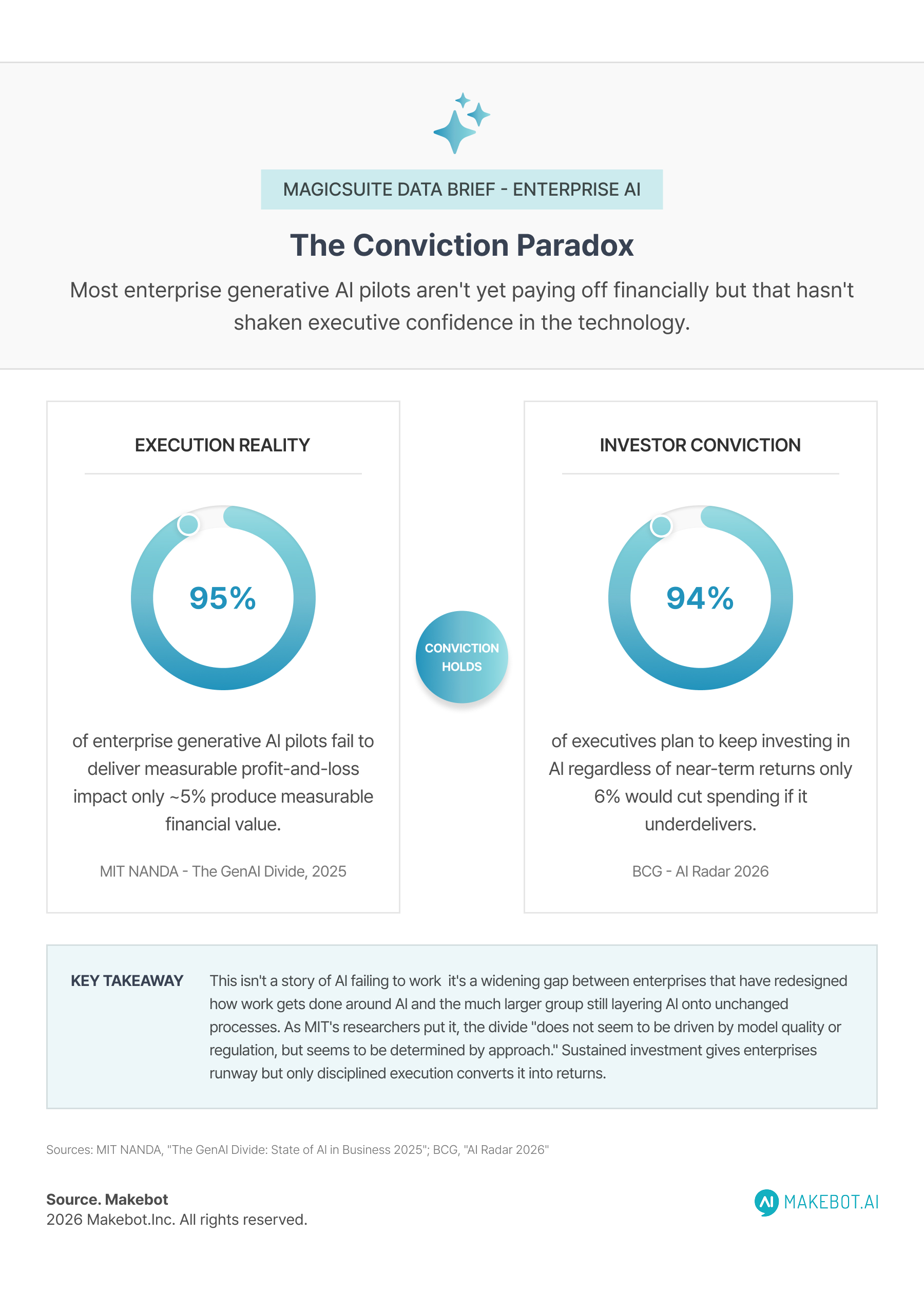
- MIT's 2025 GenAI Divide study - based on more than 300 deployments, 52 case studies, and 153 leadership interviews - found that 95% of enterprise generative AI pilots fail to deliver measurable profit-and-loss impact, with only about 5% producing measurable financial value.
- PwC's 2026 CEO Survey of more than 4,400 executives found that just 12% of CEOs report achieving both revenue gain and cost reduction from AI - the two outcomes boards most want to see together.
Yet conviction hasn't wavered:
- According to BCG's AI Radar research, only 6% of executives say they would cut AI investment if current initiatives fail to deliver - 94% plan to keep investing regardless of near-term returns.
Taken together, this isn't a story of AI failing to work. It's a story of a widening gap between the enterprises that have redesigned how work gets done around AI and the much larger group still layering AI onto unchanged processes. MIT's researchers were blunt about the cause: the divide "does not seem to be driven by model quality or regulation, but seems to be determined by approach."
Microsoft CEO Satya Nadella On How AI Is Transforming Organizations, Teams And Leadership. See how enterprises are transforming here!
Why Some Enterprises Get Higher AI Returns Than Others
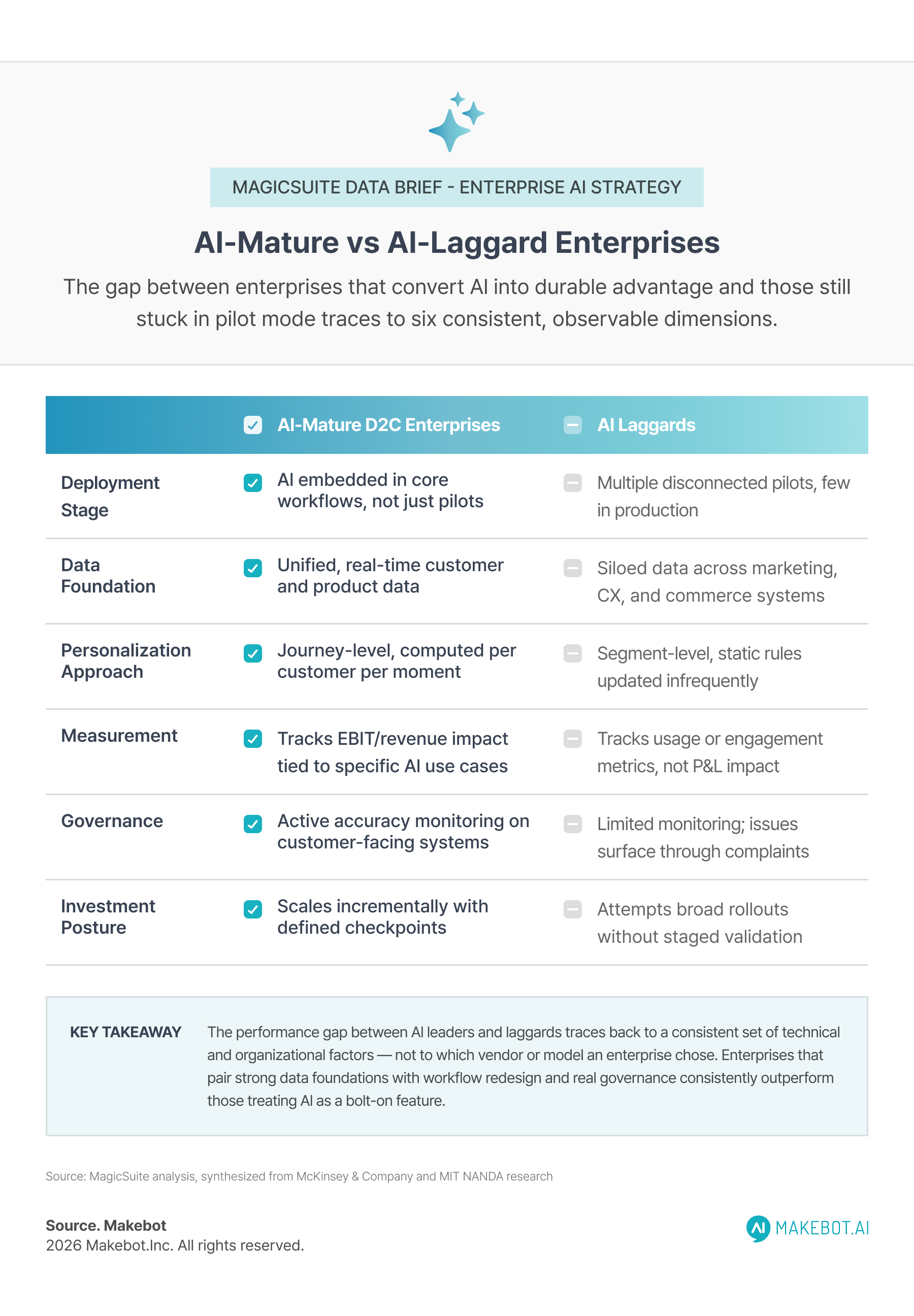
The performance gap between AI leaders and laggards traces back to a consistent set of technical and organizational factors, not to which vendor or model an enterprise chose.
Technical factors:
- Data readiness - RAG and agentic systems are only as accurate as the underlying customer and product data; brittle or siloed data pipelines are the most common reason pilots stall before reaching production.
- Workflow integration - tools bolted onto an existing process rarely change the outcome; McKinsey's research consistently shows the biggest gains go to organizations that redesign the workflow itself around the AI capability, not just the interface.
- Governance and accuracy monitoring - 51% of organizations have experienced at least one negative consequence from AI use, with inaccuracy the most commonly cited issue at 30%, per McKinsey - underscoring why monitoring can't be an afterthought once systems are customer-facing.
Organizational factors:
- Executive-sponsored scaling, not isolated pilots - the enterprises McKinsey classifies as "AI high performers" tend to treat AI as a cross-functional operating change rather than a departmental experiment.
- Realistic time-to-value expectations - enterprises that measure adoption in stages and set incremental checkpoints sustain momentum better than those attempting big-bang, enterprise-wide rollouts.
- Clear ownership of the customer experience outcome - personalization initiatives that report into a single accountable owner (rather than being split across marketing, CX, and IT) show more consistent measurement and follow-through.
Deloitte Insights: AI Fluency Becomes the Most Valuable Workforce Skill. Learn how industry leaders are adapting here!
Enterprise AI in the Customer Journey: Where It's Working Today
Several use cases have moved from proof-of-concept to reliable production value in AI in e-commerce and D2C, retail-adjacent settings:
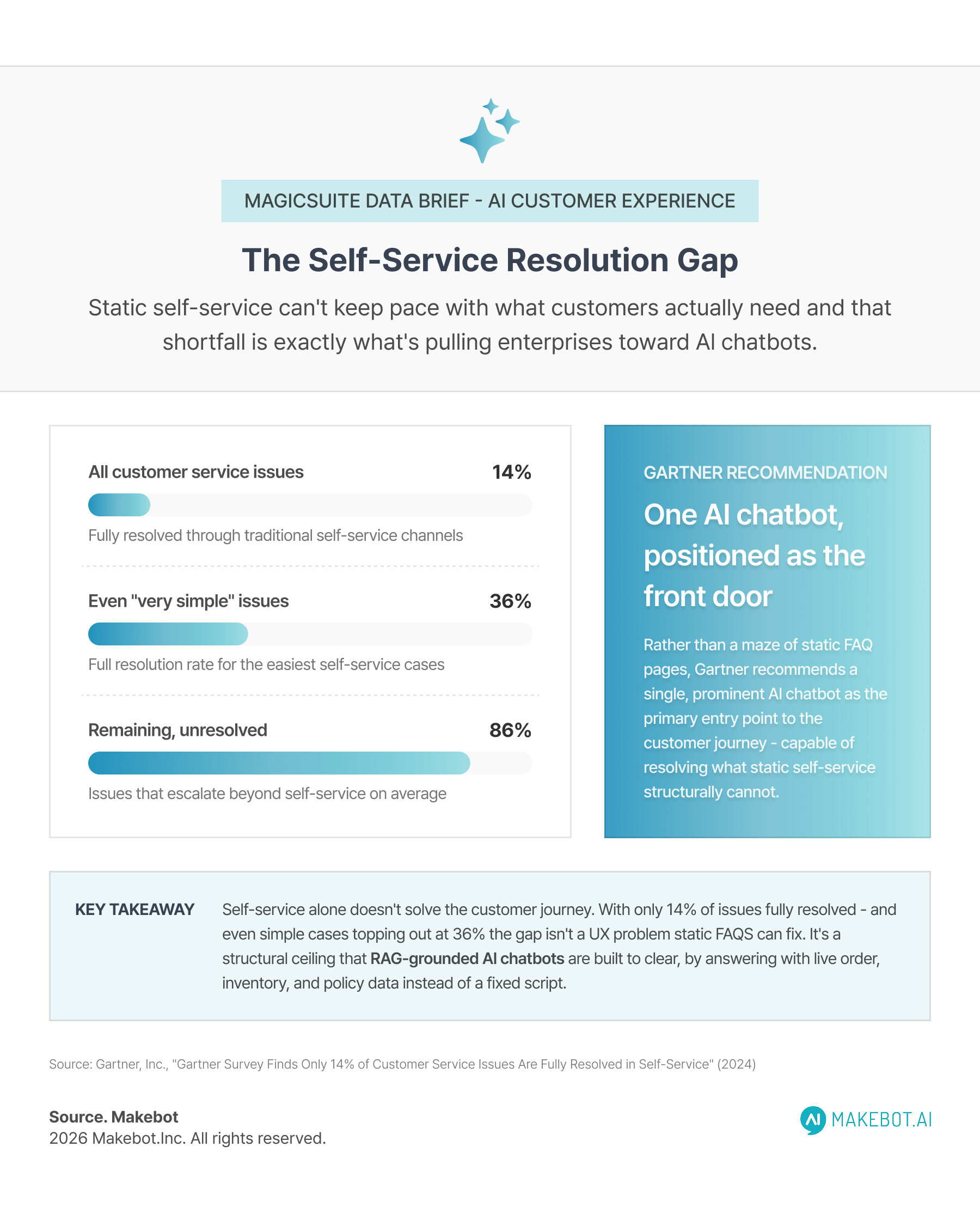
- AI chatbots for pre- and post-purchase support - Gartner's research on self-service is a useful reality check here: only 14% of customer service issues are fully resolved through self-service channels, and even "very simple" issues only resolve fully 36% of the time. That gap is precisely why Gartner recommends a single, prominent AI chatbot as the primary entry point to the customer journey rather than a maze of static FAQ pages.
- RAG-grounded product discovery - instead of keyword search, RAG lets a customer ask a natural question ("what's a good gift for someone who already owns X") and receive an answer grounded in current catalog and inventory data.
- Dynamic content and offer personalization - LLM-driven systems generate and test personalized product copy, subject lines, and offers at a granularity manual teams can't match, feeding back into the same AI customer experience loop that adjusts future recommendations.
- Proactive service - rather than waiting for a customer to reach out, AI systems increasingly flag likely friction points (a delayed shipment, a return pattern) and intervene before the customer has to.
Why Generative AI Projects Fail and How to Achieve Scalable AI Success. Explore the data and findings here!
Common Challenges Enterprises Face When Scaling AI
Even well-resourced organizations run into a recurring set of obstacles as they move past pilots:
- Fragmented customer data across commerce, CRM, and support platforms, which undermines RAG accuracy and personalization relevance.
- Unclear ROI ownership - without a single accountable metric, AI initiatives compete for budget against features that have easier-to-measure payback.
- Legacy workflow inertia - teams keep the old process running in parallel "just in case," which caps the productivity gain a redesign would otherwise unlock.
- Trust and accuracy concerns - customer-facing AI failures (a wrong order status, a fabricated policy answer) carry reputational cost that internal-only tools don't, raising the bar for launch readiness.
- Talent and change management gaps - scaling AI is as much a people and process problem as a technical one, and enterprises frequently underinvest in the former.
Strategic Recommendations for D2C Leaders
- Start with the highest-friction journey moment, not the flashiest use case - self-service resolution, cart abandonment, or post-purchase support tend to offer the clearest, fastest-measurable wins.
- Invest in the data layer before the model layer - RAG and personalization quality are bottlenecked by data hygiene far more often than by model choice.
- Tie every AI initiative to a P&L metric from day one, rather than retrofitting measurement after launch.
- Treat governance as a launch requirement, not a post-incident response, especially for anything customer-facing.
- Scale in stages with defined checkpoints, mirroring the approach McKinsey and BCG both associate with sustained, rather than abandoned, AI programs.
Showcasing Korea’s AI Innovation: Makebot’s HybridRAG Framework Presented at SIGIR 2025 in Italy. Read here!
Conclusion: The Long-Term Stakes for D2C Brands
The enterprises that will define the next generation of D2C won't be the ones that simply deployed an LLM or launched a chatbot - they'll be the ones that rebuilt the customer journey around what enterprise AI actually makes possible: individualized, real-time, contextually grounded interactions at scale. The current data is a genuine split-screen. Adoption is nearly universal, yet measurable financial impact remains rare, concentrated among organizations that paired the technology with disciplined data foundations, workflow redesign, and governance. For D2C leaders, the strategic question isn't whether to invest in AI-powered personalization - the investment case is already validated by a decade of research. It's whether the organization is willing to do the harder, less visible work of restructuring how customer journeys actually get built, measured, and owned. That distinction, more than any model or vendor choice, will determine which brands turn AI into durable advantage and which remain stuck citing pilot metrics years from now.







.jpg)


What Happens to Marketing When the C-Suite Starts Using AI Every Day?







Why AI Shopping Assistants Will Replace Traditional Ecommerce Search





.jpg)

























Why Generative AI Projects Fail and How to Achieve Scalable AI Success










.jpg)

.png)