Why AI-Powered Customer Journey Mapping Is Becoming Essential for Enterprise Growth
AI journey mapping drives 10–15% revenue lift — why enterprises can't afford static CX strategies.


Introduction
For decades, customer journey mapping was a static exercise — workshop whiteboards, post-it notes, and post-campaign retrospectives that captured what customers had already done, not what they were likely to do next. That model is now operationally obsolete.
As enterprise customer interactions multiply across digital and physical channels, the volume, velocity, and complexity of behavioral data have surpassed what any manual process can meaningfully interpret. AI-powered customer journey mapping addresses this directly — transforming journey analysis from a periodic planning artifact into a real-time intelligence system capable of anticipating needs, identifying friction, and triggering personalized actions at scale.
The financial stakes are significant. The global CJA market is on track to nearly triple by 2032, and enterprises that have already embedded AI into their journey infrastructure are reporting measurable gains in revenue, retention, and operational efficiency. This article examines why that gap is widening — and what separates organizations that are realizing tangible returns from those still running disconnected experiments.
7 Proven Factors That Drive AI ROI in 2026, According to a Survey of 1,000+ Executives. Explore the latest insights here!
From Static Maps to Dynamic Intelligence: What Has Changed
Traditional customer journey mapping produced a useful conceptual framework, but it operated on two flawed assumptions: that journeys could be defined in advance and that customer segments were reliable proxies for individual behavior. Both assumptions break down at enterprise scale.
AI customer experience platforms challenge these assumptions by operating at the individual level rather than the segment level. Rather than grouping customers into behavioral archetypes and designing journeys around them, AI-driven customer journey systems continuously process signals from CRM platforms, mobile apps, contact centers, transactional systems, and third-party data sources to build dynamic, per-customer models of intent, risk, and opportunity.
This shift from descriptive to predictive is what gives AI-powered customer journey mapping its operational edge. Instead of answering "what did our customers do last quarter?" the system answers "what is this customer likely to do in the next 48 hours — and what should we do first?" The result is a fundamentally different category of customer experience AI — one that acts on foresight rather than hindsight.
Verizon's deployment of generative AI illustrates this concretely. The company built a system capable of predicting the reason behind 80% of incoming service center calls before the call was even connected to an agent — enabling smarter routing across its 60,000-strong call center workforce. CEO Hans Vestberg stated the initiative was expected to retain approximately 100,000 customers from churning in 2024 alone. The program was subsequently expanded under "Project 624," integrating AI across retail, app, and phone service channels simultaneously.
APAC AI Outlook 2026 Signals AI's Breakout Moment as a New Revenue Driver. Read the expert analysis here!
The Business Case for AI Customer Journey Investment
The financial argument for AI-powered customer experience investment has moved well beyond theoretical ROI projections. Multiple independent research bodies now confirm measurable, repeatable returns for organizations that deploy AI across the full customer journey — not just within isolated use cases.
McKinsey's "Next in Personalization" research shows that AI-driven personalization most often drives 10–15% revenue lift (with company-specific outcomes spanning 5–25% depending on sector and execution capability) alongside 10–30% improvement in marketing ROI. The research also confirms that fast-growing companies generate 40% more of their revenue from personalization than their slower-moving peers — a compounding advantage that widens with each subsequent investment cycle.
Accenture's 2024 "Reinventing Enterprise Operations with Gen AI" report, based on a survey of 2,000 executives across 12 countries and 15 industries, reinforces this picture:
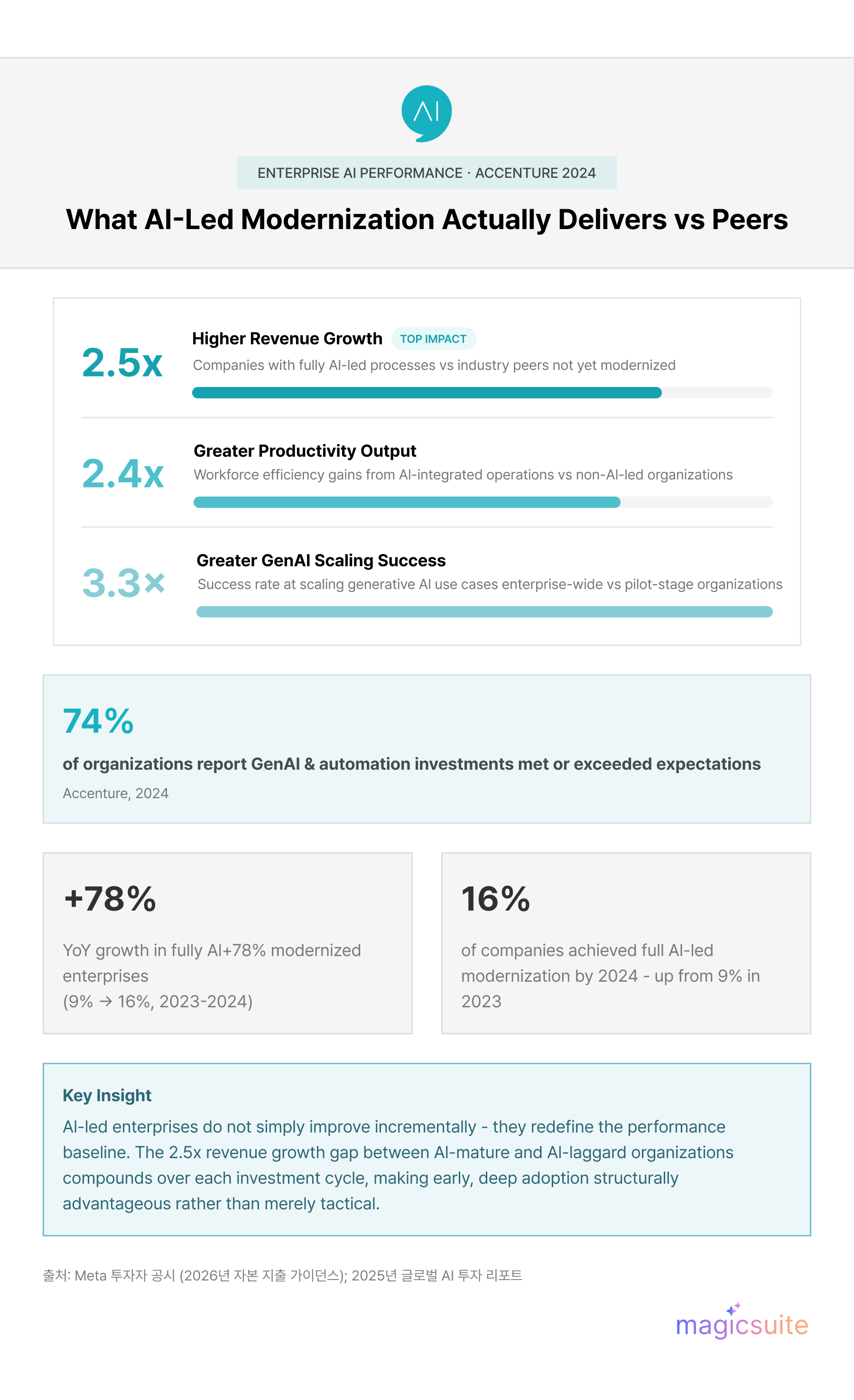
- 74% of organizations report that their generative AI and automation investments met or exceeded expectations
- Companies with fully AI-led processes achieve 2.5x higher revenue growth, 2.4x greater productivity, and 3.3x greater success at scaling generative AI use cases compared to peers
- The share of companies achieving full AI-led modernization jumped from 9% in 2023 to 16% in 2024 — a 78% year-over-year increase
Deloitte adds critical context on the personalization-revenue link: companies leading in personalization are three times more likely to exceed revenue targets, with 56% of marketers now actively investing in personalization capabilities. Deloitte also projected USD 10 billion in revenue uplift for enterprise software companies leveraging generative AI by the end of 2024 — signaling AI's transition from a cost optimization tool to a direct revenue engine.
These figures are not drawn from early-adopter outliers. They reflect an industry-wide pattern that enterprise leaders are increasingly unable to dismiss.
Gartner Predicts That Agentic AI Will Solve 80 Percent of Customer Problems by 2029. Discover what’s next here!
How AI-Driven Customer Journey Mapping Works in Practice
Understanding the mechanics of AI-driven customer journey systems is essential for organizations evaluating enterprise deployment. The architecture typically operates across four functional layers.
1. Data Unification
The foundation of any effective customer journey analytics platform is its ability to integrate data from every relevant source — websites, mobile applications, contact centers, CRM systems, point-of-sale, email, and third-party behavioral data. Without this unified data layer, AI models operate on incomplete inputs and produce unreliable outputs. Forrester's 2024 evaluation of customer journey orchestration platforms identified the strongest vendors as those enabling real-time decisioning through cross-system data fusion — not those with the most sophisticated algorithms.
2. Predictive Modeling
Once unified, behavioral data feeds machine learning models that forecast customer intent, churn risk, purchase propensity, and next-best actions. McKinsey's research on AI-powered personalization programs documents revenue lifts of 10–15% as the most common range, with predictive models becoming more accurate over time as they ingest more interaction data — creating a compounding intelligence advantage for organizations that start early.
3. Journey Orchestration
Predictions are operationalized through journey orchestration engines that trigger contextually relevant actions across channels — personalized messaging, proactive support, targeted offers, or agent routing — based on each customer's current state and predicted next move. The key distinction from traditional marketing automation is that orchestration decisions are made dynamically and individually, not according to pre-scheduled campaign logic.
4. Continuous Optimization
AI customer journey systems close the loop by measuring outcome data against predictions, continuously refining models and journey logic. This creates a self-improving feedback mechanism that static journey maps cannot replicate.
Agentic AI vs Generative AI: Why the Difference Will Define Enterprise Strategy in 2026. Explore the future of AI here!
The Personalization Imperative: What Customers Now Expect
Consumer expectations have shifted significantly, and the gap between what customers expect and what most enterprises currently deliver represents a measurable business risk. McKinsey's research confirms that 71% of consumers now expect personalized interactions, and 76% report frustration when they don't receive them.
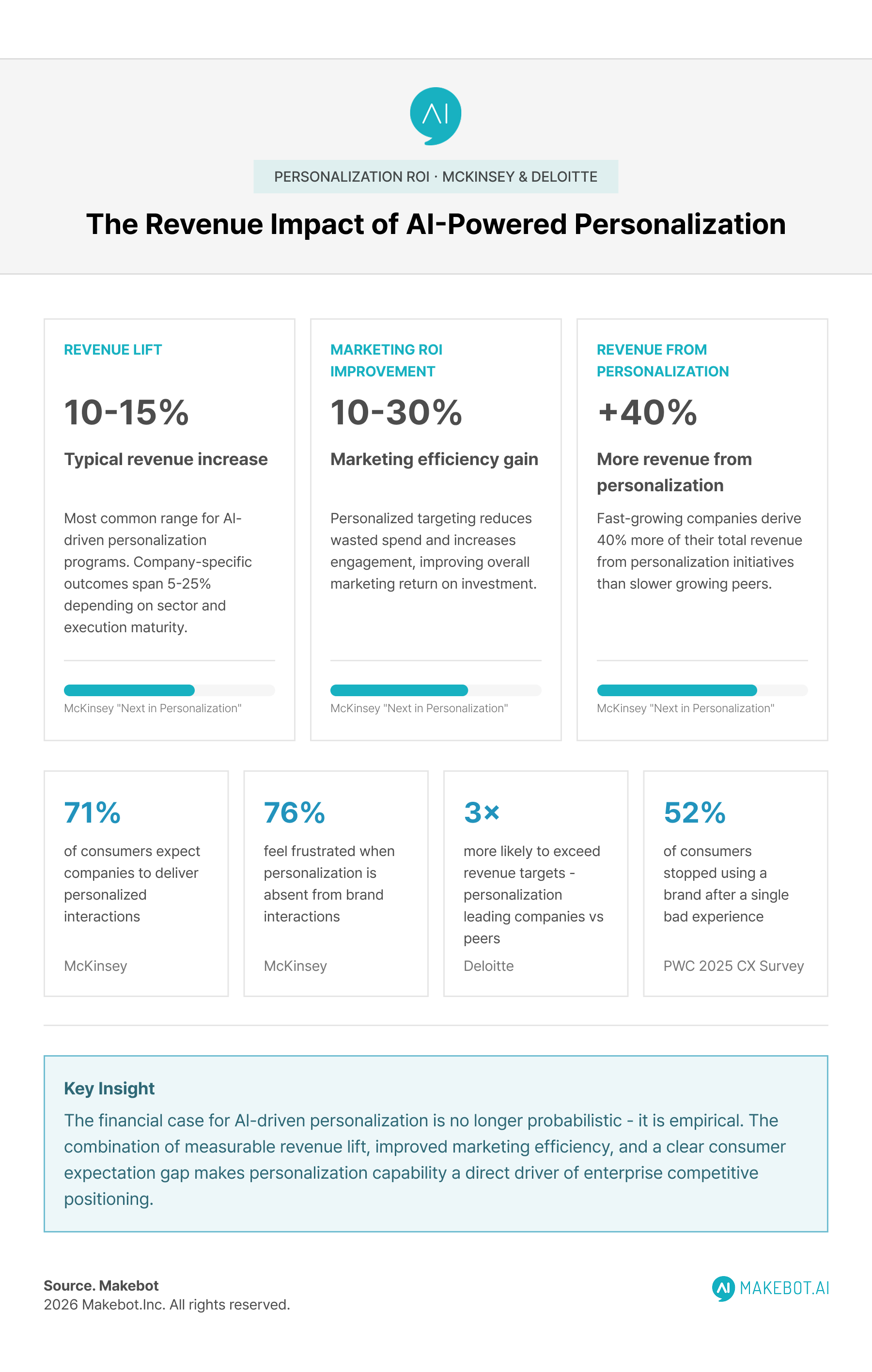
PwC's 2025 Customer Experience Survey makes the cost of falling short concrete: 52% of consumers stopped using or buying from a brand because they had a bad experience, and 70% of executives acknowledged that customer expectations are now evolving faster than their organizations can respond.
Predictive customer analytics directly addresses this expectation gap by enabling enterprises to shift from reactive to proactive engagement:
- In retail, AI-powered journey tools notify customers about abandoned carts with precision timing, present relevant offers, and surface complementary product recommendations — all triggered by behavioral signals rather than scheduled campaigns
- In financial services, McKinsey reports that 46% of banking institutions using AI have documented significant gains in customer satisfaction, with AI systems detecting early churn signals before customers reach a complaint threshold
- In customer service, Accenture found that companies using AI-driven support achieved a 30–50% improvement in customer satisfaction scores, driven primarily by 24/7 availability and dramatically reduced response times
- According to Deloitte's research on personalization strategy, 80% of consumers are more likely to purchase from brands that deliver personalized content — and personalization leaders are 3x more likely to exceed their revenue targets
Microsoft CEO Satya Nadella On How AI Is Transforming Organizations, Teams And Leadership. See how enterprises are transforming here!
Why Some Enterprises Achieve Higher Returns Than Others
Not all enterprises realize equivalent returns from AI customer journey investments. Research consistently identifies a clear gap between high-performing adopters and organizations still struggling to move beyond isolated pilots. The distinction rarely comes down to the technology itself — the differentiating factors are organizational and architectural.
High-performing enterprises tend to share these characteristics:
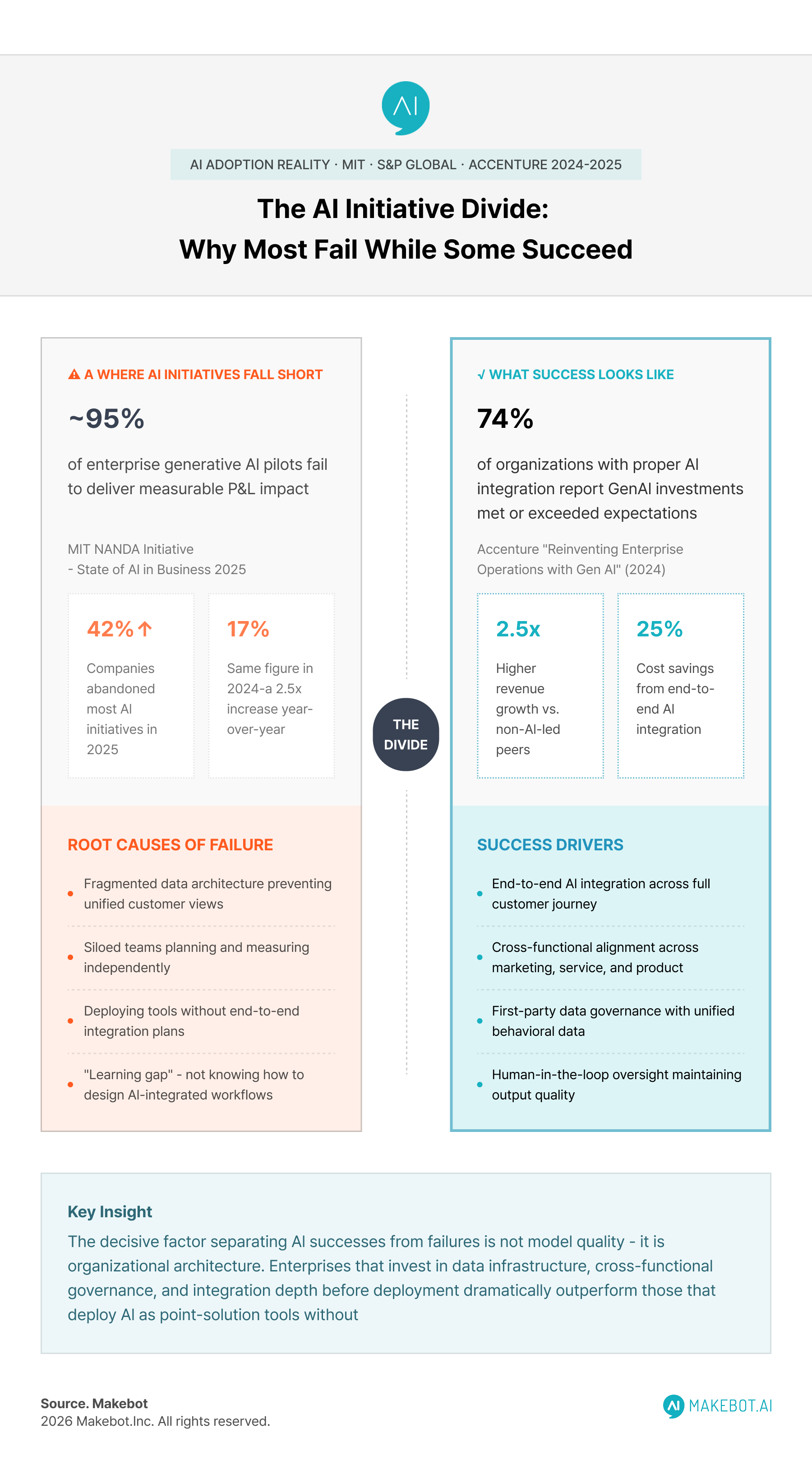
- End-to-end AI integration rather than point-solution deployments. Accenture's data shows that companies with isolated AI experiments achieve minimal returns, while those with end-to-end AI integration achieve up to 25% cost savings alongside measurable revenue lifts.
- Cross-departmental alignment. Gartner's 2025 Market Guide for Customer Journey Analytics & Orchestration explicitly identified cross-functional collaboration as a significant success factor. When marketing, service, product, analytics, and sales teams share lifecycle definitions, measurement models, and journey governance, AI systems receive richer, more consistent inputs.
- First-party data governance. As third-party data signals continue to diminish, enterprises with strong first-party data architectures — consented behavioral data unified across systems — build more accurate predictive models with fewer privacy and compliance risks.
- Human-in-the-loop processes. 76% of enterprises now include human oversight to catch AI errors before deployment, a practice that improves both output accuracy and organizational trust in AI-generated recommendations.
Organizations that underperform in AI customer journey initiatives typically share the inverse profile: siloed data, disconnected tools, metrics that measure channel-level performance rather than journey-level outcomes, and AI initiatives deployed without a plan for scaled integration.
S&P Global Market Intelligence reported that 42% of companies abandoned most AI initiatives in 2025 — up sharply from 17% in 2024 — and the MIT NANDA Initiative's 2025 study found that approximately 95% of enterprise generative AI pilots fail to deliver measurable P&L impact. The primary cause in both cases was not model quality; it was the absence of the organizational infrastructure — data pipelines, governance, cross-functional alignment — needed to translate AI capability into business value.
Deloitte Insights: AI Fluency Becomes the Most Valuable Workforce Skill. Learn how industry leaders are adapting here!
Key Challenges in Scaling AI-Powered Customer Journey Optimization
Recognizing the barriers to scale is as important as understanding the opportunity. Enterprises that approach AI customer journey deployment with clarity about these challenges tend to resolve them faster.
Data fragmentation remains the most cited structural barrier. When customer data is distributed across disconnected CRM platforms, marketing tools, support systems, and transactional databases, AI models cannot produce a unified view of the customer. Forrester's evaluation of journey analytics platforms consistently identifies data integration capability — not algorithmic sophistication — as the primary differentiator between effective and ineffective deployments.
Organizational silos amplify data silos. When teams plan and execute in isolation, customers experience disjointed journeys across channels and measurement becomes unreliable. Braze's enterprise research found that 32% of companies don't test customer engagement efforts at all due to resource constraints — a gap that prevents journey learning loops from functioning effectively.
Measurement model fragmentation prevents accurate ROI attribution. Many enterprises still measure AI performance at the tool level (chatbot deflection rates, email open rates) rather than at the journey level (end-to-end retention, lifetime value impact, cross-sell conversion across touchpoints). This makes it difficult to build the internal business case for deeper investment.
Model reliability and governance. 77% of businesses report concern about AI hallucinations, and 47% of enterprise AI users admitted to making at least one major business decision based on hallucinated AI content in 2024. For customer journey applications — where AI recommendations directly influence revenue-critical interactions — governance frameworks are not optional.
Why Generative AI Projects Fail and How to Achieve Scalable AI Success. Explore the data and findings here!
The Competitive Divide: Leaders vs. Laggards in AI Customer Experience
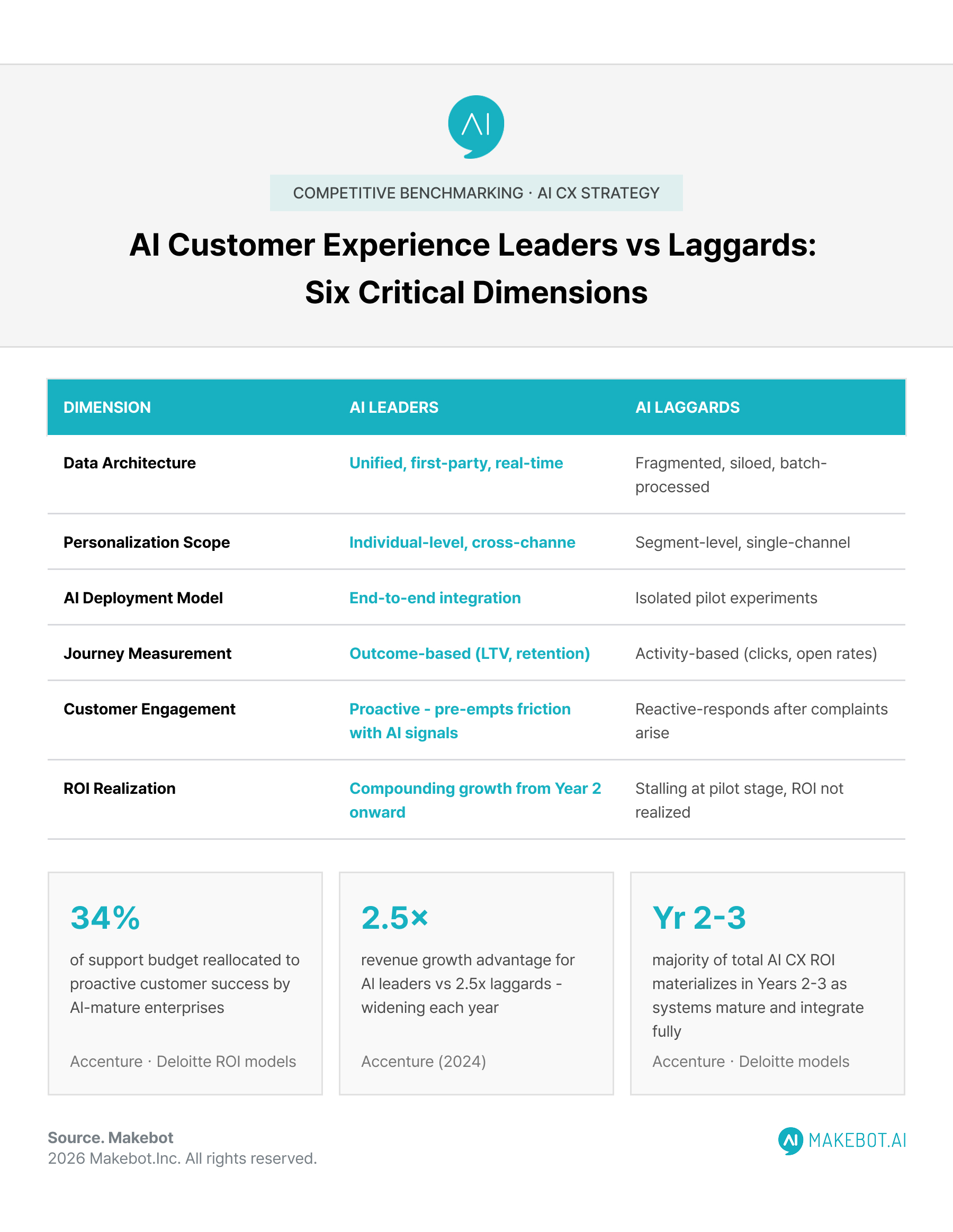
Accenture and Deloitte ROI models indicate that organizations deploying AI at scale can reallocate up to 34% of their support budget to proactive customer success — and that the majority of total AI ROI in customer experience materializes in Years 2 and 3, once systems are sufficiently trained and integration is fully operational.
Organizations that treat customer journey optimization as a continuous, AI-powered discipline rather than an occasional planning exercise are compounding those returns year over year. Those that don't are falling further behind.
Showcasing Korea’s AI Innovation: Makebot’s HybridRAG Framework Presented at SIGIR 2025 in Italy. Read here!
The Market Trajectory: Growth, Investment, and Strategic Urgency
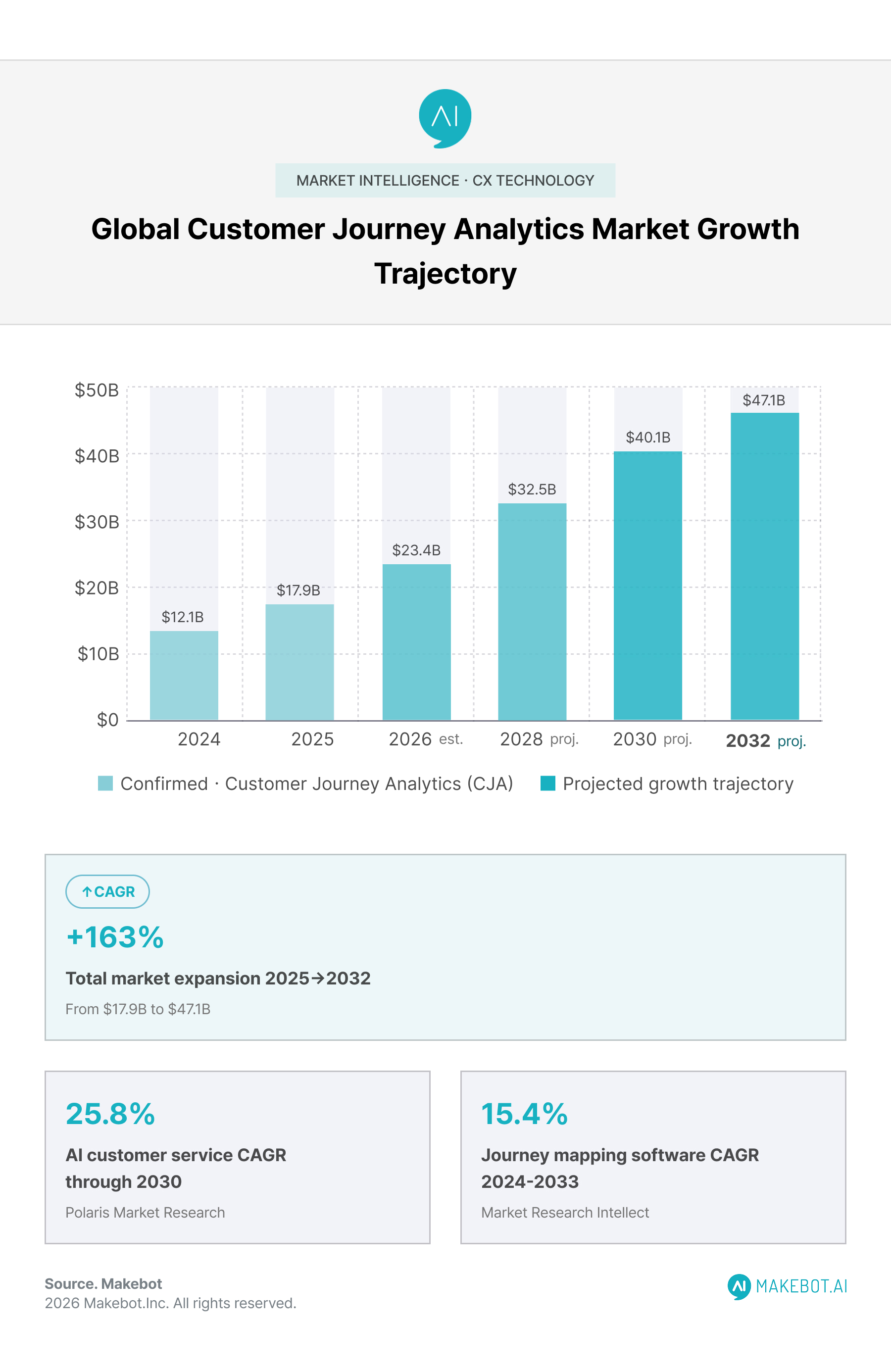
Market data reinforces the strategic urgency for enterprise leaders who have not yet committed to systematic AI customer journey investment.
- The global customer journey analytics market is projected to grow from USD 17.91 billion in 2025 to USD 47.06 billion by 2032
- The broader AI customer service market reached USD 12.06 billion in 2024 and is projected to reach USD 47.82 billion by 2030, at a 25.8% CAGR (Polaris Market Research)
- The customer journey mapping software market specifically — valued at USD 1.2 billion in 2024 — is projected to reach USD 3.5 billion by 2033, at a CAGR of 15.4% (Market Research Intellect)
- Total corporate AI investment reached USD 252.3 billion in 2024, with Gartner forecasting worldwide AI spending to reach USD 1.5 trillion in 2025
These figures reflect a market that has moved past early adoption. The enterprises now building AI-powered customer experience infrastructure are securing a durable competitive position. Those delaying are not standing still — they are falling behind organizations that are already compounding AI-driven CX advantages into measurable revenue and retention leads.
Conclusion
The evidence across McKinsey, Accenture, Deloitte, Gartner, and PwC research is consistent and reinforcing: AI-powered customer journey mapping is no longer an experimental investment. It is becoming the operational baseline for enterprise customer experience, and the organizations that have deployed it systematically are compounding advantages that become progressively harder to close.
The shift this represents is structural, not incremental. Moving from static journey maps to dynamic, AI-driven journey intelligence changes the fundamental relationship between customer behavior and enterprise response — from periodic planning to continuous adaptation. From segment-level campaigns to individual-level engagement. From reactive service to predictive care.
The financial case is clear. The market trajectory is clear. What remains variable is organizational readiness — the quality of data infrastructure, the depth of cross-functional alignment, and the willingness to move from isolated pilots to end-to-end integration. Enterprises that resolve those variables now are building a durable competitive position. Those that delay are not simply missing an opportunity; they are ceding ground that becomes increasingly difficult to recover as AI customer journey leaders continue to compound their advantages.
For enterprise leaders, the strategic question has already shifted. It is no longer whether to invest in AI customer insights and journey intelligence. It is whether the investment will be deep enough, and structured enough, to generate the returns the evidence clearly supports.
.jpg)

What Happens to Marketing When the C-Suite Starts Using AI Every Day?









Why AI Shopping Assistants Will Replace Traditional Ecommerce Search






.jpg)

























Why Generative AI Projects Fail and How to Achieve Scalable AI Success











.jpg)

.png)